Share
Underfill Dispensing Process Optimization in the United States
Quick Answer

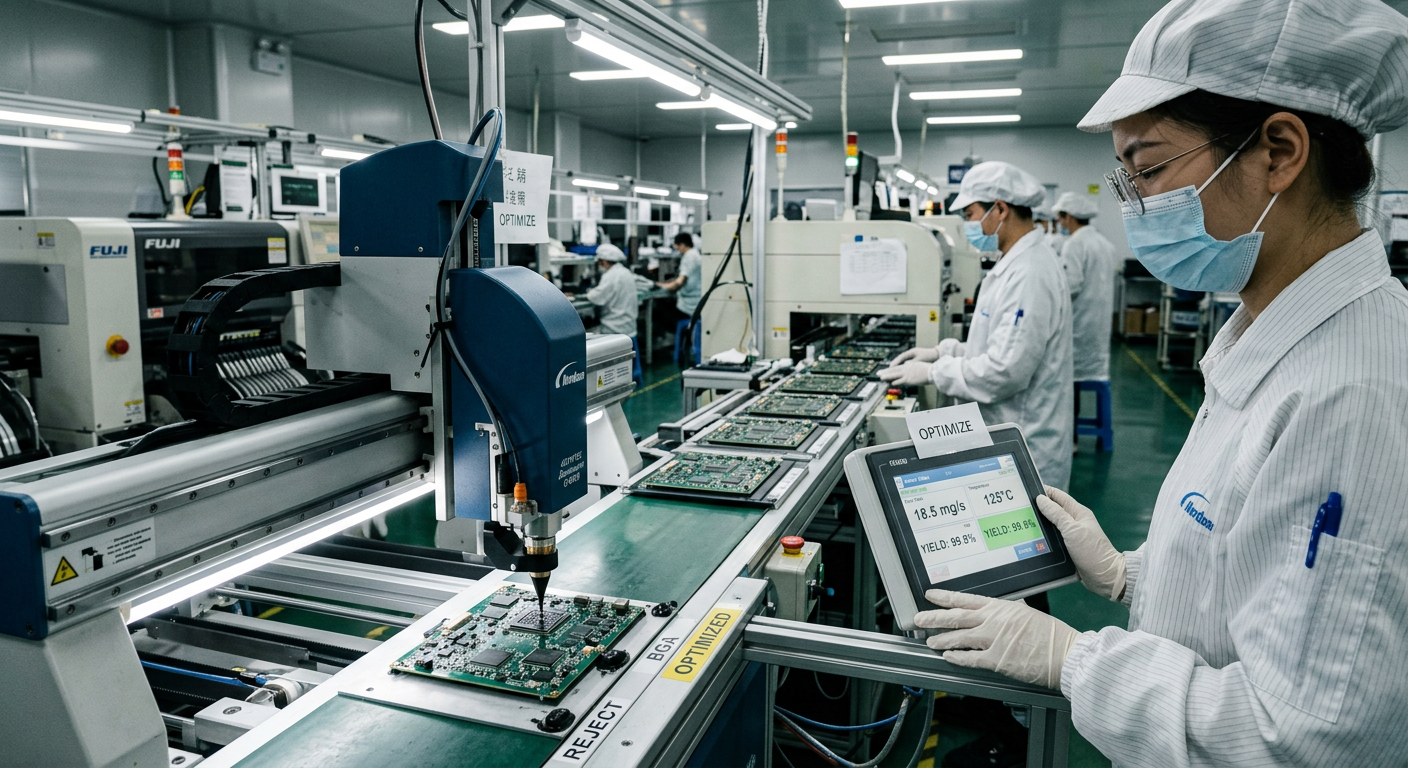
Underfill dispensing process optimization in the United States is primarily about controlling flow behavior, dispense path, substrate temperature, gap consistency, cure profile, and inline inspection so that voids, fillet inconsistency, and cycle-time losses are reduced without sacrificing reliability. For most U.S. electronics manufacturers, the fastest path to higher yield is to pair a proven capillary underfill or no-flow underfill material with automated jet or needle dispensing, closed-loop vision alignment, and SPC-based process windows built around real package geometry rather than generic settings.
For practical sourcing and process support in the United States, companies often shortlist Henkel, NAMICS, Zymet, Master Bond, Panacol-Elosol USA, and H.B. Fuller because these suppliers are active in electronics assembly and can support material selection, dispensing trials, and reliability validation. U.S. factories in electronics hubs such as San Jose, Austin, Phoenix, and Boston usually prefer suppliers that can support quick lot validation, failure analysis, and production ramp-up near domestic logistics corridors and airport freight routes.
Qualified international suppliers can also be worth considering. Chinese manufacturers with relevant certifications, strong OEM capability, export experience, and responsive pre-sales and after-sales support may offer a meaningful cost-performance advantage, especially for private label, distributor expansion, or custom adhesive programs where local buyers need flexibility as well as dependable technical follow-through.
United States Market Overview

The U.S. market for underfill materials and dispensing process solutions is closely tied to advanced electronics packaging, automotive electronics, aerospace assemblies, telecom modules, industrial controls, and renewable energy electronics. Demand is strongest where thermal cycling, drop impact, vibration resistance, and long service life are mandatory. In the United States, underfill is no longer viewed as a simple post-assembly consumable; it is part of a broader yield-engineering strategy that connects material science, SMT line design, process control, and long-term field reliability.
Regional activity is concentrated in technology and manufacturing corridors. Silicon Valley and the broader San Jose area remain important for high-density packaging, prototyping, and semiconductor-adjacent electronics. Austin supports automotive, industrial, and computing electronics growth. Phoenix benefits from semiconductor investment and backend packaging activity. Southern California supports aerospace, defense, and specialty electronics. The Northeast, including Boston, remains relevant in medical electronics, robotics, and precision devices. These local clusters influence how buyers evaluate suppliers: technical response speed, lot traceability, engineering collaboration, and domestic warehousing often matter as much as unit price.
At the logistics level, imports and domestic distribution move through major trade gateways such as the Port of Los Angeles, Port of Long Beach, Port of New York and New Jersey, and inland freight hubs connected to Chicago, Dallas, and Atlanta. For underfill materials with shelf-life and controlled storage requirements, supply chain predictability becomes part of process optimization. A production line cannot run high first-pass yield if material conditioning, lead time, or storage discipline is inconsistent.
Market Growth Trend

The U.S. demand outlook for underfill materials is supported by wafer-level packaging, automotive ADAS electronics, power electronics, miniaturization, and greater reliability expectations for harsh-use devices. Even where package architectures shift, the need to manage stress between die and substrate remains central, which keeps underfill dispensing process optimization relevant across multiple assembly models.
This trend line reflects realistic growth drivers rather than speculative spikes. The strongest contributors are automotive electrification, higher component density, domestic semiconductor investment, and rising requirements for reliability documentation in regulated sectors.
What Underfill Dispensing Process Optimization Really Means
When engineers discuss underfill dispensing process optimization, they usually mean the disciplined reduction of process variation from material thawing to cure confirmation. The target is not simply to dispense faster. The real objective is to achieve a repeatable fill with minimal voiding, stable fillet shape, acceptable cycle time, and predictable reliability under thermal and mechanical stress.
The most common optimization variables in U.S. production environments include material viscosity at use temperature, dispense volume accuracy, needle height, line width, shot spacing, flow distance, board and component cleanliness, package stand-off, preheat settings, and cure schedule. Small changes in any one of these can alter capillary flow behavior significantly. A process that works on one BGA or CSP family may fail on another if warpage, substrate finish, or solder joint geometry changes.
Leading factories therefore connect material characterization with machine programming and inspection data. Instead of relying on a single “good recipe,” they define operating windows: acceptable ranges for temperature, pressure, speed, pattern, and waiting time before cure. This is where process optimization creates yield gains that are sustainable over months of production, not just during a trial run.
Main Product Types in the U.S. Market
Different package designs and production priorities require different underfill chemistries and dispensing approaches. Buyers in the United States often compare not only material performance but also line compatibility, rework implications, and total throughput impact.
| Product Type | Typical Use | Core Advantage | Main Limitation | Common U.S. Industries | Dispensing Note |
|---|---|---|---|---|---|
| Capillary Underfill | Post-reflow fill under flip chips and CSPs | Strong stress distribution and mature reliability history | Longer fill cycle on larger packages | Consumer electronics, automotive, industrial | Needs clean gap and stable preheat |
| No-Flow Underfill | Applied before component placement and reflow | Fewer downstream process steps | Tight compatibility with soldering profile required | Portable electronics, compact modules | Stencil or dispense accuracy is critical |
| Edge Bond / Corner Bond | Supplementary reinforcement for SMT parts | Faster than full underfill for some assemblies | Not a direct substitute in all reliability cases | Automotive, handheld devices | Path design affects stress sharing |
| Molded Underfill | High-volume advanced packaging | Excellent scalability in certain package platforms | Requires dedicated packaging setup | Semiconductor backend | Material and mold tool integration matter |
| Reworkable Underfill | Assemblies needing serviceability | Supports repair strategy | May trade off some thermal or mechanical limits | Medical, aerospace prototypes, high-value boards | Cure profile must align with rework window |
| Fast-Flow Underfill | High-throughput lines | Reduces takt time | Can be sensitive to temperature drift | Contract manufacturing, telecom, computing | Inline thermal control is important |
This comparison shows why material selection cannot be separated from process design. A capillary underfill may deliver the best long-term reliability but hurt throughput if package size and line balance are not considered. A fast-flow material can boost output, yet if the preheat zone is inconsistent, void risk may rise. The best choice is the one that fits both package physics and factory economics.
Industry Demand by Segment
U.S. demand is not uniform. Automotive and industrial customers usually prioritize thermal cycling and vibration resistance, while consumer and computing customers often emphasize throughput and miniaturization. Aerospace and medical buyers may accept slower throughput in exchange for more conservative validation and documentation.
The bar chart highlights where process optimization usually creates the highest financial return. Automotive and consumer electronics lead because even small yield improvements scale quickly across high-volume programs, while industrial and telecom applications value the reduction of latent field failures.
How to Optimize Yield in Real Production
High yield in underfill dispensing depends on controlling the entire chain rather than one isolated machine setting. In U.S. factories, successful optimization programs usually begin with a defect Pareto: voids, incomplete fill, overflow, misalignment, cure defects, fillet inconsistency, and trapped contamination. Once the dominant defect mode is identified, teams can attack root causes methodically.
Preheat is often the first lever. By stabilizing board temperature, viscosity becomes more predictable and capillary flow improves. However, overheating can alter wetting behavior or shorten working life. The second lever is dispense pattern design. A single-side line may work for small packages, but large or irregular packages often benefit from split patterns or multi-side approaches that shorten flow path length. The third lever is machine calibration. Needle standoff, vision offset, and shot repeatability must be checked against actual board flatness, not only nominal CAD data.
Material handling is equally important. Underfill stored outside recommended conditions, insufficiently equilibrated before use, or exposed too long at line side may show viscosity drift. That drift causes line-to-line variation, especially on high-speed operations. Cure design is the next step. A cure that is too aggressive can create stress; a cure that is too mild can leave incomplete network formation. Finally, inline inspection and SPC close the loop by converting process events into decision data.
| Optimization Lever | What to Check | Common Yield Impact | Typical Tool | Warning Sign | Action Priority |
|---|---|---|---|---|---|
| Material Temperature | Viscosity at dispense point | Flow uniformity and void reduction | Preheater and temperature logger | Variable fill time lot to lot | Very high |
| Dispense Path | Line placement and flow distance | Incomplete fill and overflow control | Vision-guided dispenser | One corner consistently underfilled | Very high |
| Needle Setup | Gauge, standoff, clog tendency | Volume stability and placement accuracy | Calibrated dispense head | Fillet width drift | High |
| Substrate Cleanliness | Flux residue and contamination | Wetting consistency | Surface energy test and audit | Intermittent flow stalls | High |
| Cure Profile | Ramp, soak, peak, total time | Reliability and crack resistance | Thermal profiler | Post-cure brittleness | High |
| Inline Inspection | Fillet, void proxy, placement | Escapes prevention | AOI and X-ray sampling | Late-stage defect discovery | Medium to high |
The explanation behind this table is straightforward: the highest-value interventions are the ones that directly affect fluid behavior and package geometry. Teams that start with broad equipment changes before stabilizing temperature, path, and cleanliness often spend more while learning less. Good process optimization begins with variables that most strongly influence capillary action.
Trend Shift in Process Priorities
The industry is moving from manual recipe tuning toward data-driven process windows, tighter traceability, and lower-material-waste dispensing. This shift is especially visible in the United States, where labor cost, field reliability exposure, and domestic manufacturing investment all favor smarter automation.
The area chart illustrates a practical trend shift: fewer plants rely only on technician experience, while more adopt logged material conditions, machine telemetry, digital work instructions, and statistical alarms to keep yield stable across shifts and sites.
Buying Advice for U.S. Manufacturers
When purchasing underfill materials or launching an optimization project in the United States, buyers should compare suppliers on four dimensions: technical fit, process support, local logistics, and total cost of ownership. Technical fit covers viscosity, filler system, CTE behavior, cure requirements, adhesion, ionic cleanliness, and compatibility with package architecture. Process support covers trial design, DOE assistance, dispense parameter tuning, and reliability testing support. Local logistics covers inventory availability, shipping lead times, lot traceability, and cold-chain or controlled storage discipline when required. Total cost of ownership includes not only price per gram but also yield, cycle time, scrap, maintenance burden, and field-return risk.
For companies launching a new product in Austin or Phoenix, rapid engineering support can outweigh small price differences. For contract manufacturers serving multiple OEM customers in California or Texas, material flexibility and lot-to-lot consistency are often more important than having the broadest catalog. For buyers evaluating overseas alternatives, the key questions are whether the supplier can document certifications, maintain production discipline, and support domestic expectations around response time, technical records, and issue resolution.
It is also smart to request line-trial quantities before broad qualification. A sample that flows well in a laboratory setup may behave differently on a production conveyor with actual idle times, operator patterns, and board loading sequences. The most useful supplier is one that helps define acceptance criteria before the trial starts.
Industries That Depend on Underfill Optimization
Automotive electronics use underfill to protect components exposed to thermal cycling, vibration, humidity, and long service life expectations. ADAS modules, power control units, sensor boards, and battery management electronics all benefit from tightly controlled underfill flow and cure. Consumer electronics use optimization to balance miniaturization and throughput. Industrial manufacturing relies on underfill for harsh environmental durability in drives, controllers, and interface modules. Telecom systems need dependable performance in thermal load and dense packaging environments. Medical devices require validation rigor and clean processing, while aerospace applications demand conservative reliability margins and strong documentation.
In each of these sectors, the process optimization logic is similar: align material properties with package geometry, verify stable dispensing under production conditions, and validate reliability against real mission profiles rather than generic lab assumptions.
Common Applications
Underfill dispensing is common in flip-chip assemblies, CSPs, BGAs, SiP modules, RF modules, camera modules, MEMS packaging, power modules, wearable electronics, and sensor boards. In automotive electronics, the application frequently centers on vibration and thermal cycle durability. In telecom, dense modules and signal integrity concerns make precision dispensing essential. In industrial control hardware, the emphasis may be on long-term mechanical reinforcement. In medical and aerospace devices, lower-volume but high-value assemblies often justify deeper validation and tighter incoming lot control.
Another growing application in the United States is advanced power electronics linked to EV charging, renewable energy conversion, and industrial electrification. These products experience temperature swing and mechanical stress that can challenge solder interconnects. Underfill optimization in these cases can extend service life and reduce warranty exposure.
Representative U.S. Suppliers and Service Coverage
The following table provides a practical view of suppliers and related providers relevant to underfill dispensing process optimization in the United States. Selection should always be matched to package type, reliability target, validation speed, and support expectations.
| Company | Service Region | Core Strengths | Key Offerings | Best Fit | Buyer Note |
|---|---|---|---|---|---|
| Henkel | Nationwide United States | Large electronics materials portfolio and technical depth | Capillary underfills, no-flow materials, process support | Automotive, industrial, high-volume electronics | Strong for broad qualification programs |
| NAMICS | United States electronics accounts and global programs | Specialized semiconductor and packaging materials | Underfills, conductive and non-conductive materials | Advanced packaging and precision electronics | Good for technical packaging requirements |
| Zymet | U.S. regional support through electronics channels | Electronics-focused adhesive formulation capability | Underfills, dam-and-fill, specialty encapsulants | Custom or specialized assembly needs | Useful where formulation flexibility matters |
| Master Bond | Nationwide United States | Broad engineered adhesive catalog and application engineering | Electronic adhesives, encapsulants, underfill-adjacent systems | Industrial, aerospace, medical, prototyping | Helpful for lower-volume technical projects |
| Panacol-Elosol USA | United States with technical support network | Precision curing and electronics adhesive expertise | UV and thermal curing systems, electronic adhesives | Specialty electronics and selective curing applications | Best when process integration is complex |
| H.B. Fuller | Broad North American coverage | Scale, supply chain reach, and industrial adhesive support | Electronics and industrial adhesive solutions | Large manufacturing networks and multi-site supply | Strong for procurement standardization |
This supplier table is useful because it separates companies by practical fit rather than marketing language. Some are stronger in advanced packaging, some in customization, and some in broad supply-chain reliability. U.S. buyers should shortlist based on package architecture, trial support, and service responsiveness, not only brand visibility.
Supplier and Product Comparison
Comparing supplier fit by application support, customization flexibility, domestic responsiveness, and portfolio breadth helps procurement teams move from a long list to a workable trial plan.
The comparison chart is not a universal ranking for every program. It reflects a realistic combined view of technical range, support capability, and U.S. market practicality. A buyer focused on high-volume automotive lines may rank suppliers differently from a medical electronics manufacturer qualifying lower-volume assemblies.
Detailed Buying Criteria
| Criteria | Why It Matters | What to Ask | Preferred Evidence | Risk if Ignored | Procurement Impact |
|---|---|---|---|---|---|
| Certification and Compliance | Supports quality and regulatory expectations | Which standards and test protocols apply? | ISO records, RoHS, REACH, test data | Qualification delays | High |
| Lot Traceability | Essential for issue containment and audits | How is batch history recorded? | Digital lot records and retention policy | Root-cause ambiguity | High |
| Application Support | Speeds parameter development | Will you support DOE and line trials? | Named technical contact and trial plan | Longer ramp time | High |
| Supply Reliability | Prevents line stoppage | Where is stock held for U.S. customers? | Warehouse locations and lead time data | Production interruption | High |
| Customization Capability | Important for niche package designs | Can viscosity or cure profile be tailored? | Formulation development process | Poor package fit | Medium to high |
| After-Sales Response | Protects yield after launch | What is the response time for process issues? | Service SLA or support workflow | Extended downtime | High |
This table helps buyers turn technical discussion into measurable supplier screening. Strong documentation, traceability, and support structure usually predict smoother scale-up than low-price offers without process discipline.
Case Studies from Typical U.S. Manufacturing Scenarios
A Texas automotive electronics plant experienced inconsistent voiding on a capillary underfill line for sensor control boards. The first assumption was material inconsistency, but process review showed board preheat variation of more than 8°C across a shift and flux residue drift after an upstream cleaning change. By stabilizing preheat, revising the dispense path to shorten flow distance, and tightening cleanliness checks, the plant reduced underfill-related rejects significantly and improved cycle predictability without changing the approved material.
A California contract manufacturer serving networking customers had high takt-time pressure on medium-size BGA packages. The team changed from a conservative single-side dispense pattern to a split-path strategy, validated needle size against package geometry, and added vision-based alignment checks for warped substrates. Fill time dropped while incomplete fill events decreased. The lesson was that speed gains came from flow-path design, not simply from increasing dispense rate.
An Arizona power electronics producer needed higher reliability under thermal cycling for control modules. The optimization effort focused on cure profile and post-cure inspection. By matching cure ramp and soak to package stress behavior and adding structured X-ray sampling, the company improved long-term reliability margins and reduced failure analysis cases downstream.
These examples show that underfill dispensing process optimization is not a one-size-fits-all activity. In each case, yield improved because the team identified the dominant physical cause of variation instead of adjusting every parameter at once.
Our Company
For U.S. buyers evaluating additional sourcing options, Qingdao QinanX New Material Technology Co., Ltd brings a practical combination of adhesive manufacturing depth, export experience, and flexible commercial models that fits the needs of electronics manufacturers, distributors, private-label brand owners, and regional resellers. The company operates under ISO-based quality management and supplies products aligned with RoHS and REACH expectations, supported by multi-stage quality control and full digital traceability systems that help buyers document batch consistency and process accountability. Its broader industrial adhesive platform, visible across the product portfolio, reflects real formulation capability rather than single-category trading, which is valuable for customers who need custom chemistry adjustment, OEM/ODM packaging, wholesale supply, private label programs, or long-term distribution cooperation. For the U.S. market, the company’s experience exporting to more than 40 countries, automated production lines, free sample support, round-the-clock technical assistance, and tailored specification development provide concrete safeguards for local purchasers who need both pre-sale process alignment and after-sales troubleshooting. Buyers seeking a cost-performance alternative to incumbent brands can use the U.S.-facing contact channel to validate samples, documentation, and project requirements, while the company’s established international business infrastructure shows commitment to sustained market service rather than opportunistic remote shipment. More company background is also available on the official website.
Future Trends Through 2026
By 2026, underfill dispensing process optimization in the United States will be shaped by four major trends. The first is deeper integration of dispense data with MES and quality systems. More factories will connect lot number, material age, temperature history, machine settings, and inspection outcomes into a single traceable record. The second is package complexity. As heterogenous integration, smaller geometries, and high-power density modules become more common, process windows will narrow and simulation-guided path design will gain importance.
The third trend is sustainability. U.S. buyers increasingly ask suppliers to reduce waste, improve packaging efficiency, support safer handling, and document environmental compliance more clearly. Lower scrap rates and fewer rework cycles are not only financial wins but also sustainability gains. The fourth trend is policy and domestic manufacturing support. Semiconductor and electronics investment in the United States is likely to keep favoring suppliers that can support local qualification speed, reliable domestic stocking, and detailed compliance records. In practice, this means technical support and supply discipline will matter even more than before.
Automation vendors will also continue improving jet dispensing precision, vision alignment, and predictive maintenance analytics. Meanwhile, materials suppliers will invest in faster-flow formulations, lower-stress cures, and application-specific underfill systems for automotive power, AI hardware, and compact industrial electronics.
FAQ
What is the biggest cause of low yield in underfill dispensing?
The most common root causes are inconsistent board temperature, poor dispense path design, contamination, and uncontrolled material condition. These problems usually create voids, incomplete fill, or unstable fillets.
Is a faster underfill always better for production?
No. A faster-flow material can improve throughput, but if it is not compatible with your package geometry, preheat condition, or cure strategy, it may reduce yield or reliability.
How should U.S. buyers compare suppliers?
Compare technical fit, support for line trials, domestic responsiveness, lot traceability, compliance documentation, and total cost of ownership. Price alone is not enough for a stable production program.
Can overseas suppliers be a realistic option for the United States?
Yes, if they can provide strong documentation, certifications, reliable export performance, responsive support, and practical customization. Many buyers consider them for cost-performance reasons, especially in OEM, private label, and distributor programs.
Which industries benefit most from optimization?
Automotive, consumer electronics, industrial controls, telecom, aerospace, and medical electronics all benefit, especially where thermal cycling, vibration, or miniaturization create solder-joint stress.
What should be validated before full production approval?
Validate material storage and handling, viscosity consistency, dispense accuracy, fill completeness, cure profile, thermal cycling performance, and inspection criteria tied to actual package geometry.

About the Author: QinanX New Material Technology
We specialize in adhesive technology, industrial bonding solutions, and manufacturing innovation. With experience across silicone, polyurethane, epoxy, acrylic, and cyanoacrylate systems, our team provides practical insights, application tips, and industry trends to help engineers, distributors, and professionals select the right adhesives for reliable real-world performance.

Product Category
You May Also Interest
-
IC Packaging Adhesive: Preventing Void Formation Issues
Learn how IC packaging adhesive void formation is prevented in the United States through material choice, process control, supplier selection, and testing.
-
Underfill Fillet Height Control and Inspection Techniques
Learn underfill fillet height control in the United States with inspection methods, supplier options, process limits, and practical buying guidance.
-
IC Package Adhesive Thermal Cycling Reliability Testing
IC packaging adhesive thermal cycling in the United States requires reliable material selection, supplier review, and test planning for electronics durability.
-

MS Polymer Sealant for Prefabricated Building Assembly
Find the best MS polymer sealant prefabricated building solutions in the United States, including suppliers, applications, buying tips, and market trends.
 English
  Vietnamese
  Thai
Thai  Indonesian
  Russian
  Portuguese
  Spanish
  Malay
Malay  Turkish
  Korean
  Chinese