Share
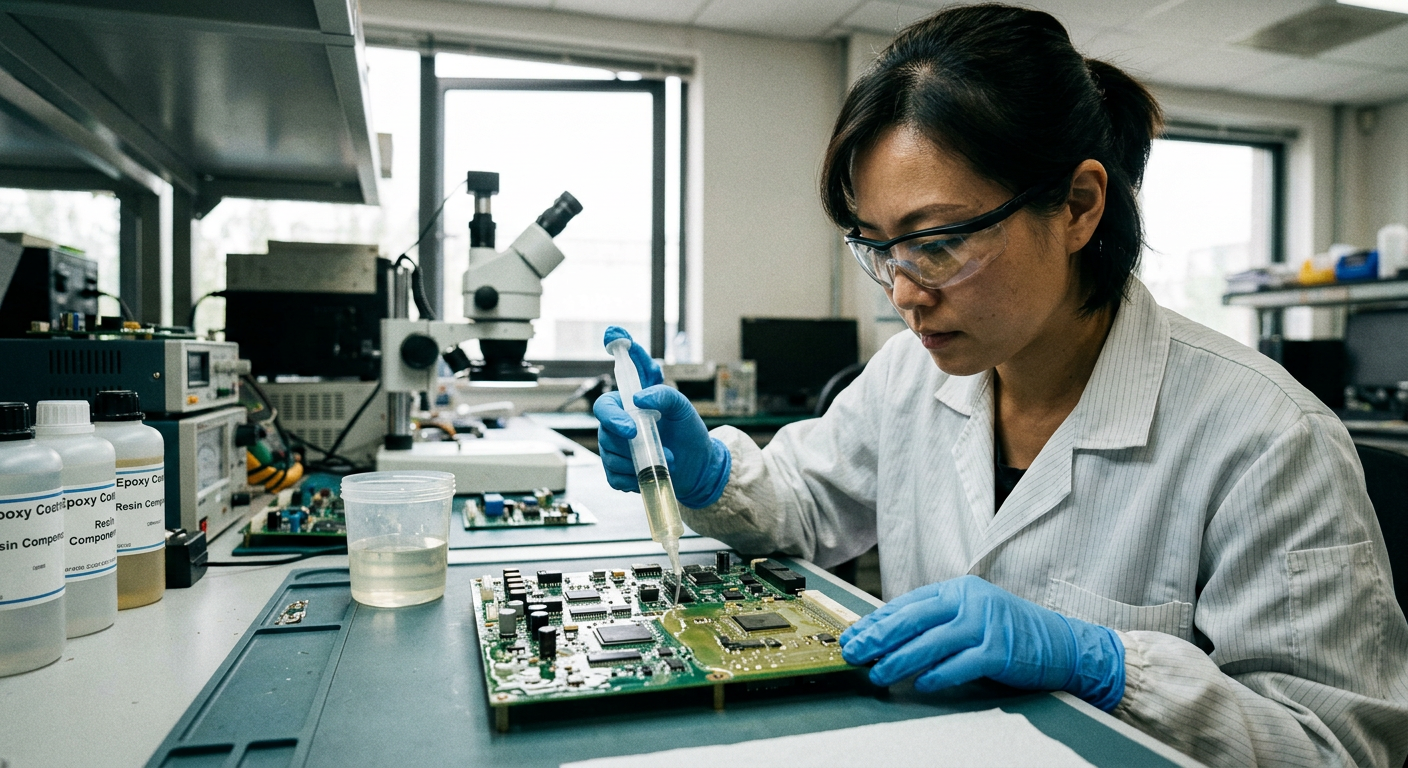
Epoxy Conformal Coating Chemical Resistance in the United States
Quick Answer

Epoxy conformal coating is one of the strongest options when chemical exposure is the main risk in electronic protection. In the United States, buyers commonly choose epoxy coatings when assemblies must resist fuels, oils, salt spray, cleaning agents, humidity, and splash exposure from industrial chemicals. Compared with acrylic coatings, epoxy systems usually offer better solvent resistance and stronger barrier performance, but they can be harder to rework and may be less flexible under thermal cycling. For U.S. applications in automotive electronics, industrial controls, energy systems, and harsh-environment PCB protection, epoxy is often the right choice when chemical durability matters more than easy repair.
For immediate sourcing consideration, practical supplier names relevant to the U.S. market include Henkel, Chase Corporation, HumiSeal, Dow, MG Chemicals, and Electrolube. These companies are widely recognized for electronics protection materials, technical support, and specification-driven product ranges. Buyers in manufacturing centers such as Detroit, Chicago, Houston, San Jose, Phoenix, and Raleigh often compare cure profile, UL-related documentation, viscosity, dielectric performance, and resistance to gasoline, brake fluid, cleaners, and process chemicals before approving a coating.
Qualified international suppliers can also be considered. Companies with strong certifications, documented quality control, export experience, and responsive pre-sales and after-sales support may offer a compelling cost-performance advantage, especially for private label, OEM, and volume industrial programs serving the United States.
What Chemical Resistance Means for Epoxy Conformal Coating

When engineers talk about epoxy conformal coating chemical resistance, they usually mean the coating’s ability to protect a printed circuit board and its components from degradation after contact with aggressive substances. In the U.S. manufacturing environment, these substances can include diesel, gasoline vapor, hydraulic fluid, road salt, battery electrolyte mist, detergents, alcohol-based cleaners, sulfur-bearing atmospheres, and industrial oils. Chemical resistance is not only about whether the coating survives. It also concerns whether insulation resistance remains stable, whether adhesion stays intact, and whether corrosion is prevented at leads, solder joints, and exposed copper features.
Epoxy coatings form dense crosslinked networks after curing. That structure makes them effective barriers against liquid ingress and many chemical attacks. For electronics installed near ports such as Los Angeles, Long Beach, Savannah, Houston, and New York/New Jersey, this matters because salt-laden air and transport handling can create combined moisture and contamination stress. In inland industrial zones such as Ohio, Michigan, and Texas, chemical splash from lubricants, fuels, and maintenance agents is often the bigger issue. In both cases, epoxy coatings can extend service life if the chemistry is correctly matched to the operating environment.
United States Market Context

The U.S. market for conformal coatings is shaped by electronics manufacturing, defense, automotive electrification, factory automation, telecom infrastructure, renewable energy, and medical devices. Demand is especially concentrated in regions with advanced assembly lines and reliability-sensitive supply chains. California remains important for electronics design and high-value manufacturing; Texas is strong in energy, industrial controls, and logistics; the Midwest supports automotive electronics; and the Southeast continues to grow in EV, battery, aerospace, and appliance-related production.
In the United States, purchasing decisions often balance technical approval with regulatory, operational, and service factors. Buyers want materials that align with RoHS and REACH expectations, fit existing dispensing or spraying equipment, and come with stable technical documentation. Fast local support is also important because production interruptions can be costly. This is why many U.S. buyers favor suppliers that can provide application guidance, lot consistency, and dependable logistics to domestic facilities.
The line chart above shows a realistic demand-growth pattern for the U.S. conformal coating market. The rise is supported by domestic PCB assembly needs, growth in vehicle electronics, increased industrial automation, and stronger reliability standards in renewable energy and infrastructure electronics.
How Epoxy Compares with Other Conformal Coating Types
Epoxy is not always the universal answer. The best coating depends on exposure profile, repair strategy, and mechanical stress. Acrylic coatings are easier to apply and rework, silicone coatings often perform better under extreme temperature swings and moisture, urethane coatings can also provide strong chemical resistance, and parylene offers highly uniform vapor-deposited coverage for specialized applications. Even so, epoxy remains a leading choice where hard barrier protection and resistance to harsh fluids are essential.
| Coating Type | Chemical Resistance | Moisture Resistance | Reworkability | Typical U.S. Use | Main Limitation |
|---|---|---|---|---|---|
| Epoxy | High | High | Low | Industrial controls, automotive modules, power electronics | Harder to remove and repair |
| Acrylic | Moderate | Good | High | General consumer and light industrial electronics | Weaker against solvents |
| Silicone | Moderate to high | Excellent | Moderate | Outdoor electronics, LED, aerospace-adjacent systems | Lower hardness than epoxy |
| Urethane | High | Good | Low to moderate | Defense, transport, chemical-prone environments | Process sensitivity |
| Parylene | High | Excellent | Very low | Medical, sensors, precision electronics | Higher cost and specialized process |
| Hybrid systems | Variable | Variable | Variable | Custom OEM programs | Needs application-specific validation |
This comparison shows why epoxy conformal coating chemical resistance is a major decision point for U.S. buyers in harsher service conditions. If the board faces solvents, oils, aggressive cleaners, or process-side contamination, epoxy usually moves to the top of the shortlist despite the trade-off in rework convenience.
Top Suppliers Serving the United States
Below is a practical supplier view for buyers who need real company names and concrete strengths rather than generic descriptions. Service coverage, formulation support, documentation, and technical responsiveness vary, so final approval should still be tied to the exact use case and internal qualification process.
| Company | Service Region | Core Strengths | Key Offerings | Typical Fit | Notes for U.S. Buyers |
|---|---|---|---|---|---|
| HumiSeal | Nationwide U.S. and global | Strong conformal coating specialization, broad approval support | Epoxy, acrylic, urethane, silicone, masking materials | Electronics manufacturers and aerospace-related suppliers | Well known in U.S. PCB protection programs |
| Henkel | Nationwide U.S. and global | Large technical network, industrial scale, process expertise | Protective materials under established industrial brands | Automotive, industrial, telecom, advanced manufacturing | Strong for high-volume production environments |
| Chase Corporation | United States and North America | Electronics protection focus, harsh-environment products | Conformal coatings, encapsulants, specialty compounds | Industrial electronics and demanding reliability programs | Often considered for robust protection requirements |
| MG Chemicals | U.S. distribution network | Accessible technical data, maintenance and electronics focus | Conformal coatings, cleaners, adhesives, repair materials | Maintenance teams, labs, lower-to-mid volume users | Good availability through distributors |
| Dow | United States and global | Materials science depth, electronics-grade product support | Electronic protective coatings and silicones | Advanced electronics and OEM development teams | Commonly assessed in engineered programs |
| Electrolube | North America and global | Wide coating portfolio, strong reliability positioning | Epoxy, urethane, acrylic, thermal management materials | Contract manufacturers and export-oriented OEMs | Useful for cross-comparing chemistry families |
This supplier table is useful because it separates global brand recognition from application fit. A major U.S. automotive supplier in Detroit may prioritize production scalability and OEM documentation, while a smaller industrial electronics producer in Minnesota may value distributor availability and flexible order sizes more heavily.
Supplier Comparison by Practical Buying Factors
The comparison chart condenses overall market perception across documentation depth, process support, product breadth, and suitability for U.S. industrial buyers. It is not a certification ranking, but it helps frame how buyers often shortlist suppliers for formal technical evaluation.
Product Types Within Epoxy Conformal Coating
Not all epoxy conformal coatings behave the same way. Some are optimized for spray application, some for selective coating lines, and some for dip or brush repair work. Viscosity, solvent content, cure mechanism, hardness, and film build influence both protection and manufacturability. In the United States, where many electronics plants aim for repeatable throughput and IPC-aligned process control, selecting the right epoxy subtype matters as much as choosing epoxy chemistry in general.
| Epoxy Type | Application Method | Chemical Resistance Profile | Processing Advantage | Best Use Case | Buyer Caution |
|---|---|---|---|---|---|
| Single-component heat cure epoxy | Spray, selective coat | High against oils and many solvents | Stable controlled production | Automotive and industrial OEM lines | Needs oven capacity and cure discipline |
| Two-component room-temperature epoxy | Dispense, brush, small-batch coat | High barrier performance | Flexible for maintenance or low volume | Repair cells and custom assemblies | Mix ratio control is critical |
| Low-viscosity epoxy coating | Spray, dip | Good to high | Better coverage on dense boards | Complex PCB geometry | May need masking precision |
| High-build epoxy coating | Brush, dispense | Very high | Thicker barrier in splash zones | Heavy-duty industrial modules | Longer cure and stress risk |
| Filled epoxy protective layer | Specialized dispense | High with extra mechanical toughness | Enhanced durability in rough environments | Vibration-prone assemblies | May reduce process simplicity |
| Custom OEM epoxy formulation | Matched to line setup | Tailored to exposure profile | Optimized for private label or regional programs | Brand owners and volume distributors | Requires qualification lead time |
This table matters because many procurement teams ask only whether they need epoxy or not. In practice, the higher-value question is which epoxy process route fits their equipment, board geometry, repair expectations, and field environment.
Key Industries in the United States Using Epoxy Conformal Coatings
U.S. end-use demand for chemically resistant conformal coatings is strongest where electronics must operate near contaminants or in long-life installations. Automotive control units, factory automation systems, utility metering hardware, renewable energy inverters, heavy equipment electronics, transport systems, and specialty defense-linked assemblies all rely on coatings to maintain electrical performance over time.
The bar chart shows the relative demand profile of major sectors. Automotive and industrial control lead because these sectors combine high electronics usage with real exposure to oils, fluids, vibration, and thermal cycles. Renewable energy is also growing as inverter and storage electronics are pushed into harsher outdoor or semi-protected environments.
Applications Where Chemical Resistance Matters Most
In practical U.S. operations, epoxy conformal coating chemical resistance becomes decisive in environments where accidental splash, vapor contact, cleaning cycles, or residue accumulation can damage circuitry. This includes under-hood automotive modules, drilling and pumping control electronics in Texas energy operations, marine-adjacent monitoring equipment near Gulf Coast ports, battery management electronics, warehouse automation boards exposed to washdown agents, and transportation electronics in road-salt regions such as the Great Lakes area and the Northeast.
The strongest application cases are not always the most visibly corrosive. Often, failure begins with thin-film contamination that combines with humidity and eventually lowers insulation resistance. Epoxy’s dense cured structure reduces permeation and can delay the onset of corrosion pathways, especially when the coating is applied with correct coverage thickness and cure conditions.
Detailed Buying Advice for U.S. Purchasers
When specifying epoxy conformal coatings in the United States, engineers and sourcing managers should avoid choosing only by brand familiarity. A good approval workflow starts with the exact exposure profile. Ask whether the board will face alcohol wipes, fuel vapor, brake fluid splash, alkaline cleaners, sulfur contamination, condensation, or coastal salt. Then review cure cycle, hardness, thermal expansion compatibility, dielectric needs, and field-repair expectations.
It is also important to evaluate process constraints. A coating that performs well in a lab may still create bottlenecks if it cures too slowly, strings during selective coating, or demands masking steps that are impractical at scale. U.S. contract manufacturers often screen materials based on tack-free time, final cure window, VOC handling, line compatibility, and whether lot-to-lot consistency is strong enough for stable production yields.
| Buying Factor | Why It Matters | What to Ask Supplier | Common U.S. Concern | Best Practice | Risk if Ignored |
|---|---|---|---|---|---|
| Chemical exposure list | Determines coating fit | Request resistance data by chemical type | Unknown cleaner or fluid mix | Test against actual plant chemicals | Early coating swelling or failure |
| Cure profile | Affects throughput and properties | Ask for full cure schedule | Oven limitations on line | Match cure to production capability | Under-cure and weak barrier performance |
| Rework need | Impacts serviceability | Ask removal procedure | Field repair requirements | Balance durability with repair policy | High service cost later |
| Film thickness | Controls coverage and protection | Request target dry-film range | Uneven geometry on PCB | Validate by inspection method | Pinholes or overbuild stress |
| Certifications and compliance | Supports qualification | Request RoHS, REACH, quality records | Customer audit pressure | Keep full technical file | Delayed approvals or audit findings |
| Support and logistics | Reduces downtime | Ask about local inventory and response time | Urgent replenishment needs | Choose suppliers with service continuity | Line stoppage and missed shipments |
This buying table is especially useful for U.S. operations teams because it links lab performance to factory reality. The best coating is the one that survives both the chemical environment and the production environment.
Case Studies from Typical U.S. Use Scenarios
A Midwest automotive electronics producer evaluating epoxy coating for under-hood sensor control boards found that acrylic materials were easier to rework but showed greater degradation after repeated exposure to aggressive service fluids and salt fog. After moving to a heat-cure epoxy coating with tighter process control, the manufacturer reduced corrosion-related field returns and improved confidence in long-term performance during winter exposure in states with heavy road salting.
In Texas, an industrial controls integrator supplying pumping and monitoring systems compared epoxy with urethane for boards exposed to oil mist, detergent-based maintenance cleaning, and high humidity. Epoxy provided the better barrier for their specific fluid profile and gave stronger adhesion on validated assemblies, although the company had to revise oven scheduling to accommodate the cure cycle.
On the West Coast, a renewable energy electronics assembler reviewed coating options for inverter control boards shipped through the ports of Los Angeles and Long Beach and then installed in dry, dusty, and chemically variable environments. The company selected an epoxy system for versions intended for harsher utility-side conditions, while retaining another chemistry for service-friendly product lines.
Trend Shift Toward Higher Reliability Formulations
The area chart reflects a realistic shift in buyer preference toward stronger barrier-performance coatings. As electronic modules move into harsher use environments and warranty expectations rise, more U.S. buyers are prioritizing long-term fluid and contamination resistance over simple ease of rework.
Local Supplier Considerations in Major U.S. Regions
Regional context matters. Buyers in Houston and the Gulf Coast often prioritize resistance to oil-related environments, humidity, and logistics speed through major industrial corridors. In Detroit and other Midwest automotive centers, OEM qualification, vibration durability, and road chemical exposure are common focus points. In California, electronics design teams may put more weight on technical collaboration, product documentation, and process tuning for specialized assemblies. In the Southeast, especially around growing EV and battery manufacturing zones, buyers increasingly seek coatings that handle both chemical and thermal reliability needs.
Local warehousing, responsive technical representatives, and short replenishment lead times often matter as much as published test data. This is why supplier selection in the United States usually involves a mix of performance review and service review.
Our Company
For U.S. buyers seeking an additional sourcing path, QinanX positions itself as a manufacturing-oriented adhesive partner with relevant capabilities for epoxy-based electronic protection materials and broader assembly chemistry programs. The company operates with ISO-based quality management and aligns products with international expectations such as RoHS and REACH, supported by multi-stage quality control and digital traceability that help document consistency from batch production through shipment. Its portfolio covers epoxy resin adhesives, electronic potting compounds, silicone and polyurethane systems, UV-curable materials, hot melts, and other industrial formulations, which is useful for customers that want one supplier across several assembly materials rather than a single coating alone. In the U.S. market, this supports cooperation models for end users, distributors, dealers, brand owners, and private label programs through OEM, ODM, wholesale, and tailored packaging arrangements. Buyers evaluating regional distribution or branded product expansion can review the company’s industrial adhesive product range, while those needing supplier background can check company information and use direct contact channels for pre-sale technical discussion, sample requests, and after-sales follow-up. Its export experience across more than 40 countries, automated production capacity, and 24/7 technical assistance suggest it is structured to support long-term U.S. business rather than one-off remote shipments, which is especially relevant for customers seeking cost-performance gains without giving up documentation discipline and responsive service.
How to Evaluate Samples Before Approval
Before approving any epoxy conformal coating for U.S. production, a formal sample plan should be built around real conditions rather than only general data sheets. A good validation route includes adhesion testing on the actual substrate finish, visual inspection under UV if supported, thickness measurement, insulation resistance review, thermal cycling, humidity exposure, and spot checks after contact with the exact fluids used in service or maintenance. If the boards are shipped through major freight corridors or exposed to coastal conditions, salt-related testing should also be considered.
Procurement teams should coordinate with process engineers, quality teams, and field service staff. This cross-functional approach prevents a common mistake: choosing a coating that looks strong in procurement documents but creates repair problems, cure bottlenecks, or incompatibility with downstream cleaning and masking steps.
2026 Outlook: Technology, Policy, and Sustainability
Looking into 2026, the U.S. market for epoxy conformal coating chemical resistance is expected to keep moving toward more specialized formulations. Electrification, sensor density, miniaturization, and distributed infrastructure electronics all increase the need for durable protective films. Suppliers are likely to focus on lower-emission processing, improved selective-coating compatibility, and better performance under mixed stress environments that combine fluids, heat, voltage, and vibration.
Policy and compliance trends will continue to influence sourcing. U.S. buyers increasingly ask for cleaner documentation on restricted substances, traceable raw material control, and supply-chain transparency. Sustainability pressure will also rise, not only through chemistry choices but through process efficiency, waste reduction, and longer product service life. In that context, coatings that reduce field failure and extend usable electronics lifetime can support broader sustainability objectives even when the chemistry itself is more specialized.
Technology trends are also shifting evaluation criteria. As EV systems, battery storage, industrial IoT, and renewable power electronics become more common, buyers will pay closer attention to coatings that hold up under combined chemical and electrical stress. Suppliers able to provide data, regional service, custom formulations, and stable logistics will have an advantage in this next phase of the U.S. market.
Frequently Asked Questions
Is epoxy conformal coating the most chemical-resistant option for PCBs?
It is among the strongest mainstream options, especially for resistance to oils, fuels, and many industrial chemicals. However, the best choice still depends on the exact fluid exposure, cure constraints, and repair requirements.
Is epoxy better than acrylic for harsh U.S. industrial environments?
Usually yes when chemical resistance is the top priority. Acrylic is often easier to rework, but epoxy generally offers a tougher barrier against solvent and fluid exposure.
Can epoxy conformal coating be used in automotive electronics?
Yes. It is commonly evaluated for under-hood modules, control units, and harsh-environment electronics where chemical splash, humidity, and corrosion risk are significant.
What is the biggest drawback of epoxy conformal coatings?
The main drawback is lower reworkability. Once cured, epoxy is usually harder to remove than acrylic and can add complexity to repair and field service workflows.
Should U.S. buyers only source from domestic brands?
No. Domestic suppliers offer strong local support, but qualified international manufacturers with relevant certifications, traceability, custom formulation capability, and dependable technical service can also be competitive, especially on cost-performance and OEM/private label supply.
How should a buyer compare suppliers?
Compare actual chemical resistance data, cure profile, application method compatibility, compliance documentation, lot consistency, and service responsiveness in the United States. Sample validation under real operating conditions is essential.
Which industries are driving demand in the United States?
Automotive, industrial automation, renewable energy, telecom infrastructure, medical electronics, and specialized transportation systems are all important demand drivers.
Will chemical resistance become more important in 2026?
Yes. As electronics move into harsher real-world conditions and reliability expectations rise, demand for coatings with stronger barrier performance is expected to increase across the U.S. market.

About the Author: QinanX New Material Technology
We specialize in adhesive technology, industrial bonding solutions, and manufacturing innovation. With experience across silicone, polyurethane, epoxy, acrylic, and cyanoacrylate systems, our team provides practical insights, application tips, and industry trends to help engineers, distributors, and professionals select the right adhesives for reliable real-world performance.

Product Category
You May Also Interest
-
IC Packaging Adhesive: Preventing Void Formation Issues
Learn how IC packaging adhesive void formation is prevented in the United States through material choice, process control, supplier selection, and testing.
-
Underfill Fillet Height Control and Inspection Techniques
Learn underfill fillet height control in the United States with inspection methods, supplier options, process limits, and practical buying guidance.
-
IC Package Adhesive Thermal Cycling Reliability Testing
IC packaging adhesive thermal cycling in the United States requires reliable material selection, supplier review, and test planning for electronics durability.
-
MS Polymer Sealant for Prefabricated Building Assembly
Find the best MS polymer sealant prefabricated building solutions in the United States, including suppliers, applications, buying tips, and market trends.
 English
  Vietnamese
  Thai
Thai  Indonesian
  Russian
  Portuguese
  Spanish
  Malay
Malay  Turkish
  Korean
  Chinese