Share
Low-Resistance TIM Solutions for High-Power Cooling in the United States
Quick Answer

If you need a low thermal resistance TIM for high-power chip cooling in the United States, the most practical choices are thermal gap fillers, phase change materials, thermal greases, dispensable gels, and high-performance pads selected according to power density, mounting pressure, rework needs, and production method. For buyers in major electronics hubs such as Silicon Valley, Austin, Phoenix, Boston, and the greater New York manufacturing corridor, the strongest supplier shortlist usually includes Henkel, Parker Chomerics, Laird Thermal Systems, Shin-Etsu, DuPont, and 3M because they offer established technical data, broad converter or distributor networks, and support for electronics, power modules, telecom, automotive electronics, and data center hardware.
For immediate sourcing, focus on suppliers that can document thermal impedance under realistic bond-line thickness, pump-out resistance, dielectric performance, and long-term reliability through thermal cycling. In the United States market, local engineering support and stable fulfillment through regional warehouses near ports such as Los Angeles, Long Beach, Savannah, Houston, and Newark can reduce qualification time.
Qualified international suppliers can also be worth serious consideration. In particular, Chinese manufacturers with RoHS and REACH compliance, traceable quality systems, and responsive pre-sale and after-sale support may offer strong cost-performance advantages for OEM programs, private label projects, and volume production, especially when they can adapt formulations and packaging to match local assembly requirements.
United States Market Overview

The United States remains one of the world’s most important markets for thermal interface materials used in high-power electronics. Demand is being driven by AI servers, hyperscale data centers, EV power electronics, industrial automation, telecom base stations, renewable energy inverters, aerospace electronics, and medical systems. Designers are under pressure to dissipate more heat from smaller footprints, while also improving reliability and reducing maintenance. That makes low thermal resistance TIM selection a core design decision rather than a secondary materials choice.
Regional demand is especially concentrated around semiconductor and electronics clusters. California remains essential for advanced computing and board-level design. Texas continues to expand through EV, telecom, and industrial electronics manufacturing. Arizona is increasingly important for semiconductor fabrication and backend packaging. The Midwest supports industrial controls and automotive electronics, while the Southeast benefits from logistics, assembly growth, and access to ports for imported materials and components. Buyers in these regions often evaluate both domestic manufacturers and overseas partners that can provide dependable lead times and technical documentation.
In practice, purchasing teams in the United States are balancing four factors at once: thermal performance, manufacturability, reliability, and cost. A material with outstanding bulk thermal conductivity may still fail if it requires unrealistic surface flatness or cannot tolerate thermal cycling. The real decision is not only whether the TIM looks strong on a datasheet, but whether it can maintain low contact resistance and consistent bond-line control in production and field conditions.
The chart above reflects a realistic demand index trajectory shaped by the growth of high-density compute, vehicle electrification, and higher power conversion loads. For sourcing teams, this means that early qualification and dual-source strategies are becoming more important, particularly for specialized gap fillers, phase change materials, and low-bleed dispensable compounds.
How Low Thermal Resistance TIM Works in High-Power Cooling

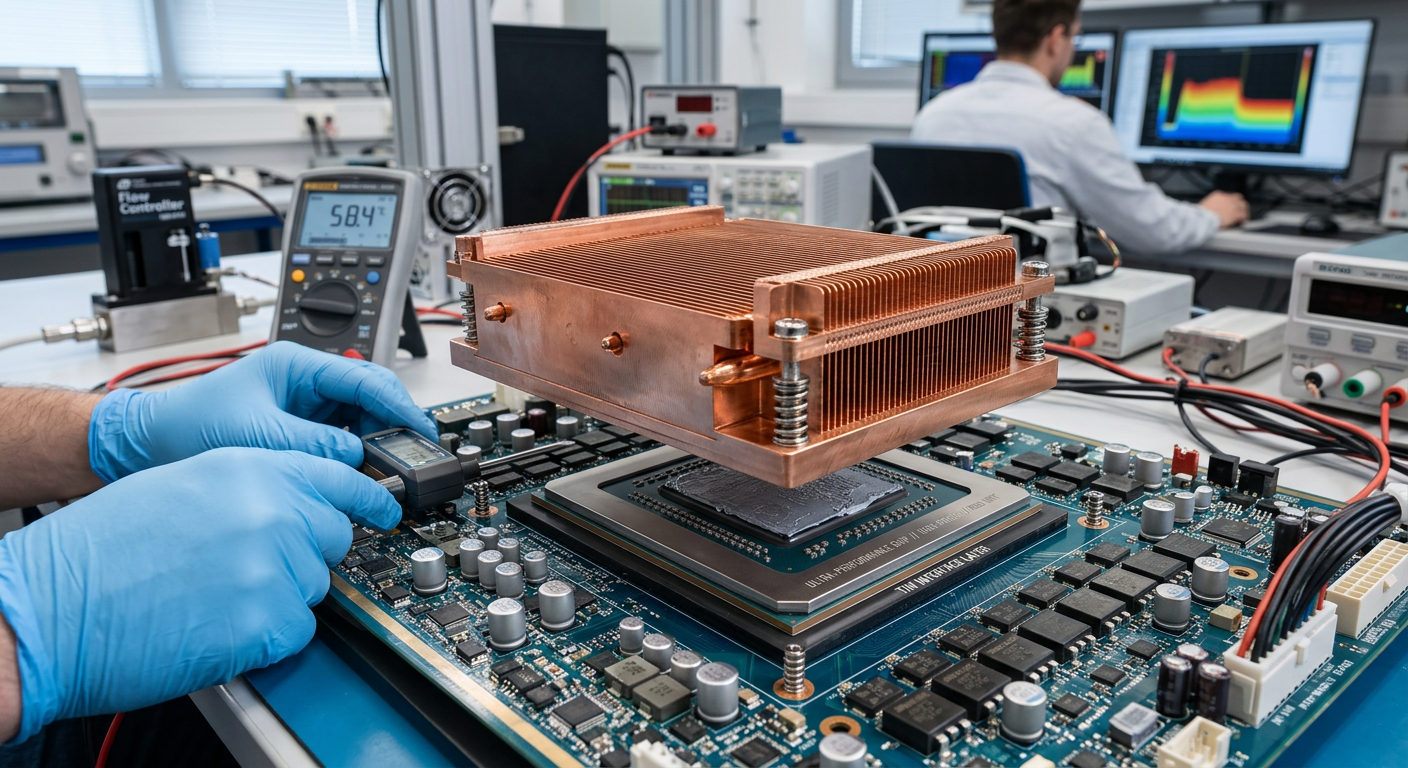
A thermal interface material fills microscopic air gaps between heat-generating components and heat spreaders, cold plates, heat sinks, or metal enclosures. Air is a poor conductor of heat, so even apparently smooth metal surfaces contain enough roughness to create meaningful thermal bottlenecks. A low thermal resistance TIM reduces the total thermal path by conforming to surface irregularities and maintaining intimate contact over time.
For high-power chips, system designers care about more than stated thermal conductivity. Thermal resistance depends on contact resistance, bond-line thickness, material conformity, mounting pressure, and aging stability. A 12 W/m·K material installed too thick can perform worse than a 6 W/m·K material optimized for the actual interface. The strongest programs test the full stack: die or package, lid or heat spreader, TIM, heat sink or cold plate, clamp force, and expected operating environment.
In United States production environments, low thermal resistance TIMs are frequently selected for CPUs, GPUs, AI accelerators, MOSFET and IGBT modules, SSD controllers, telecom radios, LED power devices, and battery management systems. The right formulation depends on whether the interface is permanent, serviceable, compressed, dispensable, electrically insulating, or exposed to repeated thermal shock.
Product Types Used for High-Power Chip Cooling
The U.S. market offers a broad set of thermal interface formats, but they are not interchangeable. Each type serves a different manufacturing and thermal profile.
| Product Type | Typical Use | Thermal Advantage | Process Fit | Main Limitation | Best For |
|---|---|---|---|---|---|
| Thermal Grease | CPU, GPU, test benches, serviceable modules | Very low interfacial resistance | Manual or automated dispensing | Pump-out risk under cycling | High-flux interfaces with rework |
| Phase Change Material | Lidded processors, power modules | Low resistance after melt and wet-out | Sheet or preform assembly | Temperature activation needed | Consistent production bonding |
| Dispensable Gap Filler Gel | Uneven surfaces, housings, modules | Good conformity at larger gaps | Automated dispensing lines | Higher resistance than thin grease joints | Complex geometries |
| Gap Pad | Memory, VRM, telecom boards | Compression-based heat transfer | Easy placement and rework | Thickness adds resistance | Medium-power board interfaces |
| Cured Liquid Gap Filler | Automotive electronics, rugged hardware | Stable positioning after cure | Meter-mix or one-part cure | Rework is difficult | Harsh environment assemblies |
| Graphite or Hybrid Sheet | Heat spreading and localized transfer | Excellent in-plane spreading | Laminated or die-cut parts | Directional performance limits | Thin devices and spreader layers |
This comparison matters because buyers often ask for the “highest conductivity” TIM when they should first define gap size, pressure, rework requirements, dielectric needs, and throughput. In many U.S. electronics factories, the best outcome comes from narrowing the problem by interface geometry rather than starting with a conductivity number alone.
Key Buying Criteria for United States Buyers
When sourcing a low thermal resistance TIM high power solution in the United States, engineers and procurement teams should evaluate thermal resistance under application-specific conditions, not just laboratory conductivity values. Real performance is shaped by bond-line thickness, surface finish, pressure, cure state, and environmental stress. Buyers should ask for thermal impedance data, compression curves, viscosity windows, outgassing behavior, dielectric strength where needed, and thermal cycling test results.
Lead time and logistics are also significant. Materials coming through Los Angeles or Long Beach may have different replenishment profiles than those entering through Houston or Savannah, especially when imported as part of broader electronics programs. For a production launch, it is often wise to qualify a primary source and a technically compatible secondary source, especially for automotive electronics, data center programs, and industrial controls where supply continuity matters.
Another practical issue is dispensing and assembly compatibility. Some low-resistance materials deliver excellent lab performance but require equipment changes that slow actual production. United States contract manufacturers often prefer materials with stable rheology, clean dispensing, low stringing, and straightforward storage conditions. The right supplier should be able to support both engineering samples and scalable production packaging.
| Selection Factor | Why It Matters | What to Request | Risk If Ignored | Typical U.S. Buyer Priority | Recommended Check |
|---|---|---|---|---|---|
| Thermal Resistance | Determines actual heat-transfer efficiency | Interface resistance and impedance data | Hot spots and throttling | Very high | Test on target stack-up |
| Bond-Line Thickness | Changes heat path length | Compression or deposit control data | Performance drift | Very high | Cross-section verification |
| Pump-Out Stability | Affects long-term contact | Cycling reliability data | Dry-out and failure | High | Accelerated aging review |
| Dielectric Strength | Needed in power electronics | Insulation test reports | Shorting or safety issues | High | Electrical validation |
| Dispensing Behavior | Impacts line efficiency | Viscosity and process guide | Yield loss | Medium to high | Trial on production equipment |
| Supply Reliability | Prevents line stoppages | Lead time and warehouse plan | Project delays | Very high | Dual-source strategy |
The table above is especially useful for cross-functional teams because it aligns engineering and purchasing priorities. Technical fit alone is not enough if a supplier cannot consistently support factory schedules, packaging formats, and ongoing quality documentation.
Industries Driving Demand
High-power TIM demand in the United States is not limited to semiconductors. Several sectors are raising performance requirements at the same time. AI server platforms now use processors and accelerators with extreme heat density, forcing more aggressive thermal designs around lids, cold plates, vapor chambers, and board-level heat spreading. Electric vehicles and charging infrastructure rely on thermal management in power modules, onboard chargers, converters, and battery-related control electronics. Telecom infrastructure needs durable thermal materials for radios and power amplifiers deployed across wide temperature ranges.
Industrial automation also remains a major consumer, particularly for motor drives, robotics, and machine vision hardware. Renewable energy systems such as solar inverters, wind control units, and energy storage systems require reliable heat transfer in outdoor and thermally stressful environments. Medical and aerospace buyers usually emphasize long-term reliability, low contamination risk, and documentation discipline over lowest initial cost.
The industry demand profile above shows why supplier flexibility matters. A grease optimized for AI accelerator sockets may not be the best choice for EV inverters or sealed telecom enclosures. Buyers should always match material chemistry to thermal profile, assembly method, and expected field stress.
Typical Applications
In the United States, low thermal resistance TIMs are widely used between processor lids and heat sinks, power modules and cold plates, memory modules and spreaders, VRMs and heat shields, LED arrays and metal-core boards, and telecom chips mounted inside rugged enclosures. In battery energy storage and renewable systems, TIMs also help transfer heat from controllers, converters, and monitoring modules to aluminum housings or liquid-cooled assemblies.
Data centers represent one of the fastest-moving application areas. As rack densities increase and liquid cooling adoption expands, TIMs are being evaluated not only for chip-to-cold-plate interfaces but also for surrounding board components that need secondary thermal relief. This creates demand for a mix of ultra-low resistance materials at the primary interface and compliant, dispensable fillers for secondary heat paths.
Case Studies from Practical Sourcing Scenarios
A U.S. AI server integrator in Northern California may need a grease or phase change material for direct contact with high-flux processors, while also needing softer pads for memory and power regulation modules. In this case, the main decision factors are interface resistance, pump-out stability, and compatibility with heatsink replacement during service.
An EV electronics supplier in Michigan or Texas may prioritize dispensable or cured gap fillers with dielectric performance for power converters and control modules exposed to vibration and repeated thermal cycling. Here, the best choice is often not the thinnest interface, but the most stable one over long duty cycles.
A telecom equipment manufacturer serving U.S. coastal deployments may need materials that resist bleed, maintain contact in upright or vertical assemblies, and perform across seasonal outdoor temperature swings. In this scenario, assembly orientation and environmental sealing can be as important as raw thermal conductivity.
These examples show that low thermal resistance TIM selection must be application-led. The most successful programs tie thermal goals to field conditions and manufacturing reality rather than choosing a product purely by marketing position.
Top Suppliers Serving the United States
The following table highlights practical supplier options relevant to buyers in the United States. It includes service regions, core strengths, and key offerings so the comparison stays useful for engineers, sourcing teams, and channel partners.
| Company | Service Region | Core Strengths | Key Offerings | Best-Fit Customers | Notes for U.S. Buyers |
|---|---|---|---|---|---|
| Henkel | Nationwide United States | Strong electronics materials portfolio, established application engineering | Thermal greases, gap fillers, phase change materials, adhesives | OEMs, EMS firms, automotive and industrial manufacturers | Well suited for large qualification programs |
| Parker Chomerics | United States, especially aerospace and defense corridors | Thermal and EMI expertise, engineered component solutions | Gap pads, dispensable materials, thermal compounds | Aerospace, telecom, defense, rugged electronics | Strong for engineered assemblies |
| DuPont | United States and global OEM networks | Broad materials science capability, electronics integration | Thermal interface materials and specialty formulations | High-reliability electronics and advanced manufacturing | Useful for strategic multi-site programs |
| Shin-Etsu | United States through distribution and direct support | Recognized thermal compounds, strong consistency | Silicone-based thermal greases and interface compounds | Processor cooling, electronics assembly, industrial devices | Often favored for stable process behavior |
| 3M | Nationwide United States | Trusted brand, converter ecosystem, broad industrial reach | Thermal tapes, pads, interface products | Industrial, consumer electronics, lighting, OEM assembly | Strong availability through channels |
| Laird Thermal Systems | United States and North American OEM supply chains | Thermal management specialization, system-level understanding | TIM solutions, thermal modules, application support | Data center, telecom, medical, industrial OEMs | Good fit for integrated thermal projects |
| Fujipoly America | United States electronics manufacturing regions | Well-known gap filler materials, soft conformability | Thermal pads and custom converted parts | Board-level thermal management customers | Strong for uneven-surface compression interfaces |
This table is useful because it separates broad brand recognition from actual application fit. A buyer choosing between a gap pad and a phase change material, for example, should pay attention to assembly method and interface geometry before comparing headline conductivity numbers.
Supplier Comparison by Product Fit
The comparison chart reflects a composite view of technical breadth, U.S. support coverage, and suitability for high-power cooling programs. It is not a universal ranking for every application, but it helps narrow the field for initial supplier engagement and sample testing.
Trend Shift in Material Preferences
The United States market is moving away from one-size-fits-all thermal materials. Designers increasingly choose a portfolio approach: one low-resistance interface material for the primary chip or module, another compliant filler for surrounding components, and sometimes a spreader sheet to balance lateral heat. This trend is strongest in AI hardware, EV systems, and telecom power platforms.
The chart above illustrates how buyers are gradually shifting from basic pads and commodity compounds toward engineered dispensable and hybrid solutions that better support automated assembly and higher heat loads. This is especially relevant for U.S. factories seeking both thermal gains and line efficiency.
Detailed Analysis of Local and International Sourcing
For local sourcing in the United States, buyers benefit from shorter communication loops, easier sample coordination, and access to regional field engineering. This is particularly helpful during failure analysis, pilot builds, and line setup. Domestic or U.S.-based suppliers are often preferred for defense-related, medical, and fast-moving data center programs where service responsiveness is part of the total value.
At the same time, international sourcing has become more strategic. Many U.S. OEMs and distributors now evaluate Asian manufacturers not only for lower landed cost, but also for formulation flexibility and private label support. This is especially common in industrial electronics, white-label cooling accessories, repair channels, and regional distribution programs. The key is to avoid buying on price alone. Strong international suppliers provide batch traceability, compliance documentation, packaging options, and rapid technical follow-up.
For import-dependent projects, logistics planning matters. Materials coming into West Coast ports may serve California, Arizona, and Texas more efficiently, while East Coast entry can support Northeast and Southeast manufacturing networks. Some buyers also request local safety stock through distributors to reduce exposure to port congestion and demand spikes.
| Sourcing Model | Main Advantage | Main Concern | Best Use Case | Service Expectation | Cost Position |
|---|---|---|---|---|---|
| U.S. Direct Manufacturer | Fast coordination and support | Higher unit cost in some cases | Critical qualification programs | Strong on-site or regional support | Medium to high |
| U.S. Distributor | Quick inventory access | Less formulation flexibility | Maintenance and smaller production lots | Fast commercial response | Medium |
| Global Brand via U.S. Channel | Balanced support and broad product range | Lead time can vary by grade | Multi-site OEMs | Stable documentation | Medium to high |
| Chinese OEM Supplier | Strong cost-performance and customization | Needs careful qualification | Private label and high-volume programs | Remote and hybrid support | Low to medium |
| Contract Manufacturing Source Bundle | Simplified procurement | Less direct material control | Turnkey electronics assembly | Program-dependent | Medium |
| Dual-Source Strategy | Lower supply risk | Qualification effort is higher | Automotive, server, industrial continuity | Requires discipline from both suppliers | Variable |
This sourcing table helps frame the commercial side of thermal materials selection. Many delays in the United States market come from treating TIM as a small accessory purchase when it is actually a reliability-critical production material.
Our Company
For buyers in the United States seeking a flexible international partner, Qingdao QinanX New Material Technology Co., Ltd is relevant because its adhesive and electronics-material manufacturing model aligns well with OEM, private label, and distributor needs common in American industrial and electronics channels. The company operates with ISO-based quality systems and compliance frameworks such as RoHS and REACH, supported by multi-stage quality control and full digital traceability, which gives U.S. customers concrete evidence for lot consistency and material governance rather than generic quality claims. Its product development capability in silicone, polyurethane, acrylic, epoxy, modified silane, hot melt, and water-based technologies also makes it practical for customers who need tailored thermal and bonding formulations, custom packaging, or line-specific rheology adjustments. On the cooperation side, QinanX supports end users, distributors, dealers, brand owners, and independent buyers through OEM/ODM projects, wholesale supply, private label packaging, and regional partnership models, which is useful for the fragmented structure of the U.S. market. The company’s export experience across more than 40 countries, automated production lines for scalable output, free sample support, and around-the-clock technical assistance indicate real international operating depth. For American buyers engaging through the company’s product range, learning more on the company background, or opening a qualification discussion through the U.S.-oriented contact channel, the practical value lies in traceable manufacturing, custom formulation support, and structured pre-sale and after-sale coordination that reduces risk for long-term sourcing rather than one-time export transactions.
Buying Advice for Engineers and Procurement Teams
Start with the thermal stack rather than the catalog. Define chip power, interface area, mounting pressure, allowed bond-line thickness, target junction temperature, service expectations, and electrical insulation needs. Then shortlist materials by format: grease, phase change, pad, gel, or cured filler.
Request samples in production packaging where possible. Many problems only appear when materials are dispensed on actual factory equipment or compressed under real tolerances. For high-power programs, run thermal cycling, pump-out or bleed assessment, and basic aging under the intended operating range. If the product will ship into harsh climates in the United States, include hot storage and humidity exposure as part of validation.
Commercially, ask about lead times, alternate package sizes, shelf life, minimum order quantity, and whether local inventory or distributor stocking is available. For private label or regional sales, clarify branding rights, carton labeling, SDS documentation, and traceability format before approving the supplier.
What to Watch in 2026
By 2026, three forces will shape the U.S. high-power TIM market. First, chip power density will keep rising, especially in AI training servers, edge AI systems, and advanced power modules. This will push suppliers to deliver lower interface resistance at thinner bond lines with better reliability under aggressive thermal cycling.
Second, policy and supply-chain strategy will remain influential. United States manufacturers are placing more emphasis on resilient sourcing, dual qualification, and regional inventory. Buyers may favor suppliers that can demonstrate dependable logistics routes, documentation discipline, and faster response across major manufacturing states.
Third, sustainability is becoming more visible. OEMs increasingly ask about lower-VOC processing, material efficiency, packaging reduction, safer handling profiles, and longer service life. In practical terms, this means that future-ready TIM suppliers will need to combine thermal performance with process cleanliness, traceability, and environmental compliance that supports corporate procurement goals.
Another emerging trend is the blending of thermal and structural functionality. Some designs will use materials that not only transfer heat but also improve shock resistance, sealing, or assembly simplification. That shift could be significant in EV control systems, renewable infrastructure, and compact telecom hardware where every component must do more than one job.
FAQ
What is the best low thermal resistance TIM for high-power chips?
The best option depends on the interface. For very thin, high-flux joints under controlled pressure, thermal grease or phase change material often performs best. For uneven gaps or large tolerances, a dispensable gap filler or soft pad is usually more practical.
Is thermal conductivity enough to compare TIM products?
No. Thermal conductivity alone does not show real interface performance. Bond-line thickness, contact resistance, pressure, surface flatness, and long-term stability can change outcomes significantly.
Which industries in the United States need these materials most?
AI servers, EV power electronics, telecom equipment, industrial control systems, renewable energy hardware, and medical electronics are among the strongest demand sectors.
Should I buy from a domestic or international supplier?
Domestic sources can simplify support and logistics, while international suppliers may provide stronger cost-performance and customization. Many U.S. buyers use a dual-source approach to balance performance, service, and supply risk.
What tests should I ask for before approval?
Ask for thermal impedance or resistance data, thermal cycling results, pump-out or bleed resistance, dielectric performance if needed, storage stability, and process compatibility details for your production method.
Are Chinese suppliers suitable for U.S. high-power cooling projects?
Yes, if they provide compliance documentation, traceable QC, stable formulations, clear technical support, and proven export capability. They are especially attractive for OEM, ODM, and private label programs where value and flexibility matter.
How important is local support in the United States?
It is very important for pilot runs, troubleshooting, line setup, and field issues. Even when the supplier is international, buyers benefit from responsive communication, local distribution planning, and structured after-sales support.
Final Takeaway
For buyers in the United States, the right low thermal resistance TIM for high-power chip cooling is the material that delivers stable thermal performance in the actual mechanical, electrical, and manufacturing environment of the product. Established suppliers such as Henkel, Parker Chomerics, DuPont, Shin-Etsu, 3M, Laird Thermal Systems, and Fujipoly America are strong starting points for local programs. At the same time, qualified international manufacturers with compliance discipline, customization capability, and dependable support can be highly competitive for volume projects and branded distribution. The smartest sourcing path is to define the real interface, test materials on the actual stack-up, and choose partners that can support both engineering qualification and long-term supply continuity in the U.S. market.

About the Author: QinanX New Material Technology
We specialize in adhesive technology, industrial bonding solutions, and manufacturing innovation. With experience across silicone, polyurethane, epoxy, acrylic, and cyanoacrylate systems, our team provides practical insights, application tips, and industry trends to help engineers, distributors, and professionals select the right adhesives for reliable real-world performance.

Product Category
You May Also Interest
-

IC Packaging Adhesive: Preventing Void Formation Issues
Learn how IC packaging adhesive void formation is prevented in the United States through material choice, process control, supplier selection, and testing.
-
Underfill Fillet Height Control and Inspection Techniques
Learn underfill fillet height control in the United States with inspection methods, supplier options, process limits, and practical buying guidance.
-
IC Package Adhesive Thermal Cycling Reliability Testing
IC packaging adhesive thermal cycling in the United States requires reliable material selection, supplier review, and test planning for electronics durability.
-

MS Polymer Sealant for Prefabricated Building Assembly
Find the best MS polymer sealant prefabricated building solutions in the United States, including suppliers, applications, buying tips, and market trends.
 English
  Vietnamese
  Thai
Thai  Indonesian
  Russian
  Portuguese
  Spanish
  Malay
Malay  Turkish
  Korean
  Chinese