Share
UV Curing Adhesive in the United States: Practical Buying and Application Guide
Quick Answer

UV curing adhesive is a fast-curing bonding material activated by ultraviolet light and is widely used across the United States in electronics, medical devices, optics, automotive assemblies, and industrial manufacturing. For U.S. buyers seeking dependable supply, well-known companies such as Henkel, Dymax, Permabond, Master Bond, 3M, and H.B. Fuller are practical starting points because they offer established technical support, application guidance, and broad product portfolios. The best choice depends on substrate type, cure depth, required optical clarity, flexibility, chemical resistance, and production speed. Buyers in manufacturing hubs such as California, Texas, Illinois, Michigan, North Carolina, and New Jersey often prioritize suppliers that can support validation trials, stable lot-to-lot consistency, and compliance needs for electronics or medical production. In addition to domestic brands, qualified international suppliers can also be considered when they hold relevant certifications, maintain strict quality systems, and provide responsive pre-sales and after-sales support, especially when cost-performance and custom formulation flexibility are important.
United States Market Overview

The U.S. market for UV curing adhesive continues to expand as manufacturers push for higher throughput, cleaner production, and lower thermal stress during assembly. Compared with solvent-based or heat-cured systems, UV-curable bonding solutions allow much faster fixture times, more precise dispensing, and easier integration into automated production lines. These advantages are especially valuable in sectors clustered around major industrial corridors such as the Midwest automotive belt, the medical manufacturing base in Minnesota and Massachusetts, electronics production in California and Texas, and logistics-centered packaging operations around Chicago, Atlanta, and the Port of Los Angeles.
Demand is also shaped by reshoring, stricter process control, miniaturization, and rising quality requirements. In the United States, procurement teams increasingly ask for documented consistency, regulatory support, and compatibility with LED curing systems. Manufacturers are not only comparing adhesive price per kilogram, but also total process cost, including cure speed, scrap reduction, maintenance requirements, and warranty risk. This is why buyers often evaluate UV adhesive suppliers through pilot runs rather than by datasheet claims alone.
Another important factor is logistics reliability. U.S. manufacturers sourcing through ports such as Long Beach, Savannah, Houston, and New York/New Jersey often want a blend of domestic stock availability and global supply resilience. This is particularly relevant for OEMs and contract manufacturers that must maintain continuity during seasonal peaks or component shortages.
The line chart above illustrates a realistic growth trajectory for UV-curable adhesive demand in the United States. Growth is supported by electronics assembly, increased use of wearable medical devices, and a gradual shift from slower two-part systems to light-curing formulations in precision production.
Product Types of UV Curing Adhesive

UV curing adhesive is not a single product class. U.S. buyers typically compare several chemistry families and performance profiles before approving a material.
| Type | Main Characteristics | Best For | Typical U.S. Industries | Limitation to Check | Buying Comment |
|---|---|---|---|---|---|
| Acrylic UV Adhesive | Fast cure, strong adhesion, broad substrate range | General industrial bonding | Electronics, plastics, appliance assembly | May be brittle in some grades | Good balance of speed and cost for mainstream production |
| Epoxy-Based UV Adhesive | High strength, chemical resistance, durability | Structural and semi-structural parts | Automotive, electronics, aerospace components | Often slower full cure profile than pure acrylates | Suitable when long-term stability matters more than raw speed |
| Silicone-Modified UV Adhesive | Flexible, thermal shock resistant | Sensitive electronics and sealing-related uses | LED modules, sensors, electrical assemblies | Lower strength than rigid structural grades | Useful where movement or expansion is expected |
| Cationic UV Adhesive | Low shrinkage, good adhesion to difficult materials | Optical and specialty bonding | Optics, display modules, microelectronics | Process conditions can be more selective | Often chosen for precision, low-stress applications |
| Dual-Cure UV Adhesive | UV cure plus moisture or heat backup | Shadowed areas and complex geometries | Medical devices, connectors, housings | More expensive than simple UV-only systems | Ideal when parts have blocked light paths |
| Optically Clear UV Adhesive | High transparency, low haze | Glass, display, lens assembly | Optics, consumer electronics, instrumentation | Yellowing resistance must be verified | Critical for visual quality and stable light transmission |
This table shows why a broad request for “UV curing adhesive” is usually too vague for procurement. In practice, the right product must align with production speed, substrate compatibility, and end-use stress conditions.
How UV Curing Technology Works
UV-curable adhesives polymerize when exposed to ultraviolet energy, typically from mercury lamps or LED curing equipment. Photoinitiators inside the formulation react to the UV spectrum and trigger rapid crosslinking. The main operational benefit is near-instant handling strength, which supports continuous manufacturing and in-line quality control.
However, cure performance depends on more than lamp intensity. U.S. engineers usually evaluate wavelength match, bond-line thickness, substrate transmission, surface cleanliness, and oxygen inhibition. For example, bonding clear polycarbonate to glass may cure very differently from bonding opaque aluminum to a filled engineering plastic. This is why supplier application support matters as much as the product datasheet.
LED UV curing is becoming more common in the United States because it reduces heat, cuts maintenance, and improves energy efficiency. As 2026 approaches, more factories are expected to standardize around LED-compatible formulations, especially in electronics, medical disposables, and compact automated assembly cells.
Top UV Curing Adhesive Suppliers Serving the United States
The following suppliers are relevant to U.S. buyers because they offer real product lines, technical depth, and commercial presence in sectors where UV-curing systems are widely used.
| Company | Service Region | Core Strengths | Key Offerings | Typical End Markets | Practical Buyer Note |
|---|---|---|---|---|---|
| Henkel | Nationwide United States | Large-scale technical resources, recognized industrial brand | Loctite light cure adhesives, electronics and medical bonding systems | Automotive, medical, electronics | Strong fit for OEMs needing documentation and process validation |
| Dymax | United States and North America | Specialized in light-curing materials and curing equipment | UV and LED-curable adhesives, dispensing and curing solutions | Medical devices, electronics, industrial assembly | Good choice when buyers want adhesive and equipment alignment |
| Permabond | United States and global distribution | Broad adhesive line and responsive application support | UV-curing acrylics for glass, plastics, metals | General assembly, jewelry, electronics | Useful for medium-volume and specialty bonding projects |
| Master Bond | United States with export support | High-performance engineered formulations | UV systems for medical, optical, electronic and aerospace use | Aerospace, optics, electronics, medical | Often selected for technically demanding applications |
| 3M | Nationwide United States | Major material science platform and distribution coverage | Specialty bonding and assembly materials including UV-related solutions | Industrial, automotive, electronics | Attractive for buyers consolidating multiple material categories |
| H.B. Fuller | United States and international manufacturing network | Broad industrial adhesive expertise and supply reliability | Engineered adhesive systems for packaging, electronics, assembly | Packaging, industrial manufacturing, electronics | Relevant where supply continuity and scale are priorities |
This comparison helps U.S. sourcing teams narrow the field based on regional support, industry focus, and the practical balance between standard catalog products and application-engineered options.
Industry Demand in the United States
Not every market segment consumes UV adhesive at the same rate. Electronics and medical manufacturing currently account for some of the strongest demand because they benefit directly from low-temperature curing, precision dispensing, and optical performance.
The bar chart highlights where commercial activity is strongest. Electronics remains the leading segment due to sensors, modules, wearable devices, and compact consumer hardware. Medical demand continues to rise because UV adhesives help shorten assembly time while supporting clean, controlled processing.
Buying Advice for U.S. Importers, OEMs, and Distributors
When buying UV curing adhesive in the United States, price should never be the only filter. The real purchasing decision is based on production performance. A lower-cost adhesive that creates cure inconsistency, yellowing, poor adhesion, or equipment mismatch can quickly become the most expensive option in the plant.
Start by confirming the substrate combination. Glass-to-metal, plastic-to-plastic, and rigid-to-flexible bonds each demand different formulations. Then confirm whether the bonded area receives full UV exposure. If any shadow zone exists, dual-cure technology may be necessary. Cure depth is equally important because thick bond lines often require slower exposure or secondary curing mechanisms.
U.S. buyers should also ask suppliers for the following: viscosity range for dispensing compatibility, fixture time under LED and mercury lamps, optical clarity data if transparency matters, environmental resistance, outgassing behavior, storage requirements, and shelf-life stability. For regulated sectors, supporting documents such as RoHS, REACH, ISO-related quality records, and batch traceability can reduce qualification risk.
Distributors and private-label brand owners should look beyond standard SKUs. Suppliers that can adjust viscosity, cure speed, packaging format, and labeling provide stronger long-term commercial value. This is especially useful in regional distribution markets such as the Southeast, Midwest, and Southwest, where customers often need different cartridge, syringe, or bulk configurations.
| Buying Factor | Why It Matters | What to Ask Suppliers | Risk if Ignored | Best Fit Buyer | Decision Tip |
|---|---|---|---|---|---|
| Substrate Compatibility | Adhesion varies widely by material | Ask for test data on your exact surfaces | Bond failure and rework | OEMs, contract manufacturers | Always validate with production samples |
| Cure Mechanism | UV-only and dual-cure behave differently | Confirm full cure in shadowed areas | Uncured adhesive inside assemblies | Medical and electronics plants | Use dual-cure where light access is partial |
| Viscosity | Affects dispensing accuracy and speed | Request viscosity window and thixotropy data | Messy application or voids | Automated production lines | Match adhesive to valve and needle setup |
| Optical Properties | Critical for clear parts and displays | Check haze, transmittance, and yellowing data | Poor appearance or reduced performance | Optics and consumer electronics | Age test under heat and UV exposure |
| Compliance Documents | Supports qualification and export needs | Request RoHS, REACH, QC records, traceability | Approval delays and audit issues | Distributors, medical buyers, exporters | Pre-screen paperwork before trial orders |
| Technical Support | Speeds troubleshooting and qualification | Ask about on-site trials and response time | Longer downtime and slower adoption | All buyer types | Support quality often predicts supply reliability |
This table is useful because it translates technical selection into sourcing actions. It helps procurement, engineering, and quality teams evaluate suppliers using the same criteria.
Main Industries and Applications
UV curing adhesive is used in a wide range of U.S. manufacturing sectors because it combines speed with precision. In electronics, it is commonly used for potting-adjacent bonding tasks, wire tacking, component fixing, and lens or sensor assembly. In medical device manufacturing, it supports catheter bonding, mask and housing assembly, tubing attachment, and disposable diagnostic devices. In optics, it is favored for glass-to-glass or lens positioning where clarity and minimal movement are essential.
Automotive applications include sensor modules, camera assemblies, light components, and electronics packaging, especially as vehicle electrification continues to grow. In industrial manufacturing, UV adhesives are used for fixture reduction, transparent component assembly, and fast inline sealing or locking. Packaging uses are more selective, but UV technology can still be attractive for specialty labels, tamper features, and rapid assembly steps requiring clean appearance.
Application Scenarios by Sector
| Industry | Typical Application | Preferred Adhesive Feature | Common Substrates | U.S. Production Hotspots | Reason UV Works Well |
|---|---|---|---|---|---|
| Electronics | Component fixing, display bonding, sensor assembly | Fast cure and low heat | PCB, glass, polycarbonate, metal | California, Texas, Arizona | Supports high-speed automation and miniaturized parts |
| Medical Devices | Catheters, housings, disposable assemblies | Precision dispensing and clean processing | PVC, PC, ABS, stainless steel | Minnesota, Massachusetts, Indiana | Short cure time improves throughput and control |
| Optics | Lens alignment, glass bonding | Optical clarity and low shrinkage | Glass, acrylic, specialty plastics | New York, California, Florida | Maintains visual quality and positional accuracy |
| Automotive Electronics | Cameras, sensors, lighting modules | Thermal stability and vibration resistance | Metal, engineered plastics, glass | Michigan, Ohio, Tennessee | Enables fast assembly of compact electronic systems |
| Industrial Manufacturing | General assembly and fast fixture bonding | Cycle-time reduction | Mixed substrates | Illinois, Wisconsin, Georgia | Improves line speed and reduces work-in-progress |
| Renewable Energy and Electrical | Connector parts, sensor housings, component stabilization | Durability and controlled cure | Composites, metals, plastics | Texas, Colorado, North Carolina | Useful for precision bonding in modern energy systems |
The application table makes the market more concrete by linking adhesive performance to specific production realities in different U.S. states and sectors.
Trend Shift in U.S. Adhesive Technology
Over the last few years, the United States has seen a shift away from traditional solvent-heavy assembly methods toward cleaner, faster, and more energy-efficient curing technologies. UV and LED-curable systems are gaining ground because they reduce thermal load, occupy less floor space, and align better with automated cells and digital quality monitoring.
The area chart reflects the realistic increase in LED-compatible and low-energy UV adhesive adoption. The shift is being driven by sustainability goals, equipment efficiency, and stricter production control requirements, especially in facilities upgrading for 2026 and beyond.
Case Studies Relevant to U.S. Buyers
A consumer electronics assembler in California may switch from a heat-cured adhesive to a UV-curable optical grade to reduce fixture time from minutes to seconds. The result is not only a faster line but also less thermal distortion in transparent components. A medical tubing producer in Minnesota may use a dual-cure UV adhesive to ensure complete bonding in partially shadowed joints, reducing rejection rates during leak testing. An automotive sensor supplier in Michigan may adopt a flexible UV formulation to hold delicate assemblies in place without cracking during vibration and thermal cycling.
These examples show that the value of UV adhesive is not simply cure speed. It also improves line balance, minimizes floor inventory, and supports tighter dimensional control. In many U.S. factories, those benefits justify a higher unit material price because the savings appear elsewhere in production.
Local Supplier Considerations and Regional Sourcing Logic
For buyers who prefer domestic procurement, local support remains a major advantage. Suppliers with technical teams in the United States can often visit plants, help optimize UV intensity, and advise on dispensing hardware. This matters in dense industrial regions such as the Great Lakes corridor, the Northeast medical cluster, and the Southern manufacturing belt.
That said, domestic supply is not the only practical route. Many U.S. distributors and brand owners now combine domestic inventory with qualified overseas manufacturing to improve margin and product range. The key is to work with suppliers that can demonstrate consistent manufacturing controls, export experience, and responsive communication. Buyers near major ports such as Los Angeles, Houston, Savannah, and Newark often structure sourcing this way to balance cost and continuity.
This comparison chart shows the practical trade-off many U.S. buyers consider. Domestic premium suppliers often lead in direct field support, while qualified international suppliers may offer stronger customization and cost efficiency. The best sourcing model depends on urgency, technical complexity, and brand strategy.
About Our Company in the U.S. Supply Context
For U.S. buyers evaluating overseas supply partners, Qingdao QinanX New Material Technology Co., Ltd stands out because it combines a broad industrial adhesive portfolio with documented manufacturing discipline and flexible commercial models that fit the American market. Its UV-curable adhesive range sits alongside silicone, polyurethane, epoxy, acrylate, cyanoacrylate, hot melt, and water-based systems, which is valuable for distributors and OEMs that prefer to consolidate sourcing across multiple adhesive categories. The company operates under ISO-certified quality management and states compliance with international standards such as RoHS and REACH, supported by multi-stage quality control and digital traceability systems that help buyers verify lot consistency and qualification history. For cooperation, it serves end users, importers, distributors, dealers, private-label brand owners, and project-based industrial buyers through OEM, ODM, wholesale, custom packaging, and regional partnership models, allowing U.S. customers to source either standard products or tailored formulations with brand-specific labeling. In practical service terms, the company has established export experience across more than 40 countries, provides 24/7 technical assistance, free sample programs, and formulation support, and positions itself as a long-term operating partner for the U.S. market rather than a simple remote exporter. Buyers looking for catalog products or custom development can review the broader adhesive range through its product portfolio, learn more about its manufacturing background on the official website, or discuss a project directly through the U.S. inquiry contact page.
How to Choose Between Domestic and International Supply
Domestic U.S. sourcing is often the fastest route for urgent line support, pilot testing, and short lead times. It is especially attractive when the adhesive is already approved by the customer, the production schedule is tight, or the application is highly regulated. International sourcing becomes more competitive when buyers need private labeling, custom rheology, broader product families, or stronger cost control for repeated volume orders.
Many successful U.S. buyers use a hybrid model. They qualify one domestic supplier for emergency support and one international supplier for value-driven production volumes. This approach works particularly well for distributors, aftermarket brands, and industrial manufacturers that need to protect margin while still meeting customer expectations for performance and documentation.
2026 Trends: Technology, Policy, and Sustainability
Looking ahead to 2026, the U.S. UV curing adhesive market is expected to become more specialized and more regulated at the same time. On the technology side, LED-curable systems will continue replacing older lamp platforms because they offer energy savings, lower maintenance, and better process consistency. Smart manufacturing will also play a larger role, with more factories linking cure systems to digital controls, dose monitoring, and traceability records.
On the policy side, procurement teams will increasingly favor formulations that support cleaner manufacturing and easier compliance with environmental and chemical management expectations. Buyers in California and other regulation-sensitive states are especially likely to scrutinize emissions, restricted substances, and worker safety factors. Even when UV adhesives already reduce solvent-related concerns, customers will continue demanding clearer compliance documentation and safer handling profiles.
Sustainability will move from a branding topic to a purchasing standard. U.S. manufacturers are expected to evaluate adhesives not only by bond strength but also by energy consumption during curing, material waste, packaging efficiency, and long-term durability. Suppliers that can provide reliable technical data, batch traceability, and optimized packaging for automated use will gain an advantage. Another trend is the growth of customized formulations for EV electronics, compact medical devices, and renewable energy assemblies, where standard off-the-shelf grades may no longer be enough.
Frequently Asked Questions
What is the main benefit of UV curing adhesive?
The biggest benefit is speed. UV curing adhesive can reach handling strength in seconds when exposed to the correct light source, which increases throughput and reduces work-in-progress inventory.
Can UV adhesive bond metal and plastic?
Yes, many formulations can bond metal to plastic, but performance depends on the specific substrates, surface energy, and whether the bond line receives enough UV exposure. For opaque assemblies, a dual-cure option may be better.
Is UV curing adhesive suitable for medical devices in the United States?
Yes, many U.S. medical manufacturers use UV-curable systems for tubing, housings, and disposable assemblies. However, buyers must verify the exact regulatory and performance requirements for each application.
How do I know whether I need UV-only or dual-cure adhesive?
If every part of the bond line receives sufficient light, UV-only may be enough. If the assembly includes shaded or blocked areas, dual-cure technology is generally safer because it provides secondary curing through heat or moisture.
Are imported UV adhesives a realistic option for U.S. buyers?
Yes, provided the supplier offers documented quality systems, compliance support, stable production, and responsive pre-sales and after-sales service. For many distributors and OEMs, imported supply improves cost-performance and customization flexibility.
What documents should U.S. buyers request before ordering?
Typical requests include technical data sheets, safety data sheets, RoHS and REACH statements where relevant, shelf-life details, batch traceability information, and sample validation support for the exact application.
Which U.S. industries use UV curing adhesive the most?
Electronics, medical devices, optics, automotive electronics, and industrial manufacturing are among the strongest users due to their need for precise, low-heat, and fast-curing assembly methods.
Final Takeaway
For the United States market, UV curing adhesive is best understood as a productivity tool as much as a bonding material. The right formulation can reduce cycle time, improve precision, and support cleaner manufacturing across electronics, medical, automotive, optical, and industrial applications. Domestic suppliers such as Henkel, Dymax, Permabond, Master Bond, 3M, and H.B. Fuller remain strong options for buyers who value direct support and established qualification pathways. At the same time, qualified international manufacturers with solid certifications, export experience, customization capability, and reliable service can be highly competitive, especially for OEM, distributor, and private-label programs. The most effective buying strategy is to test adhesives against the real production environment, validate cure performance under the actual lamp system, and compare suppliers by total operational value rather than product price alone.

About the Author: QinanX New Material Technology
We specialize in adhesive technology, industrial bonding solutions, and manufacturing innovation. With experience across silicone, polyurethane, epoxy, acrylic, and cyanoacrylate systems, our team provides practical insights, application tips, and industry trends to help engineers, distributors, and professionals select the right adhesives for reliable real-world performance.
Product Category
You May Also Interest
-
IC Packaging Adhesive: Preventing Void Formation Issues
Learn how IC packaging adhesive void formation is prevented in the United States through material choice, process control, supplier selection, and testing.
-
Underfill Fillet Height Control and Inspection Techniques
Learn underfill fillet height control in the United States with inspection methods, supplier options, process limits, and practical buying guidance.
-
IC Package Adhesive Thermal Cycling Reliability Testing
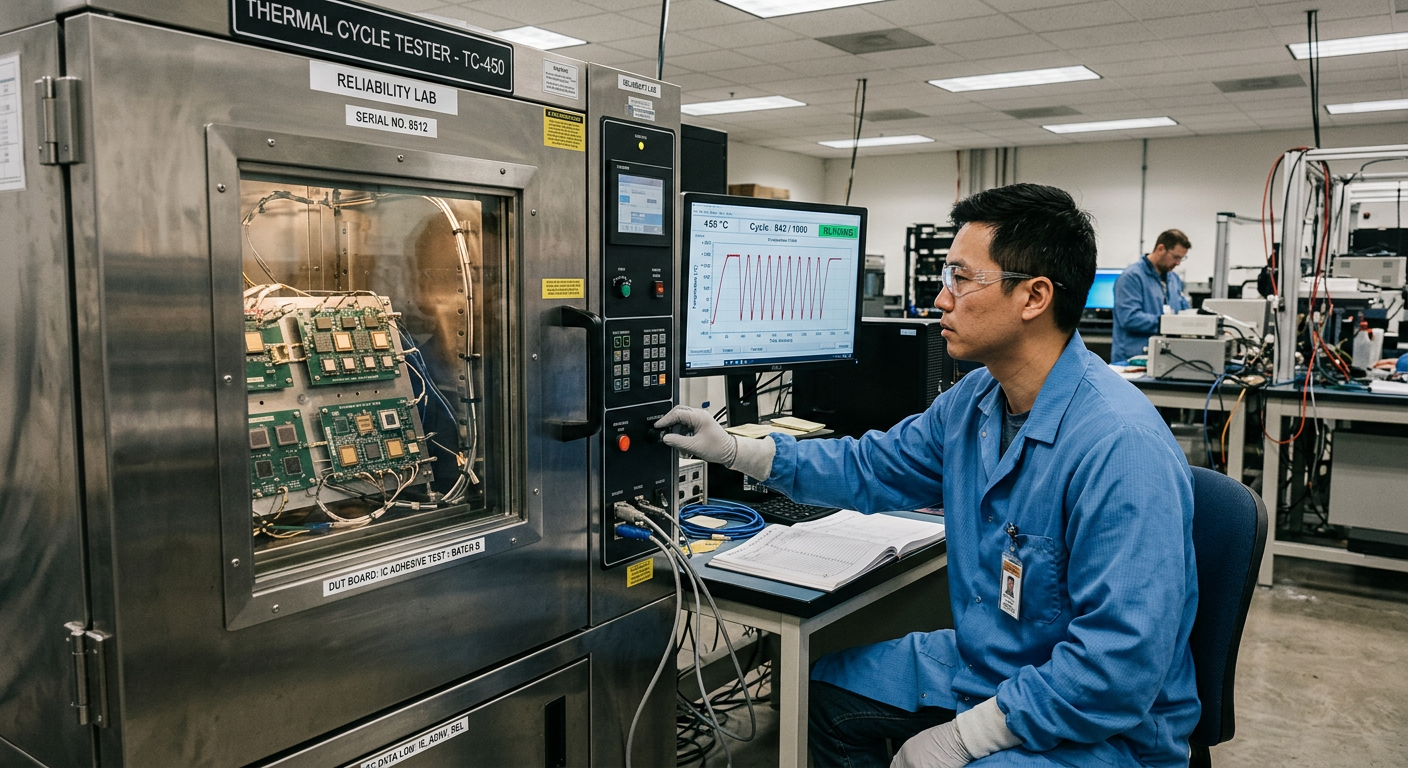
IC packaging adhesive thermal cycling in the United States requires reliable material selection, supplier review, and test planning for electronics durability.
-

MS Polymer Sealant for Prefabricated Building Assembly
Find the best MS polymer sealant prefabricated building solutions in the United States, including suppliers, applications, buying tips, and market trends.
 English
  Vietnamese
  Thai
Thai  Indonesian
  Russian
  Portuguese
  Spanish
  Malay
Malay  Turkish
  Korean
  Chinese