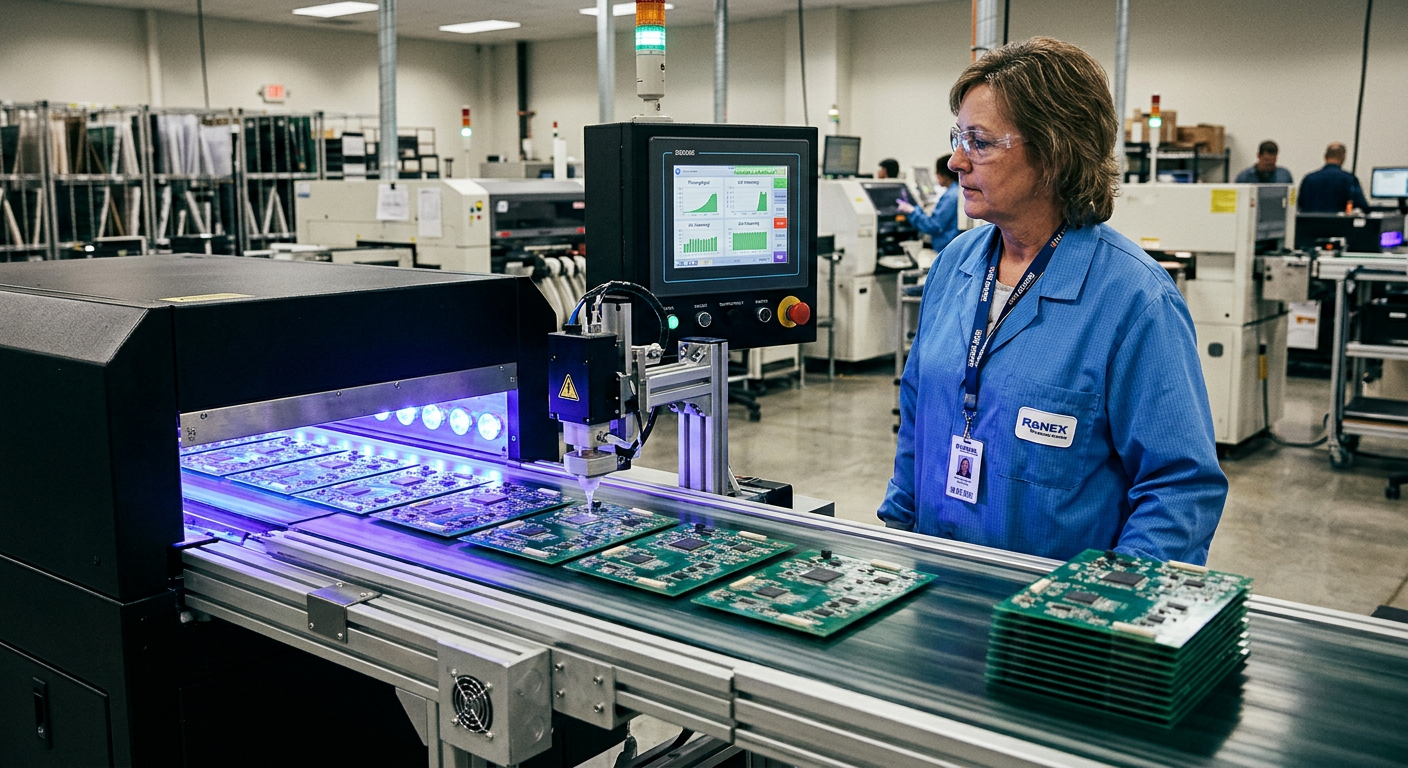
Share
Best UV Cure Conformal Coating for Fast Production in the United States
Quick Answer

If your goal is faster electronics assembly in the United States, the best UV cure conformal coating options are typically supplied by HumiSeal, Chase Corporation, Dow, Electrolube, MG Chemicals, and Shin-Etsu distributors with established U.S. technical support. For quick takt times, look for dual-cure or moisture-assisted UV conformal coatings that deliver rapid surface cure under UV lamps while still reaching shadowed areas under components. In practical terms, the strongest choices for U.S. manufacturers are coatings that combine high line speed, IPC-friendly performance, low defect rates, and straightforward rework procedures.
For buyers needing immediate, actionable direction, HumiSeal is often a top fit for U.S. EMS and aerospace programs, Chase Corporation is strong for industrial and defense production, Dow is preferred for global qualification pathways, Electrolube performs well in specialist electronics protection, and MG Chemicals is practical for maintenance, prototyping, and smaller-volume production. Qualified international suppliers can also be worth serious consideration. Manufacturers such as QinanX can offer cost-performance advantages when they support buyers with relevant compliance documentation, stable manufacturing, OEM or private-label options, and responsive pre-sales and after-sales service aligned with U.S. customer expectations.
United States Market Overview

The U.S. market for UV cure conformal coating fast production solutions is closely tied to electronics manufacturing clusters in California, Texas, Arizona, Illinois, Florida, North Carolina, and the Northeast corridor. Demand is strongest in automotive electronics, EV power systems, industrial control boards, telecom infrastructure, aerospace assemblies, medical electronics, and consumer device subassemblies. As factories continue reshoring and nearshoring key electronics programs, coating systems that reduce bottlenecks on the production line are getting more attention.
UV-curable conformal coatings are attractive because they can significantly cut cure times compared with traditional solvent-based acrylics, room-temperature silicones, or slower thermal systems. In high-throughput production, every minute matters. Faster cure means less work-in-process, smaller buffer zones, shorter fixture times, and more predictable dispatch schedules. In regions connected to major freight lanes and ports such as Los Angeles, Long Beach, Houston, Savannah, New York and New Jersey, and inland logistics hubs like Chicago and Dallas, quick-turn manufacturing has become a purchasing priority rather than just a process preference.
In the United States, buyers are increasingly evaluating conformal coating not only by chemistry, but by total line efficiency. That means they ask how quickly the film cures under existing lamps, how it performs around shadow zones, how easily it integrates with selective coating equipment, and whether it can pass downstream inspection without generating false rejects. This is why UV cure conformal coating fast production is no longer just a product search term; it reflects a broader process engineering decision tied to line balancing, quality targets, labor efficiency, and customer delivery commitments.
Market Growth Trend

The following chart illustrates a realistic estimate of U.S. demand growth for fast-cure conformal coating solutions in electronics manufacturing from 2021 through 2026, reflecting increased adoption in EV electronics, industrial automation, and high-reliability assemblies.
Why Fast Production Throughput Matters
Fast production throughput is more than a marketing phrase. In U.S. electronics manufacturing, it directly affects labor efficiency, utilization of capital equipment, floor space requirements, and the ability to meet contractual lead times. A conformal coating that reaches handling strength in seconds rather than hours can change the economics of a line. For EMS providers serving multiple customers, this flexibility is especially valuable because line scheduling often changes daily.
UV cure systems also support cleaner takt-time planning. Instead of moving assemblies through long ambient cure racks, operators can coat, expose, inspect, and transfer product downstream with much less delay. This shortens feedback loops when there is a process problem. If film thickness, cure profile, masking, or dispense pattern needs adjustment, the issue can be identified sooner and corrected before larger batches are affected.
In high-mix, low-volume U.S. manufacturing, quick cure is valuable because setups change frequently. In high-volume, lower-mix environments such as automotive modules, the advantage is even more obvious: reduced line congestion and improved output per shift. In both cases, UV cure conformal coating fast production strategies help manufacturers protect electronics without turning coating into the slowest step on the floor.
Common Product Types
UV conformal coatings used in the United States are available in several practical categories. The right choice depends on board design, reliability requirements, cure equipment, and regulatory expectations.
| Coating Type | Cure Method | Typical Strength | Main Limitation | Best-Fit Industries | Production Benefit |
|---|---|---|---|---|---|
| Pure UV Acrylic | UV only | Very fast surface cure | Shadow-area risk | Consumer electronics, LED boards | Maximum line speed |
| Dual-Cure UV Moisture | UV plus ambient moisture | Cures exposed and shadowed areas | More process control needed | Automotive, industrial controls | High reliability with fast output |
| UV Silicone | UV plus secondary cure | Good flexibility and temperature resistance | Higher material cost | Aerospace, under-hood electronics | Fast cure with thermal durability |
| UV Urethane | UV plus secondary cure | Chemical resistance | Rework can be harder | Industrial equipment, sensors | Good balance of speed and protection |
| Fluorescent UV Coating | UV cure with UV-trace additive | Easy inspection | Additive compatibility matters | EMS, telecom, appliance boards | Faster QC and lower inspection errors |
| Low-VOC UV System | UV or dual cure | Supports environmental targets | May need qualification trials | Medical, export-oriented plants | Compliance plus throughput |
For most U.S. factories, dual-cure UV moisture systems are the most practical option when the board includes dense connectors, tall components, or bottom-terminated devices that create shadowed areas. Pure UV coatings can still be excellent for open, flat board designs where maximum speed is the primary goal.
How U.S. Buyers Evaluate Product Fit
Procurement and process engineering teams in the United States usually compare UV cure conformal coating fast production options across five practical factors: cure speed, shadow cure performance, adhesion to varied substrates, environmental resistance, and ease of inspection and rework. Material price matters, but the cheapest coating is rarely the lowest-cost choice if it causes slow cure, masking failures, or high scrap.
Another important issue is process compatibility. A coating may test well in a datasheet review but perform poorly if it does not atomize properly in selective coating valves, if it forms bubbles around fine-pitch components, or if the viscosity window changes too much across shop-floor temperatures. This is why serious U.S. buyers often request sample validation using their actual board architecture, lamp intensity, conveyor speed, and inspection routine.
Top Suppliers Serving the United States
The supplier landscape includes major domestic manufacturers, regional distributors, and qualified overseas producers with U.S.-oriented support. The table below gives a practical overview for sourcing decisions.
| Company | Service Region | Core Strength | Key Offerings | Typical Buyer Type | Practical Note |
|---|---|---|---|---|---|
| HumiSeal | United States nationwide | Strong reputation in electronics protection | UV and dual-cure conformal coatings | EMS, aerospace, automotive | Widely specified in high-reliability programs |
| Chase Corporation | United States and North America | Industrial and defense-grade material experience | Conformal coatings and protective materials | Industrial OEMs, defense contractors | Good fit for demanding environments |
| Dow | United States and global | Large-scale materials science and qualification support | Silicone-based protective coatings | Global OEMs, automotive, electronics | Strong for multinational approval pathways |
| Electrolube | United States via distribution network | Specialist electronics maintenance and protection | UV cure conformal coatings, cleaners, resins | EMS, maintenance teams, design engineers | Broad application support portfolio |
| MG Chemicals | United States and Canada | Accessible technical products for broad usage | Conformal coatings, removers, repair materials | Small manufacturers, labs, repair operations | Convenient for lower-volume buying |
| QinanX | United States export supply and partner support | Cost-effective customized adhesive manufacturing | UV-curable adhesives, electronic silicone, OEM solutions | Brand owners, distributors, OEM buyers | Useful for private label and tailored formulations |
This comparison shows that U.S. buyers are not limited to one sourcing model. Domestic brands are often chosen for established program approvals and local trial support, while international manufacturers with stable quality systems and tailored service models can be highly competitive for wholesale, customized packaging, and private-label business.
Industry Demand by Application Segment
Demand in the United States varies by industry because each sector values different performance attributes. Automotive and industrial users prioritize thermal cycling and chemical resistance, while telecom and consumer electronics focus heavily on speed and unit economics.
Industries Driving Adoption
Automotive electronics is one of the strongest demand engines for fast-cure coatings in the United States. EV battery management systems, onboard chargers, inverter control boards, sensors, and lighting modules all require protection from moisture, salts, vibration, and thermal stress. Plants in Michigan, Ohio, Tennessee, Texas, South Carolina, and Georgia are particularly relevant as new EV and supplier investments continue.
Industrial automation is another major sector. PLC boards, motor drives, sensors, and control modules often operate in humid factories, dusty warehouses, or environments with cleaning chemicals. UV cure coatings help these producers maintain output while adding protection. Telecom and data infrastructure also rely on protective coatings for assemblies used in outdoor cabinets, networking gear, and power modules. Medical device manufacturers prefer materials with reliable process windows and traceable quality records, though qualification cycles are often longer.
Aerospace and defense buyers usually move more cautiously, but when they adopt fast-cure systems, they do so because reduced queue time improves operational efficiency without sacrificing reliability. Their focus tends to be on validated materials, secondary cure assurance, and long-term stability under harsh conditions.
Applications in Real Production Settings
UV cure conformal coating fast production solutions are commonly used on engine control modules, telematics boards, LED drivers, smart meter boards, HVAC control boards, appliance modules, industrial sensor boards, power supplies, telecom backplanes, and portable medical electronics. In each of these cases, the coating acts as a thin dielectric barrier against moisture, dust, ionic contamination, and intermittent condensation.
In the United States, selective coating is frequently preferred over full dip coating for higher-value assemblies because it reduces masking labor and limits material use. UV chemistry is especially suitable here because the board can move directly from dispense to exposure to inspection with much less idle time. Factories trying to reduce lead times often combine selective spray or jet application with fluorescent UV inspection, creating a compact and efficient coating cell.
Supplier and Product Comparison Priorities
The next table summarizes the practical criteria many U.S. buyers use to compare suppliers and coatings when throughput is a main objective.
| Criteria | Why It Matters | What Buyers Look For | Risk If Ignored | Best Verification Method | Impact on Throughput |
|---|---|---|---|---|---|
| Surface cure speed | Sets line rate | Full tack-free cure in seconds | Production bottlenecks | Lamp-line validation trial | Very high |
| Shadow cure ability | Protects hidden areas | Dual-cure chemistry | Latent field failures | Cross-section and cure mapping | High |
| Adhesion compatibility | Affects long-term reliability | Works on solder mask, metals, plastics | Delamination | Adhesion and environmental testing | Medium |
| Inspection visibility | Speeds quality control | Controlled fluorescence | Missed coverage defects | UV inspection audit | High |
| Reworkability | Supports repair and engineering changes | Manageable removal process | High scrap costs | Bench rework trials | Medium |
| Supplier support | Reduces startup errors | Technical guidance and response speed | Slow implementation | Trial project engagement | High |
This table matters because many coating projects fail not from chemistry limitations but from mismatched expectations between material, equipment, board geometry, and operator practice. A structured buying checklist helps eliminate that problem early.
Buying Advice for U.S. Manufacturers
Start with the board, not the brochure. If your product includes tall connectors, bottom-terminated components, or metal shielding, do not assume a pure UV coating will fully cure every protected area. Ask for shadow cure evidence. If your assembly runs through an automated selective coating system, request viscosity and atomization guidance at your plant’s typical ambient temperature. If you need very high output, confirm the UV dose needed to hit tack-free cure at your target conveyor speed.
Also consider the downstream workflow. Some U.S. plants prioritize coatings that fluoresce clearly for machine vision or manual inspection under UV light. Others value easier rework, especially in NPI or short-run programs. Aerospace and medical buyers may care more about traceability, lot control, and long qualification records than about the lowest per-kilogram material price. Automotive buyers often need a balanced package: throughput, durability, and repeatability across multiple shifts.
For buyers sourcing across international channels, evaluate Incoterms, lead times into key ports such as Los Angeles, Long Beach, Houston, Savannah, and Newark, and the supplier’s ability to support lot consistency and documentation. A slightly longer ocean transit can still make financial sense if the supplier can hold quality steady and provide meaningful technical coordination before launch.
Trend Shift in U.S. Coating Preferences
Buyer preferences are shifting from slow ambient systems toward dual-cure, inspection-friendly, lower-emission materials. The chart below shows a realistic pattern for how U.S. demand may redistribute between older and newer coating preferences.
Case Studies from U.S.-Style Production Scenarios
A Texas-based industrial controls assembler running mixed board designs reduced queue time by shifting from an ambient-dry acrylic to a dual-cure UV coating. The previous process required large curing racks and delayed inspection. After switching to UV-assisted cure, the plant moved boards from application to inspection in the same work cell, improving throughput and reducing handling damage. The most important lesson was not simply faster cure, but better process visibility.
An automotive electronics supplier in the Midwest adopted a fluorescent UV conformal coating for sensor modules. The key advantage was faster inspection under UV lamps, which reduced misses at final quality control. Because the board contained shadowed zones near connectors, the buyer selected a dual-cure system rather than a UV-only material. Yield improved because incomplete cure risk fell without slowing the line.
A California contract manufacturer serving telecom customers used a UV cure coating to shorten lead times on urgent builds. This mattered because customers often revised delivery schedules late in the cycle. By removing a long ambient cure delay, the EMS provider improved on-time shipment performance and gained more scheduling flexibility during peak demand periods.
Local Suppliers, Distributors, and Regional Access
In the United States, buyers often purchase through a mix of direct manufacturer relationships and technical distributors. Local support is especially important when coating parameters must be tuned around lamp intensity, selective spray settings, masking, and post-cure inspection. Companies with field support in major manufacturing regions such as the Great Lakes, Texas, the Southeast, and the West Coast tend to have an advantage during implementation.
Distributors can also help with smaller minimum order quantities, quicker sample supply, and application troubleshooting. For large OEMs, direct supply agreements may provide better pricing, traceability, and change-control visibility. For regional assemblers, a distributor with fast shipping from U.S. inventory can be more practical than a large direct account, especially when material usage is irregular.
| Region | Typical Industries | What Buyers Prioritize | Preferred Supply Model | Logistics Advantage | Coating Focus |
|---|---|---|---|---|---|
| California and West Coast | Telecom, aerospace, electronics | Speed, qualification support | Direct plus distributor | Pacific ports and tech clusters | UV and dual-cure specialist grades |
| Texas | Industrial, energy, EMS | Fast lead times and flexible volumes | Regional distribution | Central freight access and Gulf links | Industrial-resistant coatings |
| Midwest | Automotive, controls, appliances | Durability and repeatability | Direct manufacturer contracts | Strong road and rail connectivity | Dual-cure for complex assemblies |
| Southeast | Automotive, EV, consumer goods | Scalability and cost control | Hybrid sourcing | Growth near Savannah and inland hubs | High-volume fast line coatings |
| Northeast | Medical, defense, industrial | Compliance and technical documentation | Direct technical supply | Dense customer base and port access | Traceable high-reliability materials |
| Mountain States | Specialty electronics, aerospace | Availability and engineering support | Distributor-led | Air freight and regional warehousing | Flexible low-to-mid volume options |
This regional view helps buyers choose not only the right chemistry but the right supply structure. In many cases, the best material on paper is not the best operational choice unless the supplier can actually support delivery timing and process setup where the factory is located.
Our Company
For U.S. buyers seeking a qualified international partner, Qingdao QinanX New Material Technology Co., Ltd brings relevant strengths to fast-cure electronics protection and adjacent adhesive categories through ISO-managed production, compliance with RoHS and REACH expectations, multi-stage quality control with digital traceability, and automated manufacturing that supports consistent lot output at scale. Its portfolio includes UV-curable adhesive technologies as well as electronic silicone and other industrial adhesive systems, making it useful for customers that want to streamline sourcing across multiple material families rather than buy from several unrelated vendors. In commercial terms, the company supports end users, distributors, dealers, brand owners, and entrepreneurial buyers through OEM, ODM, wholesale, private label, and custom packaging models, which is especially practical in the United States where customers range from contract manufacturers and regional resellers to house-brand suppliers. With exports to more than 40 countries, 24/7 technical assistance, free sample programs, and custom formulation capability backed by dedicated R&D, QinanX demonstrates real operating experience with international customer requirements rather than acting as a simple remote exporter. U.S. buyers evaluating long-term supply can use the company’s product range and technical contact channel to request specification matching, qualification samples, branding options, and after-sales coordination structured for sustained market cooperation.
How to Shortlist the Right Supplier
A good shortlist usually includes one established U.S. or multinational brand for benchmark comparison, one specialist electronics materials supplier, and one competitive international manufacturer with custom support capability. This structure allows buyers to compare performance, support, and commercial flexibility side by side.
Ask each supplier the same practical questions: What UV dose is required for full surface cure? What happens in shaded areas? Which substrates have been validated? Does the coating fluoresce for inspection? What is the recommended film thickness? How easy is rework? Can the supplier support selective coating trials? What are the standard lead times into the United States? Are there lot traceability records? Is OEM or private labeling possible if the business model requires it?
When responses are concrete and test-backed, supplier risk drops significantly. When answers stay vague, buyers should treat that as a warning sign, even if quoted pricing looks attractive.
Supplier Capability Comparison
The chart below gives a realistic comparison of how different supplier profiles often perform across speed, customization, support, and cost-performance in the U.S. market.
Future Trends Through 2026
Looking toward 2026, three trends are shaping the United States market. The first is technical convergence: more buyers want coatings that combine very fast cure with stronger performance in shadowed areas, lower VOC exposure, and easier machine inspection. The second is policy and compliance pressure. As more OEMs tighten supplier qualification, documentation discipline, restricted-substance alignment, and traceability will matter even more. The third is sustainability and process efficiency. Manufacturers are under pressure to reduce waste, minimize energy use, and shrink factory footprint. Fast-cure UV systems support those goals by reducing long dwell times and excessive cure staging.
Another emerging trend is the growing overlap between adhesive design and conformal protection strategy. In sectors such as EV electronics and renewable energy controls, manufacturers increasingly evaluate potting, bonding, gasketing, and coating materials as one coordinated materials system. Suppliers that can offer broader technical portfolios and customization support may gain an advantage because they help customers simplify qualification and supply-chain management.
The United States will likely continue favoring suppliers that can prove both product performance and service reliability. That includes domestic leaders, multinational material companies, and international manufacturers that invest in documentation quality, stable process control, and responsive customer support for U.S. accounts.
FAQ
What is the biggest advantage of UV cure conformal coating for fast production?
The main advantage is the dramatic reduction in cure time, which allows electronics assemblies to move from coating to inspection and downstream handling much faster than with slow ambient systems.
Is UV-only coating enough for complex PCB layouts?
Not always. Boards with connectors, large components, or shadowed zones usually need dual-cure systems so protected areas beneath or beside components can fully cure.
Which U.S. industries benefit most from fast-cure conformal coatings?
Automotive electronics, industrial controls, telecom equipment, medical electronics, aerospace assemblies, LED systems, and consumer electronics all benefit when throughput and protection must be balanced.
How should a U.S. buyer compare suppliers?
Compare cure speed, shadow cure performance, inspection visibility, adhesion, rework, technical support, and logistics reliability into your specific U.S. location rather than focusing only on material price.
Are international suppliers a realistic option for U.S. buyers?
Yes, if they provide compliance documentation, stable production, traceability, tailored formulations, and responsive support. They can be especially attractive for OEM, private-label, or cost-sensitive sourcing models.
What should be tested before approval?
Run line trials using your actual board design, coating equipment, lamp setup, target film thickness, and inspection process. Also review adhesion, environmental resistance, cure in shadow areas, and rework behavior.
What matters more, coating chemistry or supplier support?
Both matter. A strong chemistry can still fail commercially if the supplier cannot help optimize the process, provide stable lots, or respond quickly when line conditions change.
Where can I start if I need custom support or private label options?
You can begin with a supplier that offers technical consultation and flexible cooperation models, such as requesting samples or discussing tailored requirements through a direct contact page after reviewing the supplier’s company background and coating-related product capabilities.

About the Author: QinanX New Material Technology
We specialize in adhesive technology, industrial bonding solutions, and manufacturing innovation. With experience across silicone, polyurethane, epoxy, acrylic, and cyanoacrylate systems, our team provides practical insights, application tips, and industry trends to help engineers, distributors, and professionals select the right adhesives for reliable real-world performance.

Product Category
You May Also Interest
-
IC Packaging Adhesive: Preventing Void Formation Issues
Learn how IC packaging adhesive void formation is prevented in the United States through material choice, process control, supplier selection, and testing.
-
Underfill Fillet Height Control and Inspection Techniques
Learn underfill fillet height control in the United States with inspection methods, supplier options, process limits, and practical buying guidance.
-
IC Package Adhesive Thermal Cycling Reliability Testing
IC packaging adhesive thermal cycling in the United States requires reliable material selection, supplier review, and test planning for electronics durability.
-

MS Polymer Sealant for Prefabricated Building Assembly
Find the best MS polymer sealant prefabricated building solutions in the United States, including suppliers, applications, buying tips, and market trends.
 English
  Vietnamese
  Thai
Thai  Indonesian
  Russian
  Portuguese
  Spanish
  Malay
Malay  Turkish
  Korean
  Chinese