Share
Single Component Epoxy Adhesive in the United States: Practical Buying Guide
Quick Answer

If you need a reliable single component epoxy adhesive in the United States, the most practical choices usually come from established suppliers with strong technical documentation, stable supply, and industry-specific grades for electronics, automotive, industrial assembly, and structural bonding. For many buyers, the most relevant names to review first are 3M, Henkel Loctite, Master Bond, H.B. Fuller, Permabond, and Cotronics. These companies are widely recognized in the U.S. market for technical support, compliance data, and application-specific product lines.
For buyers in manufacturing hubs such as Detroit, Chicago, Houston, Los Angeles, Atlanta, and Phoenix, the best option depends on substrate type, cure temperature, viscosity, electrical requirements, and whether your production line needs dispensing automation. U.S.-based technical support is especially valuable when qualifying epoxy for electronics, underfill, metal bonding, magnets, filters, sensors, and compact assemblies.
Qualified international suppliers can also be a smart option, especially when they hold relevant certifications, provide consistent QC documentation, and offer responsive pre-sales and after-sales support. In many cases, competitive Chinese manufacturers with OEM and private-label capability deliver attractive cost-performance value for U.S. importers, distributors, and brand owners seeking stable supply and tailored packaging.
United States Market Overview

The United States remains one of the most important markets for one-part epoxy systems because of its strong manufacturing base, large electronics sector, automotive production, aerospace engineering, renewable energy investment, and continuous demand for durable bonded assemblies. Single component epoxy adhesive products are especially attractive where users want controlled application, reduced mixing error, cleaner processing, and predictable cured performance.
Across the U.S., adoption is strongest in regions with dense industrial infrastructure. The Midwest continues to be central for automotive, metal fabrication, and industrial machinery. The South is seeing growth from EV battery plants, electronics assembly, and appliance manufacturing. The West Coast remains significant for electronics, semiconductors, medical devices, and advanced materials. Gulf Coast logistics through Houston and East Coast trade routes through Savannah, Charleston, Newark, and Norfolk also support imported adhesive supply and regional distribution.
U.S. buyers increasingly compare products not only on bond strength, but also on cure profile, outgassing behavior, shelf life, storage conditions, flame resistance, dielectric performance, and compliance documentation. Purchasing teams now expect technical data sheets, safety data sheets, sample support, lot traceability, and validation guidance before approving a supplier.
The line chart above shows a realistic demand index trend for the U.S. market. Growth reflects expanding use in EV systems, compact electronics, industrial automation, and replacement of mechanical fastening in lightweight assemblies. This pattern also matches broader purchasing behavior in American manufacturing, where process consistency and reduced labor variation are major priorities.
What a Single Component Epoxy Adhesive Is

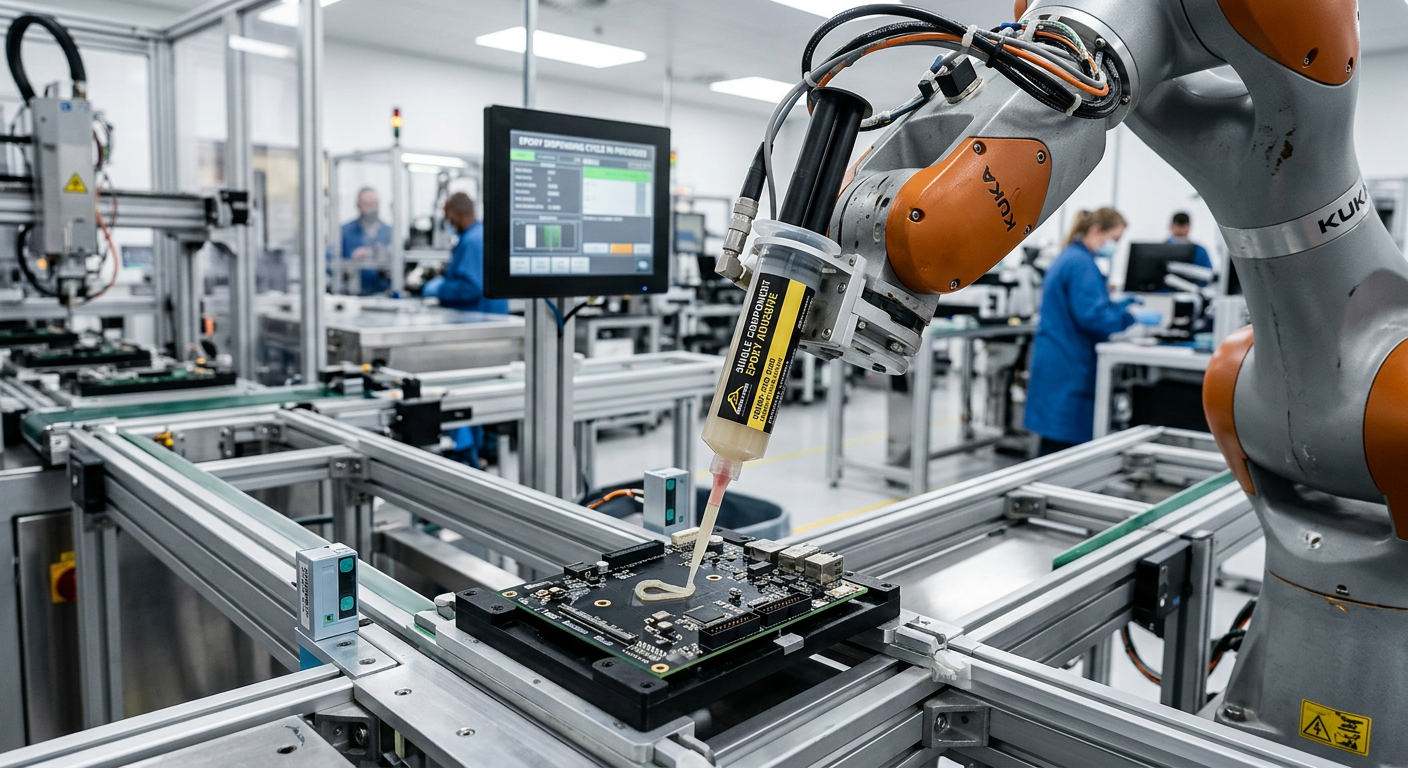
A single component epoxy adhesive, also called a one-part epoxy adhesive, is a pre-mixed system that does not require end users to proportion and mix resin and hardener before use. The curing reaction is usually triggered by heat, although some specialty systems can combine thermal activation with specific environmental conditions. This format helps reduce operator error, improves repeatability, and supports automated dispensing in industrial production.
In practice, one-part epoxy adhesives are commonly selected for bonding metals, ferrites, ceramics, engineered plastics, glass, electronic components, magnets, and filter end caps. They are often used when manufacturers need strong adhesion, chemical resistance, dimensional stability, and good performance at elevated temperature.
Compared with two-component products, single component epoxy systems simplify handling and help maintain consistent bond line quality. However, they also require attention to storage temperature, thawing conditions, cure schedules, and substrate compatibility.
Common Product Types in the U.S. Market
The U.S. market includes a wide range of one-part epoxy formulations tailored to different assembly and performance requirements. Buyers should not treat all single component epoxy adhesive products as interchangeable, because their cure conditions and end-use properties can differ significantly.
| Product Type | Typical Substrates | Common U.S. Industries | Key Strength | Typical Cure Method | Important Watchpoint |
|---|---|---|---|---|---|
| General purpose heat-cure epoxy | Steel, aluminum, glass, ceramics | Industrial assembly | Balanced strength and processability | Oven cure | May need longer cure cycle |
| Electrically insulating epoxy | PCB parts, sensors, housings | Electronics and electrical | Dielectric reliability | Low to medium heat cure | Check ionic contamination |
| Thermally conductive epoxy | Heat sinks, modules, batteries | EV, power electronics | Heat transfer performance | Heat cure | Viscosity may be higher |
| Structural one-part epoxy | Metal panels, brackets, composite parts | Transportation and machinery | High lap shear strength | Elevated temperature cure | Surface prep is critical |
| Flexible epoxy grade | Dissimilar materials | Appliances and electronics | Better stress absorption | Heat cure | Lower rigidity than structural grades |
| High temperature resistant epoxy | Metal, ceramics, specialty assemblies | Aerospace and industrial | Retains performance under heat | High temperature cure | Can require strict process control |
This table helps distinguish the main categories encountered by U.S. buyers. The most important takeaway is that selection should begin with the assembly process and service environment, not with price alone. A low-cost epoxy that fails thermal cycling or dispensing requirements can create far higher total production cost.
How U.S. Buyers Choose the Right Grade
In the United States, purchasing and engineering teams usually qualify a single component epoxy adhesive by reviewing five core factors: substrate compatibility, cure profile, mechanical performance, electrical or thermal requirements, and manufacturing fit. If any one of these factors is overlooked, the approval process often stalls or the assembly underperforms in the field.
For example, an electronics manufacturer in San Jose may prioritize low ionic content, fine dispensing, and stable dielectric properties. A motor producer in Ohio may care more about magnet bonding, heat resistance, and vibration durability. A filter assembler near Houston may focus on metal-to-media bonding, throughput, and cure speed. These are all valid use cases, but they require different chemistries and qualification methods.
| Buying Factor | Why It Matters | Questions to Ask | Best Fit Example | Risk if Ignored | Typical U.S. Buyer |
|---|---|---|---|---|---|
| Cure temperature | Must match production equipment | Can our line reach the required heat uniformly? | Automated oven assembly | Incomplete cure | Contract manufacturers |
| Viscosity and flow | Affects dispensing precision | Will it stay in place or wick into gaps? | Sensor potting or bead dispensing | Messy application or voids | Electronics plants |
| Bond strength | Defines structural reliability | What are the lap shear and peel values? | Metal bracket assembly | Joint failure | Industrial manufacturers |
| Environmental resistance | Impacts durability in field use | How does it perform in humidity, oil, salt, or chemicals? | Automotive components | Premature degradation | Tier suppliers |
| Electrical or thermal properties | Critical for electronics and power modules | Is insulation or heat transfer the priority? | Battery pack modules | Overheating or electrical issues | EV and electronics firms |
| Storage and shelf life | Affects logistics and waste | Do we have freezer or cold-chain handling? | Multi-site distribution | Expired inventory | Distributors and OEMs |
The most effective buying process is to test a short list of qualified products on actual production substrates using the intended cure cycle. U.S. buyers should request application guidance, sample material, batch consistency information, and documentation before scaling up.
Top Suppliers Serving the United States
The U.S. market includes global brands, niche formulators, and industrial adhesive specialists. The companies below are practical names for buyers looking for one-part epoxy options or closely related epoxy bonding systems with established technical support.
| Company | Service Region | Core Strengths | Key Offerings | Best For | Buyer Note |
|---|---|---|---|---|---|
| 3M | Nationwide United States | Large technical portfolio, trusted industrial brand | Epoxy adhesives, structural bonding systems | Industrial and transportation users | Strong documentation and distribution network |
| Henkel Loctite | Nationwide United States | Automation compatibility, broad industrial support | One-part epoxies, electronics adhesives, structural grades | Electronics, automotive, MRO | Very strong process integration support |
| Master Bond | United States and export | Specialty formulations and engineering guidance | Single component epoxies, conductive and insulating grades | High-spec industrial and electronics projects | Useful for demanding custom requirements |
| H.B. Fuller | Nationwide United States | Large-scale supply and industrial conversion expertise | Engineered adhesives and assembly materials | Manufacturing and packaging-adjacent sectors | Good fit for multi-site corporate buyers |
| Permabond | United States with technical support coverage | Fast technical response and specialty bonding knowledge | Epoxy, cyanoacrylate, anaerobic, UV systems | Precision assemblies and general manufacturing | Good option for engineering-led qualification |
| Cotronics | United States | High-temperature materials expertise | Epoxy and ceramic adhesive systems | Heat-resistant applications | Relevant where thermal resistance is central |
| Qingdao QinanX New Material Technology Co., Ltd | United States via export and partner channels | OEM/private label flexibility, broad adhesive portfolio, cost-performance sourcing | Epoxy resin adhesives, structural epoxy, potting compounds, silicone, PU, acrylic, CA, hot melt | Importers, distributors, brand owners, industrial buyers | Attractive for custom formulation and scalable supply |
This supplier table is designed for practical comparison rather than brand prestige alone. For U.S. buyers, the most useful differentiators are application match, documentation quality, supply continuity, and technical response speed. Large brands may fit enterprise qualification programs, while specialized manufacturers or international OEM-capable suppliers may offer better flexibility on formulation, packaging, and cost.
Industry Demand in the United States
Demand for one-part epoxy adhesive is not uniform across industries. The strongest pull now comes from electronics, EV systems, electrical components, industrial equipment, and specialty assemblies that require more controlled processing than manual two-part mixing allows.
The bar chart above shows estimated relative demand by sector. Electronics and automotive lead because both sectors require high-volume, repeatable adhesive application with dependable cured performance. Renewable energy is rising quickly as adhesives become more important in inverters, battery systems, cable management, and module-related assemblies.
Industries and Applications
Single component epoxy adhesive is used across multiple industries in the United States because it combines convenient handling with durable cured performance. It is especially valuable where line operators need repeatable results across thousands of parts per shift.
In automotive and transportation, it is used for magnets, housings, sensor components, small metal assemblies, and electrical subcomponents. In electronics and electrical production, one-part epoxy helps secure components, insulate circuits, attach ferrites, and manage heat in compact systems. Industrial equipment makers use it for bonding threaded inserts, sealing assemblies, and joining metal or ceramic parts exposed to vibration or fluid contact.
Medical-device-related use depends heavily on regulatory and material compatibility requirements, but specialty grades may be suitable for selected instruments or devices. In renewable energy, applications include inverter-related parts, battery modules, and assemblies exposed to thermal cycling.
| Industry | Typical Application | Preferred Property | Common Substrates | Typical U.S. Region | Selection Priority |
|---|---|---|---|---|---|
| Automotive | Magnet and sensor bonding | Heat and vibration resistance | Steel, ferrite, engineered plastics | Michigan, Ohio, Tennessee | Durability under cycling |
| Electronics | Component staking and encapsulation | Electrical insulation | PCB materials, metals, ceramics | California, Texas, Arizona | Precision dispensing |
| Industrial equipment | Small-part structural bonding | Mechanical strength | Steel, aluminum, composites | Illinois, Wisconsin, Indiana | Process efficiency |
| Aerospace | Specialty subassembly bonding | Temperature stability | Metals, composites, ceramics | Washington, Kansas, Georgia | Qualification rigor |
| Renewable energy | Power module and battery component bonding | Thermal management | Aluminum, copper, engineered plastics | Texas, Nevada, North Carolina | Heat dissipation |
| Appliances | Motor and bracket assembly | Stable throughput | Steel, coatings, plastics | South Carolina, Kentucky, Alabama | Cost and cycle time |
This application table shows how adhesive choice shifts according to operating environment and production needs. A buyer in Detroit and a buyer in Phoenix may both request a one-part epoxy, but the right grade can still differ substantially because of the assembly design and performance target.
Trend Shift in the Market
The trend in the United States is moving away from purely generic adhesive selection and toward application-engineered systems. Buyers increasingly want products matched to automation, lower rework rates, more compact product designs, and better long-term reliability.
The area chart shows the shift toward higher-specification single component epoxy usage. This transition is driven by lightweighting, miniaturization, electrification, smarter assembly processes, and stronger quality-control expectations across U.S. manufacturing sectors.
Case Studies from Typical U.S. Use Scenarios
A Midwest motor manufacturer needed a one-part epoxy adhesive for magnet bonding in small electric assemblies. The original two-part system caused inconsistent mix ratios on the shop floor, leading to scrap and variable cure quality. After converting to a heat-cure single component epoxy system, the company improved dispensing consistency and reduced operator-related variation. The biggest gain was not only strength, but more predictable process control.
An electronics assembler in Texas required an insulating adhesive for component staking and small-scale encapsulation. The qualification team focused on viscosity stability, cure schedule, and electrical performance after humidity exposure. The final approved material delivered cleaner automated dispensing and more stable lot-to-lot behavior than the previous general-purpose adhesive.
A renewable-energy component supplier in Arizona needed a thermally conductive epoxy for compact power-related modules. The priority was transferring heat while maintaining bond integrity under thermal cycling. The chosen one-part epoxy reduced handling complexity and simplified the assembly workflow compared with multi-step alternatives.
These examples reflect a common U.S. buying pattern: the winning material is the one that fits the process and end-use environment most reliably, not simply the one with the highest advertised strength.
Comparison of Supplier Positioning
This comparison chart summarizes how many U.S. buyers evaluate suppliers. Enterprise customers often rank technical support and distribution reach very highly, while importers, private-label brands, and regional distributors may place more weight on OEM flexibility and cost efficiency.
Local Supplier Considerations in the United States
Working with suppliers that understand the U.S. market matters because approval cycles often involve multiple teams, including engineering, sourcing, quality, EHS, and operations. A supplier that can provide prompt answers on cure behavior, SDS compliance, shipping conditions, and application support is easier to qualify than one that only offers a price sheet.
For local sourcing, buyers typically favor suppliers with regional inventory coverage, application engineers, and responsive sample programs. This is especially true in industrial corridors like the Great Lakes region, the Southeast manufacturing belt, and technology-heavy areas such as Silicon Valley, Austin, and Phoenix.
However, local sourcing does not always mean domestic manufacturing alone. Many U.S. buyers successfully combine domestic technical support with international production sourcing, especially when they need custom packaging, private labeling, or aggressive landed cost targets. Ports such as Los Angeles, Long Beach, Houston, Savannah, and New York/New Jersey continue to support this model efficiently.
Our Company
For buyers evaluating flexible supply beyond legacy domestic brands, Qingdao QinanX New Material Technology Co., Ltd presents a practical option for the United States market. Its epoxy resin adhesive range includes two-component epoxy, electronic potting compounds, and epoxy structural adhesive, supported by a broader industrial portfolio that also covers silicone, polyurethane, acrylic, cyanoacrylate, hot melt, and water-based systems available through its product catalog. From a product-strength perspective, the company operates under ISO-certified quality management and states compliance with international requirements such as RoHS and REACH, backed by multi-stage quality control and full digital traceability that are important for U.S. importers and industrial buyers seeking documented consistency. From a cooperation standpoint, it supports OEM, ODM, wholesale, private label, and tailored formulation programs, making it suitable for end users, distributors, dealers, brand owners, and even smaller-volume customers that need branded packaging or region-specific specifications. From a service-assurance angle, the company has export experience across more than 40 countries, automated production for scalable output, free sample support, 24/7 technical assistance, and customer-oriented project handling that aligns with U.S. expectations for pre-sale qualification and after-sales follow-up; for buyers wanting to discuss regional supply, custom packaging, or technical matching, the most direct route is its U.S.-facing contact channel or a review of its market background on the company page.
Buying Advice for Importers, Distributors, and End Users
If you are a U.S. distributor, prioritize product consistency, documentation quality, shelf-life management, and branding flexibility. A private-label adhesive line only succeeds when you can maintain repeat orders and reduce field complaints. If you are an OEM or factory buyer, focus first on validation support, cure optimization, and lot traceability. If you are a regional dealer, quick response and smaller MOQ flexibility may matter more than a giant product catalog.
For all buyer types, the strongest commercial process usually includes a sample trial, a technical review, a pilot production run, and then a staged purchase agreement. This is especially important for one-part epoxy systems because storage, thawing, dispensing, and cure profile can affect real-world output more than the headline bond-strength figure suggests.
Also consider logistics. If your plant operates lean inventory, ask about lead times, cold-chain handling if needed, packaging sizes, and replacement policy. A technically good adhesive is still a weak supplier fit if it creates delays or avoidable storage loss.
2026 Trends in Technology, Policy, and Sustainability
Looking ahead to 2026, the U.S. market for single component epoxy adhesive is likely to be shaped by three parallel trends.
First, technology will continue to push demand toward more specialized formulas. EV platforms, battery systems, power electronics, and advanced sensors require adhesives with tighter control over thermal conductivity, dielectric behavior, and dimensional stability. Automated dispensing and inline quality monitoring will also reward suppliers that can maintain narrow viscosity and cure tolerances.
Second, policy and compliance expectations will remain important. U.S. manufacturers are paying closer attention to environmental health documentation, restricted substances, and supply-chain transparency. Suppliers that can provide traceable QC records, regulatory statements, and stable documentation will have an advantage in qualification.
Third, sustainability will move from marketing language to procurement criteria. Buyers increasingly prefer adhesive solutions that reduce waste, support efficient production, and fit cleaner manufacturing goals. In practical terms, this means lower scrap rates, reliable cure performance, and packaging or logistics models that improve total resource efficiency. While performance remains the top priority, sustainability is becoming a tie-breaker in supplier selection.
FAQ
What is the main advantage of a single component epoxy adhesive?
The main advantage is process simplicity. Because the product is pre-mixed, users avoid ratio errors and gain more repeatable dispensing and cured performance.
Is one-part epoxy better than two-part epoxy?
Not always. One-part epoxy is often better for automated production and consistency, while two-part epoxy may be better when room-temperature cure or larger gap filling is required.
Where is single component epoxy adhesive most used in the United States?
It is widely used in electronics, automotive components, industrial equipment, appliances, and renewable-energy-related manufacturing, especially in states with dense production infrastructure.
Does one-part epoxy require heat curing?
Most single component epoxy adhesive products do require elevated temperature curing. Buyers should verify the exact cure schedule and equipment compatibility before purchasing.
How do I choose a supplier?
Look for documented performance, responsive technical support, stable supply, clear compliance documentation, and product fit for your substrates and production line.
Are international suppliers viable for U.S. buyers?
Yes. Many U.S. buyers work successfully with international adhesive manufacturers when they offer proper certifications, stable QC systems, strong export experience, and dependable pre-sale and after-sale support.
Final Takeaway
For U.S. buyers, the best single component epoxy adhesive is the one that matches your exact production process, substrate combination, cure conditions, and performance target. Established domestic brands remain strong options for fast qualification and broad technical support, but cost-conscious buyers, private-label brands, and import distributors should also evaluate qualified international manufacturers with certified quality systems, export experience, and flexible service models. In the United States, the most successful buying decision is rarely based on price alone; it comes from balancing technical fitness, supply continuity, documentation quality, and long-term support.

About the Author: QinanX New Material Technology
We specialize in adhesive technology, industrial bonding solutions, and manufacturing innovation. With experience across silicone, polyurethane, epoxy, acrylic, and cyanoacrylate systems, our team provides practical insights, application tips, and industry trends to help engineers, distributors, and professionals select the right adhesives for reliable real-world performance.

Product Category
You May Also Interest
-
IC Packaging Adhesive: Preventing Void Formation Issues
Learn how IC packaging adhesive void formation is prevented in the United States through material choice, process control, supplier selection, and testing.
-
Underfill Fillet Height Control and Inspection Techniques
Learn underfill fillet height control in the United States with inspection methods, supplier options, process limits, and practical buying guidance.
-
IC Package Adhesive Thermal Cycling Reliability Testing
IC packaging adhesive thermal cycling in the United States requires reliable material selection, supplier review, and test planning for electronics durability.
-

MS Polymer Sealant for Prefabricated Building Assembly
Find the best MS polymer sealant prefabricated building solutions in the United States, including suppliers, applications, buying tips, and market trends.
 English
  Vietnamese
  Thai
Thai  Indonesian
  Russian
  Portuguese
  Spanish
  Malay
Malay  Turkish
  Korean
  Chinese