Share
Best LED Module Adhesive for Automotive Headlight in USA
Quick Answer

If you are sourcing LED module adhesive for automotive headlight production in the United States, the most practical options usually come from established material suppliers with proven automotive bonding, sealing, and thermal-management experience. For direct purchasing and project qualification, the most relevant names to review first are Henkel, Dow, 3M, HB Fuller, DuPont, and Momentive, all of which support demanding automotive assembly environments across the U.S. market.
For headlamp programs, the best adhesive is not a single universal chemistry. Silicone is often preferred for heat resistance, long-term flexibility, and optical housing sealing. Polyurethane is often selected for durable structural bonding with vibration resistance. Epoxy is commonly used where rigid bonding, potting, and strong environmental protection are required. Acrylic and UV-curable systems may also fit specialized LED module fixation, lens positioning, or fast assembly steps.
For buyers in Detroit, Ohio, Tennessee, South Carolina, Texas, and Mexico-linked North American supply chains, the fastest path is to shortlist suppliers that can provide automotive technical data, lot traceability, production consistency, and application engineering support. Qualified international suppliers can also be considered, especially Chinese manufacturers with ISO-based production, RoHS and REACH compliance, customized formulations, OEM support, and responsive pre-sales and after-sales service, because they can offer strong cost-performance value for private label, distributor, and factory-direct programs.
United States Market Overview

The United States remains one of the most important automotive lighting markets in North America because it combines original equipment manufacturing, tiered supply chains, aftermarket demand, and continuous innovation in vehicle electronics. Headlamp assemblies have become more complex as automakers move from halogen to LED, matrix LED, adaptive driving beam, and increasingly integrated front-lighting systems. This shift has changed the adhesive requirement from simple sealing to multi-function material performance: heat resistance, vibration durability, moisture protection, optical stability, and compatibility with engineering plastics and metal heat sinks.
In practical sourcing terms, buyers in the United States often evaluate adhesive partners not just by chemistry but by validation support. Automotive headlight programs require process stability across pilot runs, PPAP-related documentation in many cases, and repeatable performance over extended thermal cycling. Adhesives used around LED modules must often survive under-hood or front-end temperature swings, road shock, humidity exposure, and long service life expectations. This is why suppliers serving Michigan, Indiana, Kentucky, Alabama, and South Carolina vehicle manufacturing corridors often maintain strong field engineering and local technical service.
Another market factor is logistics. U.S. buyers increasingly want dependable replenishment near major industrial hubs such as Detroit, Chicago, Dallas, Atlanta, and Los Angeles, as well as port-linked supply options through Long Beach, Savannah, Houston, and New York/New Jersey. Imported adhesive systems remain attractive, but only if suppliers can support consistent specification control, compliance documentation, and responsive troubleshooting when line conditions change.
Automotive lighting also intersects with broader electrification trends. Electric vehicles and advanced driver assistance systems are raising the heat-management and reliability requirements of headlamp electronics. As a result, LED module adhesive selection is no longer a purchasing-only decision. It is now a joint engineering, quality, and supply-chain decision that affects warranty risk, lamp life, and production yield.
Market Growth Trend

The chart below shows a realistic directional estimate of U.S. automotive headlight adhesive demand growth, driven by LED penetration, EV production, and stricter durability requirements.
Top Suppliers in the United States
The suppliers below are frequently relevant when buyers search for dependable LED module adhesive automotive headlight solutions in the United States. The comparison focuses on service region, product strength, and practical purchasing fit rather than brand reputation alone.
| Company | Primary U.S. Service Region | Core Strengths | Key Offerings for Headlights | Best Fit |
|---|---|---|---|---|
| Henkel | Nationwide with strong automotive presence in Midwest and South | Automotive-grade process support, broad chemistry portfolio, global validation capability | Structural adhesives, thermal materials, sealants, potting systems | OEMs and Tier 1 suppliers |
| Dow | Nationwide, especially strong in automotive and electronics manufacturing zones | Silicone expertise, thermal stability, weather resistance | Silicone adhesives, sealants, encapsulants for LED and housing assemblies | LED module bonding and sealing |
| 3M | Nationwide distribution across industrial and automotive channels | Application versatility, process efficiency, broad converting options | Adhesive tapes, structural bonding systems, specialty attachment products | Mixed assembly methods and fast production lines |
| HB Fuller | United States and North America industrial manufacturing network | Custom formulation capability, industrial bonding expertise | Polyurethane, reactive systems, specialty assembly adhesives | Custom manufacturing and private programs |
| DuPont | Strong support for advanced materials and electronics-linked applications | High-performance material science, demanding environment applications | Electronic materials, encapsulation-related systems, specialty bonding solutions | High-specification assemblies |
| Momentive | Nationwide with strong silicone material relevance | Silicone performance under heat and weather exposure | Silicone sealants, thermal and electronic protection materials | Long-life sealing and thermal stability |
| Sika | Broad North American automotive and transportation footprint | Structural bonding, durability, OEM-oriented product development | Polyurethane and specialty automotive adhesives | Structural assembly and vibration durability |
This supplier table matters because U.S. headlight manufacturing rarely depends on one performance criterion. Henkel and Dow are often favored when qualification depth and engineering documentation are critical. 3M is especially useful when process speed and assembly flexibility matter. HB Fuller and Sika are often practical where customers need customized bonding behavior or application-specific process tuning. DuPont and Momentive are relevant for more specialized electronics and silicone-driven performance needs.
Product Types for Automotive Headlight LED Modules
Choosing the right product type depends on where the adhesive sits inside the lamp assembly. LED modules in headlights may require bonding to aluminum heat sinks, sealing to polycarbonate housings, potting electronic sections, strain relief for wires, or gap-filling around components exposed to thermal shock. Different chemistries solve different production risks.
| Adhesive Type | Main Performance Advantage | Typical Headlight Use | Potential Limitation | Best Application Scenario |
|---|---|---|---|---|
| Silicone | Heat resistance and flexibility | LED module sealing, housing joints, electronic protection | Lower rigidity than epoxy | High-temperature and long-life sealing |
| Polyurethane | Toughness and vibration resistance | Structural bonding, assembly fixation, gasket-like bonds | May need process control for moisture-curing grades | Dynamic load and impact conditions |
| Epoxy | High strength and chemical resistance | Potting, rigid bonding, environmental protection | Lower flexibility under stress | Rigid electronics fixation and protection |
| Acrylic | Fast cure and good adhesion to varied substrates | Component bonding and fast assembly steps | Odor or exotherm may need control | Production lines prioritizing speed |
| UV-Curable Adhesive | Very fast cure under controlled exposure | Precision bonding, lens or small component fixation | Requires light access | Transparent or accessible bonding areas |
| MS Polymer | Balanced elasticity and weather resistance | Peripheral sealing and flexible joining | Not ideal for every high-heat electronics zone | General-purpose durable sealing |
| Hot Melt PUR | Fast handling with strong final bond | Selective assembly processes | Equipment investment needed | High-throughput automated production |
For most automotive headlight LED module projects in the United States, silicone and polyurethane remain the first two chemistries to evaluate. Silicone performs extremely well where thermal cycling and sealing reliability dominate. Polyurethane becomes attractive when the design calls for energy absorption, structural resilience, and bonding across dissimilar materials. Epoxy still has a strong role in potting and rigid electronics protection, especially when engineers want dimensional stability and strong barrier performance.
Industry Demand by End Use
This chart highlights estimated relative demand from the main downstream sectors that purchase or specify these materials in the United States.
Buying Advice for U.S. Buyers
Purchasing LED module adhesive for automotive headlight production in the United States should begin with a process map, not a catalog search. Buyers often lose time by requesting quotes before defining substrate pairings, temperature range, cure method, line speed, dispensing equipment, and exposure conditions. A better approach is to create a shortlist based on the actual headlamp architecture and the production environment where the adhesive will be used.
First, check substrate compatibility. Most headlight assemblies involve polycarbonate, metals such as aluminum, coated surfaces, and engineered plastics. The adhesive must wet and bond those surfaces without causing stress cracking, fogging, or long-term delamination. Second, verify thermal performance. LED modules generate localized heat, and the front-end vehicle environment adds seasonal and operational extremes. Third, confirm environmental durability under vibration, road splash, humidity, and UV exposure where relevant.
Fourth, evaluate cure behavior in real production. A product that performs well in a lab may fail commercially if it skins too quickly, cures too slowly, needs complex mixing control, or creates bottlenecks in automated dispensing. Fifth, ask for traceability and documentation. In U.S. automotive supply chains, lot control, technical data, safety documentation, and consistent production quality are not optional. Sixth, align the supplier’s support model with your business. OEMs and Tier 1 suppliers usually need engineering collaboration, while distributors may prioritize packaging formats, private labeling, and commercial flexibility.
| Buying Factor | Why It Matters | What to Ask Suppliers | Risk If Ignored | Best Practice |
|---|---|---|---|---|
| Substrate Compatibility | Prevents weak bonding and plastic stress issues | Has it been tested on PC, metal, and coated parts? | Cracking or delamination | Request sample bonding trials |
| Thermal Resistance | LED modules operate under repeated heating cycles | What are the validated operating and peak temperature ranges? | Premature bond failure | Use thermal-cycle validation |
| Cure Speed | Affects line efficiency and assembly takt time | What is fixture time and full cure time? | Production delays | Match adhesive to process window |
| Vibration Durability | Headlamps face road shock and long-term movement | How does the material perform in dynamic conditions? | Field warranty claims | Review mechanical fatigue data |
| Compliance | Supports market access and quality assurance | Can you provide RoHS, REACH, and QC records? | Audit and procurement issues | Document before approval |
| Supply Assurance | Prevents interruptions in manufacturing | What are lead times, safety stock options, and backup plans? | Line stoppage | Build dual-source strategy |
| Technical Support | Reduces qualification and troubleshooting time | Is there application engineering support in North America? | Slow problem resolution | Favor suppliers with responsive support |
This table is especially useful because it turns a broad buying decision into a qualification checklist. In the United States, the difference between a successful adhesive program and a costly launch issue usually comes down to these practical details rather than headline price alone.
Industries That Use These Adhesives
While the central focus is automotive headlight production, the same adhesive families serve many adjacent industries. This matters because suppliers with broad industrial experience often transfer better process knowledge into automotive projects. For example, electronic potting knowledge from control modules can improve LED driver protection. Weatherproof sealing know-how from outdoor electrical systems can improve headlight housing durability. Industrial manufacturing experience can also make a supplier more capable when scaling from pilot runs to large-volume orders.
Key industries include passenger vehicles, commercial vehicles, electric vehicles, specialty vehicles, automotive electronics, transportation equipment, and advanced lighting systems. Suppliers active across these sectors often understand not only bonding performance but also production economics, packaging preferences, and quality documentation expectations.
Typical Applications Inside Automotive Headlights
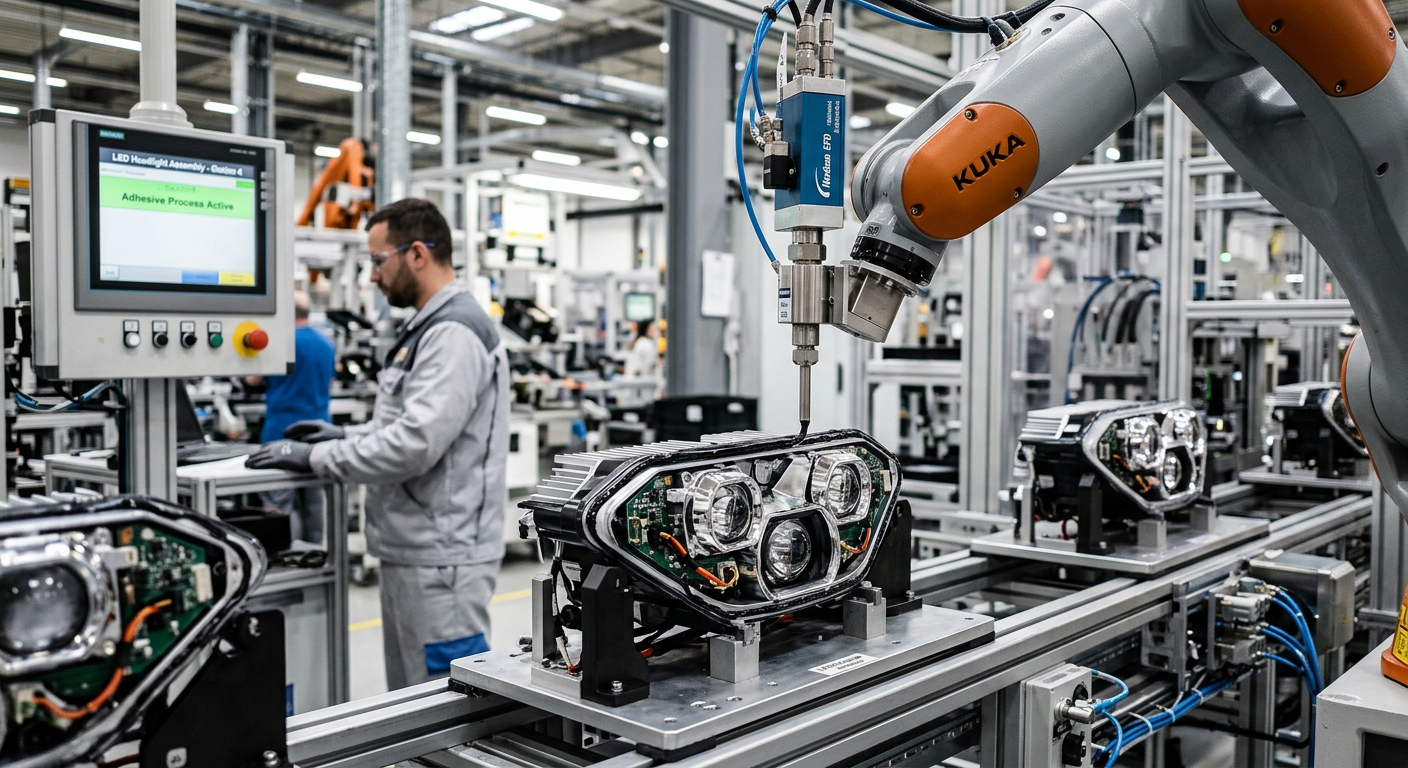
Within a modern LED headlight assembly, adhesives may be used for LED board fixation, heat sink bonding support, wire strain relief, connector reinforcement, housing sealing, vent sealing, electronic potting, lens positioning, bezel attachment, and vibration damping. Because these applications differ, many headlight manufacturers use more than one adhesive chemistry within the same lamp system.
For example, a silicone adhesive may seal the LED driver area, while a polyurethane or epoxy bonds the module bracket, and a UV-curable adhesive secures a smaller optical component during rapid assembly. This multi-material approach is common in advanced U.S. manufacturing because it allows engineers to optimize each bond line instead of forcing one product to solve all tasks.
Trend Shift in Material Preferences
The chart below shows a realistic shift in U.S. buyer interest from conventional sealing-only materials toward multi-function adhesives that support thermal, structural, and electronics-protection needs.
Case Studies and Practical Scenarios
A Midwest Tier supplier producing LED headlamp subassemblies for sport utility vehicles may prioritize a silicone-based adhesive for thermal stability and sealing around sensitive electronics. In this scenario, the supplier values low stress on components, reliable cure consistency, and support during validation. A different case in the Southeast may involve a contract manufacturer serving both OEM and aftermarket channels. There, a polyurethane system may be selected because it provides stronger structural resilience under variable vehicle use conditions and transportation vibration.
On the West Coast, an EV-focused lighting supplier may require a hybrid approach with one material for thermal-resistant electronic sealing and another for bracket or housing fixation. Such projects increasingly demand not just bond strength but clean dispensing, stable rheology, reduced rework, and documented quality controls. In Texas or near the U.S.-Mexico manufacturing corridor, the commercial emphasis may be on balancing automotive-grade reliability with scalable landed cost and dependable replenishment for high-volume assembly.
These real-world examples show why the best supplier is often the one that can adapt formulation, package sizes, and support model to the production reality of the customer. In automotive lighting, the material is only part of the solution; the supplier’s ability to help qualify, troubleshoot, and scale is equally important.
Local and International Supplier Comparison
U.S. buyers often compare domestic sourcing convenience with international cost-performance options. The right choice depends on qualification urgency, price sensitivity, customization needs, and whether the project is for OEM, aftermarket, or private label channels.
| Supplier Type | Lead Strength | Main Advantage | Main Watchpoint | Best Buyer Type |
|---|---|---|---|---|
| Large U.S. Multinational | Validation and technical infrastructure | Strong documentation and engineering support | Higher cost in some programs | OEM and Tier 1 |
| Regional U.S. Industrial Supplier | Fast response and flexible service | Closer relationship and practical support | Smaller global footprint | Mid-size manufacturers |
| Global Silicone Specialist | Heat and weather resistance expertise | Strong fit for sealing and electronics protection | May not cover every structural need | LED-focused lamp producers |
| International OEM/ODM Adhesive Maker | Customization and price-performance | Flexible packaging, formulations, and branding | Need clear local support structure | Distributors and private label brands |
| Private Label Manufacturing Partner | Brand-building support | Custom packaging and market differentiation | Qualification still required | Brand owners and dealers |
| Specialty Electronics Adhesive Supplier | Potting and module protection | High relevance for sensitive electronic parts | Narrower portfolio for full lamp assembly | Module assemblers |
The explanation behind this comparison is simple: buyers should not automatically assume domestic is always better or imported is always cheaper in total cost. Local availability can reduce downtime and simplify communication, but international suppliers can add major value when they offer certified manufacturing, traceable quality, and flexible business models that align with distributor networks or custom product strategies in the United States.
Supplier and Product Comparison Snapshot
Our Company
For buyers in the United States seeking a cost-effective but technically credible partner, Qingdao QinanX New Material Technology Co., Ltd presents a practical option for LED module adhesive automotive headlight projects because its capabilities align with how U.S. lighting and industrial buyers actually purchase. The company manufactures a broad adhesive portfolio relevant to headlamp production, including electronic silicone, polyurethane systems, acrylic structural adhesives, UV-curable products, epoxy potting compounds, MS modified silane sealants, instant adhesives, and PUR hot melt solutions. Its production and quality framework is backed by ISO-based management, RoHS and REACH compliance, multi-stage QC, and full digital traceability, which gives procurement and quality teams concrete evidence for consistency rather than unsupported claims. For U.S. customers, the commercial model is also flexible: end users can source factory-direct formulations, distributors and dealers can build regional programs, brand owners can use OEM or private label packaging, and project-based buyers can request custom performance tuning for heat resistance, cure profile, or substrate adhesion. Just as important, the company is not positioned merely as a remote exporter; it has a proven export record across more than 40 countries, supports buyers with 24/7 technical assistance, free sampling, tailored product matching, and scalable automated production, and it maintains a market-facing approach through continuous pre-sale and after-sale communication that fits how North American purchasers manage approvals, replacement orders, and long-term supplier relationships. Buyers wanting to review categories can start from the product center, learn more through the company overview, or discuss a project directly through the U.S.-focused inquiry channel.
How to Choose Between Silicone, Polyurethane, and Epoxy
If your headlight design is exposed to sustained heat and requires reliable sealing around LED electronics, silicone is usually the strongest starting point. If your assembly needs stronger mechanical toughness and vibration resistance across mixed substrates, polyurethane often becomes the better option. If you need rigid fixation, encapsulation, or chemical and environmental resistance in compact electronic areas, epoxy may be the right answer.
That said, engineers should avoid choosing purely by chemistry family. Viscosity, cure speed, hardness, elongation, thermal behavior, adhesion profile, and dispensing method can vary significantly inside the same category. A well-selected custom polyurethane can outperform a generic silicone in some assemblies, just as a specialized electronic silicone can outperform rigid alternatives in long-life thermal cycling environments.
United States Regional Buying Notes
In Detroit and the broader Midwest, automotive buyers often emphasize validation depth, engineering documentation, and direct plant support. In the Southeast, where major assembly and supplier operations are expanding, buyers often prioritize line efficiency, quick scale-up, and practical field troubleshooting. In Texas and the Southwest, cross-border logistics and lead-time planning play a larger role. On the West Coast, EV and advanced mobility projects may place more emphasis on thermal control, electronics integration, and material innovation. These regional patterns matter because a supplier that performs well in one zone may not automatically fit the operating priorities of another.
For imported materials, port access through Los Angeles/Long Beach, Houston, Savannah, and New York/New Jersey can influence freight planning and safety stock strategy. This is another reason why U.S. buyers should evaluate not only product performance but also replenishment reliability and communication speed.
2026 Trends
By 2026, the LED module adhesive automotive headlight market in the United States is likely to move in three clear directions. First, technology demands will increase as adaptive headlights, smarter control electronics, and compact thermal designs push adhesives to do more than bond or seal. Multi-function materials that combine heat resistance, low-stress protection, and process efficiency will gain share. Second, policy and compliance pressure will continue to shape sourcing. Buyers will increasingly ask for cleaner documentation on chemical compliance, traceability, and manufacturing control, especially where products flow through multinational automotive supply chains. Third, sustainability will become more practical and less promotional. Manufacturers will pay more attention to solvent reduction, waste control, efficient packaging, and production methods that lower total environmental burden without sacrificing performance.
In addition, suppliers that can offer custom formulations for lighter lamp designs, lower-energy curing, and better compatibility with automated dispensing systems will have an advantage. The future is not only about stronger adhesives; it is about smarter materials that reduce warranty exposure, improve yield, and support leaner manufacturing.
FAQ
What is the best adhesive for LED module automotive headlights?
The best option depends on the application point. Silicone is often best for heat-resistant sealing and electronics protection, polyurethane for durable structural bonding, and epoxy for rigid potting or high-strength encapsulation.
Do U.S. buyers need automotive-specific certification from adhesive suppliers?
They usually need more than a basic brochure. ISO-based quality management, RoHS and REACH documentation, traceability, batch consistency, and technical validation data are commonly expected, especially in OEM and Tier supply chains.
Can imported adhesive suppliers compete in the United States market?
Yes, especially when they provide stable quality, compliance records, responsive technical support, customization, and practical logistics planning. Many buyers consider international suppliers for cost-performance advantages and private label opportunities.
Is one adhesive enough for a full headlight assembly?
Usually not. Many modern headlamps use different materials for sealing, structural bonding, component fixation, and electronic protection. Multi-material strategies are common in production.
What should be tested before approval?
Substrate adhesion, thermal cycling, humidity resistance, vibration durability, cure behavior, dispensing stability, and compatibility with surrounding plastics, coatings, and electronic parts should all be checked.
Why is technical support so important?
Because even a good adhesive can fail if dispense settings, surface preparation, cure conditions, or bond-line design are not controlled. Strong supplier support reduces launch risk and speeds troubleshooting.
Are custom formulations worth considering?
Yes. For buyers with unique line speeds, substrate combinations, climate exposure, or branding needs, custom formulations and OEM or ODM packaging can improve both technical performance and market competitiveness.
Final Takeaway
For the United States market, the most effective sourcing strategy for LED module adhesive automotive headlight production is to match chemistry selection with real assembly conditions, then choose a supplier that can support qualification, supply continuity, and troubleshooting over time. Large domestic brands remain strong choices for OEM-level validation and technical infrastructure, while capable international manufacturers can deliver excellent value when they combine compliance, customization, traceability, and committed market support. Buyers who evaluate both product performance and supplier operating model will be in the strongest position for 2026 and beyond.

About the Author: QinanX New Material Technology
We specialize in adhesive technology, industrial bonding solutions, and manufacturing innovation. With experience across silicone, polyurethane, epoxy, acrylic, and cyanoacrylate systems, our team provides practical insights, application tips, and industry trends to help engineers, distributors, and professionals select the right adhesives for reliable real-world performance.
Product Category
You May Also Interest
-
IC Packaging Adhesive: Preventing Void Formation Issues
Learn how IC packaging adhesive void formation is prevented in the United States through material choice, process control, supplier selection, and testing.
-
Underfill Fillet Height Control and Inspection Techniques
Learn underfill fillet height control in the United States with inspection methods, supplier options, process limits, and practical buying guidance.
-
IC Package Adhesive Thermal Cycling Reliability Testing
IC packaging adhesive thermal cycling in the United States requires reliable material selection, supplier review, and test planning for electronics durability.
-
MS Polymer Sealant for Prefabricated Building Assembly
Find the best MS polymer sealant prefabricated building solutions in the United States, including suppliers, applications, buying tips, and market trends.
 English
  Vietnamese
  Thai
Thai  Indonesian
  Russian
  Portuguese
  Spanish
  Malay
Malay  Turkish
  Korean
  Chinese