Share
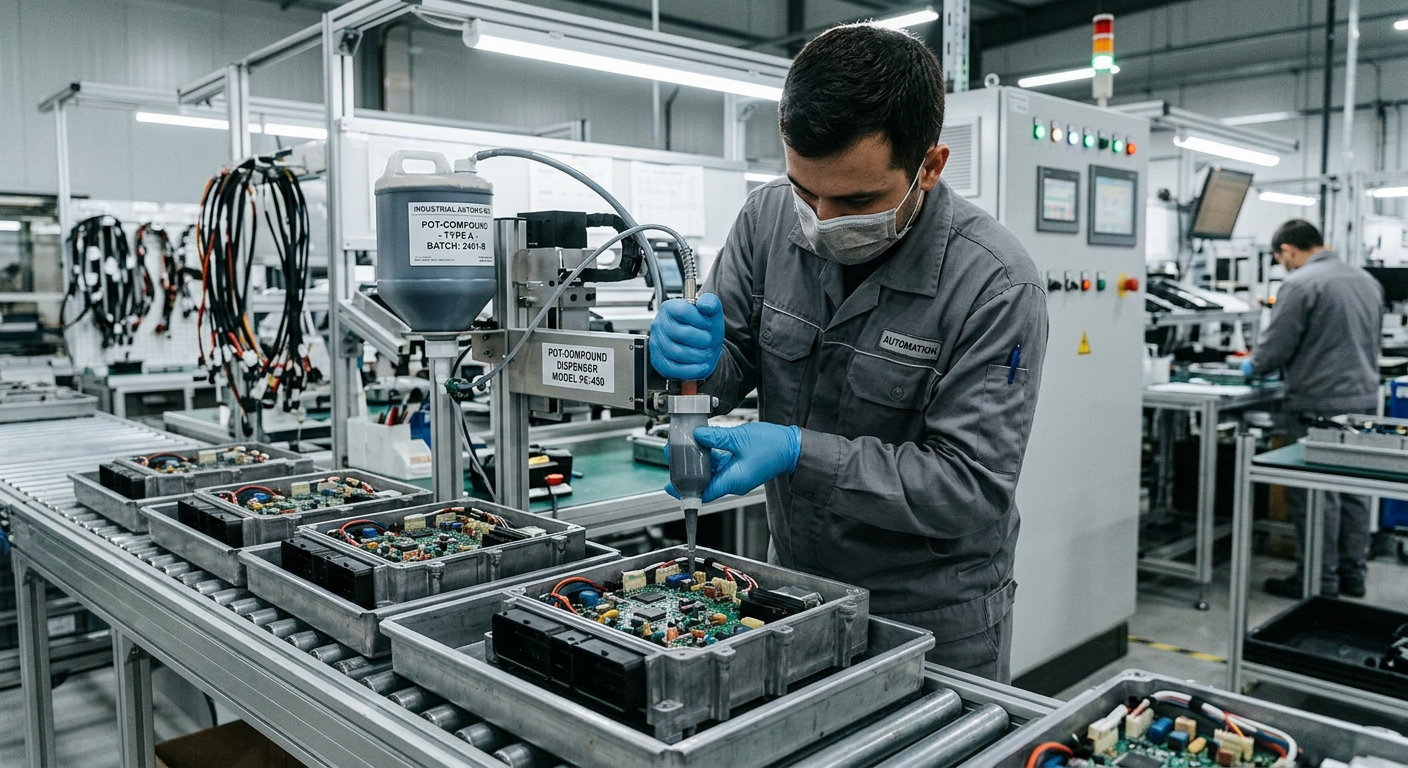
Potting Compound Industrial Automation in the United States
Quick Answer

If you are sourcing potting compound industrial automation materials for control units in the United States, the most practical approach is to shortlist suppliers that combine electrical insulation performance, thermal management, UL-aware formulation support, and stable supply for panel builders, OEMs, and maintenance teams. For buyers serving factories in Chicago, Houston, Detroit, Atlanta, Los Angeles, and other industrial hubs, commonly considered suppliers include Henkel, 3M, Huntsman, Dow, Master Bond, and MG Chemicals, depending on whether the priority is epoxy, polyurethane, or silicone chemistry.
For fast decision-making, Henkel is often chosen for broad industrial support and established electronics materials; 3M is strong in reliability-focused electrical protection; Dow is widely considered where silicone flexibility and temperature cycling matter; Huntsman is a familiar option for engineered epoxy systems; Master Bond is useful for more specialized technical requirements; and MG Chemicals is often practical for electronics assembly and maintenance channels across the United States. Qualified international suppliers can also be worth considering, especially when they offer RoHS and REACH compliance, documented quality systems, responsive pre-sales and after-sales support, and clear customization capability. In that context, cost-performance-focused manufacturers from China can be a competitive option for U.S. buyers who want tailored formulations and private-label or OEM supply without sacrificing traceability and technical assistance.
United States Market Overview

The U.S. market for potting compounds used in industrial automation is supported by a broad installed base of PLC cabinets, variable frequency drives, sensor modules, power supplies, relay assemblies, industrial gateways, and edge control hardware. Demand is concentrated around manufacturing belts and logistics corridors such as the Midwest, the Gulf Coast, the Southeast, and the West Coast. Regions linked to automotive production, food processing, warehouse automation, semiconductor manufacturing, renewable energy integration, and oil and gas controls all contribute to steady consumption.
In practical terms, buyers in the United States do not purchase a potting compound only as a raw material. They purchase risk reduction. Potting must help protect against vibration, dust ingress, washdown conditions, thermal shock, humidity, and dielectric failure. For control units installed near motors, conveyors, robotic arms, compressors, or outdoor power enclosures, the compound also affects service life, rework strategy, and warranty exposure. This is why specification teams often evaluate not only resin chemistry but also viscosity, cure speed, exotherm, hardness, adhesion to metals and plastics, and long-term electrical stability.
Another important U.S. market feature is the diversity of production scales. Large OEMs may require custom-filled formulations in drums or pails integrated into automated dispensing systems, while contract manufacturers and local panel shops may prefer cartridges, kits, or smaller containers for batch work. In port-connected markets such as Long Beach, Savannah, Houston, New York/New Jersey, and Seattle/Tacoma, availability and lead time often influence supplier decisions as much as technical performance.
Market Growth Trend

The chart below illustrates a realistic demand growth pattern for industrial automation potting materials in the United States, reflecting continued upgrades in machine control, electrification, and distributed industrial electronics.
Common Product Types
The main product categories for industrial automation potting in the United States are epoxy, polyurethane, and silicone. Each has a different performance profile and buying logic.
Epoxy potting compounds are widely used where high mechanical strength, strong adhesion, chemical resistance, and durable electrical insulation are needed. They are common in power modules, transformers, industrial control boards, and sensor electronics that are not expected to require frequent rework. Polyurethane systems are often selected where flexibility, lower stress on components, and good resistance to moisture and thermal cycling are important. Silicone potting materials are usually preferred in high-temperature environments or applications facing repeated expansion and contraction, especially in outdoor or vibration-prone installations.
| Product Type | Typical Strength | Limitations | Best U.S. Use Cases | Common Packaging | Buyer Notes |
|---|---|---|---|---|---|
| Epoxy | High strength and dielectric stability | Can be rigid and harder to rework | Power supplies, drives, encapsulated boards | Kits, pails, drums | Good for harsh industrial indoor duty |
| Polyurethane | Flexible and moisture resistant | May have lower heat tolerance than silicone | Sensors, connectors, vibration-prone modules | Cartridges, kits, bulk | Useful where impact and thermal cycling matter |
| Silicone | Excellent temperature and weather resistance | Usually lower structural strength than epoxy | Outdoor controls, high-heat electronics | Tubes, cartridges, pails | Strong option for long-term flexibility |
| Filled Epoxy | Improved thermal conductivity | Higher viscosity may complicate dispensing | Power electronics and heat-generating units | Meter-mix bulk packs | Check filler settling and pump compatibility |
| Low-Viscosity Resin | Good penetration around small components | May require stricter leak control | Dense PCB assemblies and compact controls | Dual cartridges, kits | Useful for tight clearances and void reduction |
| Flame-Retardant Grade | Safer performance in electrical assemblies | Can affect cure profile and cost | Safety-critical control units and enclosures | Bulk and kit formats | Review relevant test data before approval |
The table above matters because U.S. buyers often make a chemistry decision too early. In practice, the right choice depends on thermal load, enclosure design, expected repair policy, and production method. A rigid epoxy may outperform a soft material in shock protection but underperform if the assembly sees frequent thermal expansion. Likewise, a silicone that survives temperature cycling may not deliver the same physical support as an engineered epoxy.
Industry Demand Comparison
Demand is not evenly spread across industries. Automation-heavy sectors typically consume more encapsulation materials because they install more protected electronics in dusty, wet, high-vibration, or temperature-variable conditions.
Buying Criteria for U.S. Control Units
For U.S. industrial automation buyers, the decision framework usually includes performance, compliance, process fit, supply stability, and service response. Material selection should begin with the actual failure mode you are trying to prevent. If the primary risk is moisture ingress in a washdown environment, the optimal compound may differ from a formulation designed mainly for thermal dissipation inside a motor control cabinet.
Buyers should also confirm whether the compound works with the chosen dispensing method. Manual batching, dual-cartridge dispensing, and automated meter-mix systems all create different requirements for pot life, viscosity, cure speed, and filler behavior. Another common point is substrate compatibility. Potting compounds may contact aluminum heat sinks, steel housings, polycarbonate covers, cable jackets, connector shells, and coated PCBs. Adhesion and stress across these materials can influence long-term reliability.
In the U.S. market, logistics and support are equally important. A technically strong product with slow lead times or inconsistent lot-to-lot behavior can create more production risk than a slightly less optimized compound supported by local inventory and fast engineering response. That is why buyers often prefer suppliers with warehouse access, application guidance, and technical documentation aligned with production validation needs.
| Buying Factor | Why It Matters | What to Check | Risk if Ignored | Best For | Practical U.S. Tip |
|---|---|---|---|---|---|
| Dielectric Strength | Protects circuits and prevents arcing | Electrical test data and aging performance | Field failures and warranty returns | Power control assemblies | Request data under humidity exposure |
| Thermal Conductivity | Helps dissipate heat from components | Filled grades and heat path design | Overheating and shortened life | Drives and power modules | Match resin to enclosure airflow limits |
| Viscosity | Affects void filling and dispensing speed | Flow behavior at production temperature | Air pockets and incomplete fill | Dense electronics | Trial at actual plant conditions |
| Cure Profile | Controls takt time and exotherm | Pot life, gel time, full cure timing | Process bottlenecks or component stress | Automated lines | Validate for summer and winter shifts |
| Reworkability | Impacts service strategy | Hardness and removal difficulty | Expensive repairs or scrap | Serviceable modules | Choose softer systems for field repair needs |
| Compliance | Supports market access and customer approval | RoHS, REACH, safety-related documentation | Qualification delays | OEM and export products | Keep documents aligned with customer files |
This checklist is useful because many failures in industrial automation are not caused by the wrong resin family but by an incomplete validation process. A product that looks suitable on a datasheet may fail when dispensed into a deep cavity, cured during a hot summer week in Texas, or paired with a plastic enclosure that expands differently under heat.
Applications Across U.S. Industries
Industrial automation potting compounds are used in a broad range of applications. In automotive manufacturing plants around Michigan, Ohio, Tennessee, and Alabama, they protect sensor modules, connector backshells, and embedded electronics in robotic cells and conveyor systems. In food and beverage facilities across Wisconsin, California, and Georgia, they help seal electronics exposed to washdown cycles, humidity, and cleaning chemicals. In oil and gas environments near Houston and along the Gulf Coast, potted assemblies support control reliability under vibration and challenging field conditions.
Warehouse automation is another growth area. Distribution centers near Dallas, Inland Empire, Atlanta, and New Jersey depend on scanners, motor drives, controllers, and communication nodes that must perform reliably through continuous operating cycles. Renewable energy installations, especially solar and battery storage sites in Texas, Arizona, and California, also increase demand for compounds that combine insulation, weather resistance, and thermal stability.
| Industry | Main Equipment | Typical Potting Need | Preferred Chemistry | Service Region | Key Concern |
|---|---|---|---|---|---|
| Automotive Manufacturing | Robots, sensors, drives | Vibration and dust protection | Epoxy or polyurethane | Midwest and Southeast | Long duty cycles |
| Food Processing | Control boxes, washdown sensors | Moisture sealing | Polyurethane or silicone | California, Wisconsin, Georgia | Cleaning chemical exposure |
| Oil and Gas | Field controls, junction electronics | Mechanical protection | Epoxy | Texas and Gulf Coast | Harsh operating conditions |
| Warehouse Automation | Sorters, scanners, drive modules | Shock and cycle durability | Polyurethane | Texas, Georgia, New Jersey | High uptime expectations |
| Renewable Energy | Inverters, combiner electronics | Heat and weather resistance | Silicone or filled epoxy | Texas, Arizona, California | Outdoor exposure |
| Water Treatment | Monitoring and pump controls | Humidity and corrosion defense | Polyurethane or epoxy | Nationwide municipal markets | Long service intervals |
The table shows how industry context shapes product selection. A buyer sourcing for a solar inverter monitoring box in Arizona will likely prioritize UV-adjacent environmental durability and heat behavior, while a buyer for an indoor PLC interface board in Ohio may focus more on dielectric insulation and production cost.
Trend Shift in Material Preference
The U.S. market is gradually shifting from purely rigid protection toward more balanced formulations that combine protection, process efficiency, and thermal management. The chart below illustrates a realistic trend toward flexible and thermally optimized systems.
Local and National Suppliers in the United States
The following suppliers are among the most relevant names for buyers searching for potting compound industrial automation products in the United States. They differ in chemistry depth, application support, distribution reach, and customization flexibility.
| Company | Service Region | Core Strengths | Key Offerings | Best Fit | Buyer Takeaway |
|---|---|---|---|---|---|
| Henkel | Nationwide United States | Global electronics materials expertise and industrial support | Epoxy, polyurethane, and specialty encapsulants | Large OEMs and industrial manufacturers | Strong for broad validation and supply continuity |
| 3M | Nationwide United States | Electrical insulation reputation and diversified industrial portfolio | Electrical resins and protection materials | Electrical and control system buyers | Good option for reliability-focused programs |
| Dow | Nationwide United States | Silicone leadership and temperature-cycle durability | Silicone potting and protective materials | Outdoor and heat-stressed electronics | Strong where flexibility and heat resistance are needed |
| Huntsman | Nationwide United States | Engineered resin systems and industrial formulation depth | Epoxy-based encapsulation systems | Power electronics and demanding controls | Useful for engineered structural and insulating needs |
| Master Bond | United States with custom technical support | Application-specific adhesive and resin engineering | Specialty epoxy, silicone, and urethane compounds | Niche and high-spec assemblies | Good for buyers needing tailored technical input |
| MG Chemicals | U.S. distributors and industrial channels | Accessible electronics materials and maintenance-friendly supply | Potting and encapsulating compounds for electronics | Maintenance teams, smaller OEMs, prototyping | Practical for shorter runs and repair-oriented channels |
These suppliers are practical options because they are recognizable to U.S. buyers and can support multiple production models. Large plants may lean toward suppliers with stronger field engineering and approval infrastructure, while smaller integrators may prioritize accessible pack sizes and distributor availability.
Supplier Comparison Snapshot
The chart below compares suppliers using a realistic index based on technical breadth, customization, U.S. availability, and industrial automation fit.
How to Evaluate Suppliers in Practice
When comparing suppliers, U.S. buyers should move beyond brand familiarity and test operational fit. Ask each supplier whether they can support your exact enclosure depth, cure window, dispensing setup, and thermal target. Confirm whether they can provide traceable quality records, technical response during line trials, and reformulation support if your design changes. If your control unit is part of an OEM platform, also verify whether documentation can support customer approval packages and broader market compliance needs.
It is also useful to evaluate the supplier’s commitment to the U.S. market. Inventory planning, regional support, and distributor network quality can significantly affect total cost. A low quoted price becomes less attractive if it increases line stoppage risk or complicates troubleshooting after installation.
Case Studies from U.S. Industrial Contexts
A Midwest panel builder supplying automotive plants needed to improve the field reliability of compact I/O modules installed near welding cells. The original rigid resin provided strong mechanical protection but caused stress around sensitive components during repeated thermal cycling. After switching to a more balanced low-stress formulation with controlled viscosity, the builder reduced cracked solder joint incidents and improved warranty performance. The key lesson was that mechanical strength alone did not define success.
A food processing equipment OEM in California had recurring issues with moisture ingress in sensor interface boxes exposed to washdown procedures. The team adopted a moisture-resistant, flexible potting system better suited to seal cable exits and tolerate expansion. This reduced service calls during sanitation-intensive operations. The lesson here was that edge sealing performance and chemistry flexibility mattered more than maximum hardness.
A Texas energy controls manufacturer working on power conditioning modules for renewable energy applications needed better heat dissipation without sacrificing insulation. By selecting a filled system with appropriate process controls for dispensing, the company improved thermal behavior and stabilized electronic performance under summer field temperatures. The lesson was that material choice must align with both thermal targets and production capability.
Our Company
For U.S. buyers looking beyond traditional domestic brands, Qingdao QinanX New Material Technology Co., Ltd offers a practical option for industrial automation potting programs that need dependable quality control and flexible commercial structure. The company manufactures electronic potting compounds and related industrial adhesive systems under ISO-managed production, with compliance aligned to RoHS and REACH expectations, multi-stage quality control, and digital traceability across manufacturing, which gives procurement and engineering teams clearer lot accountability during qualification and repeat orders. Its product range across silicone, polyurethane, acrylic, epoxy, modified silane, cyanoacrylate, hot melt, and water-based systems allows end users, distributors, dealers, private-label brand owners, and project-based buyers to work through OEM, ODM, wholesale, retail, and regional partnership models rather than a one-size-fits-all offer. For U.S. customers, that matters because automation projects often mix standard demand with custom viscosity, cure speed, hardness, or packaging needs. The company’s export experience in more than 40 countries, automated production lines, free sample programs, and around-the-clock technical assistance provide evidence of real operational maturity, while its willingness to support both pre-sale material matching and after-sale troubleshooting gives American buyers practical safeguards similar to what they expect from established market participants. Buyers can explore product options through the product catalog, review the manufacturer background on the company page, or request application advice through the U.S. inquiry contact channel.
Buying Advice for 2026
Looking ahead to 2026, the U.S. market for industrial automation potting compounds is likely to move in three clear directions. First, materials will increasingly support higher power density and compact electronics, especially as factories add edge computing, machine vision, smart sensors, and more connected control architecture. That means growing demand for thermally conductive yet process-friendly compounds.
Second, sustainability and policy pressure will influence purchasing decisions more directly. Buyers will continue asking for lower-VOC handling profiles where relevant, better environmental documentation, and stronger alignment with global substance control frameworks. Even when a U.S. application is domestic, many OEMs build products that must satisfy multinational customer requirements.
Third, supply chain resilience will remain a purchasing priority. Manufacturers increasingly want second-source strategies, regional warehousing, and better traceability in case of disruption at ports or across international freight lanes. A supplier’s ability to support documentation, packaging flexibility, and stable lead times may matter as much as raw product performance.
For U.S. buyers, the smartest 2026 strategy is to qualify at least one premium brand and one cost-performance supplier, then compare them through actual pilot production data rather than datasheets alone. That approach improves resilience, increases negotiating leverage, and often reveals which formulation truly fits the production environment.
Frequently Asked Questions
What is the best potting chemistry for industrial automation control units?
There is no single best chemistry for every unit. Epoxy is often preferred for strong insulation and mechanical protection, polyurethane for flexible moisture-resistant protection, and silicone for high-temperature and thermal cycling environments. The best choice depends on the enclosure, component sensitivity, and field conditions.
Do U.S. buyers need locally stocked material?
Local or regional stock is highly beneficial because it reduces production risk, supports urgent maintenance needs, and simplifies repeat ordering. For high-volume OEM programs, supply planning may matter more than one-time unit price differences.
How important are RoHS and REACH for U.S. industrial automation applications?
They are often important even for products sold inside the United States because many OEMs serve global customers or follow multinational compliance standards. These documents can also streamline customer approval processes.
Should small panel builders use the same supplier strategy as large OEMs?
Not necessarily. Small builders often value easy ordering, smaller pack sizes, and fast distributor support. Large OEMs may prioritize technical customization, bulk packaging, and formal quality documentation.
Can international suppliers compete with U.S. brands?
Yes, especially when they provide traceable production, recognized compliance alignment, custom formulation support, and strong response before and after the sale. They are often attractive for buyers balancing performance with cost targets.
What causes potting failures most often?
Common causes include trapped air, incorrect mix ratio, unsuitable cure profile, thermal mismatch with substrates, poor adhesion to specific materials, and choosing a formulation that does not match real operating conditions.
Conclusion
For buyers in the United States, selecting a potting compound industrial automation solution for control units is ultimately a reliability and process decision rather than only a resin purchase. The best suppliers are those that can match chemistry to application, support production validation, and maintain consistent supply into U.S. industrial regions. Domestic leaders such as Henkel, 3M, Dow, Huntsman, Master Bond, and MG Chemicals remain relevant benchmarks, but cost-competitive international manufacturers with proven quality systems and customization capability also deserve serious consideration. The strongest procurement outcome usually comes from testing short-listed materials in real operating and production conditions, then selecting the supplier that offers the best balance of technical fit, documentation, lead time, and lifecycle support.

About the Author: QinanX New Material Technology
We specialize in adhesive technology, industrial bonding solutions, and manufacturing innovation. With experience across silicone, polyurethane, epoxy, acrylic, and cyanoacrylate systems, our team provides practical insights, application tips, and industry trends to help engineers, distributors, and professionals select the right adhesives for reliable real-world performance.

Product Category
You May Also Interest
-
IC Packaging Adhesive: Preventing Void Formation Issues
Learn how IC packaging adhesive void formation is prevented in the United States through material choice, process control, supplier selection, and testing.
-
Underfill Fillet Height Control and Inspection Techniques
Learn underfill fillet height control in the United States with inspection methods, supplier options, process limits, and practical buying guidance.
-
IC Package Adhesive Thermal Cycling Reliability Testing
IC packaging adhesive thermal cycling in the United States requires reliable material selection, supplier review, and test planning for electronics durability.
-

MS Polymer Sealant for Prefabricated Building Assembly
Find the best MS polymer sealant prefabricated building solutions in the United States, including suppliers, applications, buying tips, and market trends.
 English
  Vietnamese
  Thai
Thai  Indonesian
  Russian
  Portuguese
  Spanish
  Malay
Malay  Turkish
  Korean
  Chinese