Share
Optically Clear Adhesive LED Display Suppliers in the United States
Quick Answer

If you need optically clear adhesive for LED display module bonding in the United States, the most practical approach is to compare established material suppliers with proven optical bonding capability, electronics support, and nationwide logistics. For most buyers, the strongest options include 3M, Dow, DuPont, Henkel, Momentive, and Panacol for projects requiring optical clarity, environmental reliability, and support for display assembly. U.S. buyers in electronics hubs such as California, Texas, Arizona, Illinois, and New York often prioritize suppliers that can support pilot runs, qualification testing, and repeat volume supply.
For immediate sourcing, start by shortlisting suppliers based on your display structure, rework needs, cure method, and outdoor durability target. 3M is widely preferred for pressure-sensitive optical bonding films, Dow and Momentive are strong for silicone-based optical materials, Henkel is often considered for electronics manufacturing integration, and DuPont is relevant when material engineering and reliability data are central to the project. Panacol is also useful for UV-curable optical bonding applications where process speed matters.
Qualified international suppliers can also be worth considering, especially when they combine U.S.-market compliance knowledge, responsive technical support, and better cost-performance. Chinese manufacturers with RoHS and REACH compliance, scalable production, OEM or private-label capabilities, and documented export experience can be attractive for distributors, brand owners, and project-based buyers seeking a balance of performance, customization, and price.
United States Market Overview

The United States market for optically clear adhesive in LED display manufacturing is shaped by several overlapping industries: digital signage, transparent LED systems, control-room visualization, retail display technology, automotive electronics, and ruggedized industrial screens. Buyers are concentrated around major electronics and logistics corridors, including Los Angeles and Orange County in California, Austin and Dallas in Texas, Phoenix in Arizona, Chicago in Illinois, Atlanta in Georgia, and the Northeast corridor linking New York, New Jersey, and Pennsylvania. These markets value dependable lead times, stable quality, and technical guidance during display integration.
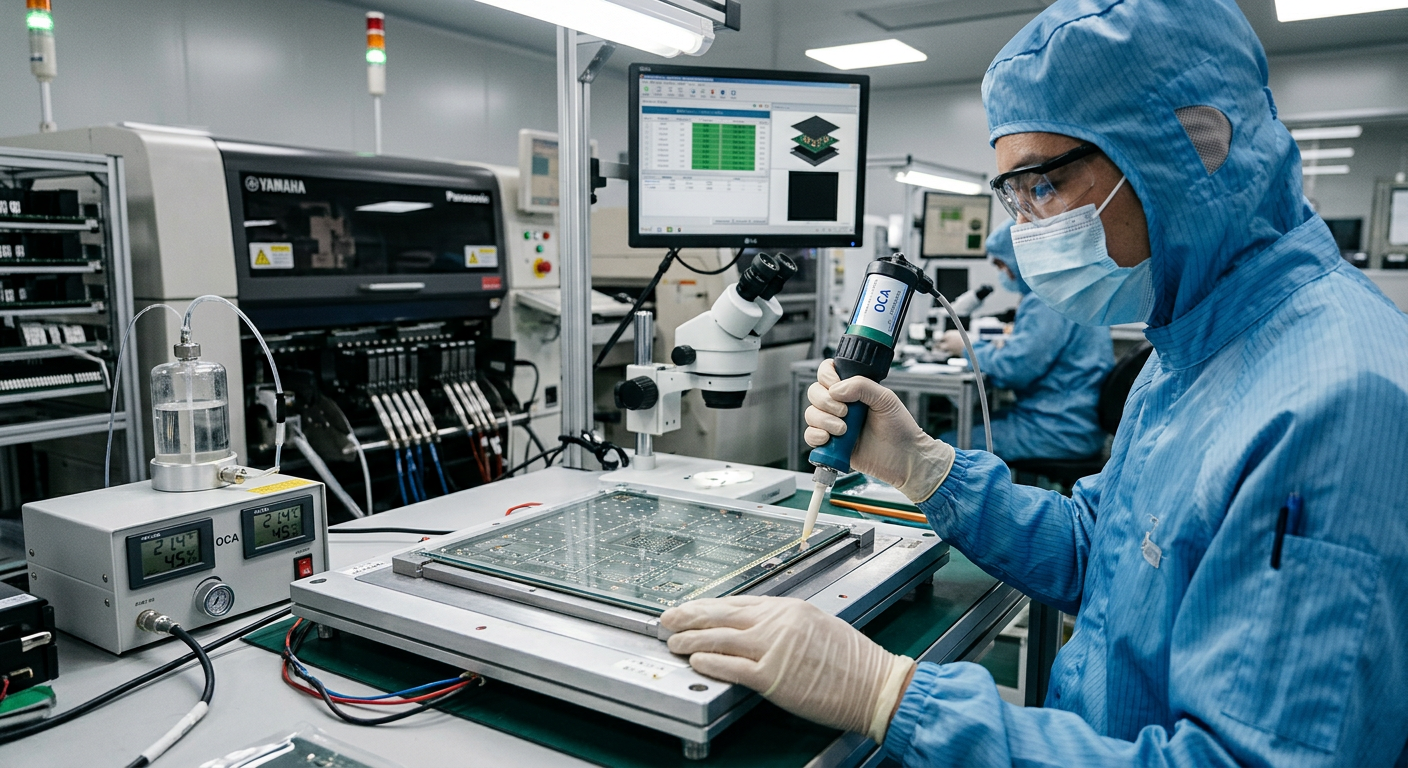
Optically clear adhesive, often abbreviated as OCA in procurement discussions, is used to bond transparent layers while minimizing haze, preserving brightness, and improving viewing performance. In LED display modules, especially fine-pitch and transparent display assemblies, the adhesive layer has a direct impact on optical transmission, lamination uniformity, heat tolerance, and long-term yellowing resistance. U.S. buyers increasingly ask for low-VOC processing, documented shelf life, UL-adjacent safety awareness in system design, and compatibility with automated lamination equipment.
Demand is also being driven by replacement of older display stacks with thinner, lighter, and more energy-efficient systems. Whether the end application is a retail window display in Manhattan, an airport wayfinding system in Chicago, a sports venue ribbon board in Texas, or a transit information display near the Port of Los Angeles, the same buying logic applies: adhesive performance must support optical quality, assembly efficiency, and field durability.
The chart above shows a realistic growth pattern for U.S. demand tied to LED display assembly. Growth is supported by expansion in retail media networks, transportation displays, conference systems, and fine-pitch indoor visualization. The acceleration into 2025 and 2026 also reflects higher demand for transparent display formats and increasing refurbishment of commercial digital signage fleets.
Top Suppliers in the United States

The supplier landscape includes multinational material companies with U.S. sales and technical service teams, plus niche optical bonding specialists that work with display manufacturers and OEMs. The table below focuses on practical sourcing criteria relevant to buyers in the United States.
| Company | Primary Service Region | Core Strengths | Key Offerings | Best Fit |
|---|---|---|---|---|
| 3M | Nationwide U.S. | Strong brand trust, optical films, converting support | Optically clear adhesive films, bonding tapes, display assembly materials | Consumer electronics, signage, display laminators |
| Dow | Nationwide U.S. | Silicone chemistry, outdoor durability, engineering support | Optically clear silicone materials, protective electronic materials | Outdoor LED, high-heat applications, durable assemblies |
| Henkel | Nationwide U.S. | Electronics manufacturing integration, process expertise | Optical and electronic bonding solutions, industrial adhesives | OEMs and EMS providers |
| Momentive | Nationwide U.S. | Silicone performance, weather resistance, specialty materials | Optically clear silicone gels and bonding materials | Harsh-environment and high-reliability displays |
| DuPont | Nationwide U.S. | Materials science reputation, reliability documentation | Advanced materials relevant to display and electronics assembly | Programs requiring detailed technical validation |
| Panacol | U.S. distributors and industrial regions | UV curing speed, precision dispensing compatibility | UV-curable optical adhesives for display bonding | Fast-cycle electronics production |
| Nagase America | Major U.S. manufacturing zones | Technical sourcing and specialty materials access | Optical and electronics-related specialty adhesive materials | Buyers seeking application-specific sourcing support |
This supplier table is useful because it separates broad reputation from application fit. A buyer building transparent retail LED panels may prefer optical film consistency and converting support, while an outdoor transit display manufacturer may place greater value on silicone weather resistance and heat cycling performance. The right supplier is often determined by the display architecture and the operating environment rather than by name recognition alone.
Product Types and Material Options
Not all optically clear adhesive LED display solutions are the same. U.S. buyers typically evaluate by adhesive chemistry, cure method, thickness range, optical transmission, haze, peel strength, temperature resistance, and reworkability. The main product families are outlined below.
| Product Type | Main Chemistry | Typical Advantages | Typical Limitations | Common LED Display Use |
|---|---|---|---|---|
| OCA Film | Acrylic | Clean lamination, consistent thickness, high clarity | Less forgiving on curved or uneven surfaces | Flat display stacks and precision module bonding |
| OCR Liquid | Acrylic or silicone | Fills gaps well, useful for irregular surfaces | Process control can be more demanding | Complex display structures and specialty bonding |
| Optically Clear Silicone | Silicone | Excellent UV and heat stability, strong outdoor performance | Higher cost in some formats | Outdoor LED, transparent installations, harsh conditions |
| UV-Curable Optical Adhesive | Acrylate-based | Fast cure, high throughput, precision processing | Requires UV access and cure validation | Compact electronics and rapid assembly lines |
| Pressure-Sensitive Optical Tape | Modified acrylic | Easy processing, no mixing, clean handling | May be less suitable for large gap filling | Display layers and cover-lens bonding |
| Hybrid Optical Bonding Material | Custom formulation | Balanced clarity, adhesion, and process flexibility | Qualification time may be longer | Customized OEM display projects |
This comparison matters because LED display module bonding can vary from rigid indoor fine-pitch assemblies to semi-open transparent structures exposed to sunlight and moisture. Acrylic OCA film remains popular for clean indoor lamination, but silicone-based optical adhesives are gaining ground in the United States where outdoor reliability, UV exposure, and thermal cycling are decisive. UV-curable optical adhesives also remain relevant where assembly speed and line efficiency are major priorities.
How Buyers in the United States Evaluate Performance
Procurement teams and engineers rarely buy only on price. They look at transmission, haze, yellowing resistance, resistance to thermal aging, adhesion to glass, PMMA, PC, and coated surfaces, and whether the adhesive can survive humidity, vibration, and transportation shock. In practical U.S. projects, these factors affect warranty exposure and field maintenance cost as much as the original material price does.
For LED display modules, the most common checkpoints include optical transmittance above typical commercial thresholds, low haze to preserve image sharpness, reliable adhesion after humidity aging, and minimal bubble formation during lamination. Buyers serving casinos in Las Vegas, airports in Dallas, storefront networks in Miami, or public information systems in Seattle often request validation through small pilot builds before authorizing volume orders.
The bar chart highlights where demand is strongest. Retail signage leads because of ongoing upgrades in shopping centers, chain stores, and experiential storefronts. Hospitality follows closely due to hotels, casinos, and event venues adopting high-visual-impact displays. Transportation remains a steady buyer because airports, rail stations, and urban transit systems require durable and legible display assemblies that perform in variable environments.
Buying Advice for U.S. Importers, OEMs, and Distributors
The best purchasing strategy starts with application definition. Buyers should identify whether the display is indoor or outdoor, flat or contoured, temporary or long-life, and whether the adhesive must allow rework. They should also define whether the priority is low cost, premium optical performance, or production speed. A mismatch between adhesive type and process is a more common source of failure than poor nominal specifications.
For U.S. buyers sourcing domestically, quick access to technical representatives and warehousing is valuable. For import buyers, especially those bringing product through the Port of Los Angeles, Port of Long Beach, Port of Houston, Port Newark, or Savannah, the priority shifts toward consistent batch quality, export documentation, packaging stability, and dependable communication. If a supplier can support both trial quantities and volume orders, it reduces qualification risk.
| Buying Factor | Why It Matters | What to Ask Suppliers | Risk if Ignored | Recommended Priority |
|---|---|---|---|---|
| Optical Transmission | Affects brightness and viewing quality | What is the tested transmission level? | Duller display output | Very High |
| Haze Level | Determines image sharpness and clarity | What haze result is typical after aging? | Cloudy appearance | Very High |
| UV and Heat Resistance | Important for outdoor or high-load use | How does the product perform in thermal cycling? | Yellowing or bond failure | High |
| Substrate Compatibility | Prevents adhesion mismatch | Which surfaces are validated? | Delamination | High |
| Process Fit | Impacts throughput and yield | Film, liquid, UV, or silicone format? | Production inefficiency | High |
| Supply Reliability | Protects project timelines | Can the supplier support safety stock or repeat lots? | Line stoppages | High |
| Technical Support | Reduces startup errors | Is application guidance available before and after sale? | Slow troubleshooting | Medium to High |
This table works as a supplier interview checklist. It helps buyers move the conversation beyond marketing claims and toward measurable technical fit. In many LED display projects, especially where visibility under strong ambient light is important, optical transmission, haze, and UV resistance deserve more weight than headline pricing.
Industries Driving Demand
Optically clear adhesive is no longer limited to one display niche. In the United States, demand is spread across a set of industries that all require durable image quality and stable assembly performance.
Retail and commercial signage remains the largest segment, particularly for chain stores, shopping districts, pop-up digital merchandising, and smart storefronts. Transportation is another strong segment, with transit authorities and airport operators in major metro areas replacing older screens with brighter and thinner systems. Control rooms for utilities, security monitoring, and industrial operations continue to invest in high-clarity displays where viewing consistency matters across large wall formats.
Hospitality and entertainment make up another large market. Sports arenas, convention centers, hotels, and casinos seek vivid indoor and semi-outdoor displays that maintain visual quality under heavy usage. Automotive and mobility electronics also contribute, especially where transparent or laminated displays are integrated into advanced interfaces. Industrial manufacturing, renewable energy monitoring, and smart building control panels create smaller but technically demanding opportunities.
Typical Applications
In real projects, optically clear adhesive LED display materials are used in transparent LED window screens, fine-pitch indoor modules, touch-enabled information displays, digital menu boards, conference displays, interactive kiosks, and architectural media panels. The adhesive layer improves light transmission between surfaces, reduces internal reflections, and can help increase perceived contrast under ambient lighting.
For transparent LED systems in urban storefront corridors such as Manhattan, Chicago’s Magnificent Mile, or Santa Monica retail zones, the adhesive must preserve visibility while supporting a neat, low-haze finish. In transportation systems, the emphasis is on durability during temperature swings and long daily operating cycles. In industrial displays, the priority is often stable bonding under vibration, dust, and maintenance exposure.
Case Studies from the U.S. Market
A retail integrator in Southern California upgrading transparent in-window LED displays typically needs a material that balances optical clarity with fast installation speed. In that situation, optical film products are often preferred if the assembly is highly controlled and flat. By contrast, a transportation display project in Texas or Illinois may prioritize silicone optical bonding because sunlight, heat, and long service life matter more than lowest initial cost.
A display assembler near Phoenix working on fine-pitch indoor modules may use UV-curable optical adhesive if throughput is critical and process conditions are tightly managed. A hospitality project in Las Vegas may choose a premium optical bonding solution to reduce visible defects under bright architectural lighting. These examples show why the same keyword can point to different technical answers depending on the end-use environment.
The area chart illustrates a realistic trend shift in the United States from basic optical bonding materials toward more durable, specialized solutions. The rise is linked to outdoor installations, transparent LED growth, longer warranty expectations, and demand for lower-maintenance systems. It also reflects growing interest in materials that perform well under thermal stress and environmental exposure.
Local Suppliers and Regional Coverage
U.S. buyers often prefer suppliers that can support local sampling, technical review, and faster replenishment. The companies below are relevant because they either maintain a strong U.S. commercial footprint or are commonly accessible through American channels and industrial distribution networks.
| Company | U.S. Coverage | Notable Strength | Typical Product Focus | Common Buyer Type |
|---|---|---|---|---|
| 3M | California, Texas, Midwest, Northeast, Southeast | Broad converting ecosystem and materials familiarity | Optically clear films and tapes | OEMs, laminators, distributors |
| Dow | Nationwide industrial support | Silicone expertise for harsh environments | Optically clear silicone bonding materials | Outdoor display manufacturers |
| Henkel | Nationwide manufacturing markets | Strong integration into electronics production lines | Electronics and optical bonding adhesives | EMS providers and brand owners |
| Momentive | Major industrial corridors | Weatherability and specialty silicone performance | Clear silicone materials for robust assemblies | Industrial and transportation users |
| DuPont | National coverage through technical and commercial channels | Engineering credibility and validation culture | Advanced materials for display-related uses | High-spec project teams |
| Panacol | Accessible through U.S. channels | UV-curing and precision application speed | Optical UV adhesives | High-throughput electronics assemblers |
This regional view is important because U.S. purchasing often depends on practical support rather than catalog breadth alone. A company with responsive application help in California or Texas may be more valuable than a broader supplier that cannot assist during lamination trials. Buyers should weigh local responsiveness, documentation quality, and repeatability together.
Supplier and Product Comparison
The comparison chart shows a common U.S. sourcing reality. Premium domestic or heavily localized suppliers often score strongly on support access and high-end validation, while qualified international suppliers can be more competitive on customization and cost efficiency. For distributors and brand owners, this often leads to a dual-source strategy: one premium benchmark supplier and one scalable cost-performance supplier.
Our Company in the U.S. Market
Qingdao QinanX New Material Technology Co., Ltd serves U.S. buyers as a specialized adhesive manufacturer with a product system that covers silicone, polyurethane, acrylic, epoxy, cyanoacrylate, hot melt, MS polymer, and water-based technologies relevant to industrial bonding and electronics assembly. For customers evaluating optical or display-adjacent bonding materials, the company’s value rests on ISO-certified manufacturing, compliance with RoHS and REACH requirements, multi-stage quality control with digital traceability, and the ability to tailor formulations to specific performance targets rather than pushing a one-grade-fits-all approach. In practice, this supports end users, distributors, dealers, private-label brand owners, and even smaller project buyers through flexible OEM, ODM, wholesale, retail, and regional cooperation models, making it easier to align material performance, packaging, and commercialization plans with U.S. market requirements. The company already has proven export experience across more than 40 countries and backs that with automated production capacity, free sample programs, round-the-clock technical assistance, and structured pre-sale and after-sale support that reduce qualification risk for American customers; buyers who want to review product options, discuss private label supply, or plan recurring orders can use the company’s product pages, learn more on the company overview, or arrange direct technical follow-up through the U.S. inquiry contact channel.
What Makes a Good Supplier Relationship
For U.S. buyers, a strong supplier relationship depends on more than a good initial sample. It requires repeatable production quality, clear data sheets, realistic lead time commitments, and responsive troubleshooting when the first assembly run reveals lamination issues. This is especially important for LED display programs tied to deadlines such as retail rollouts, trade show launches, sports seasons, or transportation contracts.
The best suppliers usually help buyers narrow the specification before quoting. They ask about substrate, module design, cure conditions, environmental exposure, and failure history. They can also suggest whether a film, liquid optical resin, UV-curable system, or silicone route is likely to be the best fit. That kind of application support is a useful E-E-A-T signal because it shows real process knowledge instead of generic selling.
2026 Trends in Technology, Policy, and Sustainability
Looking ahead to 2026, the United States market is expected to move further toward advanced optical bonding materials that combine clarity with environmental resilience. Technically, silicone-based and hybrid optical systems are likely to gain market share in outdoor LED, transparent display, and high-brightness applications. Buyers will continue asking for lower yellowing, stronger resistance to heat and UV, and better compatibility with thinner display structures.
On the policy side, U.S. procurement will increasingly reflect documentation expectations around chemicals compliance, supply chain transparency, and responsible sourcing. Even where not mandated uniformly across all states and sectors, buyers are becoming more cautious about substance disclosure, traceability, and long-term availability. Suppliers that can clearly document RoHS- and REACH-aligned practices, stable quality control, and lot traceability will have an advantage in bids and vendor approvals.
Sustainability will also matter more. Customers are paying more attention to solvent reduction, waste control in lamination, longer service life, and the overall cost of maintenance and replacement. This does not mean buyers will automatically pay premium prices, but it does mean they increasingly view durability and process efficiency as sustainability metrics. In practice, an adhesive that lasts longer, reduces rework, and minimizes scrap can be more attractive than a cheaper material with inconsistent yield.
Practical Sourcing Strategy for U.S. Buyers
A practical sourcing plan in the United States usually starts with technical screening, then a small-batch validation, then a volume pricing negotiation. Buyers should first collect technical data sheets and identify a shortlist of two to four suppliers. They should then test those materials on their actual display stack, not just rely on laboratory marketing data. Real bonding trials reveal how the adhesive handles alignment, bubble control, cure time, and post-aging clarity.
After qualification, the next step is commercial alignment. This includes packaging format, lot consistency, shelf life, minimum order quantity, freight terms, and replenishment schedule. Import buyers may also want to discuss safety stock and split shipments, especially when project timelines depend on container arrivals through West Coast or Gulf Coast ports. For recurring business, supplier willingness to support formulation refinement or branded packaging can be a major advantage.
FAQ
What is the best optically clear adhesive for LED display bonding?
The best choice depends on whether your display is indoor or outdoor, flat or irregular, and whether you need film lamination or liquid gap filling. Acrylic OCA film is common for clean flat assemblies, while optically clear silicone is often preferred for outdoor durability and thermal stability.
Are U.S. suppliers always better than international suppliers?
Not always. U.S.-based suppliers often provide easier technical access and faster logistics, but qualified international suppliers can offer stronger customization and better cost-performance if they have reliable compliance, export experience, and responsive support.
What properties matter most for transparent LED displays?
Optical transmission, low haze, UV resistance, yellowing resistance, and stable adhesion to the chosen substrate are the most important factors. Process control during lamination is also critical.
Is silicone better than acrylic for LED displays?
Silicone is often better for outdoor or high-temperature conditions because it handles UV and thermal cycling well. Acrylic can still be excellent for indoor flat-panel applications where clean lamination and visual precision are the main priorities.
Can small U.S. buyers work with OEM adhesive manufacturers?
Yes. Many manufacturers support sample programs, pilot orders, private labeling, and distributor partnerships. This is especially useful for integrators, regional dealers, and brand owners building specialized product lines.
How do I reduce the risk of bonding failure?
Request substrate compatibility information, run pilot tests, validate the assembly process, and review aging data under heat and humidity. Bonding failure is often caused by process mismatch rather than by the adhesive alone.
Which U.S. regions are strongest for sourcing and support?
California, Texas, Illinois, Arizona, New York, and Georgia are among the strongest because they combine electronics activity, logistics access, and industrial service networks.
What should I ask a supplier before buying?
Ask for optical transmission, haze, thermal aging data, UV resistance, compatible substrates, shelf life, lead time, minimum order quantity, and whether pre-sale and after-sale technical support are available.
Conclusion
For buyers seeking optically clear adhesive LED display solutions in the United States, the best results come from matching the material to the display architecture and the real operating environment. 3M, Dow, Henkel, Momentive, DuPont, and Panacol are strong names to review first, especially for projects requiring technical validation and dependable service. At the same time, qualified international manufacturers with compliance credentials, flexible OEM or ODM models, and proven export discipline can be highly competitive for U.S. distributors, assemblers, and brand owners. The smartest procurement strategy is to test narrowly, compare carefully, and choose the supplier that can support both optical performance and long-term business continuity.

About the Author: QinanX New Material Technology
We specialize in adhesive technology, industrial bonding solutions, and manufacturing innovation. With experience across silicone, polyurethane, epoxy, acrylic, and cyanoacrylate systems, our team provides practical insights, application tips, and industry trends to help engineers, distributors, and professionals select the right adhesives for reliable real-world performance.

Product Category
You May Also Interest
-
IC Packaging Adhesive: Preventing Void Formation Issues
Learn how IC packaging adhesive void formation is prevented in the United States through material choice, process control, supplier selection, and testing.
-
Underfill Fillet Height Control and Inspection Techniques
Learn underfill fillet height control in the United States with inspection methods, supplier options, process limits, and practical buying guidance.
-
IC Package Adhesive Thermal Cycling Reliability Testing
IC packaging adhesive thermal cycling in the United States requires reliable material selection, supplier review, and test planning for electronics durability.
-

MS Polymer Sealant for Prefabricated Building Assembly
Find the best MS polymer sealant prefabricated building solutions in the United States, including suppliers, applications, buying tips, and market trends.
 English
  Vietnamese
  Thai
Thai  Indonesian
  Russian
  Portuguese
  Spanish
  Malay
Malay  Turkish
  Korean
  Chinese