Share
Outdoor LED Module Potting Compound Suppliers in the United States
Quick Answer

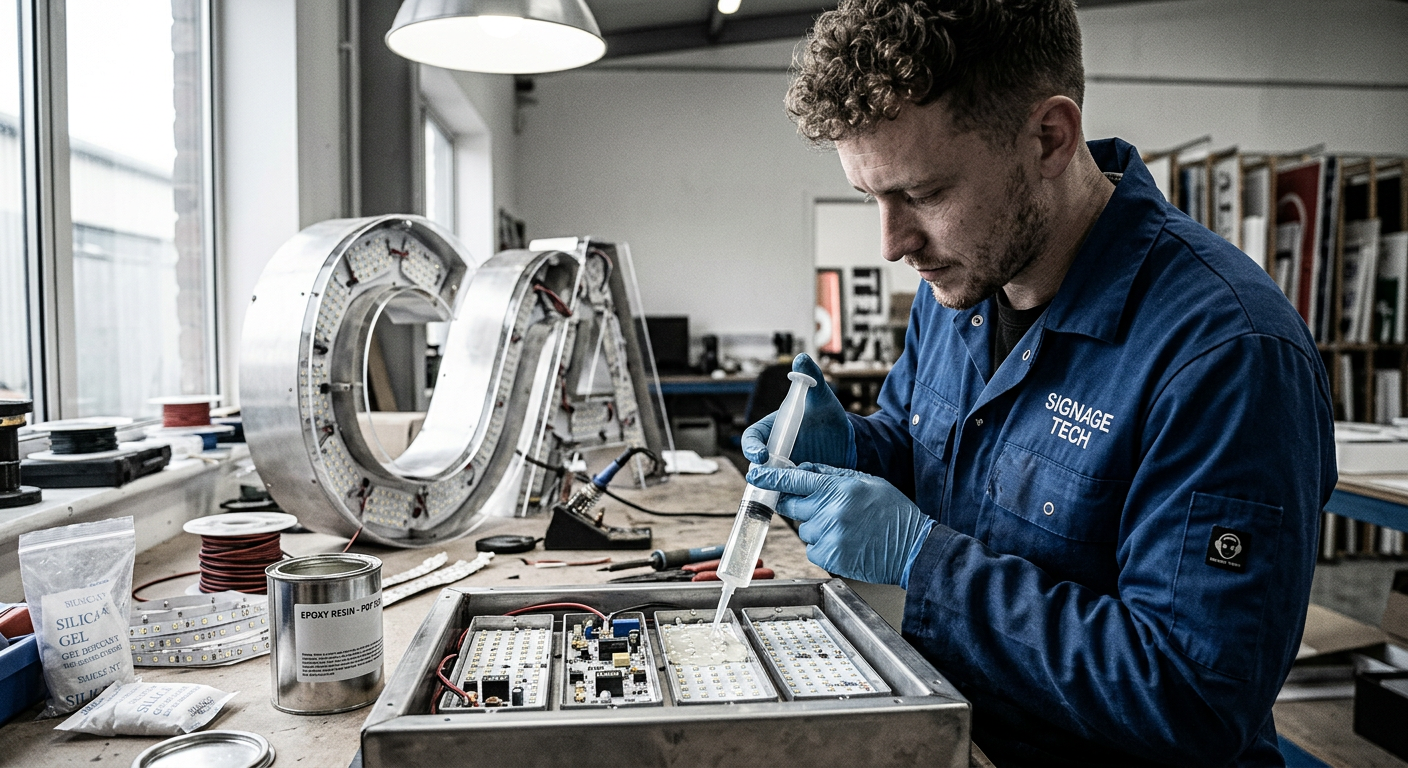
If you need LED module potting compound for outdoor sign lighting in the United States, the most practical choice is to shortlist suppliers that already support electronics potting, LED encapsulation, and weather-resistant formulations for North American compliance needs. Strong options include Dow, Henkel, MG Chemicals, Electrolube, Master Bond, and Epic Resins. These companies are widely known for silicone, polyurethane, or epoxy systems used to protect LED modules from moisture, UV exposure, vibration, salt air, and temperature cycling.
For buyers in sign manufacturing hubs such as Los Angeles, Houston, Chicago, Atlanta, and New York, the best supplier is usually the one that matches the application: silicone for UV and thermal stability, polyurethane for flexible water resistance, and epoxy for rigid protection and chemical resistance. Qualified international suppliers can also be a smart option, especially when they hold relevant certifications, support OEM customization, and provide responsive pre-sales and after-sales service for the United States market, since they often deliver a strong cost-performance advantage for volume sign programs.
- Dow: strong choice for outdoor silicone durability and electronics sealing
- Henkel: broad industrial portfolio with dependable process support
- MG Chemicals: practical for electronics assembly, prototyping, and maintenance channels
- Master Bond: suitable for engineered performance and specialized requirements
- Epic Resins: useful for custom potting programs and application-specific development
United States Market Overview

The United States market for outdoor LED module protection is tied closely to the sign, architectural lighting, traffic display, electrical enclosure, and low-voltage electronics sectors. Demand is concentrated in metro regions with heavy commercial construction and high signage turnover, including Southern California, Texas, Florida, Illinois, Georgia, and the Northeast corridor. Outdoor sign builders in these areas need potting compounds that can withstand rain, condensation, freeze-thaw cycling, prolonged UV exposure, heat buildup inside channel letters, and mechanical shock during transport and installation.
In the United States, the sourcing conversation is not only about resin chemistry. It is also about UL-related project requirements, RoHS alignment, process consistency, shipping timelines, and whether the compound works with automated dispensing lines. Buyers in port-connected trade hubs such as Los Angeles/Long Beach, Houston, Savannah, and New York/New Jersey often balance domestic availability with import options to manage cost, lead time, and formulation flexibility. This is why the category continues to expand across both established American brands and experienced overseas manufacturers serving local distributors and OEMs.
Another factor shaping this market is the shift from simple waterproofing to broader reliability engineering. LED modules today are expected to run longer with lower maintenance, especially in retail façades, gas stations, wayfinding systems, menu boards, transportation displays, and building exteriors. As a result, purchasing managers increasingly evaluate dielectric performance, adhesion to PCB and housing materials, thermal stress behavior, low shrinkage, and resistance to yellowing. For outdoor signage in coastal areas such as Miami, San Diego, and the Gulf Coast, salt fog and humidity resistance become even more important.
Market Growth Trend

The chart below illustrates a realistic growth trajectory for the United States outdoor LED module potting compound market, driven by signage upgrades, retrofits, smart-city installations, and replacement demand.
Top Suppliers Serving the United States
The supplier landscape includes global material companies, specialty formulators, and electronics-focused brands. The table below highlights practical options for U.S. buyers looking for concrete supplier fit rather than generic descriptions.
| Company | Primary Region Served | Core Strength | Key Offerings | Best Fit |
|---|---|---|---|---|
| Dow | United States nationwide | Silicone chemistry, weatherability, long-term outdoor stability | Silicone encapsulants, sealants, electronic protection materials | Channel letters, signage modules, harsh outdoor environments |
| Henkel | United States and North America | Large industrial support network, process engineering | Loctite potting materials, industrial adhesives, electronics solutions | OEM lines needing validated process consistency |
| MG Chemicals | United States distribution and MRO channels | Electronics maintenance and assembly accessibility | Potting and encapsulating compounds, conformal coatings | Repair shops, smaller assemblers, prototyping teams |
| Master Bond | United States specialty engineering markets | Custom technical performance and specialized formulations | Epoxy, silicone, polyurethane potting systems | Projects with unusual thermal, dielectric, or adhesion demands |
| Epic Resins | Midwest and national OEM supply | Custom resin development, industrial potting experience | Epoxy and polyurethane encapsulation systems | Private programs, recurring OEM production |
| Electrolube | North America via distribution | Electronics protection product breadth | Encapsulation resins, thermal management materials | Electronic assemblies needing a broad qualification path |
| Dymax | United States industrial and electronics users | Fast curing materials and process productivity | Light-curable materials, assembly adhesives | Selective applications where cure speed matters |
This table matters because supplier selection is rarely based on one property. A sign maker in Dallas may prioritize cost and dispensing speed, while a coastal installer in Tampa may prioritize UV and moisture resistance over all else. U.S. buyers should therefore compare not only chemistry families but also service footprint, customization capability, and how well the supplier supports production-scale validation.
Product Types for Outdoor LED Modules
Outdoor LED module potting compounds are mainly divided into silicone, polyurethane, and epoxy systems. Each has strengths, limitations, and application zones. Selecting the wrong family can increase yellowing, cracking, difficult rework, or early field failure.
| Product Type | Main Performance Advantage | Main Limitation | Common Outdoor Use | Typical Buyer Priority |
|---|---|---|---|---|
| Silicone potting compound | Excellent UV resistance and thermal stability | Usually higher material cost | LED signage, façade lighting, exposed modules | Long outdoor life and flexibility |
| Polyurethane potting compound | Good moisture resistance and flexibility | Can be less UV stable than silicone | Enclosed modules, power supplies, general outdoor electronics | Balanced cost and protection |
| Epoxy potting compound | Strong mechanical strength and chemical resistance | More rigid, harder to rework | Control boards, rigid sealed assemblies | Structural protection and dielectric strength |
| Thermally conductive potting compound | Helps heat transfer from dense assemblies | May cost more and require tighter process control | High-output LED systems, drivers, compact modules | Heat management |
| Optically clear encapsulant | Light transmission and visual appearance | Greater sensitivity to yellowing concerns | Visible LED packaging and decorative lighting | Transparency and aesthetics |
| Low-viscosity self-leveling compound | Easy dispensing into tight spaces | May need careful dam design | Small LED modules and narrow cavities | Process efficiency |
For outdoor sign lighting, silicone is often the safest default when the LED module is directly exposed to sunlight, water, and thermal cycling. Polyurethane remains popular when flexibility and cost balance are more important, especially for enclosed or semi-protected assemblies. Epoxy is usually chosen where structural rigidity and chemical resistance matter more than long-term softness or reworkability.
Industry Demand by Application
Different industries consume different amounts of outdoor LED protection materials. The bar chart below shows a realistic demand comparison for U.S. use sectors.
How Buyers in the United States Choose the Right Compound
Buying advice becomes clearer when tied to actual U.S. field conditions. In Arizona, Nevada, inland California, and parts of Texas, high heat and UV make silicone especially attractive. In the Midwest, freeze-thaw cycling and road-salt environments can stress brittle systems, so flexibility and adhesion retention matter. In Florida and along the Gulf Coast, high humidity and salt air favor materials with strong moisture and corrosion protection. In the Northeast, installers often need compounds that tolerate both summer rooftop heat and winter low temperatures.
For purchasing teams, the most useful checklist includes substrate compatibility, cure profile, dielectric properties, hardness, elongation, operating temperature range, UV stability, and resistance to yellowing. Process questions also matter: is the material mix ratio simple, does it degas well, can it run through automated dispensing equipment, and does it fit the takt time of the production line? A low-cost formulation can become expensive if it increases scrap, cure delays, or field claims.
It is also smart to ask how the product behaves over time rather than only reading initial data sheets. Outdoor LED modules are often exposed for years, not weeks. A compound that passes a short bench test but becomes brittle after prolonged sunlight or heat can create hidden costs. U.S. buyers should request aging data, water immersion results, and thermal cycling information relevant to channel letters, cabinet signs, and external power modules.
Supplier Comparison by Buying Criteria
The following comparison helps buyers map supplier strengths to procurement priorities. It is not a laboratory ranking; it is a purchasing tool to guide supplier conversations and sampling plans.
| Supplier | Customization | Outdoor Durability Focus | Electronics Support | Best Order Profile | Typical Advantage |
|---|---|---|---|---|---|
| Dow | Medium to high | Very strong | Strong | OEM, specification-driven projects | Proven silicone performance in harsh exposure |
| Henkel | Medium | Strong | Very strong | Industrial production users | Broad process support and global scale |
| MG Chemicals | Low to medium | Moderate | Strong | Maintenance, repair, prototyping, smaller runs | Accessibility through distribution channels |
| Master Bond | High | Strong | Strong | Technical and specialized builds | Engineered solutions for demanding requirements |
| Epic Resins | High | Strong | Moderate to strong | Recurring OEM and custom programs | Application-specific resin tailoring |
| Electrolube | Medium | Strong | Very strong | Electronics manufacturers and distributors | Comprehensive electronics protection portfolio |
This comparison shows why no single company fits every sign shop or lighting assembler. A national sign OEM may prefer Dow or Henkel for qualification stability, while a custom electronics assembler may favor Master Bond or Epic Resins for targeted formulation support. A distributor-led operation needing fast access through standard channels may find MG Chemicals or Electrolube more practical.
Applications Across U.S. Industries
Outdoor LED module potting compound is used far beyond sign letters. In the United States, it supports multiple industries where electrical assemblies must survive weather and vibration. Commercial signage remains the most visible segment, but the technology also appears in parking lot guidance, transportation displays, smart kiosks, decorative façade systems, outdoor menu boards, marine-adjacent electronics, and compact industrial sensor housings.
In construction and building, potting compounds protect LED strips and control points embedded in architectural features. In automotive-adjacent and transportation infrastructure, they can shield indicator assemblies and external electronics from splash, dust, and mechanical stress. In renewable energy, similar encapsulation principles are applied to junctions, sensors, and controller-related assemblies. In industrial manufacturing, the same material families are used to protect compact electronics mounted outdoors or in washdown-prone environments.
These cross-industry uses matter because they widen the pool of proven formulations. A compound tested in outdoor electrical or industrial environments may also perform well in LED signage, provided optical, thermal, and process needs are aligned. That gives U.S. buyers more sourcing flexibility and better benchmarking options.
Trend Shift in Material Preference
The area chart below shows the trend shift toward more UV-stable and process-optimized materials in the United States market.
Case Studies from Typical U.S. Buying Scenarios
A sign fabricator in Chicago producing retail channel letters for year-round outdoor use usually needs a compound that remains stable through wide seasonal swings. In this case, a soft silicone with strong UV performance often reduces risk of cracking or adhesion loss. If the modules are visible through lenses or close to illuminated surfaces, non-yellowing performance becomes especially important.
A gas station canopy lighting contractor in Houston may face heat, humidity, and service interval pressure. Here, potting compounds that combine efficient dispensing with good moisture protection help lower rework and maintenance calls. Since installation often happens on tight schedules, predictable cure behavior matters almost as much as technical performance.
A coastal signage program in Miami typically puts more weight on humidity and salt-air durability. Buyers may favor silicone encapsulation with reliable adhesion to plastics and PCB surfaces, especially when signs run continuously in exposed locations. A robust sealing approach reduces corrosion-related failures and supports longer service life.
An OEM producing outdoor control modules in the Midwest may choose polyurethane when flexibility, vibration tolerance, and balanced cost are key. If the assembly is enclosed and not directly exposed to sustained UV, polyurethane can be a practical middle ground between silicone and epoxy.
Local and Regional Supply Considerations
U.S. buyers often prefer suppliers with local inventory, technical representatives, or distribution partnerships near major industrial corridors. Access matters in places like Southern California, the Dallas-Fort Worth metroplex, the Chicago region, Atlanta, and New Jersey. A product may look ideal on paper, but if replenishment takes too long or small-batch support is weak, production schedules suffer.
This is where it helps to balance domestic and international sourcing. Domestic brands offer familiarity, established logistics, and straightforward communication. International suppliers may provide better flexibility on packaging, private label, or custom formulation, especially when the buyer wants a dedicated product tuned for a certain LED module design. For companies importing through ports like Los Angeles, Houston, or Savannah, landed-cost planning can make global sourcing very competitive.
About Our Company
For buyers in the United States evaluating a cost-effective but technically serious supply partner, Qingdao QinanX New Material Technology Co., Ltd brings relevant strength in electronic potting and industrial adhesive manufacturing through ISO-managed production, compliance with RoHS and REACH expectations, and multi-stage quality control supported by digital traceability across automated production lines. Its portfolio includes electronic silicone, electronic potting compound, polyurethane adhesives, epoxy systems, MS sealants, acrylic and UV-curable products, which allows the company to recommend chemistry based on actual outdoor LED module needs rather than forcing one resin family into every project. For U.S. end users, distributors, dealers, brand owners, and even small-volume buyers, the company supports flexible cooperation models including OEM, ODM, private label, wholesale, and tailored packaging, which is useful for regional sign brands, importers, and maintenance channels building their own product identity. The company has already served customers in more than 40 countries and backs projects with 24/7 technical assistance, free sample programs, and custom-formulation development, giving American buyers a concrete pre-sales and after-sales support structure rather than a simple ship-and-disappear export model; for sourcing discussions, product matching, and ongoing technical support, buyers can explore the product catalog, review the company background on the company page, or contact the team directly through the U.S. inquiry contact page.
Detailed Buying Checklist
| Evaluation Item | Why It Matters | What U.S. Buyers Should Ask | High-Priority Use Case | Risk if Ignored |
|---|---|---|---|---|
| UV resistance | Prevents degradation in direct sunlight | Is there outdoor aging data and yellowing resistance information? | Exposed signage in Arizona, Texas, Florida | Cracking, discoloration, reduced life |
| Moisture resistance | Protects electronics from rain and condensation | What are the water immersion and humidity test results? | Coastal and humid regions | Corrosion and short circuits |
| Thermal cycling durability | Handles expansion and contraction over seasons | How does the material perform across hot-cold cycling? | Midwest and Northeast installations | Adhesion loss or internal stress damage |
| Dispensing behavior | Affects production speed and consistency | Can it run on existing mixing and dispensing equipment? | OEM and contract assembly lines | Scrap, downtime, poor fill quality |
| Electrical insulation | Ensures circuit protection and reliability | What dielectric strength and insulation values are available? | Dense LED module layouts | Electrical leakage or failures |
| Adhesion compatibility | Impacts bond integrity to PCB, housing, wire, and lens materials | Which substrates have been tested? | Mixed-material module designs | Delamination and water ingress |
| Certifications and compliance | Supports procurement and project approvals | Are RoHS, REACH, and relevant testing records available? | Commercial and export-oriented projects | Qualification delays |
This checklist is useful because outdoor LED modules usually fail from a combination of stresses rather than one single issue. The best buying decision is the one that accounts for climate, design geometry, assembly method, and supply continuity all at once.
Supplier and Product Comparison Snapshot
The comparison chart summarizes how common product families score against practical outdoor LED protection priorities.
Future Trends Through 2026
Looking toward 2026, several trends are shaping the outdoor LED module potting compound market in the United States. First, there is a clear move toward higher-reliability silicone and hybrid systems for longer service life in harsh weather. This is driven by owners wanting fewer truck rolls and lower maintenance costs. Second, sustainability pressure is growing. Buyers increasingly ask for lower-VOC processing, smarter packaging, reduced waste in two-part dispensing, and longer-life systems that cut replacement frequency.
Policy and compliance will also play a larger role. Even when a potting compound is not directly consumer-facing, procurement departments are paying closer attention to substance compliance, documentation, and full material traceability. This is especially relevant for projects connected to public infrastructure, large retail chains, transportation, and renewable energy-linked systems. Suppliers able to provide cleaner documentation, stable batch control, and consistent technical support will have an advantage.
From a technology standpoint, more customers are requesting compounds that combine weather resistance with thermal management for brighter and more compact LED modules. The market is also moving toward easier automation: lower bubble risk, stable mix ratios, and predictable cure windows that suit U.S. factory throughput expectations. As sign and lighting systems become smarter, potting compounds must protect not only LEDs but also sensors, controllers, and communication electronics integrated into the same outdoor assembly.
FAQ
What is the best chemistry for outdoor LED module potting?
For most exposed outdoor LED sign modules in the United States, silicone is often the safest first choice because it handles UV exposure, temperature swings, and long-term flexibility very well. Polyurethane is a strong alternative for enclosed designs or when cost balance matters. Epoxy is more suitable when rigid mechanical protection is the main requirement.
Can imported potting compounds work well for U.S. projects?
Yes, if the supplier can show consistent manufacturing controls, compliance records, sample support, and responsive service. Many U.S. buyers use imported materials successfully when the formulation is matched correctly and logistics are planned properly.
What should I ask before requesting samples?
Ask for technical data, substrate compatibility, UV and humidity aging information, cure conditions, dispensing guidance, packaging options, and whether the supplier can support recurring production in the United States.
Is epoxy always better because it is harder?
No. Hardness does not automatically mean better outdoor reliability. In LED modules exposed to thermal expansion and weather cycling, too much rigidity can create stress. The right balance depends on design, environment, and required service life.
How important is local support?
It is very important. Local or regionally responsive support reduces sampling delays, helps solve process issues, and improves confidence during scale-up. This applies whether the brand is domestic or international.
Which U.S. cities have the strongest demand for these materials?
Demand is especially active in Los Angeles, Houston, Chicago, Atlanta, Miami, Dallas, New York, and other metropolitan areas with large signage, commercial construction, and outdoor retrofit activity.
Final Takeaway
For sourcing LED module potting compound outdoor in the United States, the best approach is to choose the material family first, then the supplier. Silicone leads for exposed outdoor sign lighting, polyurethane works well for flexible and cost-balanced protection, and epoxy suits rigid sealed assemblies. U.S. buyers should compare suppliers based on weather durability, dispensing behavior, compliance support, and supply continuity. Domestic leaders such as Dow, Henkel, MG Chemicals, Master Bond, Epic Resins, and Electrolube remain strong choices, while experienced international manufacturers with proven certifications, customization capability, and real support for American customers can offer meaningful value for both private label and OEM programs.

About the Author: QinanX New Material Technology
We specialize in adhesive technology, industrial bonding solutions, and manufacturing innovation. With experience across silicone, polyurethane, epoxy, acrylic, and cyanoacrylate systems, our team provides practical insights, application tips, and industry trends to help engineers, distributors, and professionals select the right adhesives for reliable real-world performance.

Product Category
You May Also Interest
-
IC Packaging Adhesive: Preventing Void Formation Issues
Learn how IC packaging adhesive void formation is prevented in the United States through material choice, process control, supplier selection, and testing.
-
Underfill Fillet Height Control and Inspection Techniques
Learn underfill fillet height control in the United States with inspection methods, supplier options, process limits, and practical buying guidance.
-
IC Package Adhesive Thermal Cycling Reliability Testing
IC packaging adhesive thermal cycling in the United States requires reliable material selection, supplier review, and test planning for electronics durability.
-
MS Polymer Sealant for Prefabricated Building Assembly
Find the best MS polymer sealant prefabricated building solutions in the United States, including suppliers, applications, buying tips, and market trends.
 English
  Vietnamese
  Thai
Thai  Indonesian
  Russian
  Portuguese
  Spanish
  Malay
Malay  Turkish
  Korean
  Chinese