Share
LED Module Adhesive vs Mechanical Fastener in the United States
Quick Answer

In the United States, LED module adhesive is usually the better choice when you need fast assembly, lower visible hardware, vibration resistance, and cleaner light-box or channel-letter aesthetics. Mechanical fasteners are usually the better choice when you need easy disassembly, very high load security, strict field-service access, or substrates that are dirty, oily, or hard to bond reliably. For most sign manufacturing, architectural lighting, display lighting, and enclosed LED module mounting, a properly specified adhesive or adhesive-backed module can reduce labor time and distribute stress more evenly than screws, clips, or rivets. However, for outdoor installations exposed to extreme heat cycles, impact risk, or frequent replacement, many U.S. buyers prefer a hybrid approach that combines adhesive placement with selective mechanical retention.
Practical supplier options in the U.S. market include 3M, Henkel, Avery Dennison, Permabond, Ellsworth Adhesives, and regional sign-supply and lighting-integration firms serving cities such as Los Angeles, Chicago, Houston, Atlanta, and New York. Qualified international suppliers can also be considered, especially when they hold relevant certifications such as ISO, RoHS, and REACH compliance and provide responsive pre-sales and after-sales support; Chinese manufacturers with strong OEM capability often offer attractive cost-performance advantages for distributors, private-label buyers, and large-volume module assemblers in the United States.
United States Market Overview

The United States LED module installation market spans channel letters, retail light boxes, architectural façades, refrigerated display cases, commercial interiors, transportation signage, and specialty OEM lighting assemblies. Demand is concentrated in metropolitan construction and signage corridors including Los Angeles, Dallas, Chicago, Miami, Atlanta, Phoenix, and the Northeast corridor from Philadelphia to Boston. Import flows also shape purchasing patterns, with components moving through major ports such as Los Angeles/Long Beach, Savannah, Houston, New York/New Jersey, and Seattle-Tacoma before final assembly or distribution inland.
Across this market, the core decision is not simply adhesive versus fastener; it is a performance tradeoff across labor, substrate compatibility, serviceability, environmental exposure, thermal behavior, and total installed cost. U.S. buyers increasingly compare the two methods using line-side efficiency, rework rates, UL-related design considerations, and field failure history rather than only unit price. That shift has made engineered bonding systems more attractive, especially where labor costs are high and assembly speed matters.
In retail signage and standard indoor light boxes, adhesive-backed LED modules often reduce install time and improve visual cleanliness. In heavy-duty architectural or municipal projects, mechanical clips, rails, or screws remain common because project owners want visible retention confidence and easier component swaps. In practice, the market often settles on a mixed method: adhesive for alignment and stress distribution, plus a limited number of fasteners at critical points.
The chart above reflects a realistic growth pattern driven by retrofit programs, commercial renovation, electrification, digital signage expansion, and higher demand for durable low-voltage lighting assemblies. By 2026, sustainability rules, installation labor shortages, and demand for cleaner assembly methods are expected to increase interest in advanced adhesive systems, especially low-VOC, solvent-free, and electronics-safe formulations.
How Adhesive and Mechanical Fastener Differ

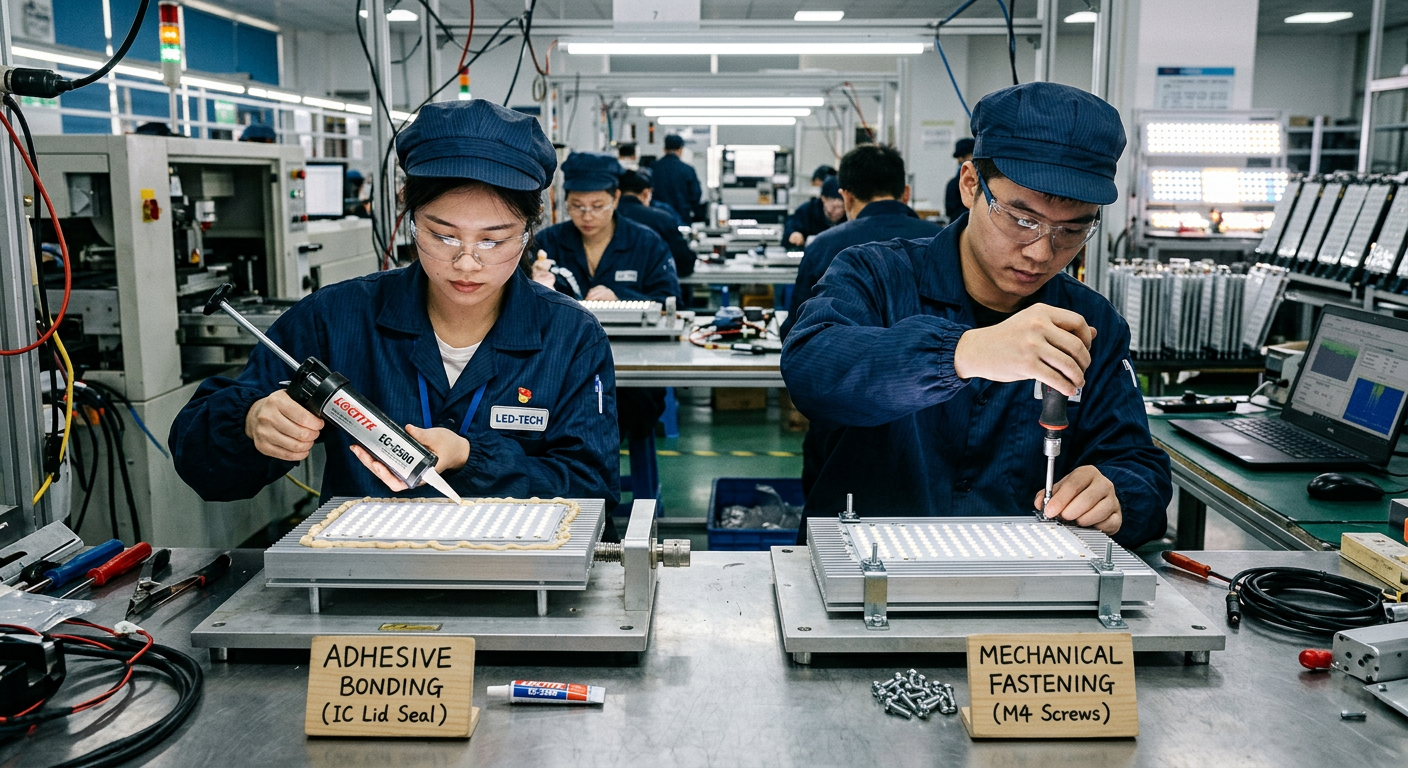
LED module adhesive refers to pressure-sensitive adhesive tapes, liquid structural adhesives, silicone-based electronics adhesives, acrylic bonding systems, polyurethane bonding systems, epoxy formulations, and hybrid sealant-bonding materials used to mount LED modules or related housings onto metal, plastic, composite, glass, or painted surfaces. Mechanical fasteners include screws, rivets, clips, brackets, rails, anchors, snap-fits, and customized retainers.
The main technical difference is how load transfers into the substrate. Adhesive spreads stress over a broader area, which reduces point loading and can improve vibration performance. Mechanical fasteners concentrate force at drilled or clipped points, which can be advantageous for high pull-out security but may increase local stress, require extra hardware, and create visual interruptions or corrosion points if materials are mismatched.
For LED systems, thermal expansion is important. Aluminum channel returns, polycarbonate housings, painted ACM panels, and PVC sign backs do not all expand at the same rate. Adhesives with elasticity can accommodate differential movement better than rigid fasteners in some assemblies. On the other hand, if a module must be removed repeatedly for maintenance, screws or clips usually make field service simpler.
Comparison Table for U.S. Buyers
| Factor | LED Module Adhesive | Mechanical Fastener | Best Fit in the United States |
|---|---|---|---|
| Installation speed | Usually faster for repetitive assembly | Slower due to drilling or hardware placement | Adhesive for production shops and high-volume sign makers |
| Appearance | Clean surface with no visible hardware | Hardware may remain visible or require concealment | Adhesive for premium retail and architectural finishes |
| Serviceability | Can be harder to remove cleanly | Usually easier to remove and replace | Fastener for maintenance-heavy installations |
| Vibration resistance | Good when properly specified | Can loosen unless locked or designed carefully | Adhesive or hybrid for mobile or vibration-prone settings |
| Substrate preparation | Requires clean and controlled surfaces | More tolerant of imperfect surfaces | Fastener where field conditions are unpredictable |
| Water ingress risk | No drill holes required | Holes may need sealing | Adhesive for enclosures and outdoor sign cabinets |
| Load security | Depends on adhesive chemistry and area | High pull-out confidence with proper anchoring | Fastener for heavy modules or public infrastructure |
| Total installed cost | Often lower when labor is included | Hardware and labor may increase cost | Adhesive often wins in labor-intensive U.S. markets |
This comparison matters because labor in the United States often outweighs raw material savings. A lower-cost screw-based method may look attractive on paper but become more expensive after drilling time, alignment work, touch-up labor, and sealing. Conversely, a premium adhesive system may fail if the shop skips surface cleaning or uses it on a low-energy plastic without a primer. The right choice depends on the full installation process, not just the purchase price.
Product Types Used for LED Module Bonding
U.S. buyers should understand that “adhesive” is not a single category. Different module designs and climates require different chemistries. Pressure-sensitive tape is common in sign modules for speed and ease. Silicone adhesives are favored where flexibility, electronics safety, and weather resistance matter. Acrylic structural systems are selected for stronger bonding to metals and engineered plastics. Polyurethane and MS polymer systems can bridge sealing and bonding functions, while epoxies are used where rigid structural performance is needed.
| Adhesive Type | Typical Use | Strength Profile | Limitations | Common U.S. Applications |
|---|---|---|---|---|
| PSA tape | Fast LED module placement | High assembly speed | Surface prep is critical | Channel letters, retail signs, indoor boxes |
| Silicone adhesive | Flexible electronics bonding | Weather and temperature resistance | Longer cure time | Outdoor signage, LED strips, enclosure sealing |
| Acrylic structural adhesive | Metal and plastic bonding | High structural performance | Odor and mixing controls may be needed | Architectural lighting assemblies |
| Polyurethane adhesive | Impact-resistant bonding | Good toughness | Moisture sensitivity in some systems | Transport lighting, cabinet components |
| Epoxy adhesive | Rigid structural fixing | Strong and durable | Less flexible under movement | Industrial fixtures, potting-adjacent assemblies |
| MS polymer | Bonding and sealing combination | Balanced elasticity and adhesion | Not ideal for every low-energy surface | Exterior fixtures, mixed-material housings |
The explanation behind this table is simple: the adhesive must match both the module and the surface. A sign shop bonding lightweight LED modules to cleaned aluminum backs may get excellent productivity with quality PSA-backed systems. A lighting OEM assembling modules into weather-exposed housings may prefer silicone or hybrid systems because movement, moisture, and long-term reliability matter more than immediate tack.
Where Mechanical Fasteners Still Win
Mechanical fasteners remain highly relevant in the U.S. market. Public transit systems, outdoor wayfinding, sports venue signage, and heavy industrial environments often prefer screws, rivets, or rails because these systems provide immediate and inspectable retention. In many municipalities and engineering-led projects, facility managers are more comfortable approving visible retention methods, especially where maintenance teams need familiar tools and predictable replacement procedures.
Fasteners are also useful when substrate condition is uncertain. Retrofit jobs in older buildings around Chicago, Detroit, or Philadelphia may involve aged paint, surface chalking, oil residue, or inconsistent composite panels that reduce bond reliability. In those conditions, drilling and fastening may offer more predictable field performance unless there is time for complete cleaning, priming, and bond validation.
That said, mechanical retention often introduces secondary requirements: corrosion-resistant hardware, hole sealing, galvanic compatibility, precise spacing, and extra labor. For coastal markets such as Miami, Tampa, Houston, or Southern California, hardware corrosion and seal integrity become real lifecycle issues.
This demand pattern shows why adhesives have become central in signage and display work, where aesthetics and speed dominate. At the same time, transportation and industrial categories still rely more heavily on mechanical retention or hybrid designs due to safety, serviceability, and environmental exposure.
Buying Advice for United States Importers, Distributors, and End Users
If you are buying in the United States, begin with the substrate. Ask whether the module is going onto raw aluminum, powder-coated steel, PVC, polycarbonate, acrylic, painted ACM, or another material. Then define whether the installation is indoor, outdoor, refrigerated, exposed to UV, or exposed to vibration. These conditions will quickly narrow the correct adhesive family or show that a fastener or hybrid solution is safer.
Next, calculate total installed cost. Labor rates in Los Angeles, Seattle, Boston, and New York can make a five-second adhesive placement far more economical than a screw-based process requiring drilling and sealing. In lower-cost assembly environments, buyers may accept more manual fastening if serviceability is the top priority.
Ask suppliers for peel, shear, temperature, humidity, and aging data specific to the target substrate. Generic claims are not enough. If the product is being used in outdoor LED cabinets in Arizona or Texas, thermal cycling data matters. If the product is being installed near the Gulf Coast, humidity and salt exposure matter. If the product will go into refrigerated display cases in supermarkets, low-temperature bond retention matters.
Finally, evaluate supply-chain reliability. U.S. buyers increasingly prefer suppliers that can support regional stocking, technical onboarding, private label options, and quick response if a field issue arises. That is why many buyers start with established domestic brands but also compare specialized global manufacturers that can combine certification, custom formulation, and competitive landed cost.
Applications by Industry
LED module adhesive and mechanical fasteners serve overlapping but distinct U.S. industries. In signage, adhesive-backed modules dominate due to rapid installation and clean cabinet interiors. In architectural lighting, both systems are used depending on project code requirements and access needs. In retail fixtures, adhesive placement is common because display cycles are fast and appearance matters. In transport assemblies, mechanical retention remains more common, though bonding is growing where vibration-damping performance is valued.
| Industry | Preferred Method | Why It Is Chosen | Typical U.S. Project Context |
|---|---|---|---|
| Channel letter signage | Adhesive | Fast install and clean appearance | Urban storefronts in Los Angeles, Dallas, Atlanta |
| Retail light boxes | Adhesive | High production efficiency | Mall and chain-store rollouts nationwide |
| Architectural façade lighting | Hybrid | Need for durability plus installation flexibility | Commercial projects in New York and Chicago |
| Transportation signage | Mechanical fastener | Inspection and service access are critical | Transit systems and roadside assets |
| Industrial equipment lighting | Hybrid | Vibration and maintenance both matter | Factories in the Midwest and Southeast |
| Refrigerated display lighting | Adhesive | Compact installation and sealed assembly | Supermarket chains and convenience stores |
| Temporary displays | Mechanical or removable adhesive | Replacement and repositioning needs | Trade shows in Las Vegas and Orlando |
The explanation here is that use case drives method selection more than product category alone. Two sign projects may use entirely different mounting methods depending on whether the priority is speed, permanence, maintenance, or public exposure. Buyers who treat all LED modules the same usually overpay somewhere in the process.
Real-World Application Scenarios
A regional sign fabricator in Texas producing channel letters for restaurant chains may favor adhesive-backed LED modules because technicians can complete large runs quickly and consistently. The adhesive method also reduces internal hardware clutter and helps maintain a neat wiring layout. If the signs are mounted outdoors, the fabricator may still add selective clips at corners or high-stress zones for extra assurance.
A public transportation contractor in the Northeast may lean toward mechanical retention because maintenance teams need to swap modules during scheduled service windows. A screw or clip system makes replacement straightforward and produces a retention method that inspectors immediately recognize.
An architectural lighting integrator in California may use silicone or hybrid adhesive to mount modules or strips inside custom housings where differential thermal expansion and visible finish quality matter. In these projects, the elasticity of the adhesive helps absorb movement that could stress brittle or rigid mounting points.
A supermarket fixture OEM in the Midwest may choose adhesive systems for refrigerated display lighting because they simplify assembly in tight profiles and reduce water ingress points. Low-temperature performance and long-term bond stability become the main qualification criteria.
This trend shift is realistic for the United States because labor efficiency, cleaner designs, and material innovation keep improving adhesive acceptance. Mechanical fastening remains important, but its relative share is likely to narrow in sectors where engineered bonding now proves reliable.
Case Studies
A sign distributor serving Florida franchise rollouts compared adhesive-backed modules with screw-mounted modules across 120 store signs. The adhesive approach reduced installation time by roughly 28% and lowered visible rework. However, the team discovered that humid coastal storage conditions reduced early tack on unconditioned inventory, so they adjusted storage and surface-cleaning procedures. The lesson was that adhesive can outperform fasteners when process discipline is respected.
An OEM cabinet builder in Ohio tested silicone adhesive against aluminum clip retention for backlit display modules. Silicone provided better vibration resistance during shipping and reduced noise from internal contact. Yet clips were still retained on service-critical product lines because field replacement time remained a customer requirement. The result was a split product strategy rather than a single universal method.
A West Coast architectural lighting contractor evaluated acrylic structural adhesive versus concealed screws for custom lobby installations. Adhesive produced the preferred finish and avoided substrate penetrations into premium panels. The concealed screw option remained as a fallback where the general contractor could not guarantee surface cleanliness. Here, purchasing flexibility protected the project schedule.
Top Suppliers Relevant to the United States
The U.S. market includes multinational adhesive leaders, specialized bonding distributors, and component-focused LED installation suppliers. The table below gives buyers a practical starting point with real company names and concrete selection factors.
| Company | Service Region | Core Strengths | Key Offerings | Best Fit |
|---|---|---|---|---|
| 3M | Nationwide United States | Strong brand trust, tape technology, technical documentation | VHB tapes, transfer adhesives, electronics bonding materials | Large OEMs, sign makers, national spec projects |
| Henkel | Nationwide United States | Broad adhesive chemistry portfolio and industrial support | Loctite structural adhesives, sealants, electronics materials | Industrial OEMs and engineered assemblies |
| Avery Dennison | Nationwide United States | Pressure-sensitive adhesive expertise and converting options | Adhesive tapes and specialty bonding materials | Converters, displays, signage manufacturers |
| Permabond | United States and North America | Technical specialty adhesives and application guidance | Cyanoacrylates, epoxies, anaerobics, UV systems | Precision assemblies and specialty bonding needs |
| Ellsworth Adhesives | United States distribution network | Multi-brand technical distribution and selection support | Adhesives, dispensing systems, technical consulting | Buyers comparing multiple brands with engineering support |
| FASTSIGNS supplier networks and regional sign distributors | Major U.S. metro areas | Market proximity and sign application knowledge | Sign modules, mounting accessories, local sourcing support | Installers and local sign fabrication shops |
| Qingdao QinanX New Material Technology Co., Ltd | United States import supply and private-label channels | Custom industrial adhesive formulations and OEM flexibility | Silicone, polyurethane, acrylic, epoxy, hot melt, MS polymer systems | Distributors, brand owners, and cost-sensitive volume buyers |
This supplier comparison helps U.S. buyers split the market into two groups. The first group includes well-known domestic or multinational brands with mature local documentation and specification support. The second group includes internationally capable manufacturers that compete on customization, private label, category breadth, and landed-value economics. The best choice depends on whether your priority is immediate domestic availability, specification familiarity, custom formulation, or margin control.
Our Company
For U.S. buyers evaluating global sourcing alongside domestic options, Qingdao QinanX New Material Technology Co., Ltd stands out as a practical industrial adhesive partner because its portfolio covers the main bonding families used in LED and electronics-adjacent assembly, including silicone, polyurethane, acrylic, epoxy, MS polymer, cyanoacrylate, hot melt, and water-based systems, while its ISO-based manufacturing controls, RoHS and REACH compliance, multi-stage quality control, and digital traceability provide concrete evidence that products are made and tested to internationally recognized benchmarks rather than generic export standards. The company supports U.S. end users, distributors, dealers, brand owners, and private-label programs through flexible OEM/ODM, wholesale, custom packaging, and regional partnership models, allowing buyers to source both standard and application-specific materials through one platform; buyers can explore categories through the product catalog or learn more about the manufacturer on the company page. Just as important for the United States market, QinanX is not positioned as a distant one-off exporter: it has an established record serving more than 40 countries, maintains automated production for scalable and consistent supply, and backs transactions with 24/7 technical assistance, free sample programs, custom-formulation support, and responsive pre-sale and after-sale communication that gives U.S. purchasers a workable protection framework from qualification to repeat ordering; for direct project discussion, buyers can use the contact channel for application review, samples, and commercialization planning.
How to Decide Between Adhesive, Fastener, or Hybrid
A simple U.S. buying framework is to score the project across six factors: appearance, assembly speed, maintenance access, substrate condition, environment, and liability. If appearance and labor speed dominate, adhesive usually leads. If maintenance access and retention visibility dominate, fasteners usually lead. If the project is outdoor, public-facing, or exposed to vibration while also requiring clean installation, a hybrid system is usually safest.
Use adhesive when the substrate is well controlled, the module is light, and installation volume is high. Use mechanical fasteners when the assembly is heavy, the field is dirty, or there will be repeated servicing. Use hybrid mounting when the consequences of failure are high but production efficiency still matters.
This comparison chart is not a universal ranking; it reflects a practical sourcing view for LED module projects in which technical support, product breadth, and application fit all matter. Buyers should still validate exact substrate compatibility, volume pricing, and supply responsiveness before approving any source.
Common Mistakes in the United States Market
The first mistake is choosing by unit price alone. A cheaper fastener method can become expensive after labor, hole sealing, and alignment. A cheaper adhesive can fail if it is not matched to the surface. The second mistake is ignoring climate. Installations in Arizona, Minnesota, Florida, and coastal California face very different thermal and humidity conditions. The third mistake is treating all plastics as the same. Polycarbonate, acrylic, PVC, ABS, and low-surface-energy plastics require different bonding approaches.
Another common issue is poor process control. Adhesives depend on clean surfaces, correct pressure, proper cure conditions, and suitable storage. When distributors train installers and standardize prep methods, performance improves significantly. Mechanical fasteners also need process discipline, especially torque control, corrosion management, and hole sealing.
2026 Trends: Technology, Policy, Sustainability
By 2026, the United States market is expected to move further toward smarter adhesive selection rather than simple adhesive adoption. Three trends are driving this shift. The first is technology: better silicone electronics adhesives, low-odor acrylics, moisture-curing polyurethane systems, and hybrid sealant-bonding materials are making it easier to balance strength, flexibility, and environmental resistance in one installation process. The second is policy: stricter expectations around VOCs, material disclosure, and product stewardship will push buyers toward documented formulations from suppliers with clear compliance credentials. The third is sustainability: lighter assemblies, fewer drilled holes, reduced rework, and lower material waste all support adhesive growth, especially in large-scale retail and commercial rollouts.
In addition, U.S. labor constraints support bonding methods that reduce install time and simplify training. At the same time, resilience standards for public and infrastructure projects will continue to protect the role of mechanical retention. As a result, hybrid systems are likely to gain share in premium outdoor and civic applications.
FAQ
Is LED module adhesive strong enough for outdoor use in the United States?
Yes, when the adhesive chemistry is matched to the substrate and environment. Outdoor use requires validation for UV, temperature cycling, humidity, and surface condition. Silicone, acrylic, and hybrid systems are common choices depending on design needs.
When should I choose mechanical fasteners instead of adhesive?
Choose mechanical fasteners when the module is heavy, the surface is difficult to clean, the unit will require frequent replacement, or the project owner wants visible and easily inspectable retention.
Is a hybrid mounting method common?
Yes. Many U.S. installers use adhesive for initial placement and stress distribution, then add limited clips or screws in key positions for redundancy, especially in outdoor or high-liability projects.
What matters most when selecting an adhesive supplier?
Look for substrate-specific data, temperature and humidity performance, compliance documentation, supply stability, and responsive technical support. For private-label or distribution buyers, packaging flexibility and consistent batch control also matter.
Are international suppliers realistic for U.S. buyers?
Yes. Many U.S. importers and brand owners source from qualified global manufacturers when they need better cost-performance, OEM options, broad chemistry access, or custom formulations, provided that certification, traceability, and support are in place.
Which industries in the United States prefer adhesive most often?
Channel letter signage, retail displays, interior architectural features, and refrigerated lighting systems often favor adhesive because speed, appearance, and compact assembly are important.
Final Takeaway
For most LED module installations in the United States, adhesive is the better choice when productivity, appearance, and even stress distribution matter most. Mechanical fasteners remain the better option when serviceability, heavy retention, or uncertain field conditions dominate. The strongest procurement strategy is not to choose one method by habit, but to match the mounting system to substrate, environment, labor economics, and maintenance needs. In today’s U.S. market, that often leads to either a well-engineered adhesive system or a hybrid design that combines efficient bonding with selective mechanical security.

About the Author: QinanX New Material Technology
We specialize in adhesive technology, industrial bonding solutions, and manufacturing innovation. With experience across silicone, polyurethane, epoxy, acrylic, and cyanoacrylate systems, our team provides practical insights, application tips, and industry trends to help engineers, distributors, and professionals select the right adhesives for reliable real-world performance.

Product Category
You May Also Interest
-
UV Resistant MS Polymer Sealant for Exterior Cladding
Find the best UV resistant MS polymer sealant exterior options in the United States, with supplier comparisons, buying tips, applications, and market trends.
-
UV Curable Adhesive for Microelectronics Encapsulation
Explore UV curable adhesive microelectronics solutions in the United States, including suppliers, applications, buying tips, and 2026 market trends.
-
IC Lid Seal Adhesive for Hermetic Package Applications
Find the right IC lid seal adhesive hermetic package solution in the United States, with supplier comparisons, buying advice, applications, and market trends.
-
Underfill for Fan-Out Wafer Level Packaging Applications
Explore underfill fan-out wafer level packaging solutions in the United States, including suppliers, applications, buying tips, and 2026 market trends.
 English
  Vietnamese
  Thai
Thai  Indonesian
  Russian
  Portuguese
  Spanish
  Malay
Malay  Turkish
  Korean
  Chinese