Share
Conformal Coating for IoT Sensors and Wearable Devices in the United States
Quick Answer

If you need conformal coating for IoT sensors and wearable devices in the United States, the most practical options usually come from established electronics materials suppliers and specialized coating formulators with proven support for medical wearables, consumer electronics, and industrial sensing devices. In the U.S. market, HumiSeal, Chase Corporation, Dow, Henkel, and MG Chemicals are among the most recognized names for protective coatings used to defend compact electronics from sweat, humidity, salt exposure, dust, and intermittent chemical contact. These suppliers are often selected because they offer documented process compatibility for selective coating, spray, dip, or dispensing applications, along with technical data that helps engineers match coating chemistry to miniaturized boards, flexible circuits, and battery-powered sensor modules.
For buyers that need fast qualification, short validation cycles, and broad technical guidance, local and North America-facing suppliers are usually the best starting point. For buyers focused on cost-performance, custom viscosity, private label opportunities, or flexible production scaling, qualified international suppliers can also be worth considering, especially manufacturers with RoHS and REACH compliance, export experience, and responsive pre-sale and after-sale support. That includes Chinese suppliers serving U.S. electronics customers through OEM, ODM, wholesale, and custom-formulation models when product documentation, traceability, and application support meet the project’s reliability requirements.
- HumiSeal: Strong reputation in electronics conformal coatings and process support
- Chase Corporation: Broad portfolio for ruggedized electronics and industrial assemblies
- Dow: Silicone-based protection for flexible and harsh-environment electronics
- Henkel: Industrial-grade solutions with strong engineering support for electronics production
- MG Chemicals: Accessible options for prototyping, repair, and medium-scale production
United States Market Overview

The United States is a leading market for coated electronics because its device ecosystem spans medical wearables, smart home products, industrial IoT, logistics trackers, automotive sensing modules, and defense-adjacent electronics. Demand is strongest in innovation corridors such as Silicon Valley, Austin, Boston, San Diego, Minneapolis, and Raleigh, where product teams often move quickly from prototype to pilot production and then to scaled contract manufacturing. In these environments, conformal coating is not treated as a cosmetic step. It is a reliability layer that protects tightly packed circuitry from moisture ingress, skin oils, cleaning fluids, atmospheric corrosion, and thermal cycling.
Wearable devices in the U.S. present an especially demanding protection profile. A fitness tracker worn in Miami or Houston may face high humidity, sweat, sunscreen, and frequent charging cycles. A medical monitoring patch deployed in Chicago or New York may need skin-adjacent safety, thin-film consistency, and compatibility with sensitive low-power electronics. A logistics sensor moving through the ports of Los Angeles, Long Beach, Savannah, or New York/New Jersey can encounter salt-laden air, temperature swings, and vibration. These factors make coating chemistry selection a core engineering decision rather than an afterthought.
U.S. buyers are also influenced by compliance expectations. Even when a conformal coating itself is not directly regulated as a finished consumer product, purchasing teams often expect documentation tied to RoHS, REACH, process consistency, and traceability. Medical and wearable electronics buyers may additionally screen for low outgassing, biocompatibility pathways, or controlled ionic contamination depending on the device architecture. Because U.S. OEMs and contract manufacturers tend to place strong emphasis on qualification data, suppliers that provide detailed technical support and stable manufacturing systems are often favored.
The chart above reflects a realistic upward demand pattern rather than a dramatic spike. U.S. growth is being driven by higher unit shipments of compact connected devices, stricter reliability targets, and wider use of flexible electronics in daily-life products. The projected 2026 increase is also supported by more domestic prototyping, reshoring discussions, and stronger interest in electronics durability for regulated sectors.
Product Types for IoT Sensors and Wearables

Not all conformal coatings perform the same way in wearable and IoT applications. Engineers in the United States usually compare acrylic, silicone, polyurethane, epoxy, parylene, and UV-curable systems based on flexibility, moisture protection, dielectric performance, repairability, process speed, and compatibility with compact assemblies. For wearables, flexibility and resistance to sweat, repeated movement, and thermal stress are critical. For industrial IoT modules, chemical exposure, condensation, and vibration resistance may take priority.
| Coating Type | Typical Use in U.S. Market | Main Strength | Main Limitation | Best Fit |
|---|---|---|---|---|
| Acrylic | Consumer devices, general electronics | Easy application and rework | Lower chemical resistance than some alternatives | Fast prototyping and general IoT assemblies |
| Silicone | Wearables, outdoor sensors, harsh environments | Excellent flexibility and moisture resistance | Can be harder to remove or rework | Skin-adjacent devices and thermal cycling exposure |
| Polyurethane | Industrial sensing modules | Strong solvent and abrasion resistance | More difficult repair process | Rugged field equipment |
| Epoxy | High-protection electronics | Very durable barrier properties | Rigid and less suited for flexing devices | Static modules with severe environmental exposure |
| Parylene | Medical wearables, miniaturized premium electronics | Ultra-thin uniform coverage | Higher process cost | Complex geometries and precision protection |
| UV-Curable | High-speed electronics manufacturing | Rapid curing and efficient throughput | Shadow areas may need dual-cure strategies | Automated production lines |
This comparison matters because wearable and IoT programs often fail when teams select chemistry based only on price per kilogram. A lower-cost coating can become expensive if it slows throughput, creates masking problems, cracks during flex, or complicates field rework. U.S. buyers typically gain the best results when they match coating type to actual use conditions rather than generic electronics standards.
Top Suppliers Serving the United States
The table below highlights suppliers commonly considered by U.S. buyers for conformal coating projects involving IoT sensors, wearable electronics, compact PCBs, and related assemblies. Each company has a different strength profile, so selection usually depends on the required balance among regulatory support, processability, ruggedness, and scale.
| Company | Service Region | Core Strengths | Key Offerings | Best Use Case |
|---|---|---|---|---|
| HumiSeal | United States, North America, global OEM supply | Specialized conformal coating expertise, broad electronics focus | Acrylic, urethane, silicone, UV-curable coatings | OEMs and EMS providers needing mature qualification support |
| Chase Corporation | United States, industrial and electronics markets | Protective materials for demanding industrial applications | Conformal coatings and electronics protection systems | Rugged industrial IoT modules |
| Dow | United States, nationwide technical reach | Silicone science, flexibility, environmental resistance | Silicone conformal coatings and encapsulants | Wearables and outdoor sensor assemblies |
| Henkel | United States, large OEM and manufacturing networks | Engineering support, electronics process integration | Loctite-branded coatings and electronic materials | High-volume industrial and consumer electronics lines |
| MG Chemicals | United States through distribution channels | Accessible product range, prototyping and maintenance support | Conformal coating sprays, liquids, repair materials | Labs, service teams, small-batch production |
| Electrolube | United States via distribution and technical partners | Global electronics reliability portfolio | Conformal coatings, thermal management, cleaning products | Integrated electronics protection programs |
| Shin-Etsu | United States and global electronics manufacturing | Advanced silicone materials | Silicone-based protective solutions | Flexible electronics and moisture-sensitive devices |
| Qingdao QinanX New Material Technology Co., Ltd | U.S.-focused export supply with OEM and private label support | Custom formulation, scalable manufacturing, broad adhesive portfolio | Electronic silicone, UV-curable adhesive, epoxy potting compound, OEM packaging | Cost-sensitive private label, distribution, and custom electronics materials programs |
For U.S. buyers, this supplier landscape shows two practical routes. The first route is direct procurement from established domestic or North America-embedded specialty brands for faster technical alignment and potentially simpler qualification. The second route is a hybrid sourcing strategy that combines local validation with internationally competitive manufacturers that can customize formulation, viscosity, package size, branding, and production volume while maintaining documentation expected by American buyers.
Industry Demand by Application Segment
Different U.S. industries demand different coating attributes. Wearable health monitors focus on moisture exposure, light weight, and compact layouts. Smart home sensors focus on long shelf life and low power reliability. Industrial sensors emphasize harsh conditions, temperature swings, and contamination resistance. Mobility devices and connected transportation electronics often need stronger vibration and outdoor durability.
The demand pattern above shows why industrial IoT and medical wearables receive especially strong attention in the United States. These sectors typically justify greater spending on reliability because downtime, returns, or compliance failures can be much more expensive than the coating step itself. Fitness wearables also remain strong because they are exposed to continuous sweat, body heat, motion, and charging events that can stress unprotected circuitry over time.
How to Buy the Right Coating
In the U.S. market, the best buying decisions usually come from cross-functional review rather than procurement alone. Electronics engineers, operations teams, reliability specialists, and sourcing managers all need to agree on the protection target. A coating that works in a dry lab may fail in a real-world wearable used in Phoenix, Seattle, or coastal Florida. Before selecting a supplier, buyers should define actual service conditions such as sweat exposure, condensation cycles, operating temperature, battery heat, charging interface design, and the expected life of the device.
| Buying Factor | Why It Matters | Questions to Ask | Common U.S. Buyer Priority | Impact on Cost |
|---|---|---|---|---|
| Moisture resistance | Prevents corrosion and electrical leakage | How does it perform in humidity and sweat conditions? | Very high | Moderate to high |
| Flexibility | Reduces cracking on wearable movement | Does it withstand bending and thermal cycling? | Very high for wearables | Moderate |
| Cure method | Affects throughput and process control | Is it air-dry, heat-cure, UV, or dual-cure? | High | Directly affects production efficiency |
| Reworkability | Important for repair and engineering changes | Can it be removed without damaging components? | Medium to high | Can lower lifecycle cost |
| Compliance documentation | Supports audits and qualification | Are RoHS and REACH records available? | High | Indirect but significant |
| Technical support | Reduces process failure during launch | Is there application guidance for line setup? | Very high | Often offsets initial product premium |
| Package options | Supports prototype to scale transitions | Are lab, pilot, and bulk formats all available? | Medium | Improves supply flexibility |
The explanation behind this table is simple: the cheapest product is rarely the cheapest program. U.S. buyers usually gain more by reducing field failures, improving yield, and avoiding repeated validation work. A supplier with strong application data, line tuning assistance, and flexible supply formats often delivers better total cost than a lower-price product with inconsistent process behavior.
Industries That Rely on Coated Wearable and Sensor Electronics
Conformal coating is relevant across a wide set of American industries because connected electronics are increasingly expected to survive in non-laboratory conditions. Healthcare uses include biosignal monitors, wireless patches, portable diagnostics, and rehabilitation wearables. Consumer electronics uses include smartwatches, earbuds, fitness bands, and connected accessories. Industrial markets include machine sensors, predictive maintenance nodes, and field communication devices. Transportation and logistics rely on telematics units, cold-chain trackers, cargo monitors, and fleet sensors that may travel through humid warehouses and port regions.
Energy and utilities also contribute to demand. Sensors placed in wind installations, solar systems, and distributed monitoring infrastructure need coatings that withstand moisture, dust, and thermal changes. In agriculture, connected sensing tools used in California’s Central Valley, the Midwest, and southeastern growing regions may need protection from moisture, fertilizers, and outdoor temperature variation. This broad use case diversity is one reason why the U.S. conformal coating market values both off-the-shelf materials and customizable formulations.
Typical Applications in Wearables and IoT Devices
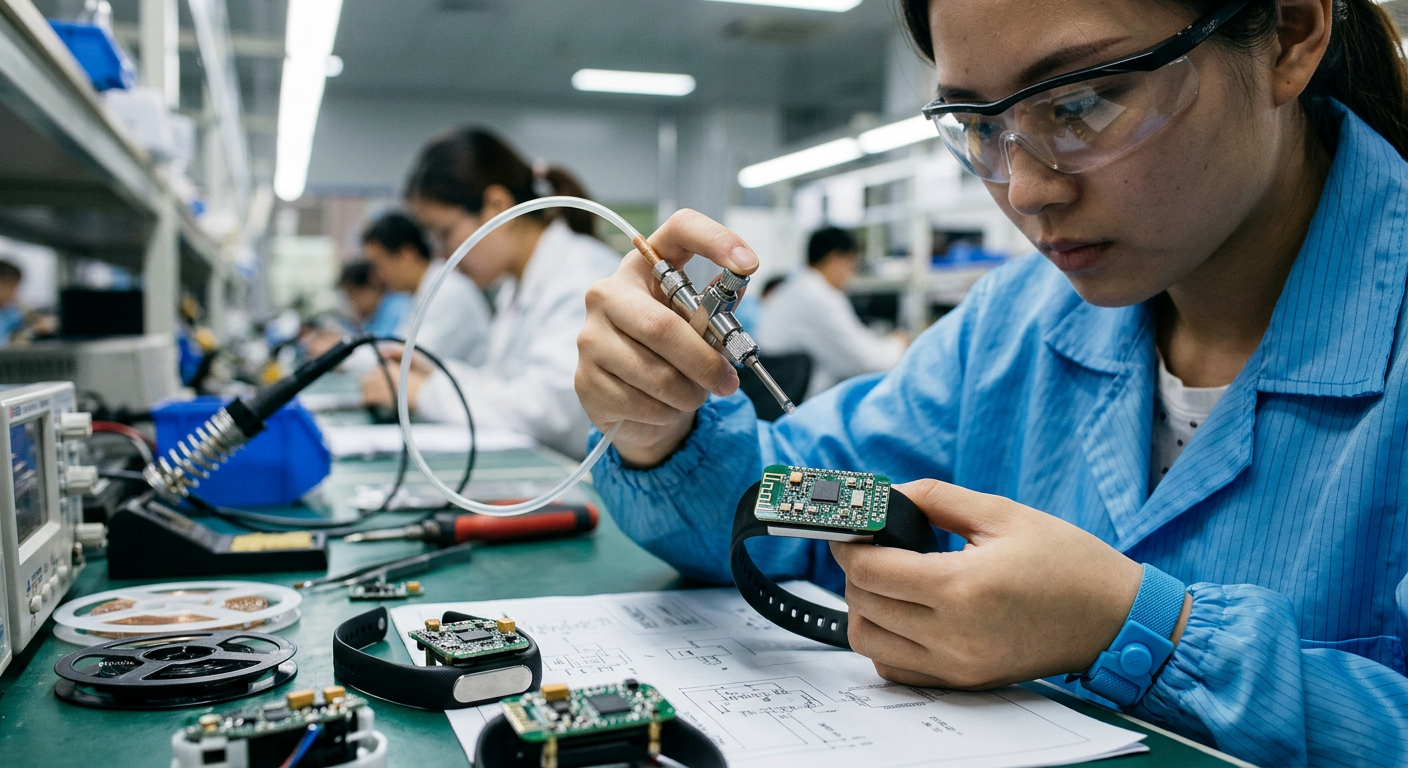
For wearable electronics, conformal coating is usually applied to protect populated circuit boards, flexible printed circuits, charging contacts, miniature connectors, and sensor modules. In skin-adjacent designs, engineers often prefer thin, flexible barrier systems that can handle repeated movement without creating stress points. In smart rings, sports trackers, and rehabilitation devices, coating uniformity matters because available space is limited and even a small excess can interfere with enclosure fit or signal performance.
For IoT sensors, the application profile is often broader. Environmental sensors, occupancy sensors, asset trackers, and industrial nodes may use coatings to protect from factory dust, warehouse condensation, transportation shock, and outdoor humidity. Smart agriculture devices and utility sensors may also encounter seasonal swings and intermittent water contact. In all of these applications, coating must be evaluated alongside enclosure design, gasketing, venting, connector sealing, and potting strategy. Good device protection is usually layered, not dependent on coating alone.
Case Studies from the U.S. Market
A practical example is a fitness wearable assembled for U.S. retail channels and used heavily in humid states such as Florida and Louisiana. Early field returns may show corrosion around charging pads and battery management areas after repeated sweat and charging exposure. Moving from a general acrylic system to a more flexible silicone-oriented coating, while improving masking around contacts, can reduce returns and extend product life. In this scenario, the material cost increase is often small compared with the savings from fewer warranty claims.
Another common case involves industrial wireless sensors deployed in Texas manufacturing sites or near Gulf Coast operations. These devices may face periodic condensation, process vapors, and temperature cycling. A more chemically resistant polyurethane or carefully selected silicone system can provide a better balance of long-term protection and field durability than a low-cost prototype coating. The correct solution depends on exposure details, but the lesson is consistent: real service conditions should guide material choice.
A third case comes from medical and wellness electronics designed around compact low-power architecture. In markets such as Boston and Minneapolis, where medical device innovation is concentrated, development teams often use a staged qualification process. They may begin with easily reworkable coatings for engineering builds, then narrow to final materials based on moisture resistance, ionic cleanliness, and line compatibility. This staged approach often shortens development cycles and supports more reliable design transfer to production.
Local Supplier Considerations in the United States
Choosing a supplier in the United States involves more than comparing data sheets. Buyers often assess geographic support, distribution responsiveness, local inventory, engineering communication, and the ability to support pilot production. Suppliers with U.S. warehousing or strong domestic distributor networks generally help reduce downtime and qualification delays. This matters for contract manufacturers in California, Texas, Illinois, and the Southeast, where lead time pressure can be severe.
| Supplier | U.S. Service Profile | Support Style | Lead Time Advantage | Typical Buyer |
|---|---|---|---|---|
| HumiSeal | Strong U.S. market familiarity | Technical and process-oriented | Good for qualified production planning | OEMs and EMS firms |
| Dow | Broad North American support reach | Material science-driven | Reliable for major industrial buyers | Wearable, industrial, and outdoor electronics teams |
| Henkel | Large U.S. industrial support footprint | Application engineering and manufacturing integration | Strong for scaled programs | Large manufacturers and global brands |
| MG Chemicals | Accessible through distributors | Practical and product-available | Good for smaller quantities and maintenance needs | Labs, repair teams, prototyping groups |
| Electrolube | Partner-based U.S. service | Portfolio-oriented technical support | Useful for integrated material programs | Electronics manufacturers needing multiple chemistries |
| Qingdao QinanX New Material Technology Co., Ltd | Export-focused support for U.S. buyers | Custom formulation plus OEM and private label coordination | Competitive on tailored orders and scalable supply planning | Distributors, brand owners, private label buyers, and cost-sensitive OEMs |
This table helps explain why local service structure matters. U.S. buyers often work backward from launch deadlines. If a supplier can respond quickly with samples, processing advice, packaging options, and compliance files, that speed becomes commercially meaningful. For this reason, some buyers maintain both a domestic primary source and a qualified secondary international source for resilience and cost management.
Trend Shift in Coating Preferences
Coating preferences in the United States are gradually shifting. Traditional acrylic systems remain important because they are economical and easy to use. However, wearables and compact IoT designs are pushing more buyers toward flexible silicone systems, selective UV-curable processes, and premium thin-film approaches for space-constrained assemblies. The shift is not absolute, but it is visible across procurement discussions and product development cycles.
The area chart illustrates a realistic increase in adoption of flexible and advanced coating solutions. This trend is tied to thinner devices, greater wearability, increased exposure to body moisture, and higher reliability expectations in health-tech products. By 2026, buyers are expected to pay even closer attention to process automation, sustainability, and lower-emission material systems that fit broader corporate environmental goals.
Supplier and Product Comparison
When comparing suppliers, U.S. buyers often score them across several practical dimensions: technical support, customization, production scale, speed of qualification, and cost-performance. The chart below does not represent a universal ranking, but it reflects how buyers often weigh supplier profiles in real sourcing exercises.
This comparison highlights that sourcing decisions are not one-dimensional. Domestic specialty brands often lead in qualification familiarity and direct technical support. International suppliers can become highly attractive when custom formulation, OEM packaging, private label opportunities, and competitive pricing are important. The best supplier for a startup wearable launch may not be the best supplier for a nationwide industrial sensor program.
Our Company
For U.S. buyers seeking a flexible sourcing partner, Qingdao QinanX New Material Technology Co., Ltd brings a practical combination of electronics materials capability, documented manufacturing control, and scalable cooperation models that fit the American market. The company manufactures industrial adhesive and electronics-related materials under ISO-managed production and aligns with RoHS and REACH expectations, while its multi-stage quality control and digital traceability systems provide the kind of batch accountability U.S. importers, brand owners, and distributors expect during qualification and repeat purchasing. Its portfolio is relevant to wearable and IoT programs because it includes electronic silicone, UV-curable adhesive, epoxy electronic potting compounds, polyacrylate systems, and other engineered materials that can be tailored to specific performance targets. Through its product range, the company supports end users, distributors, dealers, brand owners, and individual buyers through OEM, ODM, wholesale, retail-style supply, and private label packaging, allowing customers to move from sample validation to scaled branded sales without changing manufacturing partners. Backed by automated production lines, an export track record across more than 40 countries, and around-the-clock technical assistance, QinanX serves U.S. buyers with concrete pre-sale support such as formulation matching, sample evaluation, packaging customization, and documentation response, followed by after-sale coordination for repeat orders and application feedback. For buyers who want to review capabilities or discuss regional cooperation directly, the company’s market-facing information through its company profile and direct consultation via the contact team make it clear that this is not simply a remote commodity exporter, but a manufacturer investing in long-term, specification-based relationships with international customers, including the United States.
Buying Strategy for U.S. Importers, OEMs, and Distributors
For importers and private label sellers in the United States, a strong strategy is to qualify one established domestic brand for benchmark performance and one flexible international manufacturer for cost optimization and supply continuity. This dual-track model is increasingly common in electronics sourcing because it gives purchasing teams leverage in both price and resilience. Domestic suppliers may shorten engineering communication and accelerate urgent deliveries. International suppliers may offer better support for custom packaging, house branding, and margin-sensitive channel programs.
Distributors serving electronics repair, prototyping, or regional industrial customers should also consider pack-size flexibility. A supplier that can ship small pilot batches, mid-volume line packs, and full production quantities reduces transition friction. Brand owners entering the U.S. market with wearable accessories or smart devices may benefit from private label partnerships, especially when they want packaging tailored to retail or online channels. The key is to secure clear test criteria, batch consistency, and a written support path before launch.
2026 Trends in Technology, Policy, and Sustainability
Looking toward 2026, the U.S. conformal coating market for IoT sensors and wearable devices is expected to evolve in three linked directions. The first is technology. Coatings will increasingly be selected for compatibility with flexible electronics, dense miniaturized layouts, and mixed-material assemblies that combine rigid boards, flex circuits, sensors, and compact batteries. UV and dual-cure systems are likely to expand further in automated manufacturing because they support faster takt time and more consistent throughput.
The second direction is policy and procurement discipline. U.S. buyers are likely to ask for stronger documentation around material composition, restricted substances, traceability, and reliable quality records. Even when formal regulation does not directly dictate each purchase, large OEMs and contract manufacturers increasingly expect supplier transparency as part of their risk management. This benefits manufacturers that already operate with digital traceability, repeatable QC, and clear compliance documentation.
The third direction is sustainability. Corporate buyers in the United States are gradually giving more weight to low-emission processing, waste reduction, efficient packaging, and longer device life. A coating that reduces product failure and extends useful life can support both cost and sustainability goals. Suppliers that offer process efficiency, reduced rework, and stable performance in selective coating lines may have an advantage as environmental metrics become more visible in sourcing reviews.
FAQ
What is the best conformal coating type for wearable devices?
For many wearable devices, silicone-based coatings are often preferred because they offer flexibility, moisture resistance, and good performance under thermal cycling. However, the best option depends on whether the device uses rigid or flexible circuits, how much rework is needed, and how the device contacts skin, sweat, or charging surfaces.
Are domestic U.S. suppliers always better than international suppliers?
Not always. Domestic suppliers often provide easier qualification support and faster local communication. International suppliers can offer strong value when they provide compliant materials, traceable production, flexible OEM or private label models, and responsive technical support. Many U.S. buyers use both.
How important is RoHS and REACH documentation for U.S. buyers?
It is very important, especially for larger OEMs, distributors, and export-oriented brands. Even when not legally required in every use case, these documents help support purchasing approval, customer confidence, and long-term supply consistency.
Can conformal coating replace enclosure sealing?
No. Conformal coating should be treated as one protection layer within a broader design strategy. Good durability usually depends on a combination of coating, enclosure design, gasket control, connector protection, and sometimes potting or encapsulation in especially harsh environments.
What is the biggest mistake buyers make?
The most common mistake is selecting coating by unit price instead of total program performance. If a coating causes rework problems, poor line throughput, or field failures, it can become more expensive than a higher-priced but better-qualified alternative.
Which U.S. regions have strong demand for these materials?
Demand is especially visible in California, Texas, Massachusetts, Minnesota, North Carolina, and other regions with strong medical device, electronics, industrial automation, and logistics technology activity. Ports such as Los Angeles, Long Beach, Savannah, and New York/New Jersey also influence demand through connected asset tracking and imported electronics assembly flows.
Conclusion
For buyers in the United States, conformal coating for IoT sensors and wearable devices is best approached as a reliability investment tied to real use conditions. HumiSeal, Chase Corporation, Dow, Henkel, MG Chemicals, and Electrolube are among the most practical supplier references for direct qualification, while internationally experienced manufacturers such as Qingdao QinanX New Material Technology Co., Ltd can offer attractive value through customization, OEM support, and scalable supply. The right decision depends on chemistry fit, process compatibility, compliance documentation, technical support, and long-term sourcing resilience. In a market where devices are getting smaller, smarter, and more exposed to real-world stress, the best coatings are the ones that protect both the electronics and the business model behind them.

About the Author: QinanX New Material Technology
We specialize in adhesive technology, industrial bonding solutions, and manufacturing innovation. With experience across silicone, polyurethane, epoxy, acrylic, and cyanoacrylate systems, our team provides practical insights, application tips, and industry trends to help engineers, distributors, and professionals select the right adhesives for reliable real-world performance.

Product Category
You May Also Interest
-
IC Packaging Adhesive: Preventing Void Formation Issues
Learn how IC packaging adhesive void formation is prevented in the United States through material choice, process control, supplier selection, and testing.
-
Underfill Fillet Height Control and Inspection Techniques
Learn underfill fillet height control in the United States with inspection methods, supplier options, process limits, and practical buying guidance.
-
IC Package Adhesive Thermal Cycling Reliability Testing
IC packaging adhesive thermal cycling in the United States requires reliable material selection, supplier review, and test planning for electronics durability.
-

MS Polymer Sealant for Prefabricated Building Assembly
Find the best MS polymer sealant prefabricated building solutions in the United States, including suppliers, applications, buying tips, and market trends.
 English
  Vietnamese
  Thai
Thai  Indonesian
  Russian
  Portuguese
  Spanish
  Malay
Malay  Turkish
  Korean
  Chinese