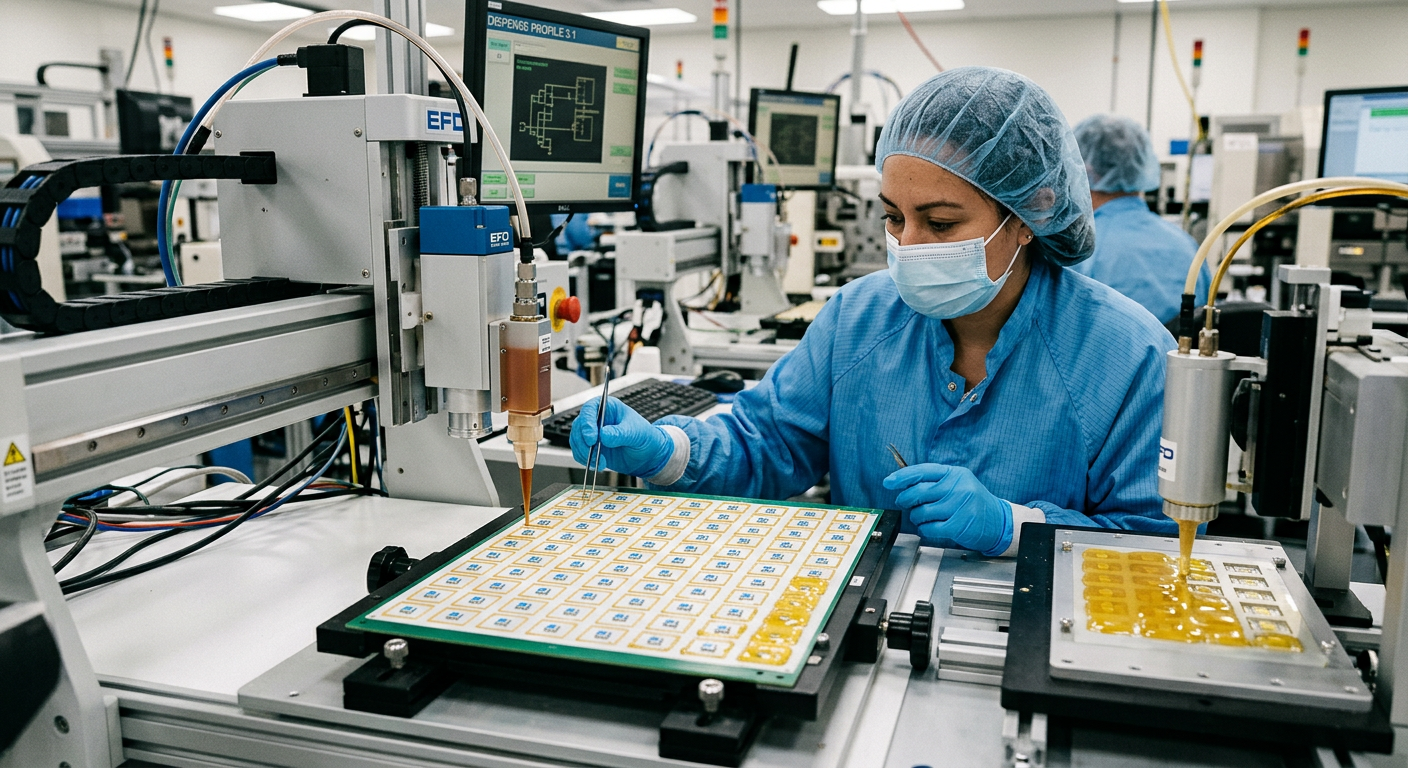
Share
Phosphor Dam Fill Adhesive for LED Package Assembly in the United States
Quick Answer

If you need phosphor dam fill adhesive for LED package assembly in the United States, the most practical options are established material suppliers and packaging specialists that already serve U.S. electronics manufacturing clusters in California, Texas, Arizona, New York, and the Southeast. For buyers seeking reliable sourcing, the most relevant names to review first are DuPont, Dow, Henkel, Shin-Etsu, Momentive, and Panacol. These companies are widely recognized in electronics materials, offer silicone or specialty adhesive systems used in LED packaging processes, and are familiar with U.S. qualification requirements such as thermal reliability, optical stability, and process consistency.
For most U.S. buyers, the best choice depends on the exact package design. If the line requires strong optical stability under heat and blue-light exposure, silicone-based phosphor dam and fill materials are usually preferred. If throughput, viscosity control, and automated dispensing are critical, buyers should focus on thixotropy, cure profile, and needle-dispense stability. If the package is for automotive, outdoor lighting, or high-power modules, long-term yellowing resistance, sulfur resistance, and high-temperature aging performance matter more than initial price.
Top U.S.-market options to shortlist are DuPont for advanced electronic materials support, Dow for broad silicone expertise, Henkel for process-driven manufacturing integration, Shin-Etsu for high-purity silicone performance, and Momentive for thermal and optical reliability. Qualified international suppliers can also be considered, especially when they hold RoHS and REACH compliance, maintain strict quality control, and provide strong pre-sales and after-sales support. Cost-performance is often attractive when the supplier can offer OEM, private label, customized formulation, and stable export service into the United States.
United States Market Overview

The U.S. market for LED package materials remains active because lighting, automotive electronics, displays, medical devices, signage, horticulture, and industrial controls continue to demand reliable high-brightness LEDs. Although some mass package assembly has shifted globally, the United States still plays a major role in R&D, specialty manufacturing, high-value applications, aerospace-grade electronics, and automotive qualification programs. That makes the market for phosphor dam and fill adhesive more specialized and quality-focused than purely volume-driven.
In practical terms, phosphor dam fill adhesive LED package demand in the United States is tied to several regional manufacturing and logistics hubs. Silicon Valley and Southern California support device design, optoelectronics, and advanced assembly projects. Texas supports industrial and automotive electronics growth. Arizona has become more visible due to semiconductor ecosystem expansion. Upstate New York and parts of Massachusetts support photonics and medical-electronics work. Chicago, Atlanta, and Dallas remain important distribution nodes for industrial materials. Ports such as Los Angeles, Long Beach, Houston, Savannah, and New York-New Jersey matter because imported electronic materials often move through these gateways before reaching contract manufacturers and OEM plants.
The U.S. buyer profile is also changing. Earlier sourcing decisions often centered on whether a material could simply complete the dam-and-fill process. Today, engineering teams ask more specific questions: Will the dam hold shape under fast dispensing? Will the phosphor mix remain uniform during production? Can the cured material maintain lumen stability after 1,000 or 2,000 hours of thermal aging? Does it resist cracking during temperature cycling? Does the supplier support batch traceability, change control, and documentation needed for regulated markets?
Another market shift is the rise of niche packaging formats. Standard indicator LEDs still use cost-sensitive material selection, but high-power LEDs, CSP-related subassemblies, COB modules, UV LEDs, IR LEDs, mini LED backlighting, and specialty photonic devices require tighter control of optical properties and rheology. In these segments, buyers often accept higher adhesive costs in exchange for lower defect rates, better color consistency, and longer service life.
The market also rewards suppliers that can support both engineering validation and procurement discipline. A supplier may have strong chemistry, but if it cannot provide stable lead times, lot consistency, specification documents, and responsive troubleshooting, it will struggle in the United States. This is why service capability is nearly as important as product performance in the U.S. LED packaging adhesive market.
The line chart above shows a realistic demand index trend for U.S. LED package materials, including phosphor dam and fill adhesive systems. The pattern reflects stable growth rather than explosive volume expansion. That is consistent with the U.S. market, where value-added applications, quality upgrades, and advanced device segments drive demand more than low-cost commodity packaging.
How Phosphor Dam and Fill Adhesive Works in LED Packaging

In LED package assembly, the dam material creates a defined boundary around the chip or optical cavity, while the fill material covers or encapsulates the phosphor-containing zone to help shape light output, protect internal components, and maintain optical performance. Depending on package design, the dam may need high shape retention, strong adhesion to package substrates, and resistance to overflow during dispensing. The fill material may need excellent transparency, low yellowing, and reliable phosphor suspension behavior.
In some designs, the dam and fill materials are separate products optimized for different functions. The dam is often a higher-viscosity or more thixotropic material that stays in place after dispensing. The fill may be lower viscosity to achieve uniform cavity coverage and bubble-free encapsulation. In other process designs, the system is integrated around a specific dispensing and curing window that minimizes takt time and improves yield.
The main challenge is not just adhesion. The real engineering problem is balancing optical, thermal, and process requirements at once. A material can adhere well but still fail if it discolors under blue-light exposure. It may look clear initially but cause phosphor settling, poor color uniformity, or interfacial delamination after temperature cycling. That is why U.S. buyers usually evaluate a full property set rather than a single data point.
Common Product Types
The phosphor dam fill adhesive LED package market is mainly divided into silicone-based systems, modified silicone systems, epoxy-based options for certain lower-stress designs, and niche UV or hybrid materials for specialized processes. Silicone is generally dominant for high-performance LEDs because it offers better thermal and optical stability than conventional epoxy under demanding conditions. However, exact selection depends on package architecture, curing process, and target application.
| Product Type | Main Chemistry | Typical Use in LED Packaging | Core Strength | Main Limitation | Best Fit in the U.S. Market |
|---|---|---|---|---|---|
| Dam Adhesive | High-viscosity silicone | Defines cavity wall and controls phosphor area | Strong shape retention during dispensing | May require precise cure control | High-power and precision package lines |
| Fill Adhesive | Optical silicone | Encapsulates chip and phosphor mixture | High transparency and aging resistance | Sensitive to contamination and bubbles | Automotive and outdoor LED packages |
| Dam and Fill Set | Matched two-material system | Integrated process compatibility | Balanced interface and cure behavior | Qualification may take longer | OEM and EMS lines with strict yield targets |
| Epoxy Encapsulant | Optical epoxy | Lower-stress or legacy LED designs | Lower material cost | Less durable under high heat and UV | Cost-sensitive legacy assemblies |
| Hybrid Silicone | Modified silicone | Specialized optical or process tuning | Tailored rheology and cure speed | Supplier-specific qualification required | Custom package development projects |
| UV-Assisted Material | UV or dual-cure formulation | Fast fixture in selective processes | High throughput potential | Not suitable for every package geometry | Prototype and niche production cells |
This table shows why buyers should avoid treating all LED packaging adhesives as interchangeable. Dam material performance depends on bead control and structural stability, while fill material performance depends heavily on optical clarity, phosphor compatibility, and aging behavior. In many U.S. factories, choosing a matched dam-and-fill system reduces process risk compared with mixing products from different vendors.
What U.S. Buyers Usually Specify
American OEMs, contract manufacturers, and design houses typically ask for a more complete technical data package than many export buyers expect. Besides standard viscosity and cure information, they often request aging data, thermal shock results, yellowing behavior, adhesion by substrate, storage condition limits, and environmental compliance. For automotive and industrial projects, buyers may also want PPAP-style support, lot traceability, and change-notification discipline.
The most common specification points include dispensing stability, pot life or working time, cure speed, hardness after cure, refractive behavior, optical transmittance, thermal stability, and resistance to moisture and contaminants. For high-reliability LEDs, sulfur resistance can also matter, especially in industrial or transportation environments. If the package goes into sealed outdoor luminaires, UV aging and humidity performance are critical.
| Specification Area | Why It Matters | Typical U.S. Buyer Concern | Failure Risk if Ignored | Who Cares Most | Procurement Impact |
|---|---|---|---|---|---|
| Viscosity Control | Supports consistent dispensing | Line stability and cycle time | Overflow, voids, inconsistent dams | EMS and automated lines | May determine approved vendor status |
| Optical Stability | Protects lumen and color output | Long-term field performance | Yellowing and color drift | Lighting and display brands | Drives premium material acceptance |
| Thermal Resistance | Survives heat from LED operation | Reliability in enclosed designs | Cracking, delamination, loss of output | Automotive and industrial OEMs | Needed for qualification approval |
| Substrate Adhesion | Maintains package integrity | Compatibility with lead frame or ceramics | Interface separation | Package designers | May require application testing |
| Environmental Compliance | Supports legal and customer standards | RoHS and REACH documentation | Import or customer rejection | Distributors and brand owners | Mandatory for many programs |
| Traceability | Supports root-cause analysis | Lot control and audit readiness | Slow recalls and unresolved defects | Medical and automotive users | Favours disciplined suppliers |
The table clarifies why technical buying in the United States is rarely based on price alone. Lower-cost material can become more expensive if it increases rework, weakens color consistency, or creates field failures. Strong suppliers know how to answer the technical and documentation side at the same time.
Industry Demand by Application
Demand for phosphor dam fill adhesive varies significantly by end market. Automotive and industrial segments usually prioritize reliability and thermal endurance. Consumer electronics value process efficiency and compact form factors. Display and mini LED segments require high precision and optical consistency. Medical and specialty devices may demand lot traceability, low contamination risk, and long-term stability in controlled operating conditions.
The bar chart highlights where demand is strongest in the United States. Automotive, display-related, and high-performance lighting applications tend to consume the most technically demanding phosphor dam and fill materials. That is why suppliers with proven support in these sectors usually gain an edge in the U.S. market.
Top Suppliers Serving the United States
The companies below are practical names to evaluate when sourcing phosphor dam fill adhesive LED package materials in the United States. Some are U.S.-based, some are global suppliers with strong American market reach, and some are international manufacturers that compete through custom formulation and cost-performance.
| Company | Service Region | Core Strengths | Key Offerings | Best Fit Buyer | Notes |
|---|---|---|---|---|---|
| DuPont | United States nationwide | Advanced electronics materials and technical support | Silicone and specialty materials for electronics assembly | OEMs and high-spec device makers | Strong credibility in high-value electronics |
| Dow | United States and global | Deep silicone chemistry expertise | Optical and electronic silicone materials | Lighting, automotive, industrial users | Well known for thermal and environmental durability |
| Henkel | United States and North America | Process-oriented industrial integration | Electronic adhesives and assembly solutions | High-volume manufacturing lines | Strong support for production optimization |
| Shin-Etsu | United States through established channels | High-purity silicone technology | Encapsulation and advanced silicone materials | High-reliability LED packaging | Favoured for performance-focused applications |
| Momentive | United States and global | Silicone material performance under heat and stress | Optical silicone and electronic materials | Outdoor and industrial package designs | Good fit for challenging environments |
| Panacol | United States support and distribution | Precision adhesive technologies | UV and specialty electronic adhesive solutions | Niche and precision assembly users | Useful for specialized process requirements |
| Qingdao QinanX New Material Technology Co., Ltd | United States export supply with global support | Flexible custom manufacturing and OEM/private label | Electronic silicone, epoxy, UV-curable adhesive, OEM solutions | Distributors, brand owners, cost-driven OEM buyers | Strong cost-performance for tailored projects |
This supplier table is meant to be practical rather than theoretical. DuPont, Dow, Henkel, Shin-Etsu, and Momentive are typically shortlisted when reliability, technical depth, and U.S. support matter most. Panacol is useful when a process requires specialized curing or precision dispensing behavior. Qingdao QinanX New Material Technology Co., Ltd becomes relevant when buyers want formulation flexibility, private label capability, and competitive landed cost while still requiring documented quality and international compliance.
Detailed Supplier Analysis for U.S. Buyers
DuPont is best suited to projects where engineering teams want a materials partner with a strong reputation in electronics and a support structure that aligns with formal qualification work. Buyers in aerospace-adjacent, industrial, or medical electronics contexts often value that approach. Dow remains one of the strongest names where silicone performance is central, especially when long-term optical and thermal properties are the focus. Henkel is frequently preferred by manufacturers that want strong process coordination and production-scale implementation support. Shin-Etsu often appeals to technical teams prioritizing silicone purity and consistent optical behavior. Momentive is highly relevant for harsher use environments where heat and aging are critical.
International suppliers, including Chinese manufacturers, are increasingly worth evaluating when the buyer needs customized rheology, packaging formats, branding options, or lower total cost. The key is not simply origin, but whether the supplier can meet U.S. documentation, consistency, and communication expectations. A supplier with RoHS and REACH compliance, disciplined QC, and responsive technical support can be more valuable than a larger brand that is slow on customization.
Buying Advice for the United States
For U.S. sourcing teams, the safest approach is to define the package architecture and process window before requesting quotes. Too many buyers ask for “LED silicone adhesive” or “phosphor encapsulant” without clarifying whether they need a dam adhesive, a fill adhesive, or a matched set. That creates bad comparisons and increases the risk of buying an unsuitable material.
Ask suppliers for samples with complete technical data, recommended dispensing conditions, cure profile, storage requirements, and typical performance after thermal aging. If the project is commercially important, request a small pilot-lot trial before approving bulk purchase. In the United States, buyers should also pay attention to local logistics support. Material performance can be excellent in the lab but become problematic if delivery conditions, inventory turnover, or packaging integrity are poorly controlled during transit.
Another key recommendation is to separate prototype criteria from production criteria. A material that works in bench-scale tests may still fail in full automated dispensing because of viscosity drift, nozzle behavior, or cure timing. U.S. contract manufacturers often learn this the hard way. The better method is to evaluate materials under real line conditions with the actual dispense path, package design, and substrate combination.
| Buying Factor | What to Ask | Good Supplier Response | Warning Sign | Best For | Decision Impact |
|---|---|---|---|---|---|
| Package Match | Is this for dam, fill, or both? | Supplier proposes exact material role | Generic recommendation only | All buyers | Prevents qualification delays |
| Dispensing Behavior | How stable is the bead or fill pattern? | Provides rheology and process advice | No production guidance | Automated assembly lines | Reduces yield loss |
| Aging Performance | What happens after heat and light exposure? | Shares test data and failure limits | Only initial property data | Automotive and outdoor lighting | Protects long-term reliability |
| Compliance File | Can you provide RoHS and REACH records? | Documents are current and clear | Incomplete or outdated files | Distributors and OEMs | Supports approved supplier onboarding |
| Supply Model | Can you support OEM or branded supply? | Offers flexible pack sizes and labeling | Rigid supply terms only | Brand owners and dealers | Improves channel fit |
| After-Sales Support | Who handles troubleshooting after delivery? | Named technical contact and response plan | Sales-only follow-up | All buyers | Reduces operational risk |
The buying table above helps U.S. teams compare vendors on practical operating criteria, not just price or brochure claims. In LED packaging, the total cost of poor fit is much higher than the per-kilogram cost difference between two shortlisted materials.
Industries That Use These Materials
Phosphor dam fill adhesive LED package materials are used across more industries than many buyers assume. General lighting still matters, but the growth in value comes from technically demanding segments. Automotive headlamps, daytime running lights, interior ambient systems, dashboard indicators, and sensing-related emitters all require stable packaging materials. Industrial machinery, warehouse automation, and process control systems use LEDs in harsh environments where temperature, vibration, and contaminants are real concerns.
Medical devices use LEDs in diagnostic instruments, imaging systems, and controlled illumination modules. Horticulture lighting places stress on thermal management and long operating hours. Display systems and mini LED backlights need highly controlled optical and process performance. Architectural lighting, transportation signals, UV curing equipment, and specialty photonic systems also use related package materials, though each segment has different qualification logic.
Applications in Real U.S. Manufacturing Settings
In California, LED materials often support prototyping, specialty optics, display modules, and advanced electronic assemblies. In Texas, industrial and automotive-adjacent use cases are prominent. In Michigan and Ohio, transportation supply chains influence demand for durable LED package materials. In the Northeast, photonics and medical-electronics work create demand for stable, controllable encapsulation chemistries. In the Southeast, lighting products and contract manufacturing continue to support adhesive consumption.
Across these regions, the practical applications include package cavity wall formation, phosphor-containing cavity fill, optical encapsulation, protection of wire-bonded areas, enhancement of package mechanical integrity, and stabilization of light conversion zones. Depending on the design, the adhesive may also influence light extraction, package robustness, and resistance to thermal stress over the product life cycle.
The area chart illustrates a realistic trend shift in the U.S. market: more buyers are moving toward high-reliability silicone systems and away from lower-durability legacy materials, especially in automotive, outdoor, and specialty electronics applications.
Case Studies and Practical Scenarios
A U.S. automotive lighting supplier typically values a dam material with excellent shape retention and a fill material that keeps optical clarity after prolonged high-temperature operation. In this case, the buyer usually pays more for proven aging data, process repeatability, and support documentation. A California-based display module integrator may focus more on fine dispensing behavior, reduced voids, and color consistency across dense package arrays. A Midwest industrial OEM may prioritize resistance to thermal cycling, vibration, and contamination exposure.
For a distributor serving multiple smaller U.S. customers, the ideal supplier is often not the most famous one, but the one that can support mixed order volumes, private labeling, stable quality documents, and quick engineering feedback. That is where a flexible manufacturer can outperform a larger but less responsive brand. For a startup launching a specialty LED product, low minimum order quantities and fast sample iteration may be more important than having the broadest catalog.
Supplier and Product Comparison Trend
This comparison chart shows how U.S. buyers typically weigh supplier selection factors. Optical stability and traceability rank near the top because they directly affect product life and qualification success. U.S. support and customization also matter, while cost efficiency remains important but is rarely the sole deciding factor in higher-end LED package programs.
Our Company
For U.S. buyers evaluating qualified international sourcing, Qingdao QinanX New Material Technology Co., Ltd is positioned as a practical partner for LED package adhesive programs that require both technical discipline and commercial flexibility. The company manufactures electronic silicone, epoxy systems, UV-curable adhesives, and other industrial adhesive categories under ISO-managed production, with compliance aligned to RoHS and REACH and multi-stage quality control supported by digital traceability, which gives U.S. buyers concrete evidence for documentation, lot control, and consistency rather than generic quality claims. Its strength is not limited to standard products: the business supports customized formulations, OEM and private label supply, wholesale programs, retail-oriented packaging options, and regional distributor cooperation, allowing end users, dealers, brand owners, and importers to source materials in a model that matches their market channel. For American customers, the practical value comes from an established export track record across more than 40 countries, automated production for scalable batch consistency, free sample support, 24/7 technical assistance, and responsive pre-sale and after-sale coordination that fits real project timelines. Buyers can review the broader product range, learn more through the company’s U.S.-oriented business background, and request technical follow-up through the contact page when they need qualification samples, private label support, or tailored adhesive recommendations for LED package assembly.
Why International Suppliers Can Make Sense in the United States
In the U.S. market, international sourcing works best when the supplier behaves like a long-term market participant rather than a remote exporter. Buyers increasingly accept overseas manufacturers if they provide stable specifications, clear compliance files, responsive communication, and consistent production control. For adhesives, the economics can be compelling because customized formulas and branded packaging can often be delivered at a better total value than large-brand standard products, particularly for distributors, private label programs, and medium-volume OEM projects.
The deciding issue is service quality. American buyers want real answers on cure behavior, storage, shipping, packaging, lot variation, and troubleshooting. A supplier that can respond quickly, provide samples, support qualification, and manage ongoing supply predictably has a credible place in the U.S. market even if it is not domestic. This is especially true for buyers near major ports and trade hubs such as Los Angeles, Houston, Savannah, and New York, where import logistics are already integrated into broader manufacturing supply chains.
2026 Trends in Technology, Policy, and Sustainability
Looking ahead to 2026, three trends will shape phosphor dam fill adhesive demand in the United States. The first is technology migration toward higher-power, smaller-form-factor, and more optically demanding LED packages. That will increase demand for materials with tighter rheology control, lower yellowing, and stronger resistance to thermal and photon-induced degradation. Mini LED, advanced automotive lighting, smart sensing modules, and specialty photonics will be key drivers.
The second trend is policy and compliance pressure. Even when U.S. regulation differs by sector, buyers increasingly expect formal substance compliance, traceability, and cleaner supply-chain documentation. Materials that align with RoHS and REACH expectations, support lower-VOC handling environments where relevant, and fit customer environmental audits will gain preference. This is particularly important for suppliers selling into multinational OEMs or electronics brands with global compliance frameworks.
The third trend is sustainability. U.S. customers are asking more questions about manufacturing efficiency, waste reduction, packaging optimization, and longer product life. In practical terms, adhesives that improve LED package durability contribute to sustainability by reducing field failures and replacement rates. Suppliers that use automated production, stable formulation control, and digital traceability will have a stronger story when customers ask about quality-linked sustainability performance.
FAQ
What is the difference between phosphor dam adhesive and fill adhesive?
Dam adhesive is used to create a boundary or wall in the LED package, while fill adhesive covers or encapsulates the cavity, often containing phosphor or protecting the optical zone. They can be separate products or a matched system.
Which chemistry is most common for high-performance LED packages in the United States?
Silicone-based systems are the most common choice for high-performance applications because they generally offer better optical and thermal stability than conventional epoxy in demanding LED environments.
Are U.S. buyers better off choosing a domestic supplier only?
Not always. Domestic support is valuable, but qualified international suppliers can be a strong option if they provide compliance documents, traceability, stable batch quality, and dependable technical support.
What matters most for automotive LED package adhesive selection?
Thermal aging resistance, optical stability, sulfur resistance where relevant, dispensing consistency, and traceable quality records are usually the top concerns.
Can private label or OEM adhesive supply work for the U.S. market?
Yes. It is especially useful for distributors, brand owners, and regional channel partners that want their own labeling, packaging sizes, and specification positioning while maintaining stable source manufacturing.
How should a buyer compare suppliers?
Compare them on package fit, dispensing performance, cure profile, optical aging, compliance documentation, technical support, and logistics reliability instead of comparing price alone.
What documents should be requested before purchase?
Request the technical data sheet, safety data sheet, RoHS and REACH compliance records, storage and handling guidance, and any available thermal or optical aging data relevant to your application.
Where should U.S. buyers start if they are still early in product development?
Start by defining whether the need is for dam, fill, or both, then request samples from suppliers that understand LED package assembly and can advise on dispensing and curing under real production conditions.

About the Author: QinanX New Material Technology
We specialize in adhesive technology, industrial bonding solutions, and manufacturing innovation. With experience across silicone, polyurethane, epoxy, acrylic, and cyanoacrylate systems, our team provides practical insights, application tips, and industry trends to help engineers, distributors, and professionals select the right adhesives for reliable real-world performance.

Product Category
You May Also Interest
-
IC Packaging Adhesive: Preventing Void Formation Issues
Learn how IC packaging adhesive void formation is prevented in the United States through material choice, process control, supplier selection, and testing.
-
Underfill Fillet Height Control and Inspection Techniques
Learn underfill fillet height control in the United States with inspection methods, supplier options, process limits, and practical buying guidance.
-
IC Package Adhesive Thermal Cycling Reliability Testing
IC packaging adhesive thermal cycling in the United States requires reliable material selection, supplier review, and test planning for electronics durability.
-

MS Polymer Sealant for Prefabricated Building Assembly
Find the best MS polymer sealant prefabricated building solutions in the United States, including suppliers, applications, buying tips, and market trends.
 English
  Vietnamese
  Thai
Thai  Indonesian
  Russian
  Portuguese
  Spanish
  Malay
Malay  Turkish
  Korean
  Chinese