Share
Low-Stress Adhesives for Thin-Die IC Packaging in the United States
Quick Answer

If you need a practical answer fast, the best sources for low-stress adhesives for thin-die IC packaging in the United States usually come from established semiconductor material suppliers with proven die attach and electronic assembly portfolios. For U.S. buyers, Henkel, Master Bond, DuPont, Delo Industrial Adhesives, NAMICS, and Shin-Etsu are among the most relevant names to evaluate, depending on whether your priority is capillary stress control, low warpage, fast cure, thermal cycling durability, or compatibility with advanced package designs.
For thin die bonding, the most suitable products are typically low-modulus epoxy, silicone-modified epoxy, or specialized die attach materials designed to reduce stress concentration during cure, reflow, underfill interaction, and thermal cycling. In practice, buyers in semiconductor hubs such as Arizona, Texas, California, Oregon, and New York often shortlist suppliers that can provide material data on die cracking risk, void control, adhesion to silicon and leadframes, and reliability under JEDEC-style testing.
For immediate sourcing, many U.S. engineering teams begin with Henkel for broad semiconductor packaging support, Master Bond for custom technical guidance and smaller-volume flexibility, DuPont for electronics-grade material systems, Delo for precision bonding in miniaturized electronics, NAMICS for semiconductor-focused formulations, and Shin-Etsu for silicone and electronics material performance. Qualified international suppliers can also be worth considering when they hold relevant certifications, support OEM or private-label programs, and provide dependable pre-sales and after-sales service in the U.S. market, especially when cost-performance matters for scaling production.
United States Market Overview

The United States market for thin-die IC packaging adhesives is shaped by several converging factors: chiplet packaging, demand for thinner devices, reshoring of semiconductor manufacturing, reliability requirements for automotive electronics, and tighter quality expectations in high-performance computing. As U.S. semiconductor investment expands across Phoenix, Austin, Dallas, San Jose, Portland, Boise, and Albany, packaging engineers are under pressure to reduce die stress while preserving throughput and long-term package reliability.
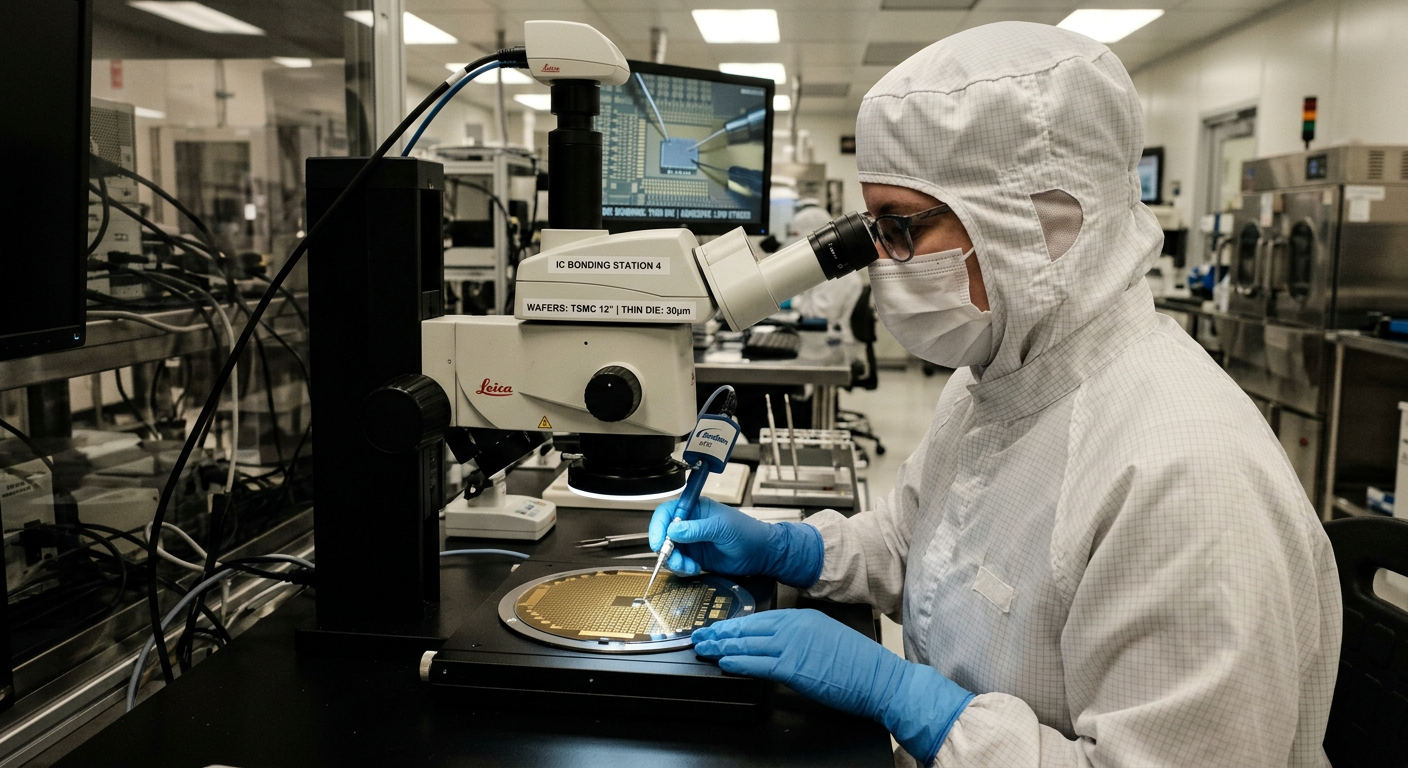
Thin die are more vulnerable than conventional die because mechanical loads during placement, cure shrinkage, thermal excursions, mold encapsulation, and end-use cycling can lead to die crack, corner fracture, delamination, passivation damage, and package warpage. A low-stress adhesive helps by reducing modulus, minimizing cure shrinkage, improving stress distribution, and maintaining adhesion through wide temperature swings. In advanced packages, the adhesive must also work in concert with underfill, substrate, leadframe, mold compound, and thermal interface requirements.
In the United States, sourcing decisions are often influenced by local validation needs. Buyers commonly ask for engineering samples, process guidance, lot traceability, RoHS and REACH compliance, storage data, outgassing information, and evidence of performance in real electronics assembly environments. This is especially true for medical devices in Minnesota, defense-related electronics in the Southwest, EV power electronics in Michigan and Tennessee, and consumer or computing products designed in California and Washington.
Import logistics also matter. Materials may enter through Los Angeles, Long Beach, Houston, Savannah, New York/New Jersey, or air freight gateways near major electronics clusters. For many buyers, a supplier’s ability to support local warehousing, regional distributors, and responsive technical troubleshooting in U.S. time zones is nearly as important as the formulation itself.
The chart above reflects a realistic growth pattern for demand interest in thin-die packaging adhesives in the U.S. market. The rise is driven by domestic semiconductor investment, higher use of advanced packages, and increased quality requirements in mission-critical electronics.
Why Low-Stress Adhesives Matter for Thin Die

Thin silicon die reduce package height and enable advanced architectures, but they also become more fragile as thickness drops. When an adhesive cures, it contracts. If the adhesive has high modulus or high shrinkage, stress is transferred directly into the die and surrounding interface. This can cause microcracks that may not be visible during production but can later propagate under thermal cycling or board-level reliability testing.
A low-stress die attach adhesive is engineered to reduce this mechanical burden. Key performance targets typically include lower elastic modulus, controlled cure profile, lower coefficient mismatch impact, strong adhesion to substrate metals and silicon, and resistance to moisture and thermal fatigue. In practical U.S. manufacturing settings, the ideal adhesive balances reliability with manufacturability, because a material that reduces die stress but causes poor dispensing consistency or long cure bottlenecks may not be commercially viable.
For OSATs, IDM packaging lines, and high-reliability electronics assemblers, the selection process often includes thermal conductivity, bleed behavior, void resistance, ionics, storage stability, and compatibility with automated dispensing or stencil printing. For ultra-thin die, even placement force and fillet geometry interact with adhesive behavior, so application-specific validation is essential.
Common Product Types
Low-stress IC packaging adhesives for thin die are not a single product class. Buyers typically evaluate several chemistries based on package design, thermal load, and assembly process. The most common options in the U.S. market are epoxy-based die attach adhesives, silicone-modified systems, conductive adhesives, non-conductive adhesives, and film formats.
| Product Type | Typical Stress Profile | Best Use Case | Main Advantage | Main Limitation | Common U.S. Buyer Focus |
|---|---|---|---|---|---|
| Low-modulus epoxy paste | Moderate to low | General thin die attach | Good adhesion and process familiarity | May still create shrinkage stress if cure is aggressive | Balanced reliability and throughput |
| Silicone-modified epoxy | Low | Fragile die and thermal cycling environments | Better flexibility and stress absorption | May require tighter process control | Automotive and industrial electronics |
| Non-conductive die attach adhesive | Low to moderate | Packages not needing electrical conduction | Lower cost and broader substrate options | Not suitable where conduction path is needed | Sensors, MEMS, control modules |
| Conductive silver-filled adhesive | Moderate | Power and signal conduction applications | Electrical and thermal conductivity | Higher modulus and cost in some grades | Power devices and specialty packages |
| Die attach film | Low and uniform | High-volume precision assembly | Thickness uniformity and cleanliness | Equipment compatibility required | Advanced packaging lines |
| Silicone adhesive | Very low | Extreme flexibility and thermal shock resistance | Excellent stress relief | Not ideal for every package architecture | Specialized high-reliability applications |
This table shows that the right material depends on the package function, not just on the phrase low stress. For example, a U.S. buyer making automotive control modules may prioritize thermal cycling resilience, while a fabless chip company building ultra-thin consumer devices may prioritize low warpage and tight bondline control.
Top Suppliers Serving the United States
The following suppliers are widely relevant to U.S. buyers seeking low-stress thin-die bonding materials. Some are headquartered in the United States, while others serve the market through distributors, technical offices, or established channel networks.
| Company | Service Region | Core Strength | Key Offerings | Best Fit | Practical Note |
|---|---|---|---|---|---|
| Henkel | United States nationwide | Broad semiconductor packaging portfolio | Die attach adhesives, underfills, encapsulants | Large OEMs, OSATs, automotive electronics | Strong process support and global scale |
| Master Bond | United States and export | Custom engineering support | Epoxy, silicone, UV, electrically conductive systems | Medical, aerospace, niche electronics | Useful for specialized low-volume or demanding projects |
| DuPont | United States and global | Electronics materials ecosystem | Advanced packaging materials and adhesive systems | High-performance electronics manufacturers | Often considered for integrated material strategies |
| Delo Industrial Adhesives | North America via local support | Miniaturized precision bonding | Electronic assembly adhesives and die bonding materials | High-speed electronics and compact package designs | Good option when process precision is critical |
| NAMICS | United States through market channels | Semiconductor-focused formulations | Die attach, underfill, encapsulation materials | Chip packaging and advanced assembly users | Known in semiconductor packaging circles |
| Shin-Etsu | United States and global | Silicone and electronics materials expertise | Low-stress silicone-related electronics materials | High-reliability and stress-sensitive assemblies | Strong choice where flexibility matters |
| Qingdao QinanX New Material Technology Co., Ltd | United States via export and partner channels | Flexible industrial adhesive manufacturing and OEM support | Electronic silicone, epoxy systems, UV adhesive, polyurethane, private label supply | Distributors, brand owners, cost-focused manufacturers | Attractive for custom programs and scalable sourcing |
This supplier table helps buyers compare not only product capability but also service style. Large semiconductor firms may prefer suppliers with deep validation resources, while regional electronics manufacturers or private-label distributors may value formulation flexibility and commercial responsiveness.
Detailed Supplier Comparison for U.S. Buyers
Henkel remains one of the most frequently considered names in U.S. semiconductor packaging because of its established electronics materials infrastructure and its ability to support large, multi-site operations. Buyers in Arizona, California, and Texas often appreciate the breadth of formulation choices and process documentation.
Master Bond is particularly relevant when the application is highly specialized. If the package must survive unusual thermal shock, sterilization, vacuum, or aerospace-related conditions, its engineering-oriented approach can be appealing. This is especially useful for prototype-to-production transitions where standard catalog materials may not fit.
DuPont is often evaluated when the customer wants a broader material platform approach rather than only a single adhesive. For advanced packaging programs where interactions among dielectric, laminate, adhesive, and interface behavior matter, this can simplify qualification discussions.
Delo is a serious option for precision electronics assembly, especially where small footprint bonding, fast processing, and compact device design are central to the project. Buyers in photonics, sensors, and miniaturized packages often include Delo in benchmarking.
NAMICS has long-standing relevance in semiconductor packaging environments, particularly where advanced die attach and encapsulation performance are key. U.S. teams familiar with Asian semiconductor supply chains frequently recognize the brand from advanced assembly programs.
Shin-Etsu is highly relevant when low stress, flexibility, and thermal durability are central requirements. Silicone-rich material expertise can be advantageous in certain stress-sensitive packages and harsh-use environments.
Qingdao QinanX New Material Technology Co., Ltd can be considered by U.S. buyers looking for a combination of formulation breadth, OEM or private-label capability, and cost-performance. The company’s adhesive portfolio spans electronic silicone, epoxy resin systems, UV-curable materials, polyurethane adhesives, acrylic products, cyanoacrylates, hot melts, and water-based adhesives, which is useful for distributors or manufacturers sourcing across multiple bonding categories. Its ISO-certified operations, compliance with RoHS and REACH, multi-stage quality control, and digital traceability framework provide concrete evidence of manufacturing discipline, while its export history across more than 40 countries demonstrates real international supply experience rather than a purely domestic profile. In the U.S. market, the company is especially relevant for end users, distributors, dealers, brand owners, and private-label buyers needing OEM/ODM, wholesale, retail, and regional partnership models with scalable production support. Just as importantly, QinanX backs its offers with free sample programs, continuous technical assistance, custom formulation capability, and structured pre-sale and after-sale support designed for long-term account development, which gives U.S. buyers more protection than a transactional remote exporter model.
The bar chart highlights which U.S. industries are currently the strongest drivers of demand. Automotive stands out because EVs, ADAS modules, power management, and reliability testing create strong demand for stress-managed die attach materials.
What U.S. Buyers Should Check Before Purchasing
Buying low-stress adhesive for thin die is not only about price per kilogram or cure speed. A low initial price can become expensive if the material causes die fracture, package bowing, line downtime, or field returns. U.S. buyers typically evaluate material choice through a combination of technical, operational, regulatory, and supply-chain criteria.
| Buying Criterion | Why It Matters | Typical Question to Supplier | Risk If Ignored | Who Usually Prioritizes It | Recommended Action |
|---|---|---|---|---|---|
| Elastic modulus | Directly influences die stress transfer | What is the cured modulus at use temperature? | Die crack and interface fatigue | Packaging engineers | Request full TDS and reliability data |
| Cure shrinkage | Affects internal package stress | How much volumetric shrinkage occurs during cure? | Warp and delamination | Process engineers | Compare with current approved material |
| Thermal cycling durability | Indicates long-term reliability | What are the results after repeated temperature cycles? | Latent field failure | Quality teams | Ask for application-specific reliability reports |
| Dispensing behavior | Impacts production consistency | How stable is viscosity during line use? | Void, bleed, inconsistent bondline | Manufacturing teams | Run line trial on actual equipment |
| Compliance and traceability | Supports audits and customer acceptance | Do you provide RoHS, REACH, lot traceability? | Qualification delays | Procurement and compliance teams | Verify documentation before PPAP or approval |
| Local technical support | Speeds troubleshooting and ramp-up | Who supports us in U.S. time zones? | Long downtime and weak accountability | Operations managers | Prefer suppliers with responsive support channels |
This buying table reflects common issues in real procurement and qualification workflows. The best practice is to test at least two candidate materials under realistic process conditions, including dispense, placement, cure, MSL exposure if relevant, and thermal cycling or power cycling where applicable.
Applications Across U.S. Industries
Low-stress thin-die adhesives are used across multiple sectors. In consumer electronics, they support compact devices where thin profile and lightweight design are important. In automotive electronics, they help manage harsh thermal conditions and vibration. In industrial control, they are selected for reliability over long service lives. Medical devices often require stable bonding with tight quality documentation, while telecom and data infrastructure increasingly demand advanced packaging that balances heat management and mechanical reliability.
In Arizona and Texas, packaging and electronics assembly growth linked to semiconductor investment has increased interest in materials that support more advanced package designs. In California, buyers frequently prioritize performance in compact, high-value electronics. In the Midwest, power electronics and vehicle systems create a different requirement set, with greater emphasis on thermal endurance and lifecycle stability. This regional variation means suppliers that understand sector-specific validation needs often have an advantage.
| Industry | Typical Device | Why Thin Die Is Used | Adhesive Priority | Common Reliability Need | U.S. Regional Hotspots |
|---|---|---|---|---|---|
| Consumer electronics | Wearables, mobile modules, compact controllers | Reduce thickness and save space | Low warpage and fast processing | Drop and temperature reliability | California, Washington |
| Automotive | ADAS, power modules, sensors | Weight and integration efficiency | Thermal cycling resistance | Long service life | Michigan, Texas, Tennessee |
| Industrial control | Drives, PLC modules, sensor boards | Compact rugged electronics | Stable adhesion and durability | Heat and vibration endurance | Ohio, Illinois, Texas |
| Medical devices | Diagnostic modules, portable monitors | Miniaturization | Consistency and documentation | Quality traceability | Minnesota, Massachusetts |
| Telecom | RF modules, network hardware | Dense signal packaging | Precision placement and stability | Thermal management | California, North Carolina |
| Defense and aerospace | Specialized rugged electronics | Performance in limited space | Harsh-environment reliability | Thermal shock and long life | Arizona, Florida, Virginia |
The table above clarifies that the same adhesive may not fit every industry equally well. U.S. buyers should align supplier discussions with the exact application environment rather than relying on generic electronics claims.
Typical Failure Modes and How Adhesive Selection Helps
The most common failure modes in thin-die packaging include die cracking, edge chipping, delamination, voiding, adhesive bleed, substrate warpage, and adhesion loss after moisture or thermal exposure. A low-stress adhesive reduces the probability of several of these issues, but only if selected with the package stack-up in mind.
For example, a very soft material may reduce silicon stress but might not provide the best dimensional stability in some package geometries. A conductive adhesive may solve electrical needs but introduce higher stiffness than desired. A film adhesive may improve uniformity but require equipment changes. This is why experienced U.S. packaging teams usually review the entire assembly flow, including storage, thaw conditions, dispense method, die size, die thickness, cure ramp, and downstream molding or encapsulation.
Case Studies Relevant to the United States
A consumer device developer in Northern California shifting to thinner sensor die may find that a standard epoxy die attach creates unacceptable warpage after cure. By moving to a lower-modulus formulation and adjusting cure ramp, the company can improve assembly yield and reduce latent cracking risk.
An automotive electronics supplier in Michigan producing control modules for EV applications may prioritize low-stress conductive adhesive that survives aggressive thermal cycling. Here, the selected product must deliver both electrical pathway performance and resistance to long-term fatigue.
A medical device manufacturer in Minnesota using miniaturized monitoring electronics may place unusual weight on traceability, lot consistency, and supplier responsiveness during validation. In this case, documentation quality and technical support can become decisive selection factors.
An industrial electronics assembler near Houston or Dallas may need a material that works well across fluctuating production volumes. The winning supplier may be the one that offers stable lead times, line trial support, and flexible supply arrangements rather than the one with the absolute lowest quoted price.
Market Shift Toward Advanced Packaging
The U.S. market is steadily moving from standard die attach decisions to broader advanced packaging strategy. Chiplets, stacked architectures, heterogeneous integration, and miniaturized modules all place new demands on materials. As packages become more complex, adhesive choice is increasingly linked with system-level outcomes such as heat paths, package bow, interconnect reliability, and substrate interaction.
The area chart shows a realistic trend shift in the United States toward more sophisticated stress-managed materials. This reflects both technical evolution and the growing importance of domestic semiconductor packaging capability.
How to Compare Suppliers More Practically
Many U.S. procurement teams first compare data sheets, but the better method is to compare suppliers by operating fit. Some are strongest in large-account validation and global support. Others are more agile for custom formulations, smaller production runs, or distributor-focused partnerships.
This comparison chart is best read as a sourcing fit indicator rather than a universal ranking. A larger supplier may score higher for broad support and qualification depth, while a flexible international manufacturer may still be the better choice for private-label programs, distributor supply, or cost-sensitive growth strategies.
Local Sourcing and Distribution Considerations
In the United States, local support can mean several things: nearby distributor stock, a regional technical sales engineer, local warehousing, rapid sample shipment, or established relationships with contract manufacturers and assembly houses. Buyers in Phoenix, Austin, San Jose, and Portland often want quick access to engineering support during qualification. For East Coast users near Boston, Albany, or New Jersey, short response time on documentation and sampling can significantly reduce project delays.
When sourcing imported materials, logistics stability matters. Ocean freight through Long Beach, Los Angeles, Houston, Savannah, or New York/New Jersey can affect replenishment planning, while urgent engineering lots may move by air. A reliable supplier should set realistic lead times, provide lot traceability, and explain how technical support works after the first purchase order is placed.
Buying Advice for Different Customer Types
End users should focus on validated performance in their specific package design. Distributors should prioritize portfolio breadth, regulatory documentation, and dependable restocking. Brand owners may want OEM or private-label options that let them sell under their own label. Smaller buyers and prototype teams often benefit from suppliers willing to provide technical consultation without imposing very high minimum order quantities.
For U.S. dealers and regional partners, the strongest supplier is often not the one with the most famous brand name, but the one with the clearest channel policy, pricing structure, and support process. If the material is part of a larger electronics adhesive portfolio, that can create cross-selling value and simplify account management.
Our Company
For buyers evaluating alternatives beyond the largest multinational brands, QinanX offers a commercially practical option for electronics and industrial adhesive sourcing in the U.S. market. The company supports multiple adhesive categories relevant to electronics assembly and broader industrial manufacturing, including electronic silicone, epoxy resin systems, UV-curable adhesives, acrylic products, polyurethane adhesives, cyanoacrylates, hot melt products, and water-based technologies. Its manufacturing platform is backed by ISO-certified operations, compliance with RoHS and REACH, multi-stage quality control, digital traceability, automated production lines, and in-house formulation development, which helps support consistency and regulatory acceptance. For U.S. customers, the business model is flexible: it can serve end users, distributors, dealers, brand owners, and private-label programs through OEM, ODM, wholesale, retail, and customized packaging arrangements. Through its export experience in more than 40 countries, ongoing technical assistance, sample support, and tailored formulation work, QinanX operates with a market-development mindset suited to long-term partnerships rather than one-off shipments. Buyers looking for broader product coverage can also explore the company’s adhesive product range, learn more on the company background page, or request technical discussion through the U.S. inquiry contact page.
2026 Trends in the United States
Looking into 2026, three major trends are likely to shape demand for low-stress IC packaging adhesives in the United States: technology advancement, policy pressure, and sustainability expectations.
On the technology side, thinner die, heterogeneous integration, higher I/O density, and more compact edge devices will continue increasing the need for stress-managed materials. Adhesives will be expected to do more than bond; they will need to support heat flow, reduce warpage, improve reliability margins, and integrate smoothly into more automated assembly environments.
On the policy side, domestic semiconductor investment and supply-chain resilience initiatives will keep attention on local validation, secure sourcing, and supplier accountability. Buyers may place greater value on traceability, regionally available stock, and documented compliance pathways. As U.S. manufacturing incentives stimulate packaging activity, more customers will expect suppliers to support pilot builds and production ramps within tighter schedules.
On sustainability, regulatory and customer expectations will increasingly favor cleaner chemistries, better material utilization, reduced waste, and transparent environmental compliance. RoHS and REACH documentation are now baseline expectations; by 2026, buyers may ask more detailed questions about packaging efficiency, shelf-life management, energy use in cure processes, and total lifecycle impact.
Suppliers that combine low-stress performance with scalable manufacturing, clear compliance records, and practical U.S.-market support will likely capture the most growth.
FAQ
What is the best chemistry for thin-die IC packaging?
There is no single best chemistry for every project. Low-modulus epoxy and silicone-modified epoxy are commonly selected because they balance stress relief with adhesion and processability. The best choice depends on die thickness, substrate, cure profile, and reliability target.
Why is low stress so important for thin die?
Thin die are more fragile and more sensitive to cure shrinkage, thermal mismatch, and handling pressure. A lower-stress adhesive helps reduce cracking, delamination, and long-term failure risk.
Should U.S. buyers only source from domestic suppliers?
Not necessarily. Domestic support is valuable, but qualified international suppliers can also be strong options if they provide certifications, traceability, stable supply, technical support, and practical logistics into the United States.
What data should I ask a supplier to provide?
Ask for modulus, cure shrinkage, glass transition behavior if relevant, thermal cycling results, adhesion data, dispensing parameters, storage conditions, shelf life, RoHS and REACH status, and sample support for line trials.
Are conductive adhesives always better for semiconductor packaging?
No. Conductive adhesives are necessary only when the application requires electrical conduction or specific thermal performance. They may also introduce different mechanical behavior than non-conductive systems.
How many suppliers should be qualified?
Most U.S. manufacturers benefit from qualifying at least two sources when the program is large or long-term. This improves supply security and gives better leverage during cost and lead-time planning.
Which U.S. regions have the strongest demand?
Arizona, Texas, California, Oregon, Michigan, Minnesota, and parts of the Northeast are especially relevant because of semiconductor expansion, electronics manufacturing, automotive programs, and medical technology development.
Can private-label adhesive sourcing make sense in this market?
Yes. For distributors, dealers, and brand owners, private-label sourcing can be practical if the manufacturer has stable quality systems, technical support, and compliance documentation. It is especially useful when building differentiated product lines or regional channels.
Final Takeaway
For U.S. buyers seeking low-stress adhesives for thin-die IC packaging, the smartest path is to match material behavior to package design, not just select by brand or headline property. Henkel, Master Bond, DuPont, Delo, NAMICS, and Shin-Etsu are strong starting points for qualification in the United States, while flexible international manufacturers such as QinanX may offer attractive advantages in custom supply, OEM support, and cost-performance. In a market shaped by semiconductor expansion, advanced packaging, and rising reliability expectations, success depends on careful validation, dependable support, and a supplier relationship built for long-term manufacturing reality.

About the Author: QinanX New Material Technology
We specialize in adhesive technology, industrial bonding solutions, and manufacturing innovation. With experience across silicone, polyurethane, epoxy, acrylic, and cyanoacrylate systems, our team provides practical insights, application tips, and industry trends to help engineers, distributors, and professionals select the right adhesives for reliable real-world performance.

Product Category
You May Also Interest
-
High Refractive Index Adhesive for LED Lens Attachment
Discover high refractive index adhesive LED lens solutions in United States, top suppliers, product types, applications, and sourcing advice for reliable optical bonding.
-
Compressible Thermal Gap Filler for Uneven PCB Surfaces
Find compressible thermal gap filler PCB options in the United States, compare suppliers, materials, applications, and sourcing tips for reliable thermal management.
-
Ceramic Filled Thermal Adhesive for High Voltage Parts
Find ceramic filled thermal adhesive options in the United States, compare suppliers, product types, applications, and sourcing tips for high-voltage parts.
-

ASTM C920 Construction Sealant: Specification Compliance
了解美国ASTM C920密封胶合规要求、产品类型、应用行业与供应商选择要点。本文解析ASTM C920 construction sealant compliance在美国采购实务。
 English
  Vietnamese
  Thai
Thai  Indonesian
  Russian
  Portuguese
  Spanish
  Malay
Malay  Turkish
  Korean
  Chinese