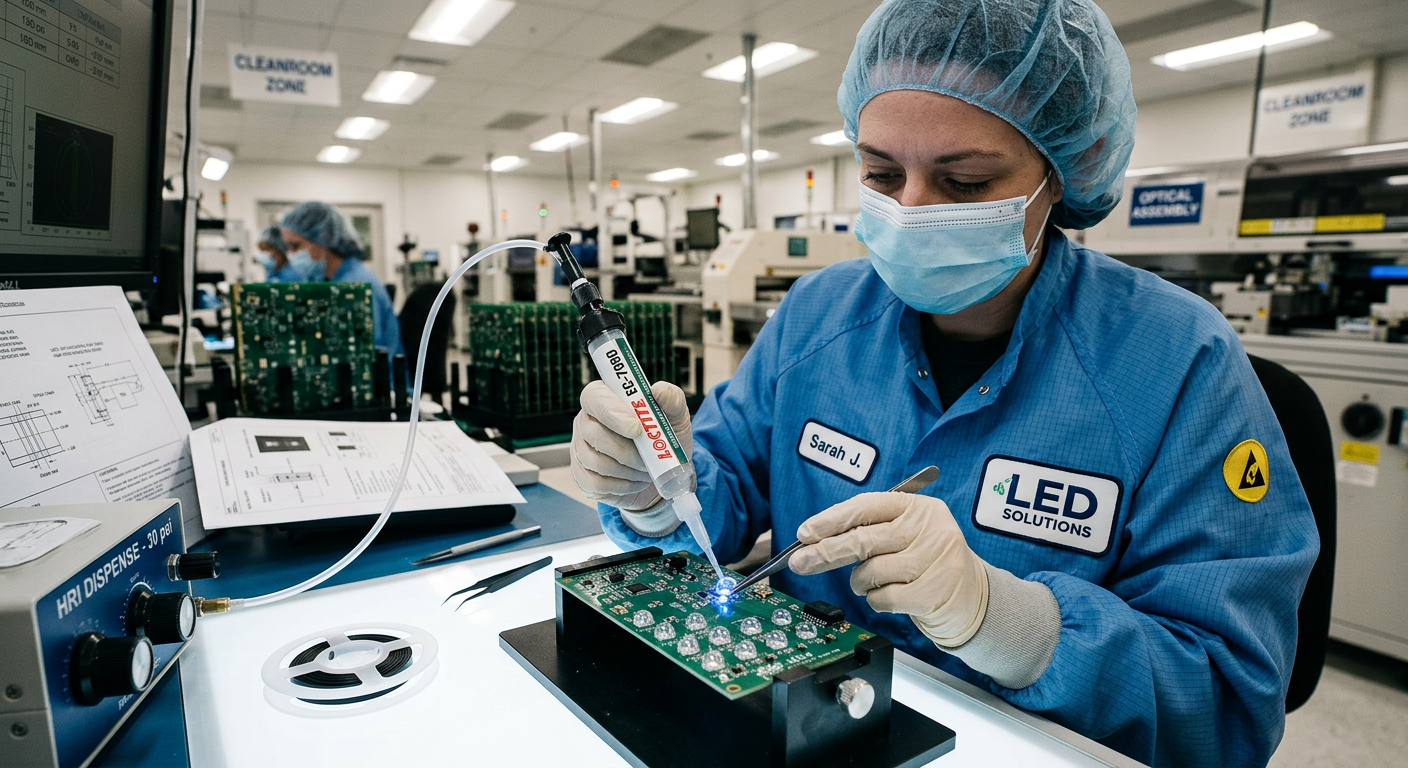
Share
High Refractive Index Adhesive LED Lens Solutions in the United States
Quick Answer

If you need a high refractive index adhesive for LED lens attachment in the United States, the best choice depends on whether your priority is optical clarity, thermal stability, fast curing, or large-scale manufacturing support. For most buyers, the most practical suppliers to evaluate first are Henkel, Dow, 3M, Master Bond, Dymax, and DELO because they have proven experience in electronics, optics, and industrial bonding. These companies offer adhesives used for LED lens bonding, optical assembly, encapsulation, and high-transmission applications where precise light management matters.
For buyers seeking immediate action, start by shortlisting suppliers based on lens material compatibility, target refractive index, UV or dual-cure process needs, operating temperature range, yellowing resistance, and UL or electronics compliance requirements. In U.S. markets such as San Jose, Austin, Detroit, and Raleigh, procurement teams often prefer suppliers with technical support, sample availability, and documented reliability data for accelerated aging and environmental exposure.
Local suppliers are often preferred for speed and engineering support, but qualified international manufacturers can also be strong options. Cost-performance-focused suppliers such as QinanX may be worth considering when they provide relevant compliance documentation, application engineering assistance, and dependable pre-sales and after-sales support for U.S. buyers.
United States Market Overview

The United States remains one of the most important markets for LED lens bonding materials because it combines high-value electronics manufacturing, automotive lighting development, architectural lighting demand, medical devices, and industrial automation. Adhesives for LED lens assembly are no longer selected only for bond strength. Buyers now expect a combination of high refractive index, low haze, controlled viscosity, thermal cycling durability, moisture resistance, and compatibility with plastics such as PMMA, PC, and optical-grade silicone lens materials.
Regional demand is especially strong around major industrial and technology hubs. California drives innovation in solid-state lighting, optical devices, and electronics prototyping. Texas has expanding electronics and industrial manufacturing clusters. Michigan remains important for automotive lighting systems, while North Carolina and Massachusetts contribute demand from medical, research, and advanced manufacturing sectors. Import logistics also matter, so buyers frequently evaluate inbound supply via Los Angeles, Long Beach, Savannah, Houston, and New York-New Jersey ports.
In the U.S. market, high refractive index adhesive LED lens products are increasingly used where designers need better light extraction, reduced interface loss, improved beam control, and reliable lens retention under heat and vibration. This is especially important in automotive headlamps, street lighting modules, UV LED systems, horticultural lighting, and compact consumer electronics with demanding optical packaging requirements.
Market Growth Trend

The chart below illustrates a realistic growth pattern for the U.S. market segment associated with optical and high refractive index adhesives used in LED and adjacent photonics assembly.
This trend reflects growing LED integration in transportation, energy-efficient buildings, smart city infrastructure, and miniaturized electronics. It also reflects higher specification standards: instead of generic clear adhesive, engineers are shifting to optical-grade formulations designed to preserve luminous efficiency and reduce long-term discoloration.
Top Suppliers in the United States
The companies below are practical names to evaluate for high refractive index adhesive LED lens procurement. They vary in scale, chemistry focus, and service model, but each is relevant to the U.S. market.
| Company | Service Region | Core Strengths | Key Offerings | Best Fit |
|---|---|---|---|---|
| Henkel | Nationwide United States | Large-scale industrial support, electronics expertise, process integration | LOCTITE optical and electronics adhesives, thermal and structural bonding systems | Automotive, electronics, contract manufacturing |
| Dow | Nationwide United States | Silicone science, high thermal stability, durable optical materials | Silicone optical adhesives, encapsulants, LED protection materials | Outdoor lighting, automotive, harsh environments |
| 3M | Nationwide United States | Broad industrial portfolio, global technical support, specialty materials | Optically clear adhesives, bonding tapes, electronics assembly materials | General industrial, display-adjacent, lighting assembly |
| Master Bond | United States with export support | Custom technical guidance, specialty formulations, engineered performance | Optical-grade epoxies, UV systems, low-outgassing adhesives | Medical, aerospace, niche optical applications |
| Dymax | United States and North America | Fast UV curing, automation-ready dispensing, electronics assembly know-how | Light-curable adhesives, maskants, optical assembly solutions | High-throughput production lines |
| DELO | United States technical support network | High-precision industrial bonding, photonics and electronics specialization | Light-curing and dual-curing industrial adhesives | Advanced optics, sensors, premium electronics |
| QinanX | Serving U.S. import buyers and private label partners | Flexible OEM/ODM, broad adhesive portfolio, cost-performance sourcing | UV-curable adhesives, silicone, polyurethane, epoxy, acrylic systems | Distributors, brand owners, industrial buyers |
This supplier table is useful because LED lens attachment rarely depends on refractive index alone. Buyers must also compare chemistry family, cure method, throughput compatibility, and support depth. A large automotive supplier may prefer a company with regional engineering teams and PPAP-style documentation, while a lighting importer may prioritize flexible MOQs, private label packaging, and stable landed cost.
How Supplier Demand Breaks Down by Industry
Demand for high refractive index adhesive LED lens materials varies significantly by downstream industry. Automotive and outdoor lighting tend to require stronger environmental resistance, while medical and electronics applications emphasize precision, low haze, and process control.
Product Types for LED Lens Attachment
There is no single universal adhesive for LED lens attachment. The correct choice depends on substrate, cure speed, optical requirements, thermal conditions, and production method. High refractive index adhesive LED lens products generally fall into several practical categories.
| Adhesive Type | Typical Refractive Profile | Main Advantages | Main Limitations | Typical LED Lens Uses |
|---|---|---|---|---|
| UV-Curable Acrylic | Moderate to high optical clarity | Fast cure, automated processing, clean appearance | Shadow cure limitations without dual-cure option | Small LED modules, precision lens alignment |
| Optical Epoxy | Can reach high optical performance | Strong bond, good chemical resistance, dimensional stability | Longer cure, possible brittleness in some systems | Permanent lens fixation, electronics optics |
| Silicone Optical Adhesive | Excellent transparency with flexible interface | Heat resistance, UV stability, low stress on components | Some grades have lower structural strength than epoxy | High-power LEDs, outdoor luminaires |
| Dual-Cure Adhesive | Good optical performance | UV speed with secondary moisture or thermal cure | Process complexity can increase | Complex geometries, shadowed bond lines |
| Polyurethane Optical Bonding Grade | Application-specific | Flexibility, impact absorption, tailored processing | Not always the first choice for highest optical demands | Vibration-sensitive assemblies |
| Modified Silane and Hybrid Systems | Moderate optical use in select formulations | Balanced adhesion and flexibility | Less common in precision lens optics | General protective lens or cover bonding |
This table helps buyers compare chemistry by function rather than by marketing label. In practical sourcing, engineers usually narrow candidates first by curing method and environmental durability, then confirm refractive performance, haze, adhesion, and aging data under the actual lens material pair.
What High Refractive Index Means in LED Lens Bonding
In LED assemblies, refractive index matters because every interface between materials affects light transmission and optical efficiency. When the adhesive refractive index better matches adjoining optical elements, it can reduce reflection losses and improve light coupling. That can support better brightness, more controlled beam shape, and less wasted light. For tightly engineered lighting products, even small improvements in optical transfer can matter in energy efficiency and product differentiation.
However, a higher refractive index alone does not guarantee better system performance. If an adhesive yellows under heat, absorbs moisture, cracks during thermal cycling, or creates internal stress that distorts the lens, the optical gain can disappear over time. That is why buyers in the United States increasingly request full qualification data, including high-temperature exposure, UV aging, humidity resistance, and adhesion retention after environmental cycling.
How the Market Is Shifting
The chart below shows the ongoing shift from conventional clear assembly materials toward higher-performance optical bonding systems across the U.S. market.
This shift is driven by higher lumen requirements, miniaturized package designs, tighter warranty expectations, and more demanding environments such as EV lighting, UV disinfection units, and connected outdoor infrastructure.
Buying Advice for U.S. Buyers
When sourcing a high refractive index adhesive for LED lens attachment in the United States, buyers should ask for more than a technical data sheet. A practical purchasing process includes lab validation, process trials, and supply assurance review. The best adhesive on paper can fail if it does not match the assembly line, substrate preparation method, or cure equipment already in use.
Start by confirming the lens substrate and housing substrate. PMMA, PC, glass, silicone, and coated optical plastics do not behave the same way. Next, identify whether the LED module experiences high junction temperatures, direct UV exposure, outdoor humidity, cleaning chemicals, or vibration. Then confirm whether the production line needs instant UV tack, room-temperature cure, heat cure, or a dual-cure process that solves shadow areas.
U.S. buyers should also evaluate lead time resilience. Domestic inventory can reduce project risk, but imported alternatives may offer a better overall cost structure for private label and mid-volume supply if documentation, consistency, and technical communication are strong. It is also smart to verify whether the supplier can support custom pack sizes, automated dispensing compatibility, and lot traceability.
| Buying Factor | Why It Matters | Questions to Ask | Risk If Ignored | Best Practice |
|---|---|---|---|---|
| Refractive Index Match | Affects light transfer and interface reflection | What is the tested optical index at operating conditions? | Lower efficiency or beam inconsistency | Compare index with lens and encapsulant materials |
| Yellowing Resistance | Maintains optical clarity over time | What are the UV and heat aging results? | Lumen loss and visual discoloration | Request accelerated aging data |
| Thermal Cycling Durability | LED modules often run hot and cool repeatedly | How does adhesion hold after cycling tests? | Cracking, delamination, premature failure | Run application-specific validation |
| Cure Method | Impacts throughput and bond consistency | Is UV, thermal, or dual-cure better for our design? | Slow production or incomplete cure | Match chemistry to production line |
| Substrate Compatibility | Different plastics react differently | Has the adhesive been tested on PMMA, PC, or silicone? | Stress cracking or weak bond | Perform adhesion trials on actual parts |
| Supply Support | Protects long-term production continuity | Are samples, technical support, and alternate pack sizes available? | Procurement delays and line stoppage | Choose suppliers with traceability and support depth |
This buying framework helps prevent the most common sourcing mistake: selecting only on price or only on stated optical clarity. The true cost comes from rework, field failures, or reduced LED efficiency after months of operation.
Industries That Use High Refractive Index Adhesive LED Lens Materials
Several industries in the United States rely on advanced optical bonding adhesives for LED lens fixation and related assemblies.
Automotive lighting is one of the largest users because headlamps, DRLs, signal lamps, and interior modules require stable optical performance under heat, moisture, vibration, and long warranty periods. Architectural and commercial lighting also create sustained demand, especially in projects focused on energy efficiency, smart building integration, and premium beam control. Consumer electronics use these adhesives in compact modules where light shaping and visual uniformity matter. Medical devices rely on optical-grade bonding for illumination, sensing, and compact diagnostics. Industrial equipment, machine vision, signage, horticultural lighting, and UV LED systems are also important application areas.
Typical Applications
In real projects, high refractive index adhesive LED lens products are used for secondary lens attachment, COB lens bonding, optical cover assembly, micro-optic positioning, LED package protection, sensor window attachment, and light engine module assembly. Some manufacturers also use them for optical potting where transparency and environmental protection must coexist.
Application specifics differ by segment. An automotive lamp may prioritize thermal shock and long-life color stability. A medical light source may prioritize low outgassing and optical cleanliness. A consumer device may focus on fast UV curing and cosmetic finish. That is why procurement teams benefit from working with suppliers that understand both chemistry and application engineering.
Supplier and Product Comparison
The following comparison chart gives a realistic qualitative score across key selection criteria for common supplier profiles in this market.
This comparison is useful because it highlights a common U.S. sourcing reality. Premium domestic and global incumbents often lead in deep validation support and local engineering response, while capable international OEM-focused manufacturers can offer strong customization, packaging flexibility, and cost efficiency. The best choice depends on program scale, qualification rigor, and margin targets.
Case Studies from the U.S. Market
A Midwest automotive supplier evaluating a new LED module for commercial vehicles needed an adhesive that maintained lens adhesion after repeated thermal cycling from winter cold to engine-bay-adjacent heat exposure. The initial generic clear adhesive passed room-temperature bond tests but yellowed and lost edge adhesion during extended aging. After shifting to an optical-grade, heat-resistant system with better refractive alignment and documented thermal durability, the supplier improved both beam consistency and warranty confidence.
A California architectural lighting brand faced a different issue. Its lens bonding process had become a bottleneck because the existing material required long cure times and created fixture handling delays. By moving to a UV-curable optical adhesive with better process stability, the company shortened assembly time, reduced cosmetic defects, and improved consistency across multiple lens geometries. The main lesson was that throughput and optical performance must be evaluated together, not separately.
A Texas electronics manufacturer developing compact UV LED modules needed low-shrink bonding for a sensitive optical stack. Small displacement during cure was affecting output pattern uniformity. After qualifying a tighter-process optical adhesive and adjusting dispensing parameters, the company reduced alignment drift and improved production yield. In this case, rheology and cure behavior were just as important as refractive performance.
Local Supplier Landscape and Practical Procurement Routes
In the United States, buyers generally source through four channels: direct from major manufacturers, through specialty adhesive distributors, through electronics material suppliers, or through international OEM/private label partners. Direct sourcing works well for large recurring programs. Distributor sourcing is often faster for engineering samples and smaller lots. International sourcing becomes especially attractive when buyers want custom branding, mixed adhesive portfolios, or better landed cost for distribution or house-brand programs.
Major purchasing centers often include Chicago, Houston, Los Angeles, Atlanta, and New Jersey because these regions combine warehousing, industrial customers, and efficient freight access. For imported adhesives, careful review of labeling, compliance documentation, transit stability, and packaging compatibility is necessary before launch into a U.S. channel.
| Supplier | Primary U.S. Relevance | Notable Strength | Typical Service Model | Common Buyer Type |
|---|---|---|---|---|
| Henkel | Broad industrial manufacturing | Deep process engineering | Direct enterprise supply and distributor network | Large OEMs and contract manufacturers |
| Dow | Harsh-environment LED systems | Silicone thermal and weather durability | Direct and channel-based support | Outdoor lighting and automotive buyers |
| 3M | Multi-sector assembly needs | Wide material ecosystem | Distributor and direct support | Industrial and diversified manufacturers |
| Master Bond | Specialized optical and engineered projects | Technical customization | Application-focused direct sales | Medical, aerospace, specialty OEMs |
| Dymax | Fast-cure manufacturing cells | UV process productivity | Direct and system-integrated sales | High-volume electronics assemblers |
| QinanX | Import, private label, and flexible industrial sourcing | Broad adhesive range with OEM/ODM capability | Wholesale, custom branding, distributor partnerships | Distributors, dealers, brand owners, regional sellers |
This table matters because supplier fit is often organizational, not just technical. A large OEM may need formal qualification support and line integration, while a distributor or private brand may value portfolio breadth and packaging flexibility more heavily.
Our Company
For U.S. buyers looking beyond standard catalog products, Qingdao QinanX New Material Technology Co., Ltd positions itself as a practical adhesive manufacturing partner rather than a single-product trader. Its strength is not limited to one chemistry: it supplies silicone, polyurethane, acrylic, epoxy, cyanoacrylate, hot melt, and water-based systems, including UV-curable adhesives relevant to optical and LED assembly applications. From a product credibility standpoint, the company operates under ISO-based quality management and aligns with RoHS and REACH expectations, using multi-stage quality control with digital traceability to support batch consistency and export accountability. For cooperation, it serves end users, distributors, dealers, brand owners, and even smaller private label buyers through OEM, ODM, wholesale, customized packaging, and regional partnership models, which is especially useful for U.S. importers building their own product lines or consolidating multiple adhesive categories from one source. From a service assurance perspective, the company already has export experience across more than 40 countries and supports buyers with free sample programs, continuous technical communication, and pre-sale and after-sale assistance structured for long-term overseas business rather than one-off remote exporting; U.S. customers evaluating custom programs can start through the company’s product range and use the U.S.-focused contact channel to discuss specifications, packaging, and sustained supply planning.
How to Choose Between Domestic and International Supply
Domestic sourcing in the United States usually provides faster sample turnaround, easier technical meetings, and lower communication friction for complex projects. It is often the right choice for highly regulated programs, urgent production lines, and applications requiring deep field engineering support. International sourcing can be compelling when the buyer needs broader adhesive category coverage, private label service, tailored packaging, or more aggressive cost targets.
The smart approach is not to frame the decision as domestic versus foreign only. Instead, compare total program value: qualification support, product consistency, landed cost, MOQ flexibility, documentation quality, responsiveness, and the supplier’s willingness to support trials. In many real procurement scenarios, U.S. buyers maintain at least one premium qualified domestic source and one competitive international backup or private label partner.
2026 Trends: Technology, Policy, and Sustainability
By 2026, the U.S. market for LED lens bonding adhesives is likely to be shaped by four major forces. First is higher optical integration. As LED modules become smaller and more efficient, adhesives will be expected to do more than hold parts together; they will actively contribute to optical coupling, thermal reliability, and long-term performance stability. Second is policy and compliance pressure. Buyers are paying closer attention to restricted substances, product stewardship, worker safety, and documentation readiness, especially for national retail channels, automotive supply chains, and electronics contracts.
Third is sustainability. More customers now ask about solvent reduction, packaging efficiency, waste minimization, and product longevity because a longer-lasting adhesive-supported assembly reduces maintenance and replacement frequency. Fourth is supply chain resilience. U.S. manufacturers increasingly want multi-source strategies, documented traceability, and suppliers that can support both premium engineering requirements and cost-controlled production programs.
Technology development is also likely to expand in low-yellowing chemistries, faster dual-cure systems, higher thermal endurance, and better compatibility with advanced lens materials. For smart city and EV-related lighting, adhesives that maintain optical performance under demanding thermal and outdoor conditions will become even more important.
Practical Checklist Before You Request Samples
Before asking suppliers for samples, prepare a simple qualification brief. Include lens and housing substrates, target bond line, cure equipment, expected operating temperature, UV exposure level, environmental exposure, throughput target, and required certifications. Also define whether you need a standard product, custom formulation, or private label packaging. This will shorten development time and improve quote accuracy.
For U.S. organizations with multiple stakeholders, it helps to involve engineering, purchasing, quality, and operations early. Optical adhesives touch product performance, manufacturing speed, field reliability, and commercial cost at the same time. Cross-functional review prevents late-stage surprises.
FAQ
What is the main benefit of a high refractive index adhesive in LED lens attachment?
It can improve optical coupling between components, reduce interface losses, and support better light transmission when matched correctly with lens and adjacent materials.
Is a higher refractive index always better?
No. It must be balanced with yellowing resistance, thermal stability, cure behavior, adhesion strength, and long-term reliability under the actual operating environment.
Which chemistry is most common for LED lens bonding?
UV-curable acrylics, optical epoxies, and silicone optical adhesives are the most commonly evaluated families, depending on cure speed, flexibility, and environmental exposure requirements.
What U.S. industries buy these adhesives most often?
Automotive, architectural lighting, consumer electronics, industrial equipment, medical devices, signage, smart infrastructure, and horticultural lighting are among the most active sectors.
How do I evaluate yellowing resistance?
Request heat aging, UV exposure, and humidity testing data, then validate with your own accelerated aging trial on the actual lens assembly.
Can imported suppliers be viable for the U.S. market?
Yes. They can be very competitive when they provide consistent quality control, compliance documentation, technical support, and reliable export service for long-term programs.
What is the fastest way to compare suppliers?
Create a scorecard covering refractive performance, substrate compatibility, cure speed, thermal reliability, yellowing resistance, lead time, support response, and total landed cost.
Where should I start if I need both optical adhesive and broader adhesive categories?
Start with suppliers that offer multiple chemistries and application guidance, especially if your business includes LED assembly alongside sealing, potting, or structural bonding needs.
Final Recommendation
For most U.S. buyers, the best path is to shortlist two or three premium suppliers for qualification-grade projects and at least one flexible OEM-capable supplier for cost and sourcing resilience. If your project has strict automotive, medical, or high-power outdoor requirements, prioritize verified durability data and local technical response. If you are a distributor, brand owner, or importer building a broader product line, a manufacturer such as QinanX may offer a more efficient combination of adhesive range, customization, and commercial flexibility. The right high refractive index adhesive LED lens solution in the United States is the one that protects optical performance, supports your production process, and remains reliable across the full life of the product.

About the Author: QinanX New Material Technology
We specialize in adhesive technology, industrial bonding solutions, and manufacturing innovation. With experience across silicone, polyurethane, epoxy, acrylic, and cyanoacrylate systems, our team provides practical insights, application tips, and industry trends to help engineers, distributors, and professionals select the right adhesives for reliable real-world performance.

Product Category
You May Also Interest
-
Low Stress IC Packaging Adhesive for Thin Die Bonding
Find low stress IC packaging adhesive thin die solutions in the United States, with supplier comparisons, material options, buying advice, and 2026 market trends.
-
Compressible Thermal Gap Filler for Uneven PCB Surfaces
Find compressible thermal gap filler PCB options in the United States, compare suppliers, materials, applications, and sourcing tips for reliable thermal management.
-
Ceramic Filled Thermal Adhesive for High Voltage Parts
Find ceramic filled thermal adhesive options in the United States, compare suppliers, product types, applications, and sourcing tips for high-voltage parts.
-

ASTM C920 Construction Sealant: Specification Compliance
了解美国ASTM C920密封胶合规要求、产品类型、应用行业与供应商选择要点。本文解析ASTM C920 construction sealant compliance在美国采购实务。
 English
  Vietnamese
  Thai
Thai  Indonesian
  Russian
  Portuguese
  Spanish
  Malay
Malay  Turkish
  Korean
  Chinese