Share
Ceramic Filled Thermal Adhesive Suppliers for High-Voltage Parts in the United States
Quick Answer

If you need ceramic filled thermal adhesive for high-voltage parts in the United States, the most practical suppliers to evaluate first are Henkel, 3M, Parker Lord, Master Bond, and DOW because they offer established thermal management materials, broad engineering support, and proven use in electrical and electronics assemblies. For specialized projects, Momentive and Epoxy Technology are also strong candidates, especially where dielectric reliability, thermal cycling resistance, and custom processing matter. Buyers in manufacturing hubs such as Texas, Michigan, California, Ohio, and the Southeast often prioritize suppliers that can support validation, pilot runs, and compliance documentation quickly. Qualified international suppliers can also be worth considering, especially when they provide RoHS and REACH compliance, stable OEM supply, and responsive technical support; cost-performance can be especially attractive for private-label, distributor, and volume procurement programs.
Why Ceramic Filled Thermal Adhesive Matters for High-Voltage Parts

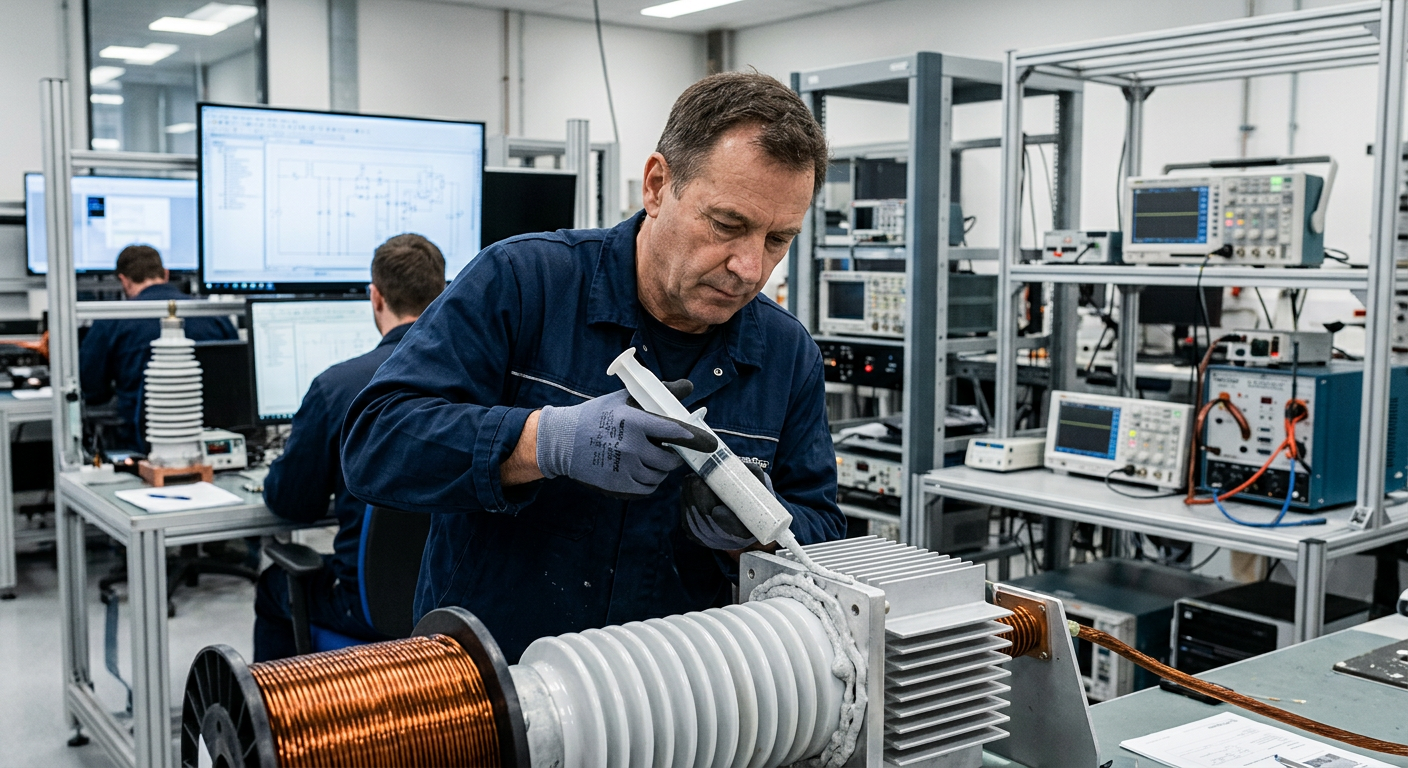
Ceramic filled thermal adhesive is used when a design needs both heat transfer and electrical insulation. In high-voltage assemblies, engineers often need to move heat away from power devices, busbar-adjacent components, insulated gate bipolar transistor modules, chargers, converters, transformers, sensors, and battery management units without creating conductive pathways. Ceramic fillers such as alumina, aluminum nitride, boron nitride, silica blends, or hybrid mineral systems help improve thermal conductivity while maintaining dielectric strength.
In the United States, this category has become increasingly important across electric vehicles, energy storage systems, industrial drives, grid equipment, aerospace electronics, and telecom infrastructure. Facilities near Detroit, Austin, Phoenix, San Jose, Charlotte, and Pittsburgh frequently evaluate these materials for potting, bonding, gap filling, encapsulation, and component fixation in assemblies where heat buildup can shorten service life or cause drift in electrical performance.
Compared with standard structural adhesives, ceramic filled thermal compounds are selected based on a wider set of technical criteria: thermal conductivity, dielectric strength, coefficient of thermal expansion, viscosity, cure schedule, bond line control, outgassing behavior, moisture resistance, flame performance, and compatibility with aluminum, ceramics, copper, coated metals, engineered plastics, and composite housings.
United States Market Overview

The U.S. market for thermally conductive adhesive materials is supported by several overlapping demand drivers. Electric mobility programs continue to increase the use of onboard chargers, inverters, DC-DC converters, battery packs, and thermal interface systems. Renewable energy projects are expanding demand for power conversion equipment, junction systems, and grid electronics. Data center growth adds pressure for better thermal management in power supplies and control modules. Defense, rail, and industrial automation applications also require materials that can maintain insulation integrity under vibration, humidity, and thermal shock.
Importantly, sourcing decisions in the United States are not driven by raw price alone. Buyers usually compare total value: documented test performance, lot consistency, engineering response time, local stock position, packaging flexibility, and whether the supplier can support validation under UL-adjacent, OEM, or customer-specific standards. Ports and logistics nodes such as Los Angeles, Long Beach, Houston, Savannah, Newark, and Chicago also shape lead times for imported adhesive systems.
The line chart above illustrates a realistic demand pattern for ceramic filled thermal adhesive in the United States. Growth is not only tied to electronics miniaturization but also to the scaling of higher-voltage power architectures. As designs move toward denser packaging, the requirement for controlled heat dissipation with reliable dielectric isolation grows more urgent.
Top Suppliers in the United States
The table below compares widely recognized suppliers that are relevant for U.S. buyers seeking ceramic filled thermal adhesive solutions for high-voltage parts. The goal is not to claim one universal winner, but to show where each supplier may fit best depending on project scale, qualification depth, and application complexity.
| Company | Primary U.S. Service Region | Core Strengths | Key Offerings | Best Fit |
|---|---|---|---|---|
| Henkel | Nationwide, strong automotive and electronics presence | Large application engineering network, broad thermal materials portfolio, OEM approvals | Thermally conductive adhesives, encapsulants, TIMs, sealants | EV, industrial power, electronics manufacturers |
| 3M | Nationwide through industrial distribution channels | Material science depth, process reliability, strong converter network | Thermally conductive adhesives, tapes, electrically insulating bonding systems | High-volume electronics and industrial assembly |
| Parker Lord | Midwest, South, and national industrial accounts | Durability under vibration, transportation expertise, engineered bonding systems | Thermal adhesives, encapsulation materials, structural bonding solutions | Transportation, heavy equipment, power electronics |
| Master Bond | Nationwide, custom technical support from U.S. base | Specialty formulations, strong dielectric and thermal options, custom advice | Epoxy systems, one- and two-part thermal adhesives, potting compounds | Medical, aerospace, electronics, low-to-mid volume specialized builds |
| DOW | Nationwide with strong electronics and industrial support | Silicone expertise, thermal stability, environmental durability | Electronic silicones, thermally conductive adhesives, encapsulants | Outdoor electronics, power conversion, harsh-environment systems |
| Momentive | Nationwide, especially electronics and industrial sectors | Silicone thermal management, dielectric reliability, flexible processing | Thermally conductive silicones, encapsulants, gap fillers | Electronics and power modules needing flexibility |
| Epoxy Technology | Northeast and nationwide OEM support | Precision adhesive formulations, electronics packaging knowledge | Thermal epoxies, optoelectronic and electronics-grade adhesives | High-precision electronic assemblies |
This supplier comparison is useful because high-voltage applications do not all behave the same way. EV power electronics, for example, often need fast cycle production, vibration resistance, and manageable cure windows, while grid control modules may prioritize long-term insulation reliability and environmental resistance over line speed. A buyer in Ohio supporting motor drives may shortlist different suppliers than a battery pack integrator in Nevada or a telecom power manufacturer in North Carolina.
Product Types and How to Choose Them
Ceramic filled thermal adhesive is not a single product class. It covers several chemistries and rheologies, each suited to different assemblies and processing conditions. Selecting the wrong type can create hidden production issues, such as poor wet-out, trapped voids, pumpability problems, brittle failure, or incomplete cure around thermally sensitive parts.
| Product Type | Common Base Chemistry | Typical Advantage | Typical Limitation | Common High-Voltage Use |
|---|---|---|---|---|
| Two-part thermal epoxy | Epoxy | Strong bond, good thermal transfer, robust dielectric properties | Can be rigid and require controlled mixing | Power modules, magnetics, busbar-adjacent fixtures |
| One-part heat-cure adhesive | Epoxy or silicone | Clean dispensing and predictable automation | Needs oven cure and storage control | Electronics assembly lines, inverter modules |
| Thermal silicone adhesive | Silicone | Flexibility, weather resistance, thermal cycling durability | Lower structural strength than some epoxies | Outdoor enclosures, charging systems, control housings |
| Potting and encapsulation compound | Epoxy, silicone, polyurethane | Protects against moisture, vibration, and arcing risk | Rework is difficult | Transformers, sensors, HV connectors, control boards |
| Gap-filling thermal adhesive | Silicone or epoxy hybrid | Accommodates uneven surfaces and tolerances | May have lower bond strength than structural grades | Battery systems, power supply housings, converters |
| Low-stress thermal adhesive | Modified epoxy or silicone | Reduces stress on fragile ceramics and components | Can cost more and cure more slowly | Ceramic substrates, insulated electronics, sensors |
The table shows that chemistry must match the application environment. If the assembly sees high mechanical stress, a rigid epoxy may perform well. If the joint experiences expansion mismatch or outdoor thermal cycling, a silicone-based thermal adhesive may last longer. Where void control is essential, especially in potting around high-voltage terminals, rheology and cure exotherm become central selection criteria.
Key Technical Specifications Buyers Should Review
Procurement teams sometimes compare products only by thermal conductivity, but experienced design engineers know that single-number marketing claims are not enough. A ceramic-filled formulation with a higher conductivity figure may still perform worse in service if it has poor adhesion to aluminum, shrinks excessively, cracks under cycling, or complicates dispensing.
For most U.S. buyers, the following specification areas deserve close review: thermal conductivity in W/mK, dielectric strength, volume resistivity, viscosity profile, cure schedule, service temperature range, hardness, elongation, CTE, moisture uptake, flame performance, and adhesion to target substrates. If the adhesive will be used near sensitive electronics or in enclosed modules, low ionic contamination and low outgassing may also matter.
Industry Demand by Application
Different industries in the United States drive demand in different ways. The chart below provides a realistic comparison of where ceramic filled thermal adhesive is most actively used. It highlights why supplier recommendations often vary by sector rather than by brand reputation alone.
The strongest demand currently comes from EV power electronics and energy storage, where high-voltage architectures and compact package designs produce significant heat loads. Industrial drives remain a stable segment due to motor control, automation upgrades, and electrification of equipment. Telecom, aerospace, and medical electronics require smaller volumes but often demand tighter qualification and traceability.
Buying Advice for U.S. Engineers and Procurement Teams
For buyers in the United States, selecting a ceramic filled thermal adhesive should begin with the actual failure mode you are trying to prevent. If your concern is overheating at the interface of a power component and metal housing, prioritize wetting behavior, bond line control, and thermal path stability. If your concern is insulation breakdown, then dielectric strength and moisture resistance need greater emphasis. If thermal cycling drives warranty failures, flexibility and CTE compatibility become more important than headline conductivity numbers.
It is also wise to align adhesive choice with manufacturing reality. A material that performs well in a lab can still create line bottlenecks if it requires long cure times, complex meter-mix equipment, narrow storage conditions, or difficult rework. U.S. plants in states like Tennessee, Georgia, Indiana, and Arizona often favor products with predictable automation, reliable domestic or regional replenishment, and strong field engineering support.
| Buying Factor | Why It Matters | Questions to Ask Supplier | Risk If Ignored | Who Should Prioritize It |
|---|---|---|---|---|
| Thermal conductivity | Drives heat transfer efficiency | What is the tested value and under which method? | Hot spots and shorter component life | Design engineers |
| Dielectric performance | Protects against leakage and breakdown | What dielectric strength and resistivity data are available? | Electrical failure and safety risk | Electrical engineers |
| Processing window | Affects throughput and consistency | What pot life, cure time, and dispensing profile apply? | Scrap, downtime, inconsistent bonds | Manufacturing teams |
| Substrate adhesion | Determines long-term joint stability | Has it been tested on aluminum, copper, ceramics, and plastics? | Delamination and thermal resistance increase | Product development teams |
| Environmental durability | Supports field reliability | How does it handle moisture, salt fog, and thermal cycling? | Warranty claims and field returns | Quality and reliability teams |
| Supply model | Ensures continuity and scale-up | Can you support pilot, annual contract, OEM label, and regional distribution? | Long lead times and limited expansion | Procurement and channel partners |
This table helps convert technical evaluation into practical sourcing decisions. In real projects, many adhesive problems come from a mismatch between design assumptions and production conditions. A disciplined supplier review reduces validation time and lowers the chance of late-stage material change.
Industries Using Ceramic Filled Thermal Adhesive
Automotive and transportation remain the most visible markets, especially for onboard power electronics, battery thermal structures, sensors, and charging hardware. Energy storage systems use these materials in battery modules, inverters, PCS units, and insulated monitoring devices. Industrial manufacturing relies on them for servo systems, variable frequency drives, power supplies, and control cabinets. Construction-related electrical systems and renewable energy installations need stable thermal materials in solar inverters, wind control systems, junction devices, and outdoor enclosures.
Electronics and electrical OEMs use ceramic filled adhesive not only for thermal management but also to minimize vibration damage, improve environmental sealing, and maintain design compactness. Aerospace and defense buyers often require a stronger documentation trail, while medical device customers may focus more on low-stress performance and precise dispensing behavior.
Typical Applications in High-Voltage Parts
In practical U.S. production settings, ceramic filled thermal adhesive appears in many forms. It may bond a power resistor to a heat sink, secure a control module to a metal chassis, fill a narrow gap between a MOSFET assembly and an aluminum plate, encapsulate a transformer winding area, or stabilize a sensor inside a sealed enclosure. In EV systems, these materials are frequently chosen for onboard chargers, DC-DC units, inverter subassemblies, and thermal control modules. In energy infrastructure, they are used in power conversion units, control boards, and field-exposed junction hardware.
When a material serves both thermal and dielectric functions, it can simplify assembly architecture. Instead of using separate thermal pads, mechanical fasteners, and insulating barriers, the design may rely on one engineered adhesive system to transfer heat, bond parts, and maintain electrical isolation. That can reduce part count and save assembly space, which is especially valuable in compact electronics.
Case Studies from U.S.-Style Buying Scenarios
A battery module integrator in Texas might need a ceramic-filled adhesive that supports quick dispensing and dependable thermal cycling for charger-side power boards. In that case, a supplier with strong process engineering and reliable domestic logistics may be preferred over a lower-cost option with uncertain lead time. A rail electronics contractor in Pennsylvania may prioritize long-term dielectric retention and vibration durability, even if cure time is slower. A California energy storage startup may want a material available in prototype kits first, then in bulk cartridges or meter-mix packaging as production grows.
These examples show that the best supplier is often the one that can bridge the full commercial path from validation to scale. That includes documentation, lot consistency, packaging options, technical response speed, and channel support for distributors or contract manufacturers.
Supplier Comparison by Selection Criteria
The next table compares suppliers through the lens of typical U.S. sourcing priorities. This format is especially useful for procurement teams that need to balance engineering requirements with distribution strategy and supply continuity.
| Company | Thermal Product Breadth | High-Voltage Suitability | Custom Support | Distribution Access | Typical Buyer Type |
|---|---|---|---|---|---|
| Henkel | Very broad | Strong for OEM power electronics | High | High | Large manufacturers, automotive, industrial OEMs |
| 3M | Broad | Strong for electronics and industrial insulation needs | Medium to high | Very high | Assemblers, converters, national industrial buyers |
| Parker Lord | Moderate to broad | Strong in transportation and harsh vibration settings | High | Medium | Transportation and industrial equipment makers |
| Master Bond | Specialized | Very strong for custom or high-spec applications | Very high | Medium | Specialty OEMs, labs, aerospace, electronics |
| DOW | Broad in silicone systems | Strong in outdoor and high-cycling environments | High | High | Electronics, power, industrial and infrastructure buyers |
| Momentive | Moderate to broad | Strong where low stress and silicone durability matter | Medium to high | Medium | Electronics and module manufacturers |
This comparison helps buyers understand trade-offs. A large OEM with annual validation cycles may prefer a multinational supplier with deep application labs, while a niche electronics maker may benefit more from a specialist that is willing to refine viscosity, cure speed, or filler balance around a specific design challenge.
Market Shift by Product Preference
Over the past few years, preference has been shifting from conventional rigid thermal bonding systems toward more application-specific materials. U.S. buyers now more often ask for lower-stress formulations, cleaner processing, and sustainability-aligned compliance support. The area chart below reflects that transition.
The area chart suggests that advanced formulations are taking a larger share of demand. This trend is driven by the rise of more compact high-voltage assemblies, pressure for longer field life, and tighter qualification requirements in EV, energy, and industrial electronics sectors.
Local Supplier Landscape and Distribution Reality
In the United States, many buyers do not purchase directly from a chemical producer on the first order. They often work through authorized distributors, regional material specialists, or contract manufacturing supply chains. This matters because availability in local hubs such as Chicago, Dallas, Atlanta, Los Angeles, and New Jersey can significantly affect prototype speed and production continuity.
For buyers that need immediate support, local stock and field technical service can outweigh a small product performance difference. That is particularly true when a project is in PPAP, pilot validation, or customer audit stages. Some companies prioritize national supplier agreements; others prefer regional distributors with faster response and lower minimum order complexity. Strong U.S. service presence, application notes, and sample turnaround remain decisive factors.
Our Company
For U.S. buyers seeking an additional supply option beyond established domestic brands, Qingdao QinanX New Material Technology Co., Ltd presents a practical route for ceramic filled thermal adhesive programs that require cost control without giving up compliance discipline or manufacturing consistency. The company’s adhesive portfolio spans electronic silicone, epoxy resin systems, potting compounds, polyurethane, acrylic, hot melt, and modified silane technologies, which is important because thermal adhesive projects often expand into sealing, encapsulation, and structural bonding during product development. Its production and quality system is supported by ISO certification, multi-stage quality control, RoHS and REACH compliance, and full digital traceability, which gives U.S. importers and brand owners stronger documentation for qualification and repeat orders. From a cooperation standpoint, the company supports OEM, ODM, private label, wholesale, and tailored formulation work, allowing end users, distributors, dealers, brand owners, and even small-volume development buyers to choose a fitting model rather than a one-size-fits-all sales structure. For market assurance, the company already serves customers in more than 40 countries and backs projects with 24/7 technical assistance, free sample programs, automated production for scale consistency, and packaging customization; this combination gives U.S. partners a workable blend of online engineering response and offline supply planning for long-term programs rather than a purely remote transactional export relationship. Buyers comparing supply channels can review the broader product portfolio through the product catalog, learn more about manufacturing and QC through the company background, and request specification alignment or sample support via the U.S. inquiry contact page.
How to Evaluate International Suppliers for the U.S. Market
International sourcing can be highly effective when the supplier understands U.S. expectations around compliance documents, packaging labels, technical data sheets, shipment consistency, and after-sales communication. The best cross-border suppliers behave like long-term program partners, not just exporters. They provide pre-sales material selection help, sample kits for evaluation, stable lot traceability, and responsive issue handling if a production line changes conditions.
This matters especially for distributors and private-label brands in the United States. If the supplier can support custom viscosity, private packaging, OEM branding, and volume scheduling through major trade routes into Los Angeles, Houston, or Savannah, the cost-performance equation may be significantly better than relying only on premium domestic brands. Still, buyers should confirm import lead time, shelf-life management, packaging durability, and the exact compliance statements needed by downstream customers.
Comparison of Product Focus Areas
Because buyers often compare not just suppliers but product strategies, the chart below shows a realistic feature comparison across the most important purchasing dimensions for ceramic filled thermal adhesive used in high-voltage parts.
This comparison chart shows that thermal performance alone should not drive the selection process. For high-voltage parts, dielectric reliability and supply flexibility often matter just as much, especially when the adhesive is embedded in a larger qualification chain involving contract manufacturing, warranty exposure, and customer-specific approval requirements.
Future Trends Through 2026
Looking toward 2026, the United States market for ceramic filled thermal adhesive is expected to move in several clear directions. First, thermal management requirements will rise as power density increases in EV charging, battery systems, renewable energy conversion, and compact industrial controls. Second, there will be more demand for materials with lower stress, improved durability under thermal cycling, and easier automated dispensing. Third, sustainability pressure will keep pushing suppliers toward cleaner manufacturing, better documentation, lower volatile content where relevant, and stronger alignment with international compliance frameworks.
Policy trends also matter. Federal and state-level investment in domestic manufacturing, electrification, grid modernization, and clean energy deployment is expanding the installed base of high-voltage hardware. That means more opportunities for adhesive suppliers that can support qualification, local stocking, and traceable compliance. Buyers will increasingly ask not only whether the adhesive works, but whether the supplier can support resilience, localization, and responsible material governance over a multiyear product life cycle.
What U.S. Buyers Should Ask Before Ordering Samples
Before requesting samples, buyers should prepare a simple but disciplined checklist. Identify the substrate pair, target thermal path, expected voltage environment, cure method available on the line, expected operating temperature, and whether the adhesive must also seal, pot, or resist vibration. Then ask for data relevant to that exact use case. If the project is in the automotive or energy sector, request information on thermal cycling, humidity exposure, and lot traceability. If the product may later shift to private label or dual-source procurement, ask early about packaging flexibility and branding options.
Doing this before trialing samples saves time. It also helps suppliers recommend a narrower set of materials, reducing test repetition and confusion caused by comparing too many formulations at once.
FAQ
What is the main benefit of ceramic filled thermal adhesive in high-voltage parts?
It combines heat dissipation with electrical insulation, helping sensitive power assemblies run cooler without creating conductive risk across the bonded area.
Which ceramic fillers are commonly used?
Common fillers include alumina, boron nitride, aluminum nitride, and engineered silica blends. The exact choice depends on thermal goals, dielectric needs, viscosity targets, and cost.
Is epoxy or silicone better?
Neither is universally better. Epoxy often offers stronger structural bonding and robust thermal properties, while silicone usually provides better flexibility, weather resistance, and thermal cycling durability.
Can these adhesives replace mechanical fasteners?
In some designs, yes. They can reduce part count by bonding and thermally coupling components at the same time, but the design still needs proper validation for load, temperature, and service life.
Are imported products suitable for the U.S. market?
Yes, if they come with reliable technical documents, compliance evidence such as RoHS and REACH where relevant, stable quality control, and responsive support before and after shipment.
What packaging formats are common?
Cartridges, pails, dual syringes, kits, and bulk meter-mix packaging are common. The best format depends on whether the work is bench assembly, prototype validation, or automated production.
What industries buy the most ceramic filled thermal adhesive in the United States?
The largest demand typically comes from EV power electronics, energy storage, industrial drives, electronics manufacturing, telecom power, and renewable energy equipment.
How should a distributor evaluate a supplier?
A distributor should review not only product performance but also documentation quality, lot consistency, OEM/private-label capability, lead times, regional support, and whether the supplier can scale with market growth.
Final Takeaway
For ceramic filled thermal adhesive used in high-voltage parts in the United States, the best sourcing path depends on the balance between engineering performance, processing practicality, and supply reliability. Henkel, 3M, Parker Lord, Master Bond, DOW, Momentive, and other established brands remain strong options for many U.S. projects, especially where field validation and local technical support are critical. At the same time, globally experienced manufacturers with strong compliance systems, OEM flexibility, and responsive service can be smart alternatives for distributors, private-label brands, and cost-sensitive industrial buyers. The most effective purchasing strategy is to compare not just conductivity figures, but dielectric reliability, cure behavior, substrate compatibility, documentation quality, and the supplier’s ability to support your program from sample stage to scaled production.

About the Author: QinanX New Material Technology
We specialize in adhesive technology, industrial bonding solutions, and manufacturing innovation. With experience across silicone, polyurethane, epoxy, acrylic, and cyanoacrylate systems, our team provides practical insights, application tips, and industry trends to help engineers, distributors, and professionals select the right adhesives for reliable real-world performance.

Product Category
You May Also Interest
-
Low Stress IC Packaging Adhesive for Thin Die Bonding
Find low stress IC packaging adhesive thin die solutions in the United States, with supplier comparisons, material options, buying advice, and 2026 market trends.
-
High Refractive Index Adhesive for LED Lens Attachment
Discover high refractive index adhesive LED lens solutions in United States, top suppliers, product types, applications, and sourcing advice for reliable optical bonding.
-
Compressible Thermal Gap Filler for Uneven PCB Surfaces
Find compressible thermal gap filler PCB options in the United States, compare suppliers, materials, applications, and sourcing tips for reliable thermal management.
-

ASTM C920 Construction Sealant: Specification Compliance
了解美国ASTM C920密封胶合规要求、产品类型、应用行业与供应商选择要点。本文解析ASTM C920 construction sealant compliance在美国采购实务。
 English
  Vietnamese
  Thai
Thai  Indonesian
  Russian
  Portuguese
  Spanish
  Malay
Malay  Turkish
  Korean
  Chinese