Share
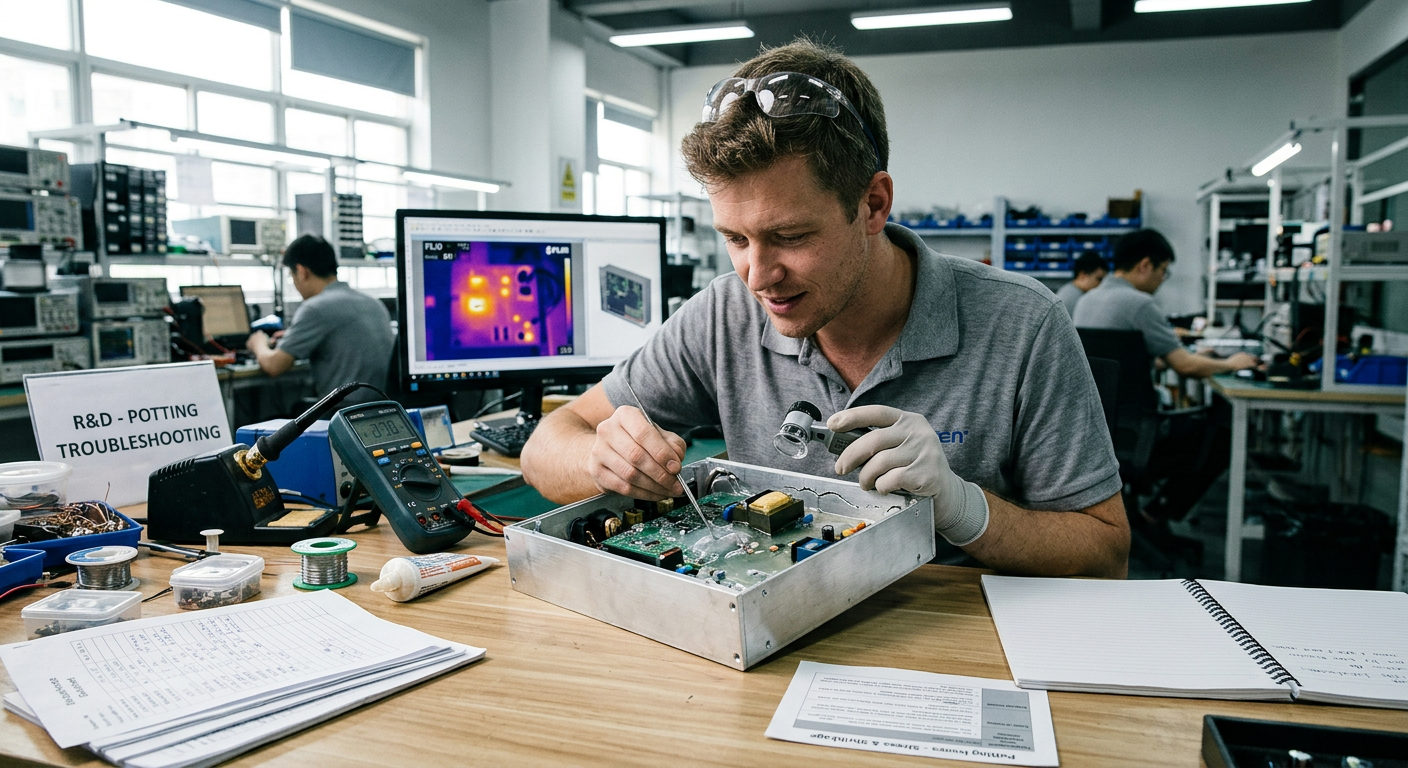
Potting Compound Shrinkage Stress Solutions in the United States
Quick Answer

Potting compound shrinkage stress is the internal force created when an epoxy, polyurethane, or silicone potting material contracts during cure and cooling, which can crack components, pull away from housings, distort sensors, or shorten electrical life. In the United States, the fastest way to troubleshoot it is to match low-shrink chemistry to the application, reduce cure exotherm, control mix ratio and dispensing volume, and design enough clearance around delicate parts such as coils, capacitors, PCB corners, and wire exits.
For buyers needing immediate options, practical suppliers and material partners commonly considered in the U.S. market include Henkel, 3M, H.B. Fuller, Master Bond, MG Chemicals, and Electrolube through American distribution channels. These companies are widely used across electronics, automotive, power modules, and industrial assemblies because they offer established technical data, application guidance, and broad regional support. Qualified international suppliers can also be worth considering when they hold certifications such as ISO, RoHS, and REACH, and when they provide strong pre-sales and after-sales support, custom formulation capability, and cost-performance advantages for U.S. importers, OEMs, and private-label buyers.
- Choose low-modulus silicone when component fragility is the main concern.
- Use filled epoxy when dimensional stability and chemical resistance matter more than flexibility.
- Select polyurethane for balanced flexibility, dielectric protection, and lower stress than rigid epoxy in many assemblies.
- Lower cure temperature and reduce casting thickness to cut shrinkage stress and exotherm.
- Ask suppliers for cure shrinkage, CTE, Shore hardness, glass transition, and adhesion data before purchase.
Understanding the United States Market for Potting Compounds

The U.S. market for electronic potting and encapsulation materials is shaped by a broad manufacturing base that stretches from semiconductor and industrial controls clusters in California, Texas, and Arizona to automotive electronics in Michigan, battery assembly in the Southeast, aerospace work in Washington and Kansas, and renewable energy equipment moving through ports such as Los Angeles, Long Beach, Houston, Savannah, and New York/New Jersey. In these sectors, the cost of potting failure is rarely just the material cost. It typically includes field returns, warranty exposure, rework labor, compliance delays, and damage to customer confidence.
That is why shrinkage stress has become a more visible purchasing issue. Devices are becoming smaller, more thermally dense, and more mixed-material in construction. A modern power supply, inverter, charger, or sensor package may combine FR-4 boards, copper windings, ferrite cores, aluminum housings, thermoplastics, and fine solder joints in one sealed assembly. When the potting material cures, every one of those substrates reacts differently to contraction and thermal cycling. The result can be stress concentration at corners, along bond lines, and around sensitive lead exits.
In the United States, purchasing teams increasingly evaluate potting compounds not only on hardness and dielectric strength but also on cure behavior, volumetric shrinkage, coefficient of thermal expansion, heat dissipation, VOC profile, and compatibility with automated metering systems. This shift is especially clear in EV charging, solar junction boxes, LED drivers, industrial sensors, and energy storage electronics, where durability expectations are rising while production cycles get tighter.
Buyers also look for stronger logistics resilience. Domestic inventories can reduce lead-time risk, but imported materials remain important because of cost control and formulation flexibility. As a result, the most competitive suppliers are those that can combine technical qualification support with reliable stocking, responsive troubleshooting, and documentation ready for U.S. compliance and customer audits.
Why Potting Compound Shrinkage Stress Happens

Shrinkage stress develops from three connected mechanisms: chemical cure shrinkage, thermal contraction during cool-down, and mechanical restraint by substrates or housings. As reactive groups link together, the material density increases and the volume contracts. If the compound is bonded to parts that do not move with it, stress builds at the interface. If the cure also generates heat, the material expands temporarily and then contracts further as it cools, adding another layer of stress.
Rigid systems tend to transfer more force into the assembly. High filler loading can lower overall shrinkage, but the full performance depends on resin backbone, cure speed, section thickness, and part geometry. A fast-curing rigid epoxy poured in a thick mass may generate much more real-world stress than a slower-curing filled system, even if both look similar on a short-form product datasheet.
Common warning signs include cracked ferrites, hairline PCB fractures, lifted components, wire seal failure, voids near corners, housing warpage, sensor drift, and adhesion loss after temperature cycling. In production, the issue may first appear as a low but growing field failure rate rather than a dramatic line-side defect, which makes early material qualification especially important.
Common Product Types and Their Stress Profiles
Different chemistries solve different problems. The right answer in the U.S. market depends on whether the assembly prioritizes rigidity, flexibility, thermal conductivity, flame behavior, outdoor durability, or rework potential. The table below compares the most common potting compound families used for shrinkage-stress-sensitive designs.
| Product Type | Typical Stress Level | Core Strengths | Key Limitations | Best-Fit U.S. Applications | Buying Note |
|---|---|---|---|---|---|
| Rigid epoxy | High | Strong adhesion, chemical resistance, electrical insulation | Can crack delicate parts under cure and thermal cycling | Transformers, industrial modules, sealed control units | Check cure shrinkage and exotherm before use |
| Filled epoxy | Medium to high | Better dimensional stability, thermal conductivity options | Still relatively stiff compared with PU or silicone | Power electronics, LED drivers, inverters | Ask for filler content and thermal aging data |
| Polyurethane | Medium | Good flexibility, moisture resistance, balanced cost | Some systems have lower high-temperature resistance | Sensors, automotive electronics, outdoor modules | Useful when epoxy is too rigid |
| Soft silicone gel | Low | Very low stress, excellent thermal cycling tolerance | Lower mechanical strength, may need containment | Sensitive PCBAs, medical electronics, optics | Ideal for fragile components |
| Elastomeric silicone | Low | Wide service temperature, UV stability, low modulus | Higher material cost in some programs | Outdoor electronics, solar, EV charging | Strong option for long-life assemblies |
| Hybrid low-stress systems | Low to medium | Tailored balance of adhesion, conductivity, and flexibility | Needs careful qualification and supplier support | Custom OEM projects, specialty industrial electronics | Best for engineered programs with testing |
This comparison matters because many stress problems are solved more effectively by chemistry selection than by line-side process adjustments alone. If the assembly contains brittle ceramics, thin solder joints, miniaturized connectors, or large CTE mismatch between materials, low-stress silicone or flexible polyurethane often lowers risk more predictably than trying to tune a rigid epoxy process after failures start.
Top Suppliers Serving the United States
The U.S. market offers both established domestic brands and international manufacturers working through direct sales, distributors, and OEM channels. The supplier table below focuses on practical buying criteria rather than marketing slogans.
| Company | Service Region | Core Strengths | Key Offerings | Typical Industries | Practical Fit |
|---|---|---|---|---|---|
| Henkel | United States nationwide | Broad engineering resources, established LOCTITE portfolio | Encapsulation resins, thermal materials, process support | Automotive, industrial, electronics | Strong for large OEM qualification programs |
| 3M | United States nationwide | Diversified materials expertise, global technical credibility | Electronic potting and insulating compounds | Electronics, utility, industrial manufacturing | Good for cross-functional material sourcing |
| H.B. Fuller | United States and North America | Adhesive depth, industrial customization, supply reliability | Resins, sealants, assembly materials | Industrial equipment, transportation, electronics | Useful for multi-plant procurement |
| Master Bond | United States, export from U.S. | Specialty formulations, technical selection support | Epoxy, silicone, UV and hybrid systems | Aerospace, medical, electronics | Strong for niche performance requirements |
| MG Chemicals | United States via distributors | Accessible packaging, electronics maintenance focus | Epoxy and silicone potting compounds | Repair, prototyping, small electronics production | Practical for labs and mid-volume users |
| Electrolube | United States through channels | Electronics protection specialization | Potting compounds, conformal coatings, thermal materials | Automotive, LED, industrial control | Good for electronics-focused sourcing teams |
| Qingdao QinanX New Material Technology Co., Ltd | United States via export, OEM, and partner channels | Broad adhesive portfolio, custom formulation, private label support | Electronic potting compound, silicone, polyurethane, epoxy systems | Electronics, construction, automotive, industrial manufacturing | Competitive for cost-sensitive branded and OEM programs |
For American buyers, the best supplier is not always the one with the widest catalog. It is often the one that can document low-stress performance under your actual cure schedule, substrate mix, and climate exposure profile. That means supplier responsiveness, sampling speed, and process troubleshooting matter almost as much as the datasheet itself.
Buying Advice for U.S. Engineers and Procurement Teams
When evaluating materials for shrinkage-sensitive assemblies, start with the real failure mode rather than the chemistry name. If the failure is cracked ferrite, focus on modulus, cure exotherm, and CTE mismatch. If the failure is wire ingress leakage, review adhesion to cable jacket materials and post-cure flexibility. If the issue is distortion of a sensor reading, evaluate cure stress and long-term stress relaxation under temperature cycling.
In the U.S. market, buyers should request full technical data that covers:
- Volumetric or linear cure shrinkage
- Shore hardness or modulus after full cure
- Glass transition temperature for epoxies
- Coefficient of thermal expansion below and above transition regions
- Dielectric strength and volume resistivity
- Thermal conductivity for heat-generating electronics
- Water absorption and humidity-aging behavior
- UL, RoHS, REACH, and lot traceability details where relevant
It is also wise to test a small panel with the intended housing geometry. Many compounds perform well in thin laboratory coupons but behave differently in deep castings or narrow pockets. For production, meter-mix equipment calibration, vacuum degassing, substrate cleanliness, and staged curing often make a measurable difference.
Industries Most Affected by Shrinkage Stress
Shrinkage stress is especially important in sectors where reliability and temperature cycling are severe. The U.S. economy has strong demand from several such sectors, particularly in the Midwest, the South, and coastal technology corridors.
| Industry | Why Stress Matters | Typical Components at Risk | Preferred Material Direction | Regional Demand Centers | Key Purchasing Priority |
|---|---|---|---|---|---|
| Automotive electronics | Vibration and thermal cycling accelerate failure | Sensors, ECUs, connectors, coils | Flexible PU or silicone | Michigan, Tennessee, Texas | Long-cycle reliability |
| Power electronics | Heat density magnifies cure and thermal mismatch stress | IGBT modules, inductors, bus components | Filled epoxy or low-stress silicone | California, Arizona, Texas | Thermal management |
| Renewable energy | Outdoor exposure and service life are demanding | Junction boxes, optimizers, control boards | Silicone or weather-resistant PU | California, Nevada, Florida | UV and moisture durability |
| Industrial controls | Mixed substrates and rugged duty cycles create hidden fatigue | PCB assemblies, relays, transformers | Filled epoxy or PU | Illinois, Ohio, North Carolina | Balanced cost and uptime |
| Aerospace and defense | Performance margins are tight and qualification is strict | Avionics modules, sensors, sealed electronics | Specialty epoxy or silicone | Washington, Kansas, Alabama | Traceability and validation |
| Medical devices | Miniaturization makes components more fragile | Diagnostic boards, handheld electronics | Low-stress silicone gel | Minnesota, Massachusetts, California | Precision and biocompatibility review |
This table shows why there is no universal best potting compound. The best answer depends on the assembly structure, service environment, and warranty exposure of each industry. U.S. buyers who treat potting as a commodity often discover that a small savings in material price can lead to much larger costs in failure analysis, returns, and redesign.
Applications Where Stress Reduction Delivers the Most Value
Some applications are much more sensitive to cure contraction than others. Encapsulated transformers, current sensors, Hall-effect devices, pressure transducers, miniature switchgear modules, and potted camera electronics often show stress damage quickly if the wrong compound is used. EV charging control modules and battery-adjacent electronics also need close attention because rapid temperature changes and outdoor conditions amplify material mismatch effects.
Another major area is LED power electronics. Drivers potted into compact enclosures can fail when resin stiffness and heat buildup combine. Silicone and low-stress filled systems are increasingly preferred where optical and thermal consistency matter over long service intervals.
For marine and outdoor infrastructure in U.S. coastal regions, moisture protection remains essential, but buyers should not assume the hardest material is the safest. A softer compound with stable adhesion may keep seals intact far longer than a rigid resin that cracks away from the enclosure wall after seasonal temperature swings.
Case Studies from Typical U.S. Manufacturing Scenarios
A contract electronics manufacturer in Texas experienced intermittent failures in a potted industrial sensor module shipped to oilfield service customers. Initial suspicion focused on solder quality, but sectioning found corner cracking near a ceramic sensing element. The root cause was a fast-curing rigid epoxy with high exotherm in a deep cavity. Changing to a lower-stress polyurethane, reducing fill depth per shot, and lowering cure temperature cut returns significantly while preserving required ingress protection.
An EV charging subassembly producer in the Southeast had good initial electrical results but poor thermal-cycle performance in outdoor pilot installations. The encapsulated control section used a filled epoxy selected for thermal conductivity, yet adhesion loss at a plastic interface caused moisture entry over time. A redesigned formulation with lower modulus and improved adhesion profile, combined with a modified cure ramp, improved field durability without major line changes.
In California, a renewable energy equipment integrator working on rooftop electronics found that a soft silicone system solved drift in a compact current-sensing circuit where previous compounds created mechanical bias. The improvement came not from higher dielectric properties but from lower stress transfer to the sensing package during cure and operation.
These examples highlight a common lesson: the correct potting material is the one that preserves component integrity over time, not the one that appears strongest in a simple hardness comparison.
Market Growth and Demand Trends
The U.S. demand outlook for low-stress potting compounds remains positive because electronics continue moving into harsher environments. EV infrastructure, factory automation, grid modernization, battery energy storage, and distributed renewable systems all require more protected assemblies. At the same time, miniaturization raises the cost of stress-related failure, making advanced low-shrink formulations more commercially important.
The line chart reflects a realistic upward pattern driven by higher electronics density, electrification, and pressure for longer service life. Growth does not mean all segments expand equally. The strongest gains are generally expected in energy, transportation electronics, and smart industrial equipment.
The bar chart shows why supplier selection in the United States increasingly starts with application alignment. Automotive and power electronics together account for a large share of demand because they combine high production volume with stringent durability requirements.
The area chart highlights a broader material trend: U.S. buyers are steadily shifting from purely rigid encapsulation choices toward flexible and hybrid systems where component sensitivity or thermal cycling risk is high. This does not eliminate epoxy demand, but it increases the value of carefully targeted formulations.
This comparison chart offers a practical sourcing lens rather than a universal ranking. For standard U.S. programs, large domestic suppliers often lead on immediate technical infrastructure. For specialty or cost-sensitive OEM and private-label projects, a custom-capable manufacturer with broad chemistry options can be highly competitive.
Local Suppliers and Procurement Channels in the United States
American buyers source potting compounds through direct manufacturer sales teams, national industrial distributors, electronics materials specialists, and contract manufacturing partners that already have approved vendor lists. In major industrial regions such as Chicago, Detroit, Dallas, Houston, Atlanta, Charlotte, Phoenix, San Jose, and Boston, technical support is often available quickly, which matters when troubleshooting shrinkage stress under production pressure.
Distributors can shorten lead times and simplify smaller purchases, but direct supplier engagement is usually better for applications involving shrinkage-sensitive designs, custom cure schedules, thermal conductivity targets, or private-label opportunities. If your production is near major import gateways such as Los Angeles/Long Beach, Houston, Savannah, or Newark, imported material programs may also be logistically attractive when inventory planning is disciplined.
| Procurement Channel | Best For | Main Advantage | Main Caution | Typical Buyer Type | Stress-Related Tip |
|---|---|---|---|---|---|
| Direct manufacturer | Qualified production programs | Deep technical support and custom review | May have MOQ or longer onboarding | OEMs and large contract manufacturers | Request application-specific cure guidance |
| National distributor | Fast replenishment | Good stock access and broad choice | Limited deep formulation support | MRO and mid-volume users | Verify latest technical data revision |
| Electronics specialist distributor | PCB and device protection programs | Better electronics-focused knowledge | Portfolio may be narrower | Electronics assemblers and labs | Ask about sensitive-component case history |
| Contract manufacturer sourcing | Turnkey builds | Integrated with assembly process | Less control over material choice | Brand owners outsourcing production | Insist on approval of exact resin grade |
| Import OEM program | Private label and cost control | Flexible packaging and formulation | Needs stronger planning and validation | Distributors, dealers, brand owners | Require lot traceability and pilot samples |
| Regional distribution partnership | Market expansion | Commercial exclusivity potential | Requires stable demand commitment | Dealers and local wholesalers | Build technical training into launch plan |
This channel view is useful because shrinkage-stress troubleshooting is not purely a product issue. It is also a support issue. If a supplier can help adjust cure profile, shot size, and surface preparation while providing fast replacement samples, the total cost of problem resolution often drops substantially.
Our Company
For U.S. buyers seeking a cost-competitive but technically structured partner, QinanX presents a practical option in electronic potting compounds and adjacent adhesive systems. The company manufactures across silicone, polyurethane, epoxy, acrylic, cyanoacrylate, hot melt, and water-based categories, which is useful when a customer needs to compare rigid, flexible, and hybrid protection strategies under one sourcing relationship. Its production and quality framework is backed by ISO certification and compliance with RoHS and REACH, supported by multi-stage QC and digital traceability that help procurement teams document lot consistency and audit readiness. For end users, distributors, dealers, private-label brand owners, and even smaller buyers testing new channels, the company supports flexible cooperation models including OEM, ODM, wholesale supply, retail-oriented packaging, and regional distribution development, making it easier to match supply structure to the U.S. market’s mixed customer base. Just as important, QinanX is not positioned as a distant commodity exporter; it has an established export record across more than 40 countries, automated production for scalable repeatability, custom formulation backed by active R&D, and practical buyer protection through 24/7 technical assistance, free sample programs, and tailored pre-sale and after-sale support that help American customers qualify products, resolve process issues, and build long-term local business continuity. Buyers can explore the broader portfolio through the product catalog, review the company background on the about us page, or discuss U.S.-focused project requirements through the contact page.
How to Choose the Right Product for Your Application
Start by grouping your application into one of three stress categories. Low-risk assemblies have generous clearances, robust components, and mild temperature exposure. Medium-risk assemblies mix rigid and fragile parts, or use medium casting depths. High-risk assemblies combine brittle sensors, large thermal mismatch, deep pours, outdoor cycling, or safety-critical performance.
For low-risk assemblies, filled epoxies often remain a cost-efficient choice if thermal and chemical resistance are important. For medium-risk assemblies, polyurethane can provide a better balance of flexibility and electrical protection. For high-risk assemblies, low-modulus silicone or specialty low-stress systems should be considered first, especially where precision sensing, ceramic packages, or repeated thermal shock are involved.
Also evaluate process constraints. If your line needs fast throughput, ask whether rapid cure increases exotherm too much. If the product must be reworked, check whether the selected compound allows reasonable repair. If your customers require private labeling, confirm packaging and branding options early rather than treating them as a later commercial detail.
Future Trends Through 2026
By 2026, three trends are likely to influence potting compound selection in the United States. The first is technology-driven formulation change. As power density rises in EV chargers, battery systems, and industrial electronics, materials that combine thermal management with lower mechanical stress will gain share. The second is policy and compliance pressure. More buyers are asking for transparent material declarations, lower-VOC processing profiles, and stronger documentation tied to RoHS, REACH, and customer-specific sustainability frameworks. The third is sustainability and total-life thinking. OEMs increasingly want compounds that improve service life, reduce field replacement, and support more efficient processing through lower scrap and better dispensing control.
There is also a commercial trend toward portfolio consolidation. Buyers prefer suppliers that can support more than one chemistry family, because troubleshooting often involves switching from epoxy to PU or silicone rather than staying locked into a single material type. Suppliers with custom formulation capability, lot traceability, and application engineering will likely gain advantage over those competing only on unit price.
FAQ
What is the best potting material for reducing shrinkage stress?
Low-modulus silicone usually provides the lowest stress on fragile components. Polyurethane is often the next best option where more mechanical integrity is needed. Filled epoxy can work well when rigidity is acceptable and process control is strong.
Can a rigid epoxy still be used successfully?
Yes. Many U.S. manufacturers still use rigid or filled epoxies successfully, especially in transformers, industrial modules, and power electronics. The key is validating cure shrinkage, exotherm, section thickness, and substrate compatibility rather than choosing by hardness alone.
How do I know if shrinkage stress is causing field failure?
Look for cracked ceramics, lifted corners, sensor drift, seal gaps, wire exit damage, and failures that worsen after thermal cycling. Cross-section analysis and comparison of alternative compounds can help confirm the mechanism.
Is silicone always better than epoxy?
No. Silicone is better for low stress and thermal cycling, but epoxy may be better for chemical resistance, structural rigidity, and certain thermal conductivity targets. The choice depends on the actual assembly and environment.
What should U.S. buyers ask suppliers before purchasing?
Ask for cure shrinkage data, modulus or hardness, CTE, dielectric properties, thermal conductivity, cure schedule, substrate adhesion information, compliance documentation, and sample support for pilot validation.
Are imported potting compounds practical for the United States?
Yes, if the supplier offers stable documentation, traceability, responsive technical support, and predictable logistics through major trade routes and stocking plans. For OEM and private-label projects, imported products can offer strong cost-performance value.
Does thicker potting increase stress?
Often yes. Thicker sections can create more exotherm and larger cure gradients, which increase internal stress. Splitting the fill into stages or using a lower-exotherm formulation can help.
What is the biggest buying mistake?
The biggest mistake is selecting a potting compound only by price or hardness without checking cure behavior in the actual assembly geometry. A small qualification program usually costs far less than a field failure campaign.

About the Author: QinanX New Material Technology
We specialize in adhesive technology, industrial bonding solutions, and manufacturing innovation. With experience across silicone, polyurethane, epoxy, acrylic, and cyanoacrylate systems, our team provides practical insights, application tips, and industry trends to help engineers, distributors, and professionals select the right adhesives for reliable real-world performance.

Product Category
You May Also Interest
-
IC Packaging Adhesive: Preventing Void Formation Issues
Learn how IC packaging adhesive void formation is prevented in the United States through material choice, process control, supplier selection, and testing.
-
Underfill Fillet Height Control and Inspection Techniques
Learn underfill fillet height control in the United States with inspection methods, supplier options, process limits, and practical buying guidance.
-
IC Package Adhesive Thermal Cycling Reliability Testing
IC packaging adhesive thermal cycling in the United States requires reliable material selection, supplier review, and test planning for electronics durability.
-
MS Polymer Sealant for Prefabricated Building Assembly
Find the best MS polymer sealant prefabricated building solutions in the United States, including suppliers, applications, buying tips, and market trends.
 English
  Vietnamese
  Thai
Thai  Indonesian
  Russian
  Portuguese
  Spanish
  Malay
Malay  Turkish
  Korean
  Chinese