Share
Best UV Adhesive Suppliers for U.S. Microelectronics
Quick Answer

If you need UV curable adhesive microelectronics solutions in the United States, the most practical starting point is to shortlist suppliers with proven electronics-grade formulations, low ionic contamination control, strong technical documentation, and responsive application support for assembly validation. For U.S. buyers, the most recognized names include Henkel, Dymax, Master Bond, Epoxy Technology, and Panacol, each serving advanced electronics manufacturing with products for encapsulation, chip bonding, display modules, camera modules, PCB protection, and miniaturized component assembly.
Among local and established regional options, Henkel and Dymax stand out for broad product ranges and technical service depth in U.S. electronics manufacturing hubs such as California, Texas, Arizona, and the Northeast corridor. Master Bond and Epoxy Technology are frequently considered when buyers need specialty performance such as thermal cycling stability, optical clarity, or precision dispensing compatibility. Panacol is also relevant for high-accuracy medical and electronics assembly applications where process repeatability matters.
For buyers balancing qualification requirements and cost control, qualified international manufacturers can also be viable. A supplier such as QinanX may be worth evaluating when the project requires customized UV-curable adhesive options, private label support, or scalable supply at more competitive cost-performance levels, especially if the supplier can provide RoHS and REACH compliance data, traceable QC records, and reliable pre-sales plus after-sales support for U.S. customers.
U.S. Market Overview

The United States remains one of the world’s most demanding markets for microelectronics adhesives because it combines semiconductor packaging, aerospace electronics, automotive electronics, medical devices, defense systems, telecom infrastructure, and consumer electronics in one procurement ecosystem. Buyers are not only comparing adhesive strength or cure speed; they also evaluate outgassing behavior, dielectric performance, thermal shock durability, moisture resistance, shelf stability, process automation fit, and regulatory documentation. In practical terms, a UV-curable adhesive for microelectronics encapsulation must perform consistently under increasingly smaller geometries and tighter tolerances.
Regional demand is especially concentrated around major manufacturing and innovation corridors. Silicon Valley and the broader California electronics sector continue to drive demand for high-precision optical and sensor assembly. Arizona has become a strategic center for semiconductor investment. Texas supports strong electronics, automotive, and industrial manufacturing demand. Massachusetts and the greater New England region remain important for precision medical and photonics assembly. In addition, logistics through ports such as Los Angeles, Long Beach, Houston, and Savannah affect lead time planning for imported specialty materials.
In the U.S. market, electronics assemblers often prefer vendors that can support trial quantities, engineering validation, line integration, and long-term volume planning. This is why technical data sheets alone are never enough. Buyers increasingly ask for cure depth profiles, yellowing resistance data, compatibility with LED UV sources, and substrate-specific adhesion results on glass, FR-4, ceramics, stainless steel, polycarbonate, LCP, and engineered thermoplastics.
The phrase UV curable adhesive microelectronics usually refers to one or more electronics-grade materials used for bonding, potting, sealing, masking, encapsulating, or protecting sensitive assemblies. In real procurement practice, the term often overlaps with UV-curing encapsulant, light-curing electronic adhesive, UV epoxy for electronics, UV acrylic adhesive for PCB assembly, and optically clear UV adhesive for module integration. U.S. buyers generally search across all these semantic variations when qualifying a solution.
Market Growth Trend in the United States

The chart below illustrates a realistic growth trend for U.S. demand related to UV-curable adhesives in microelectronics applications, driven by miniaturization, EV electronics, optical modules, and faster automated assembly lines.
This trend reflects broader investments in domestic electronics manufacturing and advanced packaging. It also mirrors the shift from slower thermal cure systems to high-throughput light-curing processes where production speed, automation compatibility, and lower energy consumption can justify material upgrades even when the unit price is higher.
Common Product Types
Not all UV-curable materials sold into electronics are interchangeable. Procurement teams usually classify them by chemistry, performance profile, and intended process window. Some products cure rapidly under UV light alone, while others are dual-cure systems that add moisture, heat, or anaerobic mechanisms for shadow areas. This distinction matters in assemblies with opaque housings, under-component bondlines, or deep cavity encapsulation.
| Product Type | Typical Chemistry | Main Use in Microelectronics | Key Strength | Main Limitation | Best Fit |
|---|---|---|---|---|---|
| UV Acrylic Adhesive | Acrylate | Fast bonding of plastics, glass, and small components | Very fast cure speed | Can shrink more than epoxy systems | High-speed assembly lines |
| UV Epoxy Adhesive | Epoxy hybrid | Encapsulation, structural bonding, component protection | Strong chemical and thermal resistance | May require longer cure optimization | Reliability-focused assemblies |
| Dual-Cure UV Adhesive | UV plus heat or moisture | Shadow-area bonding and enclosed structures | Better full cure in hidden zones | Longer total process cycle | Complex housings and connectors |
| Optically Clear UV Adhesive | Low-yellowing acrylate | Display, sensor, lens, and camera module assembly | Transparency and clarity | Usually application-specific | Optoelectronics |
| Low-Ionic UV Encapsulant | Electronics-grade modified resin | Chip protection and delicate circuitry | Reduced corrosion risk | Qualification can be strict | Sensitive PCB and chip packages |
| Flexible UV Sealant | Modified acrylic or silicone hybrid | Strain relief and sealing | Better flexibility under thermal cycling | Lower rigidity | Flexible assemblies and sensors |
This product segmentation helps U.S. buyers narrow down the field quickly. A high-speed contract manufacturer building wearable electronics may prioritize rapid tack-free curing and automated dispensing stability, while an aerospace electronics integrator will emphasize long-term environmental durability, outgassing control, and compliance documentation.
Industry Demand by Application Segment
Demand is not evenly distributed. Automotive electronics, semiconductor packaging, consumer devices, and medical assemblies each impose different performance requirements on light-curing materials.
The biggest takeaway is that no single adhesive formula can dominate across all sectors. Semiconductor packaging buyers focus on precision and low contamination. Automotive electronics teams prioritize thermal and humidity reliability. Medical device assemblers often emphasize biocompatibility pathways, low extractables, and precise optical properties for diagnostic modules.
How U.S. Buyers Evaluate UV-Curable Adhesives
In practical procurement, U.S. engineering teams move through a predictable evaluation path. First, they screen chemistry compatibility with the target substrates and end-use environment. Next, they request technical documentation and sample material. Then they validate dispensing behavior, cure conditions, adhesion performance, and accelerated aging results under actual process conditions. Finally, they compare total procurement risk: supply continuity, technical support, lot consistency, and the ability to manage ramp-up volumes.
Because encapsulation applications are highly reliability-sensitive, the best buying decision is rarely the cheapest adhesive per kilogram. The more useful metric is cost per successful assembly over the lifetime of the product. A material that cures faster, rejects fewer parts, and reduces field failures can easily outperform a lower-priced alternative.
| Buying Factor | Why It Matters | What to Ask Supplier | Warning Sign | Best Practice | Priority Level |
|---|---|---|---|---|---|
| Ionic Content | Protects sensitive circuits from corrosion | Request contamination test data | No electronics-specific data | Validate with internal reliability tests | Very High |
| Cure Profile | Affects line speed and full cure quality | Ask for wavelength and intensity range | Only generic cure claims | Match to your UV lamp setup | Very High |
| Thermal Cycling Resistance | Prevents cracking and delamination | Request cycle test results | No environmental aging data | Run substrate-specific validation | High |
| Viscosity Control | Impacts dispensing precision | Ask for viscosity window and shelf life | Wide batch variation | Test on actual dispensing equipment | High |
| Regulatory Compliance | Needed for customer and export acceptance | Request RoHS and REACH documents | Incomplete declarations | File all compliance records per lot | High |
| Technical Support | Speeds troubleshooting and qualification | Confirm sample, tuning, and response time | Slow engineering follow-up | Prefer suppliers with application support | Medium to High |
The explanation behind this table is simple: adhesive failure in microelectronics usually begins with a mismatch between application demands and supplier data depth. Buyers that define test conditions early tend to qualify faster and avoid expensive reformulation or revalidation later.
Typical Industries Using These Adhesives
UV-curable electronic adhesives are used across a wide industrial spectrum in the United States. Semiconductor and packaging operations use them for die protection, underfill-adjacent bonding tasks, and miniature housing attachment. Consumer electronics manufacturers use them in wearables, earbuds, cameras, chargers, and compact smart devices. Automotive electronics integrators apply them in sensors, camera modules, LED lighting, battery management electronics, and infotainment subassemblies. Medical device firms rely on them for compact diagnostics, disposable electronics, and optical sensing modules. Telecom and data infrastructure manufacturers use them in fiber components, connectors, and precision assemblies where cure speed improves throughput.
These sector differences shape product selection. A UV adhesive suitable for a plastic lens assembly in a handheld device may not be suitable for a vehicle-mounted module exposed to prolonged thermal shock, fluid exposure, and vibration. This is why buyers should request application-matched recommendations rather than picking solely from general catalog descriptions.
Detailed Applications in Microelectronics Encapsulation
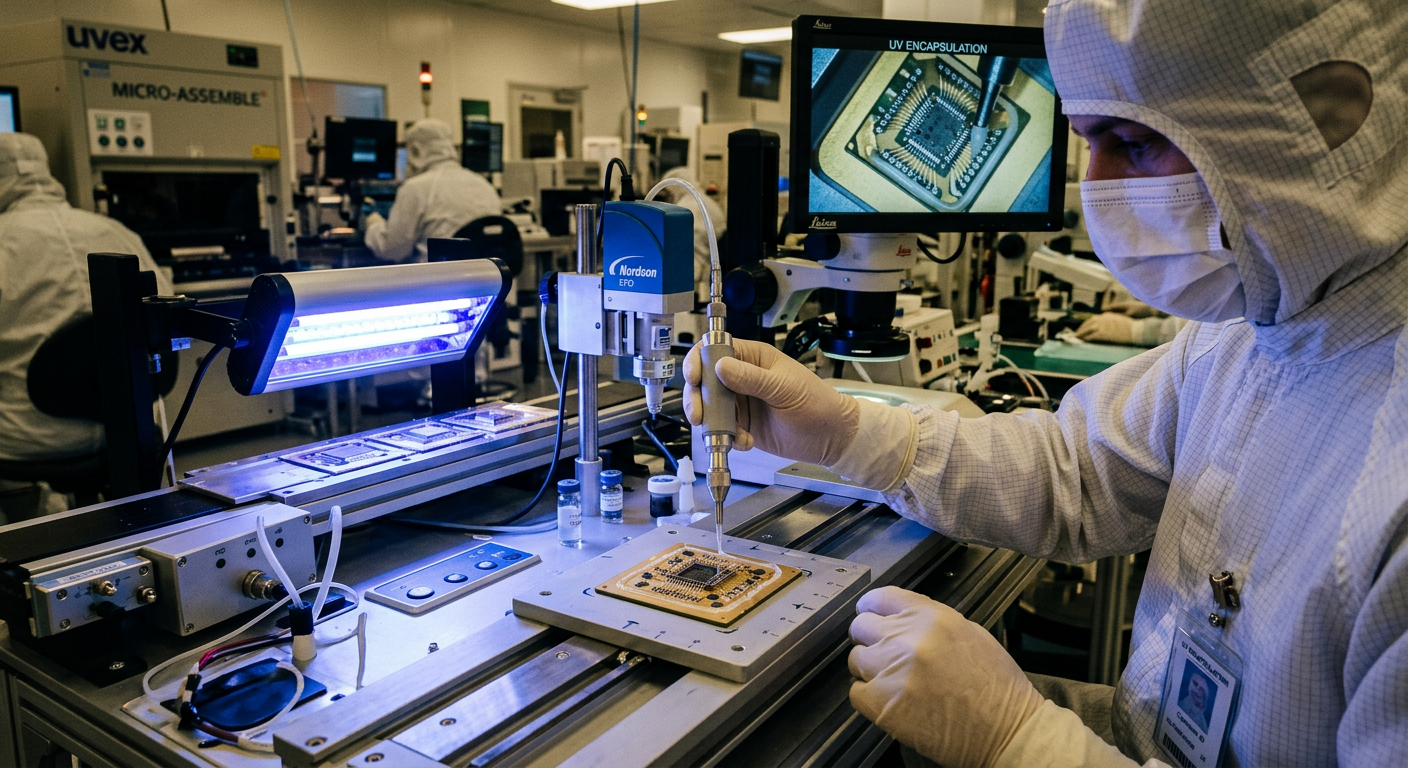
Encapsulation in microelectronics covers more than full potting. In many cases, the adhesive acts as a selective protective barrier over wire bonds, solder joints, MEMS elements, flexible circuits, LEDs, or fine-pitch interconnect regions. Some assemblies only require edge sealing, while others need localized glob-top style protection. UV-curable materials are attractive because they can be dispensed precisely and cured rapidly, reducing work-in-progress inventory and improving takt time.
Common applications include camera module bonding, speaker module reinforcement, connector retention, chip-on-board protection, PCB corner bonding, edge sealing for sensors, optical fiber fixation, wearable device enclosure sealing, and low-profile encapsulation of fragile electronic components. For transparent or semi-transparent components, UV curing provides especially strong advantages because the energy can reach the bondline quickly and with consistent control. For opaque assemblies, dual-cure variants often deliver a safer full-cure outcome.
Another important use case is rework-sensitive electronics. A well-designed light-curable system can support tighter process control and reduce thermal stress on heat-sensitive parts compared with some heat-cure alternatives. This benefit is especially relevant in compact assemblies where thermal budgets are constrained by nearby plastics, films, coatings, or precision-aligned optics.
Supplier Comparison for the U.S. Market
The table below compares representative suppliers that U.S. buyers frequently consider when sourcing UV curable adhesive microelectronics products. The purpose is not to declare a universal winner, but to help buyers align supplier strengths with project needs, volume expectations, and support requirements.
| Company | Primary Service Region | Core Strengths | Key Offerings | Best For | Buyer Note |
|---|---|---|---|---|---|
| Henkel | United States nationwide | Large portfolio, electronics credibility, global support | LOCTITE UV adhesives, encapsulants, assembly materials | Large OEMs and validated production lines | Strong choice for broad technical infrastructure |
| Dymax | United States and North America | Fast light-curing technology, dispensing and curing expertise | UV adhesives, conformal materials, curing systems | High-speed automated electronics assembly | Very process-oriented supplier |
| Master Bond | United States with export support | Specialty formulations and engineering customization | UV systems for electronics, optics, and medical use | Niche performance requirements | Useful for demanding custom specs |
| Epoxy Technology | United States and global technical markets | Precision adhesive solutions and optical assembly depth | Light-curable epoxies and specialty electronic materials | Photonics, sensors, high-precision modules | Often shortlisted for advanced assemblies |
| Panacol | U.S. customers via North American network | Fine-assembly expertise and optoelectronic focus | UV adhesives, conductive materials, medical assembly solutions | Miniaturized precision manufacturing | Relevant for photonics and medical electronics |
| QinanX | U.S. import buyers and regional partners | Cost-performance, OEM flexibility, broad adhesive portfolio | UV-curable adhesive products, electronic silicone, epoxy systems | Distributors, private label projects, cost-sensitive OEMs | Worth reviewing for tailored and scalable sourcing |
This comparison shows a clear pattern. U.S. domestic and established regional suppliers often lead in immediate field engineering support and qualification familiarity. International suppliers can become highly competitive when they combine compliance readiness, documentation discipline, customization options, and strong account support with better cost-performance economics.
Supplier Performance Comparison
The comparison chart below uses realistic benchmark scoring across factors commonly reviewed by U.S. procurement teams: technical depth, customization, cost-performance, and support responsiveness.
Scores like these help frame trade-offs. A large multinational may offer robust technical depth and application infrastructure, while a focused specialist or qualified international supplier may create better value when customization, branding flexibility, and cost control are important.
How Product Trends Are Shifting
The market is gradually moving from general-purpose light-curing products toward more application-specific formulations. Buyers are increasingly asking for low-odor, low-shrinkage, low-stress, halogen-aware, and LED-optimized systems. Materials that cure well under newer LED wavelengths and use less energy during processing are gaining attention.
This trend shift is important because procurement criteria are becoming more complex. Buyers are no longer asking only whether the material sticks and cures. They are asking whether it supports sustainability targets, reduces process energy, fits LED curing infrastructure, and simplifies environmental reporting across the product lifecycle.
Buying Advice for U.S. Procurement Teams
For U.S. buyers, the best sourcing method is usually a two-track approach. First, build a technical shortlist based on reliability requirements, cure conditions, and substrate compatibility. Second, build a commercial shortlist based on lead time, qualification support, documentation discipline, and inventory risk. This prevents engineering teams from overvaluing technical performance while purchasing teams overvalue nominal price.
When requesting quotations, it is useful to include dispensing method, substrate details, bondline thickness, target cure wavelength, expected annual volume, storage requirements, and regulatory needs. That level of detail dramatically improves supplier recommendations. If you only ask for a generic UV adhesive for electronics, most suppliers will respond with overly broad options.
It is also wise to ask about packaging formats. Small-batch R&D teams may prefer syringes or cartridges, while production lines often need larger reservoirs or custom packaging that supports automated dispensing. In U.S. manufacturing settings where line stoppage is expensive, packaging compatibility can matter as much as material chemistry.
Case Studies from the U.S. Market
A wearable electronics assembler in California needed a transparent, low-bloom adhesive for a sensor window and internal PCB stabilization. Their initial thermal-cure material created process bottlenecks and occasional warpage near heat-sensitive plastics. After switching to a UV-curable electronics adhesive designed for rapid line integration, they reduced fixture time significantly and improved visual consistency in the optical area. The deciding factors were cure speed, lower thermal stress, and easier automation tuning.
An automotive electronics supplier in Texas evaluated multiple UV-curing encapsulants for a compact camera module subassembly. The lowest-cost sample cured quickly but failed thermal shock testing and showed edge delamination after humidity aging. A more application-specific dual-cure system passed qualification because it cured effectively even in partially shadowed sections and maintained better adhesion after cycling. The lesson was clear: encapsulation materials must be chosen around geometry and environment, not just nominal cure time.
A contract manufacturer in Arizona assembling industrial sensor boards wanted to reduce imported material risk while preserving quality consistency. They qualified a dual-sourcing model: one premium domestic supplier for flagship programs and one cost-competitive international supplier for volume-sensitive programs with matched documentation and test validation. This approach improved pricing flexibility without lowering quality standards.
Local and Regional Supplier Landscape
The U.S. supplier landscape includes large multinational chemical companies, dedicated light-curing specialists, custom formulators, and specialized import partners. Buyers in California often prioritize speed of technical engagement for prototype development. Buyers in Texas may focus more heavily on industrial scale-up and logistics resilience. Arizona semiconductor-related operations frequently demand tighter qualification data and process compatibility. East Coast buyers in medical devices and photonics often require more specialized materials and stronger engineering collaboration.
Below is a practical overview of how supplier categories differ in the U.S. market.
| Supplier Category | Typical Region Strength | Advantage | Trade-Off | Best Buyer Type | Procurement Tip |
|---|---|---|---|---|---|
| Large Multinational | Nationwide U.S. | Deep product range and support system | Higher pricing and more formal qualification paths | Large OEMs | Leverage long-term contracts |
| Light-Curing Specialist | Northeast and national support | Process and curing expertise | Narrower total portfolio | Automation-focused manufacturers | Request cure equipment alignment advice |
| Custom Formulator | Project-based national reach | Better fit for niche requirements | May require longer development cycle | High-spec engineering teams | Define testing metrics early |
| Optoelectronic Specialist | Medical and photonics clusters | Optical precision and low-yellowing options | Can be application-specific and premium priced | Sensor and lens manufacturers | Ask for optical aging data |
| Import Partner | Port-based and distributor-driven regions | Competitive pricing and flexible supply models | Requires stronger qualification discipline | Distributors and cost-sensitive OEMs | Verify documentation and support depth |
| Private Label OEM Supplier | Distributor networks nationwide | Branding flexibility and scalable manufacturing | Needs careful product standard alignment | Brand owners and dealers | Confirm packaging and QC traceability |
This table matters because many sourcing problems arise from choosing the wrong supplier type rather than the wrong individual company. The best supplier is usually the one whose business model matches your qualification path, support needs, and forecast volume.
Our Company in the U.S. Supply Context
For U.S. buyers seeking a qualified international partner rather than only a domestic catalog supplier, Qingdao QinanX New Material Technology Co., Ltd presents a practical profile in the electronics adhesives segment. Its UV-curable adhesive offerings sit within a broader industrial adhesive manufacturing system that also includes electronic silicone and epoxy potting materials, which is useful when buyers want to standardize sourcing across multiple assembly steps. The company states compliance with ISO-based quality management and international requirements such as RoHS and REACH, supports multi-stage QC with digital traceability, and emphasizes custom formulation capability backed by automated production lines, all of which are relevant signals for U.S. microelectronics qualification. From a cooperation standpoint, it supports OEM and ODM projects, private label programs, wholesale orders, distributor and dealer relationships, and tailored supply arrangements for end users or brand owners, making it suitable not only for factories but also for regional channel partners. For market assurance, its established export record across more than 40 countries, continuous technical assistance, sample support, and tailored project coordination indicate that it already works in internationally regulated markets and is structured for long-term account service rather than one-off remote transactions; U.S. buyers that need responsive pre-sale validation and dependable after-sales follow-up can contact the team for project-specific review and documentation.
2026 Trends: Technology, Policy, Sustainability
Looking ahead to 2026, the U.S. microelectronics adhesive market is likely to be shaped by three converging forces. The first is technology. Electronics assemblies continue to shrink, and more devices integrate sensing, optics, communication, power control, and thermal management in smaller spaces. This drives demand for lower-stress UV materials, better shadow cure solutions, and adhesives optimized for LED light sources rather than legacy mercury systems.
The second force is policy. U.S. manufacturing policy and supply-chain resilience initiatives continue to encourage domestic production and closer scrutiny of component and material sourcing. Even when buyers import adhesives, they increasingly expect stronger documentation, compliance declarations, and continuity planning. Vendors that can demonstrate consistent lot traceability, regulatory readiness, and transparent quality systems will be better positioned.
The third force is sustainability. Buyers are asking more often about energy use during curing, solvent-free formulations, waste reduction through precision dispensing, and safer chemistry profiles. UV-curable systems already offer an advantage in many settings because they can reduce heat exposure and accelerate throughput. But by 2026, sustainability discussions are likely to move beyond process efficiency and into full procurement reporting, including packaging optimization and lifecycle-related material selection criteria.
Frequently Asked Questions
What is the main advantage of UV-curable adhesive in microelectronics?
The main advantage is fast, controlled curing that supports precision assembly, high throughput, and reduced thermal stress on sensitive components. This is especially useful for compact electronic devices and optical modules.
Are UV-curable adhesives suitable for full encapsulation?
They can be, but not every product is ideal for deep or shadowed areas. For enclosed geometries, dual-cure or specially designed encapsulation grades are often more reliable than UV-only systems.
How do U.S. buyers choose between domestic and international suppliers?
Most compare technical data depth, support speed, compliance records, lead time, and total cost of ownership. Domestic suppliers often win on field support, while qualified international suppliers can offer stronger cost-performance and OEM flexibility.
Which industries in the United States use these products most?
Semiconductor packaging, consumer electronics, automotive electronics, medical devices, industrial sensing, and telecom module manufacturing are among the most active sectors.
What documents should I request before qualification?
You should request the technical data sheet, safety data sheet, RoHS and REACH declarations, cure recommendations, shelf life details, storage requirements, and any available reliability test data relevant to your application.
Can a supplier like QinanX serve U.S. distributors and private label buyers?
Yes. Based on its stated OEM, ODM, wholesale, and private label capabilities, it appears suitable for distributors, dealers, brand owners, and manufacturers seeking customized or scalable UV-curable adhesive sourcing.

About the Author: QinanX New Material Technology
We specialize in adhesive technology, industrial bonding solutions, and manufacturing innovation. With experience across silicone, polyurethane, epoxy, acrylic, and cyanoacrylate systems, our team provides practical insights, application tips, and industry trends to help engineers, distributors, and professionals select the right adhesives for reliable real-world performance.
Product Category
You May Also Interest
-

UV Resistant MS Polymer Sealant for Exterior Cladding
Find the best UV resistant MS polymer sealant exterior options in the United States, with supplier comparisons, buying tips, applications, and market trends.
-
LED Module Adhesive vs Mechanical Fastener: Comparison
Compare LED module adhesive vs mechanical fastener in the United States with buying tips, supplier options, applications, costs, and 2026 market trends.
-
IC Lid Seal Adhesive for Hermetic Package Applications
Find the right IC lid seal adhesive hermetic package solution in the United States, with supplier comparisons, buying advice, applications, and market trends.
-
Underfill for Fan-Out Wafer Level Packaging Applications
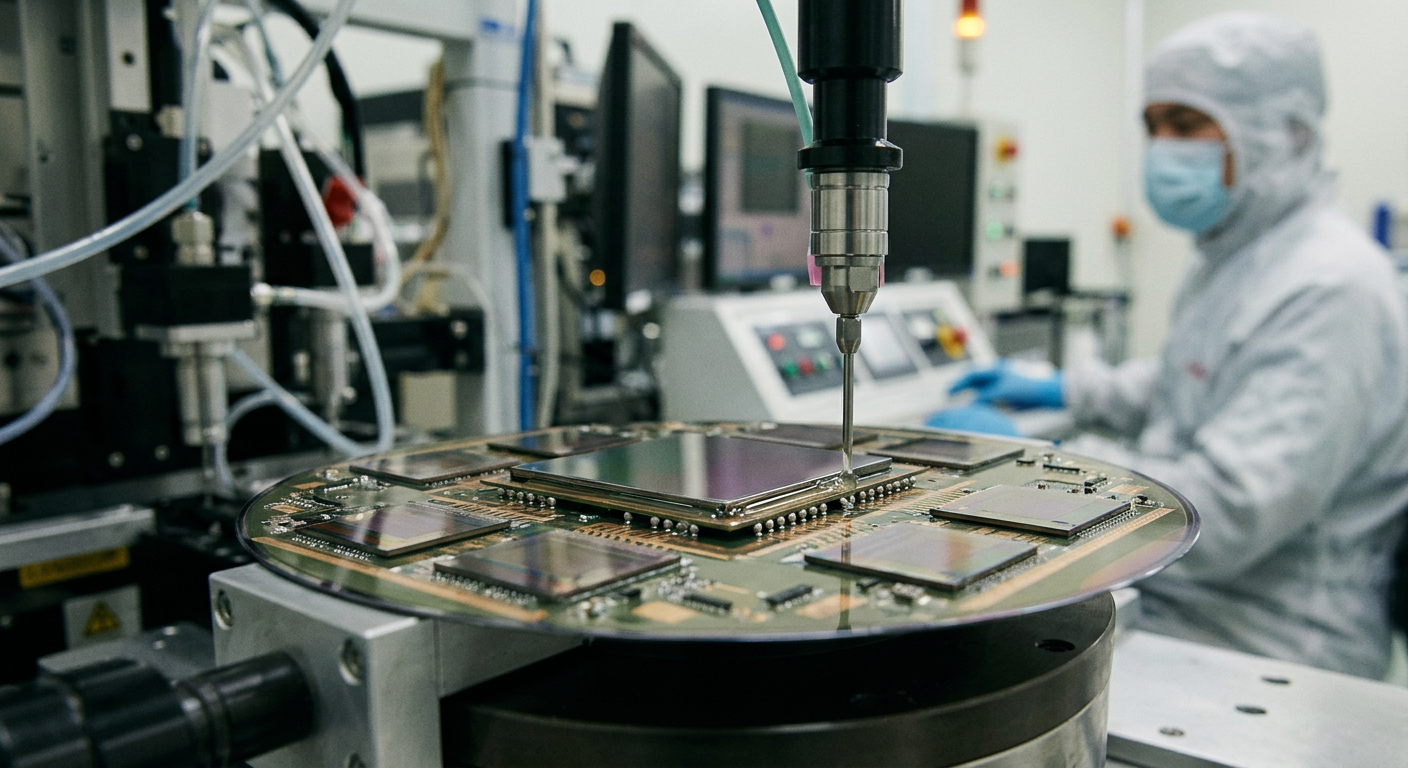
Explore underfill fan-out wafer level packaging solutions in the United States, including suppliers, applications, buying tips, and 2026 market trends.
 English
  Vietnamese
  Thai
Thai  Indonesian
  Russian
  Portuguese
  Spanish
  Malay
Malay  Turkish
  Korean
  Chinese