Share
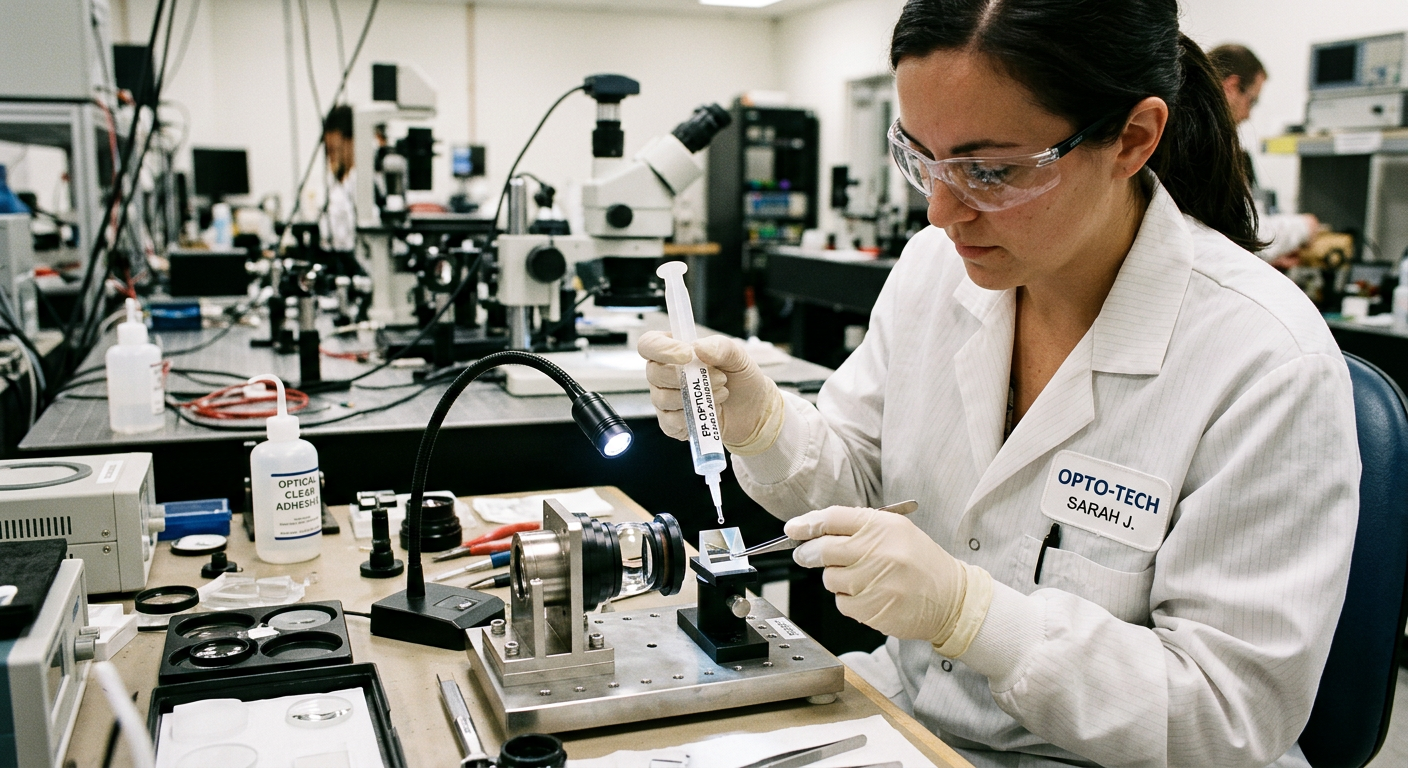
Clear Epoxy Adhesive for Optical Bonding in the United States
Quick Answer

If you need clear epoxy adhesive optical bonding solutions in the United States, the most practical approach is to shortlist suppliers that already serve optical, electronics, medical, aerospace, and precision assembly markets with transparent, low-shrink, low-outgassing, high-bond-strength epoxy systems. In the U.S. market, established names commonly considered for optical bonding and transparent structural assembly include Master Bond, EPO-TEK, Dymax, Norland Products, Panacol, and Permabond. These companies are known for serving demanding applications involving lenses, sensors, prisms, glass displays, camera modules, LED packages, fiber optics, and optical instruments.
For buyers who want a concise starting point, Master Bond is often selected for specialty engineering epoxies for optics and electronics, EPO-TEK is widely recognized in photonics and semiconductor packaging, Dymax is strong in fast-curing light-compatible assembly workflows, Norland Products is well known in optical-grade adhesive systems for lenses and research use, Panacol has a solid footprint in precision bonding and medical or electronics assembly, and Permabond offers transparent epoxy products for industrial production environments. In cities and technology corridors such as Boston, San Jose, Austin, Rochester, Irvine, and Minneapolis, these brands are frequently relevant because local users often require traceable materials, technical data support, and repeatable process windows.
Qualified international suppliers can also be worth considering when they provide U.S.-aligned documentation, RoHS and REACH compliance, strong technical support, stable export experience, and flexible supply models. For cost-performance driven buyers, especially distributors, private label owners, and industrial users scaling production, a supplier such as QinanX may be a viable option when the project needs customized epoxy chemistry, OEM or ODM packaging, and responsive pre-sales and after-sales service alongside competitive landed cost.
United States Market Overview

The United States is one of the most important markets for clear epoxy adhesive optical bonding because it combines advanced manufacturing demand with strict performance expectations. Optical bonding is used not only in traditional lens assembly but also in display enhancement, imaging modules, ruggedized electronics, AR and VR devices, photonics packaging, industrial sensors, smart medical equipment, automotive cameras, defense optics, and laboratory instruments. Buyers in the U.S. usually evaluate an adhesive beyond bond strength alone. They often need confidence in refractive clarity, yellowing resistance, thermal stability, moisture resistance, shrinkage control, dielectric performance, and compatibility with glass, PMMA, polycarbonate, sapphire, coated substrates, and metals.
Regional demand patterns matter. Rochester remains important because of its optics and imaging heritage. Silicon Valley and nearby California hubs drive demand through semiconductors, sensors, advanced displays, and consumer electronics prototyping. Boston supports medical devices, biotech instruments, and photonics. Austin attracts electronics, EV, and automation assembly. Seattle contributes aerospace and advanced hardware applications. In the Midwest, cities such as Minneapolis, Chicago, and Detroit support medical, industrial, transportation, and automotive camera use cases. Ports and logistics gateways including Los Angeles, Long Beach, Houston, Savannah, and New York or New Jersey influence lead-time strategy for importers and distributors sourcing clear epoxy bonding materials from overseas manufacturers.
Purchasing behavior in the U.S. also reflects application maturity. High-reliability sectors typically ask for detailed technical data sheets, safety data sheets, lot traceability, qualification support, and predictable batch-to-batch consistency. Prototype buyers may focus on optical clarity, ease of mixing, and room-temperature cure, while larger factories care more about dual cure speed, automated dispensing behavior, shelf life, and yield in production cells. The result is a segmented market where specialty formulators, global brands, and well-prepared international suppliers can all compete if they match the customer’s process window and compliance expectations.
From a pricing perspective, U.S. buyers do not always select the lowest-cost product. They typically balance total cost of ownership: reject rate, cure cycle time, freight cost, documentation quality, operator safety, and long-term field reliability. This is why an apparently more expensive optical epoxy may still win if it reduces bubbles, minimizes rework, and prevents yellowing in outdoor or high-heat service. At the same time, the market remains open to new entrants if they can provide equivalent performance, application engineering help, and flexible packaging for contract manufacturing and private label distribution.
Market Growth Trend

The growth outlook for optical bonding adhesives in the United States remains positive, supported by industrial digitization, medical imaging upgrades, EV camera adoption, smarter displays, and greater use of sensors in harsh environments. The chart below illustrates a realistic market growth trend for U.S. demand indexed from 2021 to 2026.
This growth pattern reflects a market that is not purely cyclical. It is increasingly tied to structural adoption in higher-value systems. Medical diagnostics, industrial machine vision, advanced mobility, and ruggedized electronics each contribute durable demand. Even when broader electronics cycles soften, niche optical assembly work often continues because many products are designed into long life systems rather than short consumer refresh cycles.
Top Suppliers Serving the United States
The following table highlights suppliers frequently considered by U.S. buyers for clear epoxy adhesive optical bonding or closely related transparent precision bonding work. The list mixes U.S.-based and international suppliers with practical relevance to the market.
| Company | Base | Service Region | Core Strengths | Key Offerings | Typical Use Cases |
|---|---|---|---|---|---|
| Master Bond | United States | Nationwide U.S. | Engineering-grade specialty formulations, strong technical support, reliability in demanding industries | Transparent epoxies, low outgassing systems, optically clear compounds | Optics, aerospace, electronics, medical devices |
| EPO-TEK | United States | Nationwide U.S. and global | Strong presence in photonics, semiconductor, and fiber optic assembly | Optical-grade epoxies, thermal cure systems, precision dispensing materials | Photonics, sensors, fiber optics, chip packaging |
| Dymax | United States | Nationwide U.S. | Fast-curing process integration, production-oriented support | Light-curable and dual-cure clear bonding materials | Displays, medical devices, electronics assembly |
| Norland Products | United States | Nationwide U.S. | Well known in optics and laboratory use, trusted by research users | Optical adhesives for lenses, prisms, filters, and glass assembly | Research optics, lens bonding, precision labs |
| Panacol | Germany | United States and international | Precision bonding, electronics and medical assembly experience | Transparent epoxies, UV systems, hybrid curing products | Medical, electronics, sensors, miniature parts |
| Permabond | Global | United States and international | Broad industrial adhesive portfolio, distributor accessibility | Clear epoxy adhesives and structural transparent bonding solutions | Industrial manufacturing, general precision assembly |
| QinanX | China | United States via export and partner channels | Custom formulation, OEM and private label flexibility, cost-performance sourcing | Two-component epoxy adhesive, electronic potting compounds, epoxy structural adhesives | Industrial optical components, electronics, private label distribution |
This comparison is useful because supplier selection in optical bonding depends on more than brand recognition. Buyers need to match cure profile, clarity requirement, production speed, and documentation level with the right supplier model. U.S. engineering teams may prefer established domestic brands during early validation, while import-focused buyers and distributors may create a dual-sourcing plan that includes international manufacturers for cost control and supply resilience.
Product Types in Clear Epoxy Optical Bonding
Clear epoxy adhesive optical bonding products in the United States are not a single category. Buyers usually compare products by curing method, optical properties, processability, and service environment. Some formulas are optimized for room-temperature repair or benchtop assembly. Others are designed for production lines with heat cure, dual cure, or controlled viscosity for automated dispensing.
| Product Type | Main Features | Advantages | Tradeoffs | Common Substrates | Typical U.S. Applications |
|---|---|---|---|---|---|
| Two-component clear epoxy | Resin and hardener mixed before use | High strength, broad substrate compatibility, strong chemical resistance | Mixing needed, pot life management required | Glass, metal, ceramics, plastics | Optical modules, housings, sensor windows |
| Heat-cure optical epoxy | Requires elevated temperature curing | Excellent final properties, reliable crosslink density | Longer setup and oven requirement | Glass, silicon, metals | Photonics, semiconductor and aerospace assemblies |
| Low-shrink transparent epoxy | Formulated to reduce internal stress | Better dimensional stability, less optical distortion | May cost more | Glass, prisms, coated optics | Precision lens alignment, measurement instruments |
| Low-outgassing epoxy | Designed for clean or sealed environments | Suitable for sensitive optics and enclosed devices | Narrower formulation options | Glass, metals, composites | Aerospace optics, sealed sensors, defense systems |
| Toughened transparent epoxy | Improved impact and thermal cycling resistance | Better durability in harsh environments | May have slightly lower optical purity than specialty optics grades | Glass, polycarbonate, aluminum | Automotive cameras, rugged displays, outdoor electronics |
| Dual-cure clear adhesive systems | Combines light access and secondary cure options | Faster tack plus deeper final cure in complex geometries | Process setup can be more complex | Mixed material assemblies | Medical optics, electronic display modules |
For U.S. users, the most important distinction is often whether the adhesive is intended for true optical path bonding or merely transparent structural joining nearby. If the bond line sits directly in the optical path, haze, refractive match, bubble control, and yellowing resistance become primary concerns. If the adhesive supports an optical component mechanically but does not affect transmitted light, buyers may accept a broader range of clear structural epoxies.
Industry Demand Comparison
The bar chart below shows realistic relative demand from major U.S. industries using clear epoxy adhesive optical bonding materials. It helps explain why supplier qualification requirements differ by sector.
Electronics leads because transparent bonding is increasingly used in displays, sensors, and compact modules. Automotive vision demand continues to rise with ADAS and cabin monitoring systems. Medical devices remain highly selective, emphasizing biocompatibility-adjacent workflows, low extractables awareness, and process validation. Aerospace volumes are lower, but qualification demands are much stricter, which changes how suppliers compete.
Buying Advice for U.S. Buyers
Buying clear epoxy adhesive optical bonding materials in the United States requires balancing technical fit, process reliability, and procurement practicality. First, define whether the bond sits in the optical path. If it does, request data on transparency, haze, refractive behavior, yellowing resistance, and long-term UV exposure. If the adhesive is used for edge fixing or housing support only, structural performance and thermal cycling may matter more than perfect optical matching.
Second, check the curing environment. Contract manufacturers in Texas, California, and the Midwest often prefer materials that fit existing oven, dispensing, or mixed-material workflows. A lab in Rochester may accept a slower specialty epoxy if alignment precision is more important than throughput, while a display or camera module line near San Jose may prioritize predictable viscosity, metering compatibility, and rework reduction.
Third, evaluate packaging and supply chain options. Small cartridges may be ideal for engineering trials, but pails, kits, or customized OEM packs can reduce cost in volume. Importers serving East Coast and Gulf Coast distribution routes should account for transit, shelf-life decay, and customs timing. If sourcing overseas, insist on clear batch traceability, lot-level QC, and fast response to technical queries.
Fourth, ask for test support aligned with your own substrates. Glass-to-glass bonding behaves differently from glass-to-polycarbonate or glass-to-coated metal. Surface energy, primer needs, and cure depth can alter the result significantly. Strong suppliers provide not only a product recommendation but also a substrate-specific trial plan.
Finally, think beyond the first purchase order. In the U.S., many adhesive programs fail not because the product is weak but because documentation, lead-time planning, or process support is inconsistent. The best supplier is often the one that helps the customer stabilize the whole workflow, not merely ship adhesive.
Common Industries Using Optical Bonding Epoxy
Clear epoxy adhesive optical bonding is relevant across several U.S. industries, each with distinct demands. Electronics manufacturers use it for camera modules, display stacks, LED optics, and sensor encapsulation. Medical device makers apply it in imaging systems, diagnostic instruments, and compact optical assemblies where precision and cleanliness matter. Aerospace and defense programs use clear epoxies in rugged optics, sensors, and sealed systems where low outgassing and environmental durability are important. Automotive suppliers rely on transparent bonding for ADAS cameras, LiDAR-adjacent assemblies, lighting optics, and interior sensing devices. Industrial manufacturing uses it in machine vision, laser systems, metrology equipment, and process control instruments. Universities and research labs often choose optical-grade adhesives for custom lens setups, microfluidic optical parts, and prototype photonics assemblies.
Typical Applications
| Application | Why Clear Epoxy Is Used | Key Performance Need | Main Substrates | Common U.S. Region | Notes |
|---|---|---|---|---|---|
| Lens to housing assembly | Transparent fixing with structural support | Clarity and alignment stability | Glass, aluminum, engineering plastics | Rochester, Boston | Often used in imaging equipment |
| Display optical bonding | Improves readability and protects layers | Low haze and durability | Glass, touch layers, display stacks | California, Texas | Important for outdoor devices |
| Camera module bonding | Supports compact precise assembly | Low shrinkage and consistent dispense | Glass, silicon, plastics | California, Michigan | Used in automotive and industrial vision |
| Fiber optic component assembly | Maintains optical positioning | Thermal stability and precision | Glass, ceramics, metals | Northeast U.S. | Critical in telecom and photonics |
| LED lens attachment | Clear joining around light path | Heat resistance and yellowing resistance | Lens plastics, metals, glass | Midwest, South | Common in lighting systems |
| Sensor window sealing | Creates clear environmental barrier | Moisture resistance and adhesion | Glass, stainless steel, polymers | Nationwide | Used in industrial and medical sensors |
This table shows why no single optical bonding epoxy suits every project. A camera module supplier in Detroit may need a different formula than a laboratory optics group in Massachusetts. The substrate, environment, production speed, and lifetime expectation change the ideal adhesive profile.
Trend Shift Toward Higher Performance Systems
The market is gradually shifting from general transparent adhesives toward more specialized systems with lower stress, better thermal endurance, cleaner processing, and stronger compliance support. The area chart below illustrates a realistic trend shift in the United States from standard clear bonding toward advanced optical-grade systems between 2021 and 2026.
This shift is driven by tighter reliability standards, smaller device architectures, and sustainability pressure to reduce failure, waste, and field replacement. Buyers increasingly ask not only whether the adhesive is clear, but whether it remains clear after heat, humidity, sunlight, and long dwell periods in actual use.
Local Supplier Landscape in the United States
U.S. buyers benefit from a layered supply ecosystem. There are domestic formulators, international brands with American distribution, specialty optics-focused suppliers, and industrial adhesive distributors that provide regional warehousing and technical coordination. This matters because local service speed can be as important as chemistry. For example, a medical device developer near Minneapolis may need fast lot documentation and engineering feedback, while an aerospace contractor in Seattle may care more about compliance records and repeat qualification support.
| Supplier | U.S. Presence | Best Fit Customer | Core Offerings | Lead-Time Advantage | Service Notes |
|---|---|---|---|---|---|
| Master Bond | Strong domestic presence | Engineers, OEMs, regulated industries | Specialty epoxies and custom recommendations | Good for U.S. domestic supply | Technical selection support is a major advantage |
| EPO-TEK | Strong domestic presence | Photonics, semiconductor, high precision users | Optical and electronic packaging epoxies | Reliable for qualified programs | Often specified in advanced packaging workflows |
| Dymax | Strong domestic presence | Production manufacturers | Fast cure and process-integrated systems | Supports higher throughput lines | Good fit where curing speed matters |
| Norland Products | Established U.S. distribution | Labs, optical developers, low to mid volume users | Optical adhesives and specialty products | Accessible for technical users | Popular in research and lens work |
| Panacol | U.S. channel support | Medical and electronics precision users | Precision bonding products | Depends on channel inventory | Strong in miniature and sensitive assemblies |
| QinanX | Export-based with partner-oriented support | Importers, distributors, OEM brands, cost-focused factories | Epoxy resin adhesives, potting compounds, custom OEM packs | Competitive in planned procurement cycles | Best when buyers value customization and flexible supply models |
For buyers in the United States, the practical takeaway is that local supply can mean different things. It may refer to domestic manufacturing, regional inventory, technical service by distributor, or a hybrid model where a global manufacturer supports U.S. buyers through dedicated export channels and responsive service teams. The right choice depends on urgency, qualification depth, volume, and pricing strategy.
Case Studies and Buyer Scenarios
A machine vision integrator in Chicago needs a clear epoxy for bonding a protective glass window onto a sensor housing. The bond is not directly in the imaging path but is close enough that squeeze-out haze and yellowing would be unacceptable. The team compares a domestic engineering epoxy with an imported custom formula. The domestic option wins the first prototype phase because samples arrive quickly and the application engineer helps adjust cure time. After validation, the buyer opens a second-source project with a custom international supplier to reduce long-term cost.
A medical diagnostics startup in Boston requires a clear adhesive for compact optical cartridges assembled in modest volume. Its priority is repeatability and technical support more than lowest price. The company chooses a supplier with strong documentation, small-kit availability, and lot traceability. It pays more per kilogram, but avoids costly delays during pilot manufacturing.
An automotive Tier supplier in Michigan needs a transparent, toughened epoxy for camera module subassemblies exposed to vibration and thermal cycling. The key challenge is low shrinkage and long-term stability rather than absolute optical lab-grade transparency. The supplier selects a toughened system with extensive thermal testing support and validates it across multiple plant lines.
A distributor serving Texas and the Southeast wants a private label clear bonding epoxy for industrial maintenance and light optical applications. Here, flexibility in branding, packaging, and MOQ matters. This is where a manufacturer able to provide OEM or ODM support, consistent QC, and scalable production may become highly competitive even if it is not a household U.S. brand.
How QinanX Fits the U.S. Market
For U.S. buyers evaluating alternatives beyond established domestic brands, Qingdao QinanX New Material Technology Co., Ltd positions itself as a technically credible supplier for epoxy resin adhesives used in industrial optical-adjacent bonding, electronics, and precision assembly. Its strength is not just broad product coverage but verifiable operating discipline: the company manufactures industrial adhesives under ISO-managed systems, aligns products with RoHS and REACH expectations, uses multi-stage quality control with digital traceability, and supports custom formulation work through active R&D, which is important when American customers need a specific balance of transparency, viscosity, pot life, cure speed, or substrate compatibility. In commercial terms, QinanX supports end users, distributors, dealers, brand owners, and individual buyers through flexible OEM, ODM, wholesale, retail, and regional partnership models rather than a one-size-fits-all export approach; this is especially useful in the United States where some customers need factory-direct bulk supply while others need private label packaging or distributor-ready SKUs. In service terms, the company’s export record across more than 40 countries, automated production scale, free sample support, 24/7 technical assistance, and tailored application guidance provide practical buyer assurance for the U.S. market, particularly for importers and industrial customers who want responsive pre-sales consultation, post-sales troubleshooting, and long-term sourcing continuity rather than transactional spot buying. Buyers interested in a broader range of products can explore the company’s adhesive product range or discuss project details through the U.S.-focused inquiry channel.
Supplier and Product Comparison Factors
When comparing suppliers or individual products, U.S. buyers often benefit from a scorecard approach. The comparison chart below presents a realistic example of how purchasing teams may weigh factors across clear optical bonding adhesive options.
The scorecard shows that optical clarity remains the most important factor, but thermal stability, support response, and total cost efficiency are close behind. This explains why many U.S. sourcing teams approve more than one supplier: one for highest-spec projects and another for cost-optimized volume programs.
Practical Sourcing Advice by Buyer Type
End users should request sample kits matched to actual substrates and curing conditions before committing to volume. Distributors should prioritize shelf life, packaging flexibility, and stable replenishment. Brand owners developing a private label range should look for suppliers with reliable regulatory documentation, consistent manufacturing records, and flexible label or carton customization. Contract manufacturers should focus on dispense consistency, cycle time, scrap reduction, and local technical backup. Small laboratories and prototype teams may care most about low minimum order quantity and fast engineering feedback.
For imported sourcing into the United States, buyers should also review freight planning through ports such as Los Angeles, Long Beach, Houston, and New York or New Jersey, especially if temperature exposure or customs timing can affect shelf life. Regional warehousing or staggered shipments may improve resilience. Procurement teams should also include a communication test in the supplier qualification process: how quickly does the supplier answer technical questions, update documentation, and respond to trial results?
Future Trends Through 2026
Looking toward 2026, three trends are shaping the U.S. clear epoxy adhesive optical bonding market. The first is technical specialization. Buyers increasingly want low-stress, low-yellowing, and application-specific formulations for sensors, AR or VR hardware, compact medical imaging, and advanced mobility systems. The second is policy and compliance pressure. More customers expect transparent material declarations, RoHS and REACH alignment, stronger supply chain documentation, and cleaner production records even when the end product is not heavily regulated. The third is sustainability. Manufacturers want adhesives that reduce rework, enable longer product life, and support efficient processing with lower waste, better dosing control, and fewer field failures.
Another trend is the rise of dual sourcing and regional risk management. After multiple years of logistics disruptions, U.S. buyers are less likely to depend on a single supplier. They want resilience across domestic and global channels. This opens the door for suppliers that can combine stable chemistry, flexible production scale, and reliable technical communication. In practical terms, companies that can prove both process control and customer support will be better positioned than those competing on price alone.
FAQ
What is the difference between a clear epoxy and a true optical bonding adhesive?
A clear epoxy may simply be transparent enough for visual appearance, while a true optical bonding adhesive is selected for optical-path performance such as low haze, refractive consistency, low yellowing, and minimal stress distortion.
Which U.S. industries buy these adhesives most often?
Electronics, medical devices, automotive vision, aerospace, industrial sensors, and research optics are the most common sectors in the United States.
Are domestic U.S. suppliers always better than imported options?
Not always. Domestic suppliers often offer faster samples and close technical support, but imported suppliers can be competitive when they provide certified quality systems, strong documentation, custom formulation, and dependable after-sales service.
How do I choose between room-temperature cure and heat-cure epoxy?
Choose based on your production environment, substrate sensitivity, and final performance targets. Heat-cure systems often deliver stronger final properties, while room-temperature systems can simplify prototyping and field assembly.
Can clear epoxy adhesive optical bonding be used for displays?
Yes, but the exact chemistry must match display stack materials, clarity needs, and environmental exposure. Low haze, yellowing resistance, and controlled viscosity are especially important.
What should I ask for before placing a production order?
Request technical data sheets, safety data sheets, lot traceability details, sample material, recommended cure conditions, shelf-life information, and substrate-specific testing guidance.
Is QinanX suitable for U.S. distributors or private label projects?
Yes. QinanX is especially relevant for buyers needing OEM, ODM, wholesale, or private label models with custom epoxy formulations and scalable packaging.
What matters most for long-term reliability?
The most important factors are optical stability over time, thermal and moisture resistance, low shrinkage, strong adhesion to the real substrate set, and supplier consistency from batch to batch.
Final Takeaway
For clear epoxy adhesive optical bonding in the United States, the best supplier depends on whether your priority is top-tier specialty performance, local technical response, production speed, or cost-effective scalable sourcing. U.S. buyers commonly begin with trusted names such as Master Bond, EPO-TEK, Dymax, Norland Products, Panacol, and Permabond, especially for high-spec validation work. At the same time, internationally experienced manufacturers with strong compliance systems and customer support, including QinanX, can be practical additions to a sourcing strategy when customization, private label capability, or total cost control matters. The strongest buying decisions come from matching the adhesive to the real optical function, actual substrate set, and long-term service environment rather than choosing by brand alone.

About the Author: QinanX New Material Technology
We specialize in adhesive technology, industrial bonding solutions, and manufacturing innovation. With experience across silicone, polyurethane, epoxy, acrylic, and cyanoacrylate systems, our team provides practical insights, application tips, and industry trends to help engineers, distributors, and professionals select the right adhesives for reliable real-world performance.

Product Category
You May Also Interest
-
IC Packaging Adhesive: Preventing Void Formation Issues
Learn how IC packaging adhesive void formation is prevented in the United States through material choice, process control, supplier selection, and testing.
-
Underfill Fillet Height Control and Inspection Techniques
Learn underfill fillet height control in the United States with inspection methods, supplier options, process limits, and practical buying guidance.
-
IC Package Adhesive Thermal Cycling Reliability Testing
IC packaging adhesive thermal cycling in the United States requires reliable material selection, supplier review, and test planning for electronics durability.
-

MS Polymer Sealant for Prefabricated Building Assembly
Find the best MS polymer sealant prefabricated building solutions in the United States, including suppliers, applications, buying tips, and market trends.
 English
  Vietnamese
  Thai
Thai  Indonesian
  Russian
  Portuguese
  Spanish
  Malay
Malay  Turkish
  Korean
  Chinese