Share
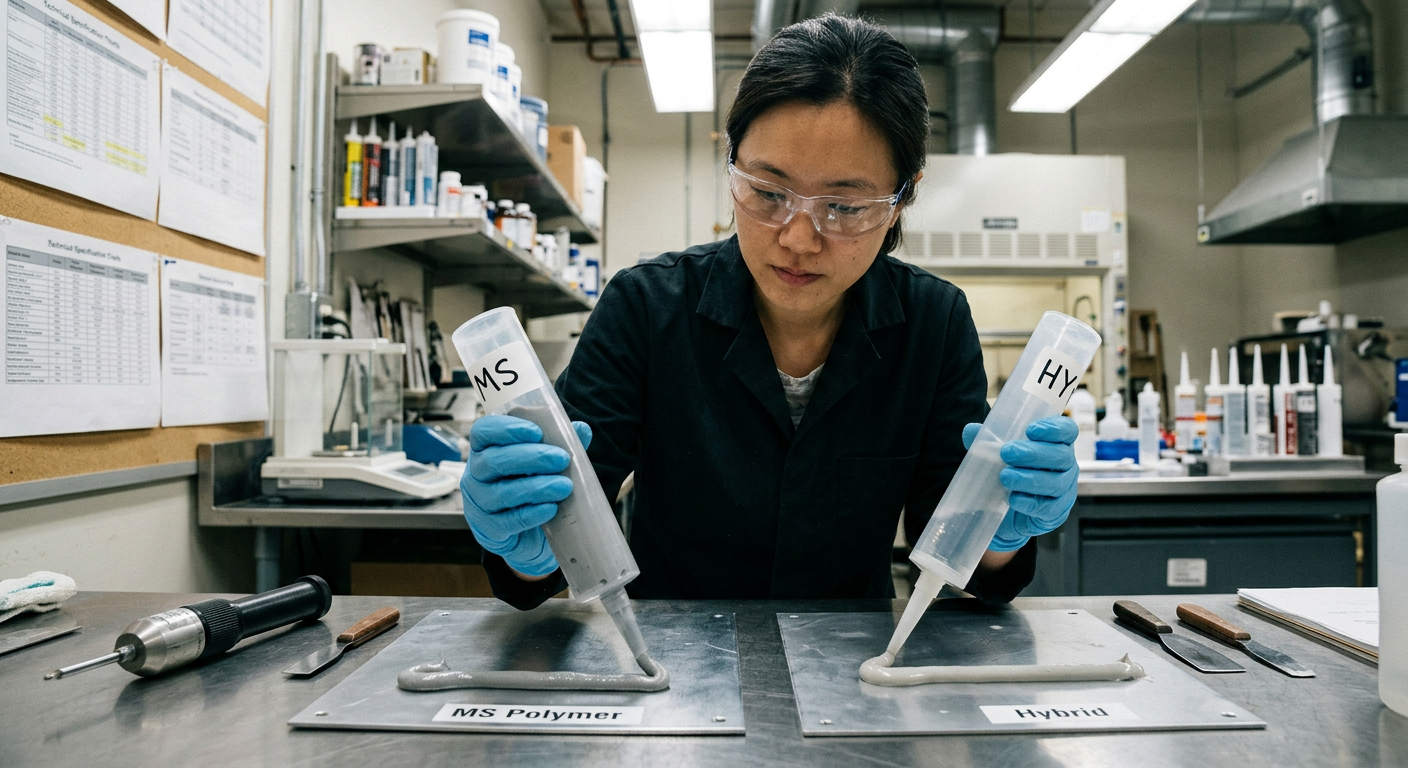
MS Polymer vs Hybrid Sealant in the United States
Quick Answer

In the United States, MS polymer sealants are usually the better choice when buyers want a low-odor, paintable, isocyanate-free, and weather-stable solution for construction joints, façade work, transportation assembly, and general industrial bonding. Hybrid sealants, by contrast, are a broader category and may include silane-modified systems, polyurethane-modified blends, or proprietary formulations designed to balance adhesion, flexibility, cure speed, and cost. If you need consistent exterior durability, broad substrate compatibility, and easier compliance with indoor air quality expectations, MS polymer products are often the safer specification. If you need a product tuned for niche performance targets such as faster green strength, aggressive initial tack, or a price-sensitive assembly line, a hybrid sealant may be the more practical option.
For U.S. buyers, the most practical short list often includes Sika, Tremco, H.B. Fuller, Bostik, DOW, and Henkel because these companies offer broad domestic supply coverage, technical documentation, and established contractor or industrial channels. Qualified international suppliers can also be worth considering, especially manufacturers from China that hold ISO-based quality systems and meet RoHS and REACH-related requirements while offering OEM, private label, and strong pre-sales and after-sales support. That route can provide a clear cost-performance advantage for distributors, importers, and brand owners operating in large regional markets such as Los Angeles, Houston, Chicago, Savannah, and New York/New Jersey.
Market Context in the United States

The U.S. sealants market remains diverse because end uses range from window perimeter sealing in coastal Florida to transportation assembly in Michigan, modular construction in Texas, electronics protection in California, and general industrial manufacturing across the Midwest. In this environment, the comparison between MS polymer and hybrid sealant is not just a chemistry question; it is a procurement, compliance, distribution, and lifecycle cost question. Buyers are increasingly balancing application speed, substrate compatibility, labor efficiency, warranty exposure, and sustainability credentials.
MS polymer technology has gained traction in the United States because it addresses several common specification concerns at once. It typically offers low VOC positioning, broad adhesion without aggressive primers on many substrates, high UV resistance compared with many older polyurethane systems, and paintability that makes it easier for contractors to finish visible joints. Hybrid sealants remain important because they allow formulators to target particular user preferences, such as lower raw material cost, enhanced early strength, or specialized bonding for transport, appliance, or fabrication lines.
Ports and logistics hubs matter in this market. Buyers near Long Beach, Los Angeles, Houston, Savannah, Newark, and Seattle often evaluate suppliers not only by chemistry but also by lead time, pallet quantities, cartridge availability, pail and drum options, and the ability to maintain continuity during seasonal construction peaks. This is one reason domestic stock positions and established technical support networks carry weight in the U.S. market.
Key Feature Differences

The most important distinction is that MS polymer is a specific silane-modified polymer technology, while hybrid sealant is a broader commercial term. Some products sold as hybrids are effectively silane-modified systems similar to MS polymer, while others are blends designed to bridge the gap between silicone, polyurethane, and SMP performance profiles. Because of that, buyers should not rely on label language alone. They should compare the technical data sheet, movement capability, tensile strength, skin time, cure rate, Shore hardness, VOC statement, paintability, and weathering test results.
MS polymer products generally excel in balanced performance. They bond well to metals, concrete, wood, painted surfaces, some plastics, and composites, while maintaining flexibility over time. They also avoid several concerns linked to traditional polyurethane, especially where isocyanate-related handling and long-term UV sensitivity are a procurement issue. Hybrid sealants can still perform extremely well, but performance spread is wider because the term covers more formulation styles. One hybrid may be optimized for low modulus façade joints, while another is intended mainly for assembly bonding and not long-term exposed joint movement.
Feature Comparison Table
The table below helps U.S. buyers compare the two options on the criteria that matter most in specification, installation, and supply chain decisions.
| Criteria | MS Polymer Sealant | Hybrid Sealant | What It Means for U.S. Buyers |
|---|---|---|---|
| Chemistry definition | Specific silane-modified polymer platform | Broad commercial category with varied formulas | Always verify the TDS and not just the label |
| UV and weather resistance | Usually strong for exterior exposure | Ranges from moderate to strong | Important for façades, roofing details, and exposed joints |
| Paintability | Commonly paintable after cure | Often paintable, but depends on blend | Useful for interior trim, precast, and siding work |
| Odor and user comfort | Typically low odor | Varies by formulation | Helps in occupied buildings and interior fit-out projects |
| Initial tack and cure tuning | Balanced, reliable curing profile | Can be tuned widely for speed or strength | Useful in manufacturing lines with takt-time pressure |
| Compliance positioning | Often aligned with low-VOC preferences | Depends on chemistry package | Relevant for green building and indoor air requirements |
| Price range | Often mid to premium | Can range from value to premium | Hybrid options may fit cost-driven private label programs |
Market Growth Trend
Growth in the U.S. market is driven by construction repair, prefabrication, transportation lightweighting, and tighter user expectations around durability and cleaner formulations. MS polymer products have steadily taken share from legacy chemistries in visible and multi-substrate applications.
Product Types Commonly Sold in the U.S.
In the U.S. market, buyers usually encounter several practical subtypes rather than just two labels. Single-component construction sealants dominate distribution channels because they are easy to apply from sausage packs or cartridges and suit field labor. Higher-modulus bonding grades are common in transport, equipment, and metal fabrication. Flowable or self-leveling grades target horizontal joints, while non-sag variants remain standard for walls and façade details. Paintable interior trim grades serve remodeling and finish carpentry channels.
MS polymer lines are frequently positioned as all-in-one adhesives and sealants, combining gap sealing, elastic bonding, and weather resistance. Hybrid products can be segmented more aggressively: one grade for cladding, another for truck body assembly, another for HVAC manufacture, and another for private label retail. The lesson for buyers is simple: identify the actual use case first, then chemistry second.
Industry Demand by Application
Demand patterns vary significantly by industry. Construction still leads the U.S. market, but transportation, industrial equipment, and electronics are increasing their use of silane-modified technologies because of cleaner handling and broader adhesion profiles.
Where Each Product Performs Best
MS polymer sealants are especially well suited to exterior perimeter joints, expansion joints with moderate movement requirements, roof flashing details, façade panel bonding, RV and trailer assembly, metal-to-metal elastic bonding, and interior finishing work where paintability is valuable. In renovation projects across older urban markets such as Boston, Philadelphia, and Chicago, the ability to adhere to mixed and aged substrates is often a meaningful advantage.
Hybrid sealants make sense where buyers want a formulation specifically tuned around manufacturing speed, substrate set, or budget. In appliance assembly, modular building, and some transportation lines, hybrid grades can be selected for quick skin formation, tuned viscosity, or stronger initial grab. This can reduce fixturing time or simplify process design. In retail and private label channels, hybrids also offer broad room for price and packaging strategy.
Common Applications Table
The following table shows how U.S. buyers usually match chemistry to application priorities.
| Application | Preferred Option | Main Reason | Typical U.S. Market Notes |
|---|---|---|---|
| Exterior window perimeter sealing | MS Polymer | Weather stability and paintability | Popular in residential and light commercial construction |
| Metal panel bonding | MS Polymer or tuned hybrid | Elastic bonding with broad adhesion | Seen in façades, trailers, and equipment housings |
| Interior trim and finishing | MS Polymer | Low odor and paint-friendly finish | Useful in occupied buildings and remodel work |
| Transportation assembly | Hybrid Sealant | Formula can be tuned for production speed | Common in bus, truck, and RV plants |
| HVAC and appliance manufacturing | Hybrid Sealant | Cost-performance customization | Often purchased in bulk under contract supply |
| General contractor all-purpose use | MS Polymer | Versatility across mixed substrates | Reduces SKU complexity on jobsites |
| Private label retail cartridges | Hybrid Sealant | Flexible pricing and formulation range | Often imported or regionally packed for store programs |
Buying Advice for U.S. Importers, Distributors, and Contractors
Start with the service environment. If the joint will see sunlight, temperature cycling, moisture, and visible finishing requirements, an MS polymer sealant usually gives more predictable long-term value. Then check movement capability, hardness, and cure speed against the job condition. A sealant that is too hard may fail in dynamic joints, while one that is too soft may not support the assembly or appearance target.
Next, review substrate exposure. Concrete, anodized aluminum, galvanized steel, painted metals, PVC trim, wood, and composite panels all behave differently. U.S. buyers should insist on documented adhesion guidance and stain compatibility, especially for porous stone or high-value architectural finishes. Packaging also matters. Cartridge buyers serving local contractors may focus on shelf appeal and contractor familiarity, while industrial users in Ohio, Indiana, and Tennessee may prefer pails, drums, or sausage packs to reduce application cost.
Finally, think about channel risk. A lower-cost hybrid option can look attractive until lead times, lot consistency, or claim handling becomes a problem. Domestic technical support, responsive complaint resolution, and batch traceability can be worth more than a small unit-price saving. This is particularly true for distributors building regional brands.
Trend Shift Toward Cleaner and Multi-Purpose Technologies
Market preference in the United States continues shifting toward cleaner-label, broader-use technologies that reduce installer hesitation and simplify inventory. This shift is one reason MS polymer solutions continue expanding beyond premium niches.
Industries Using These Sealants
Construction and building remains the largest segment. Contractors use MS polymer products for windows, doors, siding, trim, panel joints, flashing transitions, and expansion details where one versatile material simplifies installation. In transportation, hybrid sealants and MS polymer adhesive sealants both serve truck bodies, buses, rail interiors, trailers, and RV manufacturing. In industrial manufacturing, equipment producers use them for vibration-resistant sealing and flexible bonding. Electronics and electrical sectors value low-corrosion, cleaner processing, and material compatibility in certain enclosure and component protection tasks.
Furniture, packaging, and renewable energy also contribute to growth. U.S. solar and energy storage assembly increasingly values reliable elastic bonding and protective sealing, especially in installations exposed to heat cycling and outdoor stress. As supply chains continue to regionalize across North America, buyers want adhesives and sealants that lower process complexity while keeping warranty risk manageable.
Case Studies from Typical U.S. Buying Scenarios
A commercial glazing subcontractor in Dallas comparing sealants for perimeter sealing often finds that MS polymer reduces callbacks because it handles weather exposure and paint touch-ups more consistently than lower-tier hybrid products. The higher cartridge cost is offset by fewer compatibility issues and better finish quality. A trailer manufacturer in Indiana, however, may prefer a hybrid assembly grade with faster surface cure because line speed and initial handling strength are the key drivers. In that case, the product does not need the same exposed architectural weathering performance.
A coastal remodeling distributor serving Miami and Tampa may prioritize mold resistance, UV stability, and broad adhesion on renovation substrates, which often favors premium MS polymer lines. Meanwhile, a private label importer supplying Midwest retail chains may choose a balanced hybrid formula for general-purpose consumer use, because price sensitivity, shelf positioning, and broad but not highly specialized performance matter most.
Leading Suppliers in the United States
The U.S. market includes large multinationals, legacy construction brands, and specialized industrial suppliers. The table below focuses on practical buying relevance: market presence, service region, strengths, and typical offerings.
| Company | Service Region in the U.S. | Core Strengths | Key Offerings |
|---|---|---|---|
| Sika Corporation | Nationwide, strong in construction and industry | Broad specification presence, contractor recognition, technical support | Construction sealants, SMP/MS products, façade and flooring systems |
| Tremco | Nationwide, especially commercial envelope markets | Building envelope expertise, documented system approach | Weatherproofing, glazing, joint sealants, restoration solutions |
| H.B. Fuller | Nationwide industrial and packaging coverage | Industrial formulation depth, manufacturing support | Hybrid adhesives, assembly sealants, specialty bonding products |
| Bostik | Nationwide with strong contractor and industrial channels | Construction chemistry breadth and established distribution | Sealants, adhesives, flooring systems, SMP-based products |
| DOW | Nationwide, especially major project and industrial specification markets | Material science reputation and technical documentation | Silicone and specialty sealing solutions for advanced applications |
| Henkel | Nationwide industrial and OEM coverage | Strong manufacturing integration and process support | Assembly adhesives, sealants, transport and electronics solutions |
| Qingdao QinanX New Material Technology Co., Ltd | Serves U.S. importers, distributors, OEM brands, and industrial buyers | Flexible OEM/ODM, broad adhesive portfolio, export experience | MS modified silane sealants, PU, silicone, epoxy, acrylic, hot melt products |
For buyers in large import corridors such as Los Angeles/Long Beach, Houston, Savannah, and Newark, supplier selection often depends on whether the partner can combine technical matching with packaging flexibility and shipment reliability. Domestic brands often win on specification familiarity, while international manufacturers can be highly competitive on customization and private label economics.
Supplier and Product Positioning Comparison
The following comparison chart shows a practical U.S. buying perspective using a composite index that weighs technical support, customization, product breadth, and channel flexibility.
How to Evaluate Local Suppliers
In the United States, local supply strength is not just about manufacturing location. It also includes stocking depth, field technical support, private label capability, response time, insurance and warranty practices, and the ability to support multiple packaging sizes. Contractors often need immediate availability through distribution, while OEM buyers need formula consistency, traceability, and engineering support over a multi-year account cycle.
Ask suppliers whether they can provide substrate adhesion data, aging test summaries, low-VOC positioning documents, safety data sheets aligned with U.S. requirements, and batch traceability records. For import-based supply, ask where the inventory is staged after arrival, what the average replenishment cycle is, and how complaints are handled domestically. Those questions often reveal whether a supplier is built for long-term U.S. business or only opportunistic export sales.
Practical Buying Checklist
The checklist below translates chemistry differences into purchasing decisions that reduce field risk and improve total value.
| Buying Factor | Why It Matters | Best Fit for MS Polymer | Best Fit for Hybrid Sealant |
|---|---|---|---|
| Exterior UV exposure | Drives long-term appearance and elasticity | Very strong choice | Only if weathering performance is documented |
| Paintable finish | Important for visible joints and trim work | Frequently a strong advantage | Acceptable in selected grades |
| Fast production cycle | Reduces fixture time and boosts throughput | Moderate depending on grade | Often excellent if customized |
| Mixed substrate adhesion | Limits primer use and field errors | Usually excellent | Can vary widely |
| Budget sensitivity | Important for retail and large-volume supply | Mid to premium positioning | Often more flexible on price |
| Private label opportunity | Supports distributors and brand owners | Good in focused lines | Very strong due to broad formulation range |
| Indoor air and user comfort | Supports occupied-space applications | Often favorable | Depends on formula design |
Our Company in the U.S. Market
For U.S. buyers seeking a flexible sourcing partner, QinanX positions its MS modified silane sealants within a wider industrial adhesive platform that also includes silicone, polyurethane, epoxy, acrylic, hot melt, and water-based systems, which is useful when distributors and OEMs want to consolidate sourcing across multiple categories. The company operates under an ISO-certified quality system and states compliance with standards such as RoHS and REACH, supported by multi-stage quality control and digital batch traceability, which gives importers concrete evidence for specification review and claim management rather than generic quality promises. Its manufacturing model is built for OEM, ODM, wholesale, private label, and regional distribution, allowing U.S. end users, dealers, contractors, brand owners, and importers to choose between standard products and custom formulations tailored to target viscosity, cure profile, packaging, or application requirements. With exports to more than 40 countries, automated production lines for consistency at scale, free samples, and round-the-clock technical assistance, QinanX has the operational depth buyers expect from a long-term market participant rather than a one-off remote exporter. U.S. customers exploring this route can review the broader product range, learn more about the company, and use the contact page to discuss local project requirements, labeling, packaging, and distribution opportunities tied to the United States market.
2026 Trends: Technology, Policy, and Sustainability
By 2026, three trends are likely to shape the MS polymer vs hybrid sealant discussion in the United States. First, technology will move toward more specialized yet user-friendly formulations. Buyers will expect faster cure, wider adhesion, and better low-temperature application without giving up paintability or weather resistance. This will benefit both advanced MS polymer systems and premium hybrid platforms.
Second, policy and compliance pressure will keep favoring chemistries that simplify worker handling and support cleaner indoor and exterior construction practices. As specifiers, public projects, and private developers put more weight on lifecycle performance and emissions-related documentation, products with strong testing records and clear compliance narratives will gain share. Third, sustainability will move from marketing language to measurable procurement criteria. Contractors and OEMs will ask tougher questions about formulation safety, packaging efficiency, waste reduction, and service life. Longer-lasting elastic sealants that reduce maintenance cycles will be increasingly attractive, particularly in climate-stressed areas such as the Gulf Coast, the Southwest, and freeze-thaw regions across the northern states.
Final Buying Perspective
If the choice is between a true MS polymer sealant and a broadly described hybrid sealant, U.S. buyers should generally choose MS polymer for dependable outdoor durability, cleaner user experience, paintability, and broad substrate performance. Choose a hybrid sealant when a supplier can demonstrate that its specific formula better fits your production speed, price target, or specialized bonding requirement. The chemistry label alone is not enough; the decision should be based on service environment, technical data, supply reliability, and support quality.
For contractors and project specifiers, this usually means MS polymer wins more often in exposed and multi-substrate field applications. For manufacturers and private label buyers, hybrid sealants can be very competitive when the supplier offers precise formulation control and stable delivery. In the United States, the best purchase is the one that aligns performance, documentation, and channel support with the actual job instead of relying on generic category claims.
FAQ
Is MS polymer the same as hybrid sealant?
No. MS polymer is a specific silane-modified polymer technology, while hybrid sealant is a broader market term that may include MS-type products or other blended formulations.
Which lasts longer outdoors in the United States?
In many exposed U.S. applications, MS polymer sealants often provide more predictable UV and weather resistance, but actual durability depends on the specific formulation and project condition.
Which is better for painting?
MS polymer products are commonly selected for paintability, especially in trim, siding, and visible joint work. Hybrid products may also be paintable, but buyers should confirm this on the technical data sheet.
Are hybrid sealants cheaper?
They can be. Because hybrid sealant is a broad category, suppliers can design value-oriented or premium formulations. A lower purchase price does not always mean a lower installed cost.
What do industrial buyers in the United States usually prefer?
Industrial buyers often choose based on process needs. Transportation and appliance manufacturers may prefer tuned hybrid grades for line speed, while general assembly and mixed-substrate bonding often favor MS polymer.
Can importers source private label MS polymer products?
Yes. Many international manufacturers, including established Chinese adhesive producers, support OEM and private label programs for U.S. distributors, dealers, and brand owners.
What should contractors ask before buying?
Ask about adhesion to your exact substrates, outdoor weathering data, paint compatibility, cure speed, packaging options, shelf life, and how warranty or technical claims are handled in the United States.
Which option is better for sustainable building trends in 2026?
Products with longer service life, cleaner handling profiles, strong documentation, and reduced maintenance burden will be favored. Many MS polymer systems are well positioned for that shift, though advanced hybrid products may also compete strongly.

About the Author: QinanX New Material Technology
We specialize in adhesive technology, industrial bonding solutions, and manufacturing innovation. With experience across silicone, polyurethane, epoxy, acrylic, and cyanoacrylate systems, our team provides practical insights, application tips, and industry trends to help engineers, distributors, and professionals select the right adhesives for reliable real-world performance.

Product Category
You May Also Interest
-
IC Packaging Adhesive: Preventing Void Formation Issues
Learn how IC packaging adhesive void formation is prevented in the United States through material choice, process control, supplier selection, and testing.
-

Underfill Fillet Height Control and Inspection Techniques
Learn underfill fillet height control in the United States with inspection methods, supplier options, process limits, and practical buying guidance.
-
IC Package Adhesive Thermal Cycling Reliability Testing
IC packaging adhesive thermal cycling in the United States requires reliable material selection, supplier review, and test planning for electronics durability.
-
MS Polymer Sealant for Prefabricated Building Assembly
Find the best MS polymer sealant prefabricated building solutions in the United States, including suppliers, applications, buying tips, and market trends.
 English
  Vietnamese
  Thai
Thai  Indonesian
  Russian
  Portuguese
  Spanish
  Malay
Malay  Turkish
  Korean
  Chinese