Share
Conductive vs Non-Conductive IC Adhesive in the United States
Quick Answer

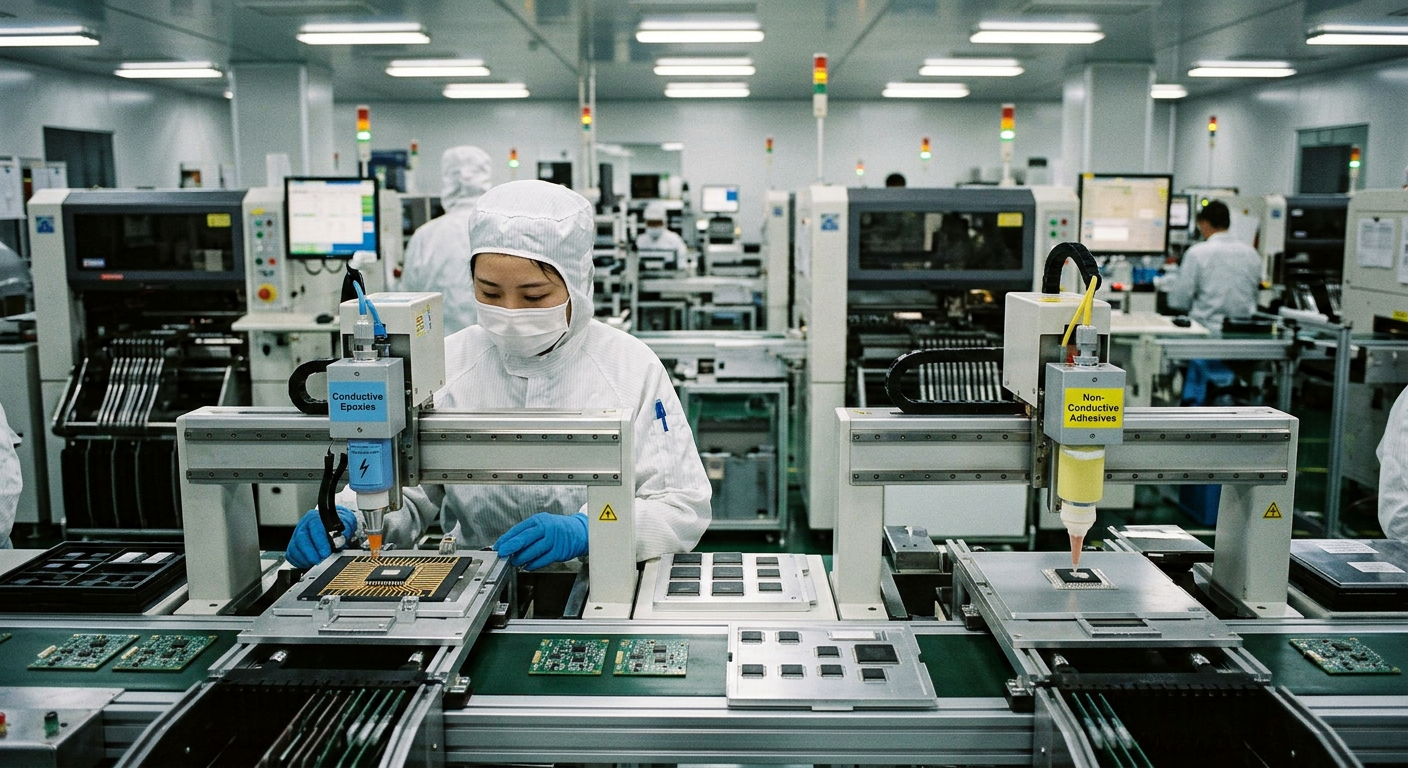
For IC packages in the United States, conductive adhesive is the right choice when the bond line must also carry electrical current or help dissipate heat, such as die attach in certain semiconductor packages, grounding paths, EMI-sensitive assemblies, and some power electronics modules. Non-conductive adhesive is the better option when the main goal is mechanical bonding, underfill, encapsulation, insulation, gap control, shock resistance, or environmental protection without creating an electrical pathway. In practical purchasing terms, conductive IC adhesive usually costs more, requires tighter process control, and must be validated for conductivity stability, while non-conductive IC adhesive typically offers broader processing windows and lower risk of electrical shorting.
For buyers in U.S. electronics hubs such as Silicon Valley, Austin, Phoenix, Boston, and the broader Midwest manufacturing corridor, the most effective approach is to match the adhesive to the assembly function first: electrical path, thermal path, or insulation requirement. Local buyers often shortlist established suppliers such as Henkel, Indium Corporation, Master Bond, 3M, Parker Lord, and AI Technology for critical electronics bonding programs. At the same time, qualified international suppliers can also be worth considering when they hold relevant certifications, understand RoHS and REACH requirements, and provide strong pre-sales and after-sales support. That combination can offer a meaningful cost-performance advantage for U.S. OEMs, distributors, and private-label buyers managing cost pressure and lead-time risk.
Direct Comparison: What Changes the Buying Decision

The difference between conductive and non-conductive IC adhesive is not just whether electricity can pass through the bond. In U.S. semiconductor and electronics manufacturing, that distinction affects package reliability, assembly yield, rework difficulty, thermal design, and compliance qualification. Conductive formulations often rely on silver-filled epoxy, hybrid metal-filled resin systems, or specialized electrically conductive polymer chemistry. Non-conductive formulations are commonly epoxy, silicone, acrylic, polyurethane, or other engineered resins designed to secure, protect, seal, or cushion components while preventing current flow.
When a design engineer in San Jose or Chandler selects conductive die attach adhesive, they are usually solving for current transfer, heat transfer, or both. When a manufacturing team in Minneapolis or Raleigh selects non-conductive adhesive, they are often optimizing insulation, underfill reliability, moisture resistance, coefficient of thermal expansion management, vibration resistance, or dispensing efficiency. That is why the right question is not which adhesive is better in general, but which adhesive function aligns with the package structure, substrate, chip size, cure profile, throughput target, and field reliability standard.
| Comparison Point | Conductive IC Adhesive | Non-Conductive IC Adhesive | Practical Impact for U.S. Buyers |
|---|---|---|---|
| Electrical behavior | Allows electrical conduction | Provides electrical insulation | Determines whether the bond can serve as an active electrical path |
| Typical filler system | Often silver or metal-filled | Usually unfilled or ceramic/non-conductive filled | Strongly affects price, viscosity, and storage conditions |
| Thermal conductivity | Often higher | Can range from low to medium, depending on formulation | Important for power devices and compact IC packaging |
| Risk profile | Risk of migration, shorting, and conductivity drift if poorly selected | Risk of insufficient heat dissipation if used in the wrong design | Wrong selection can lead to field failures or yield loss |
| Processing cost | Usually higher material and validation cost | Usually lower material cost and simpler validation | Directly affects total assembly economics |
| Common package use | Die attach, grounding, conductive joining | Underfill, encapsulation, sealing, structural bonding | Defines whether the product fits semiconductor back-end lines |
| Best fit | Electrical and thermal path required | Insulation and protection required | Helps engineering teams make faster qualification decisions |
This table matters because many U.S. buyers begin with conductivity as the headline property but later discover that cure temperature, moisture absorption, ionic cleanliness, outgassing, and long-term thermal cycling performance are equally important. In aerospace electronics near Seattle, medical electronics in Minnesota, and EV power electronics in Michigan, these secondary characteristics often decide the final approved vendor.
United States Market Overview

The U.S. market for IC adhesive reflects the country’s diverse electronics production footprint. Demand is not concentrated in one region alone. Silicon Valley remains influential for design-led semiconductor programs. Arizona continues to expand wafer, packaging, and electronics investment. Texas supports strong demand from telecom, automotive electronics, and industrial controls. Massachusetts and the Northeast maintain demand from medical devices, defense electronics, and photonics. The Great Lakes region supports automotive, battery, and industrial automation uses, while Southern states continue to attract electronics assembly and component manufacturing.
Several macro factors shape conductive and non-conductive IC adhesive demand in the United States. First, domestic semiconductor investment has increased interest in advanced packaging materials. Second, EV growth expands demand for thermally managed adhesive systems. Third, miniaturization in wearables, medical devices, and sensor modules increases the value of precise dispensing and low-stress materials. Fourth, compliance expectations around RoHS, REACH, and process traceability push buyers toward better-documented suppliers. Finally, procurement teams are actively balancing resilience, local inventory, and supplier diversification after multiple years of logistics volatility at U.S. ports and inland distribution hubs.
The line chart shows a realistic market growth index rather than a fixed dollar value. It helps buyers visualize the steady rise in adhesive demand tied to packaging complexity, domestic electronics investment, and high-reliability electronics expansion. The expected 2026 increase is consistent with broader market movement in advanced materials, especially where U.S. manufacturing policy and energy-transition programs support electronics production.
Product Types Used in IC Packaging
IC packaging does not rely on a single adhesive type. Instead, engineers select materials based on function within the package or module. Conductive adhesives are commonly chosen for die attach and conductive attachment where solder alternatives or lower-temperature processing is needed. Non-conductive adhesives cover a broader range, including underfill, corner bonding, encapsulation, conformal protection, structural attachment, thermal interface layers without electrical conduction, and sealing around sensitive components.
U.S. buyers should also distinguish between electrically conductive and thermally conductive materials. Some non-conductive adhesives are electrically insulating yet thermally conductive due to ceramic fillers. That makes them particularly valuable in battery management systems, LED modules, automotive ECUs, and power control assemblies where heat must move away from the component without causing electrical bridging.
| Adhesive Type | Electrical Property | Typical IC Packaging Use | Main Benefit |
|---|---|---|---|
| Silver-filled conductive epoxy | Conductive | Die attach, grounding joints | Supports electrical and thermal transfer |
| Conductive silicone adhesive | Conductive | Shielding and flexible conductive bonding | Better flexibility than rigid epoxies |
| Non-conductive epoxy | Insulating | Underfill, corner bond, encapsulation | High mechanical strength and chemical resistance |
| Non-conductive silicone | Insulating | Stress relief and high-temperature protection | Excellent flexibility and thermal stability |
| Thermally conductive insulating adhesive | Insulating | Power package heat management | Dissipates heat without electrical shorting |
| UV-curable insulating adhesive | Insulating | Fast fixture for sensors and microelectronics | Speeds processing for select assembly lines |
| Polyurethane electronics adhesive | Insulating | Flexible module bonding and protection | Good vibration resistance |
This table is useful because many procurement teams initially ask for conductive versus non-conductive options, but the actual requirement is often more specific: conductive die attach, low-modulus encapsulant, non-conductive underfill, or insulating thermal adhesive. Clear category selection shortens supplier qualification time and reduces the risk of requesting the wrong sample set.
How Buyers in the United States Should Choose
For U.S. OEMs, EMS providers, and component distributors, the best buying decision starts with application mapping. Ask whether the adhesive must carry current, isolate current, manage heat, absorb mechanical stress, or protect against moisture and contamination. Then define the substrate pair, cure schedule, line speed, package geometry, and reliability target. Conductive materials that look ideal on a data sheet can fail if stencil behavior, dispense repeatability, or storage conditions do not match production reality. Likewise, a non-conductive material may pass mechanical tests but fail thermal performance in dense power packages.
Buyers should also evaluate the commercial side. Lead time, minimum order quantity, lot traceability, packaging format, and local technical support all influence the real cost of qualification. A supplier with a lower material price but weak batch documentation may create expensive downstream delays. This is especially true in sectors such as medical electronics, aerospace, defense-adjacent production, and EV electronics, where validation records and process repeatability matter as much as unit cost.
| Buying Criterion | Why It Matters | Better Fit for Conductive | Better Fit for Non-Conductive |
|---|---|---|---|
| Need for electrical path | Defines core material function | Yes | No |
| Need for insulation | Prevents shorting and leakage | No | Yes |
| High heat load | Protects die and package reliability | Often yes | Sometimes, if thermally conductive grade |
| Flexible stress absorption | Reduces cracking under thermal cycling | Less common | Often better with silicone or flexible resin |
| Cost sensitivity | Impacts program margin | Usually higher cost | Usually lower cost |
| Short-circuit risk tolerance | Critical in fine-pitch electronics | Needs strict control | Generally safer |
| Qualification speed | Affects launch timeline | Usually longer review | Often faster for standard protection uses |
This table gives a practical framework for sourcing teams. In most cases, the purchase decision becomes clearer when the buyer ranks electrical function, thermal demand, and insulation risk before discussing brand preference.
Industry Demand in the United States
Demand for IC adhesives varies by sector. Consumer electronics still uses large volumes, but automotive electronics, medical devices, industrial controls, telecom infrastructure, and defense-linked electronics often create higher-value qualification opportunities. Conductive adhesives are particularly relevant in power management, RF modules, and specialty microelectronics. Non-conductive adhesives dominate applications requiring protection, sealing, underfill, or structural reinforcement.
The bar chart highlights where adhesive demand is strongest in the U.S. market. Automotive electronics leads because EVs, ADAS modules, battery control systems, and in-vehicle connectivity all increase the use of thermal and protective adhesive systems. Consumer electronics remains large in volume, while medical and aerospace segments often command stricter material qualification standards and higher documentation requirements.
Applications Where Conductive Adhesive Wins
Conductive adhesive becomes the preferred choice when an IC package or module needs more than mechanical attachment. In many power devices and specialty packaging formats, it supports current flow and heat transfer simultaneously. This makes it useful for die attach in selected semiconductor packages, sensor modules with conductive pathways, and assemblies where lower-temperature joining is preferred over solder due to substrate sensitivity or process integration concerns.
It also becomes attractive in applications that require reduced thermal stress during assembly. Since many conductive adhesives cure at lower temperatures than traditional solder reflow, they can help protect temperature-sensitive materials and reduce warpage risk. That said, U.S. manufacturers still need to validate long-term conductivity stability, moisture resistance, ionic contamination behavior, and compatibility with the package architecture.
Applications Where Non-Conductive Adhesive Wins
Non-conductive adhesive is the broader workhorse across U.S. electronics manufacturing. It is widely used for underfill beneath chip-scale packages, corner bonding for reinforcement, encapsulation for environmental protection, potting for vibration resistance, and dielectric bonding in densely packed assemblies. If the assembly must remain electrically isolated, non-conductive adhesive is almost always the safer starting point.
In automotive and industrial electronics, non-conductive adhesives also help absorb mismatched thermal expansion between materials. Flexible silicone and polyurethane systems can improve shock and vibration resistance, while epoxy systems can deliver high structural strength and strong chemical resistance. Thermally conductive but electrically insulating grades are especially valuable in modern control boards and battery-related electronics, where heat removal matters but shorting risk must stay near zero.
Trend Shift in Material Selection
Over the last several years, U.S. buyers have gradually shifted from a simple conductive-versus-insulating comparison toward a function-based selection model. More procurement teams now ask for low-stress, thermally managed, low-ionic, low-voiding, or fast-curing formulations rather than broad adhesive categories. This shift is driven by package miniaturization, heat density, and reliability targets in automotive, telecom, and medical devices.
The area chart illustrates a realistic trend shift in U.S. sourcing behavior. Buyers are moving toward specialized formulations tailored to a defined package function. That trend supports suppliers who can provide technical consultation, sample customization, and application-specific validation rather than only standard catalog products.
Case Studies from U.S. End-Use Scenarios
A Phoenix-based power electronics assembler may select conductive die attach adhesive for a compact module where thermal management and current transfer are both critical. The same company may use non-conductive encapsulation around adjacent control components to avoid leakage and improve environmental resistance. In this scenario, both adhesive classes are necessary, but each solves a different reliability problem.
An Austin telecom equipment manufacturer may favor non-conductive underfill for BGA reinforcement on vibration-sensitive boards while reserving conductive adhesive for shielding-related subassemblies. A Minneapolis medical device producer may prioritize biocompatibility-adjacent cleanliness standards, low outgassing, and long-term bond stability, making non-conductive specialty formulations more attractive except in tightly defined conductive interconnect areas. In Detroit-area EV electronics, thermally conductive insulating adhesives are increasingly selected for control modules where electrical isolation and heat management must coexist.
These examples show why experienced U.S. buyers often use multiple adhesive families within the same product line. The key is not choosing one class across all applications, but applying the correct class at each package location.
Top Suppliers Serving the United States
The U.S. market includes global leaders, specialty formulators, and technically agile international manufacturers. Buyers usually evaluate supplier depth, local distribution, support response time, and qualification documentation alongside price.
| Company | Service Region | Core Strengths | Key Offerings |
|---|---|---|---|
| Henkel | Nationwide United States | Large electronics materials portfolio, deep application engineering | Conductive die attach, non-conductive underfills, encapsulants, thermal materials |
| Indium Corporation | United States and North America | Strong electronics assembly expertise, advanced materials support | Conductive materials, solder-related solutions, semiconductor packaging materials |
| Master Bond | United States with global supply | Specialty formulations, custom engineering, high-reliability focus | Conductive epoxies, insulating epoxies, medical and aerospace-grade solutions |
| 3M | Nationwide United States | Broad industrial innovation base, established channel access | Electronics adhesives, tapes, thermal and insulating bonding systems |
| Parker Lord | United States industrial regions | Strong structural and engineered adhesive expertise | Specialized electronics and industrial adhesive systems |
| AI Technology | United States semiconductor and electronics accounts | Microelectronics focus, niche high-performance formulations | Conductive adhesives, die attach, encapsulants, underfill materials |
| Qingdao QinanX New Material Technology Co., Ltd | United States import and distribution-oriented supply programs | Flexible OEM/ODM support, broad industrial adhesive manufacturing capability | Electronic silicone, epoxy systems, UV-curable adhesive, polyurethane and acrylic solutions |
This supplier table gives U.S. buyers a practical starting point. Large domestic and multinational brands usually bring strong field engineering support and established qualification history. Agile specialist manufacturers can offer better customization. International manufacturers can become especially attractive when they combine documentation, compliance readiness, stable production, and responsive service for regional buyers.
Supplier Comparison by Commercial Fit
Beyond technical performance, supplier fit depends on whether the buyer is an OEM, contract manufacturer, distributor, private-label brand, or maintenance-focused end user. Some companies are strongest in standard catalog products, while others are better at custom formulations, private labeling, or lower-volume specialty orders.
The comparison chart summarizes what U.S. buyers often care about most when choosing an adhesive supplier. Technical support and documentation readiness remain top priorities for electronics and semiconductor applications. Customization and OEM/private-label capability also matter more as regional distributors and brand owners seek differentiated products and margin control.
Local Supplier Landscape and Trade Realities
The United States benefits from strong domestic supplier networks, but many buyers still maintain a dual-sourcing strategy that includes overseas manufacturers. This approach is especially common among companies near major logistics corridors such as Los Angeles/Long Beach, Savannah, Houston, New York/New Jersey, and Chicago. Access to imported adhesive systems can improve price leverage, reduce dependence on a single source, and help distributors build private-label programs for targeted market niches.
For U.S. buyers, the best overseas suppliers are not simply low-cost exporters. They are partners who understand American compliance expectations, can document RoHS and REACH alignment, provide batch traceability, support sample validation, and respond quickly during qualification or field troubleshooting. That is increasingly important when adhesive selection affects regulatory submissions, warranty exposure, or customer audits.
Our Company
For buyers looking beyond standard catalog sourcing, Qingdao QinanX New Material Technology Co., Ltd offers a practical option for the United States market through its broad industrial adhesive manufacturing base and electronics-oriented product families, including electronic silicone, epoxy resin systems, UV-curable adhesive, acrylic formulations, polyurethane materials, and related specialty products available through its product range. The company’s manufacturing system is backed by ISO certification and compliance with RoHS and REACH, supported by multi-stage quality control and full digital traceability, which gives U.S. buyers concrete evidence that materials are produced under controlled standards rather than informal export practices. Its cooperation model is also highly relevant to the U.S. market because it supports end users, distributors, dealers, brand owners, and smaller independent buyers through OEM, ODM, wholesale, retail-style project supply, and custom branding or packaging programs suited to regional distribution and private-label strategies. With automated production lines, formulation customization capability, and export experience across more than 40 countries, QinanX demonstrates the scale and technical flexibility that U.S. purchasers often seek when balancing qualification requirements and cost targets. Just as important, the company positions support as a market commitment rather than a remote transaction, offering ongoing technical assistance, sample programs, and tailored pre-sale and after-sale coordination for overseas customers, including those in the United States; buyers who want to discuss application fit, packaging formats, or regional supply plans can reach the team directly through the U.S.-focused contact channel or learn more about its operating background on the company overview page.
Buying Advice for Distributors and OEMs
If you are a U.S. distributor, look for suppliers that can provide not only technical data sheets but also consistent packaging formats, stable labeling, and low variability between lots. Regional distributors in California, Texas, Illinois, Georgia, and New Jersey often gain the most from suppliers who can support mixed models: standard products for immediate turnover and OEM/private-label programs for margin expansion.
If you are an OEM or electronics manufacturer, prioritize adhesive selection based on the final reliability requirement, not just laboratory test values. A conductive adhesive with excellent bulk conductivity may still perform poorly if dispense stability or substrate wetting is inconsistent. A non-conductive adhesive with strong lap shear values may still fail under repeated thermal cycling if modulus is too high. Ask every shortlisted supplier for evidence of batch consistency, cure recommendations, storage guidance, and field technical support.
Industries with the Strongest Need
Automotive electronics is one of the most important growth sectors because EV architecture, battery management, onboard charging, power conversion, and ADAS all raise the value of thermally managed adhesive systems. Medical electronics is another strong segment, especially where small packages, device cleanliness, and long-term reliability are required. Industrial automation, robotics, and sensor networks drive additional demand for non-conductive protection materials and selective conductive bonding solutions.
Telecom and data infrastructure also matter, particularly as thermal density increases in edge equipment and high-speed networking hardware. In aerospace and defense-linked production, material selection tends to be slower and more documentation-heavy, but successful qualification can translate into longer product life cycles and stronger supplier retention.
2026 Trends: Technology, Policy, and Sustainability
Looking toward 2026, the U.S. market is likely to see stronger demand for low-voiding die attach materials, thermally conductive but electrically insulating adhesives, and formulations optimized for miniaturized advanced packaging. Automation compatibility will matter more, including precise jet dispensing, repeatable viscosity control, and cure profiles tailored to higher-throughput lines.
Policy will also continue to influence buying patterns. Domestic manufacturing support, supply-chain resilience initiatives, and scrutiny around materials documentation will keep pushing buyers toward suppliers with clear compliance systems and traceable production. Sustainability will become more visible in sourcing decisions as manufacturers seek lower-waste processing, solvent-reduction strategies, and longer-lasting materials that reduce warranty failures and replacement frequency. In practical terms, suppliers that combine performance, traceability, and efficient manufacturing will be better positioned than those competing on price alone.
FAQ
Is conductive adhesive always better for IC packages?
No. Conductive adhesive is only better when the package needs an electrical path or enhanced thermal transfer. If the package needs insulation, underfill, sealing, or mechanical reinforcement, non-conductive adhesive is usually the better choice.
Can non-conductive adhesive still manage heat?
Yes. Many electrically insulating adhesives are formulated to be thermally conductive, especially for power electronics, battery systems, LED modules, and compact control assemblies.
Why do conductive IC adhesives usually cost more?
They often contain silver or other conductive fillers, require tighter process control, and need more rigorous validation for conductivity stability, making them more expensive than standard non-conductive systems.
What do U.S. buyers usually ask suppliers before qualification?
They usually ask about electrical and thermal properties, cure schedule, substrate compatibility, shelf life, package format, lot traceability, compliance status, and local technical support availability.
Which industries in the United States use the most IC adhesive?
Automotive electronics, consumer electronics, industrial controls, telecom equipment, medical devices, and aerospace-related electronics are among the most important sectors.
Are overseas suppliers suitable for U.S. adhesive buyers?
Yes, if they can provide compliance documentation, traceability, stable quality control, and responsive pre-sale and after-sale support. Many U.S. buyers include qualified overseas suppliers in dual-sourcing strategies for cost and supply resilience.
How should a buyer decide between conductive and non-conductive IC adhesive quickly?
Start with three questions: does the bond need to carry current, does it need to remove heat, and must it remain electrically insulated? Those answers usually narrow the right material class immediately.
Final Takeaway
In the United States, the conductive versus non-conductive IC adhesive decision should be made by package function, not by habit. Choose conductive adhesive when the joint must carry electricity or support high thermal transfer in specialized package structures. Choose non-conductive adhesive when insulation, environmental protection, reinforcement, or flexible stress management is the main goal. For most U.S. buyers, the best results come from suppliers that combine reliable materials, documented compliance, practical technical support, and a supply model suited to local manufacturing and distribution needs.

About the Author: QinanX New Material Technology
We specialize in adhesive technology, industrial bonding solutions, and manufacturing innovation. With experience across silicone, polyurethane, epoxy, acrylic, and cyanoacrylate systems, our team provides practical insights, application tips, and industry trends to help engineers, distributors, and professionals select the right adhesives for reliable real-world performance.

Product Category
You May Also Interest
-
IC Packaging Adhesive: Preventing Void Formation Issues
Learn how IC packaging adhesive void formation is prevented in the United States through material choice, process control, supplier selection, and testing.
-
Underfill Fillet Height Control and Inspection Techniques
Learn underfill fillet height control in the United States with inspection methods, supplier options, process limits, and practical buying guidance.
-
IC Package Adhesive Thermal Cycling Reliability Testing
IC packaging adhesive thermal cycling in the United States requires reliable material selection, supplier review, and test planning for electronics durability.
-

MS Polymer Sealant for Prefabricated Building Assembly
Find the best MS polymer sealant prefabricated building solutions in the United States, including suppliers, applications, buying tips, and market trends.
 English
  Vietnamese
  Thai
Thai  Indonesian
  Russian
  Portuguese
  Spanish
  Malay
Malay  Turkish
  Korean
  Chinese