Share
Silicone Potting Compound Sensor Solutions in the United States
Quick Answer

If you need a silicone potting compound for sensor module protection in the United States, the most practical approach is to shortlist suppliers that can prove stable dielectric performance, low shrinkage, thermal cycling resistance, and compatibility with sensitive electronics such as pressure, temperature, flow, proximity, and automotive sensor assemblies. For U.S. buyers, strong options include Dow in Midland, Michigan; Momentive in Waterford, New York; Wacker Chemical Corporation in Adrian, Michigan; MG Chemicals serving the U.S. electronics market; and Henkel for engineered encapsulation systems used across industrial and automotive applications.
For buyers focused on cost control, custom viscosity, OEM packaging, or private-label sourcing, qualified international suppliers can also be a smart option. Companies with RoHS and REACH compliance, ISO-managed production, and responsive pre-sales and after-sales support can offer attractive cost-performance value, especially for sensor manufacturers, contract assemblers, and distributors seeking scalable supply.
In most U.S. applications, the best silicone potting compound sensor choice is a two-part, low-stress, electrically insulating silicone system designed for moisture sealing, vibration damping, and long-term reliability across broad temperature ranges. Buyers should request a technical data sheet, UL or compliance-related evidence where relevant, cure profile details, adhesion data for plastics and metals, and sample validation before committing to production volumes.
United States Market Overview

The U.S. market for sensor protection materials continues to expand as electronics become more distributed across factories, vehicles, power systems, buildings, medical equipment, and outdoor monitoring networks. Silicone potting materials are especially important because sensors often fail not from design flaws, but from environmental exposure: humidity ingress, thermal shock, salt fog, vibration, chemical splash, and condensation. In regions such as the Gulf Coast, the Great Lakes manufacturing belt, California’s electronics corridor, and Texas industrial hubs, environmental stress can be severe enough that a poorly selected encapsulant shortens product life dramatically.
Sensor manufacturing and assembly in the United States is concentrated around industrial centers such as Detroit, Austin, San Jose, Phoenix, Minneapolis, and Boston. These cities support automotive electronics, semiconductor packaging, industrial automation, medical instrumentation, and energy systems. Ports and logistics hubs including Los Angeles, Long Beach, Houston, Savannah, New York-New Jersey, and Chicago also matter because many OEMs source formulations, fillers, packaging, and electronic components globally. As a result, procurement teams increasingly compare domestic brands with imported alternatives that can meet the same technical and compliance standards.
Demand is also being shaped by the shift to electrification, smart buildings, Industry 4.0, and edge sensing. A modern sensor module may combine MEMS components, wire bonds, PCB traces, connectors, and housings made from mixed substrates. Silicone is often preferred over harder encapsulants when low modulus, stress relief, and durability under cycling are more important than maximum hardness. In the United States, this is particularly relevant for automotive ADAS sensors, battery pack monitoring, industrial control sensors, and renewable-energy monitoring devices exposed to heat and outdoor weather.
The line chart above illustrates a realistic demand trajectory for sensor potting compounds in the U.S. market. Growth is driven by more connected devices, longer reliability expectations, and stricter field performance demands. The increase is not only volume-based; it also reflects movement toward specialized formulations with better flame resistance, lower outgassing, improved rework characteristics, and compatibility with miniaturized sensor architecture.
Top Suppliers Serving the United States

The supplier landscape in the United States includes major global silicone producers, specialty electronics material brands, and selected international OEM/ODM manufacturers. U.S. buyers usually compare suppliers by cure chemistry, dielectric stability, production consistency, lot traceability, local inventory, and support speed for qualification testing.
| Company | Service Region | Core Strengths | Key Offerings | Best Fit |
|---|---|---|---|---|
| Dow | United States nationwide | Deep silicone chemistry portfolio, strong technical support, broad industrial approvals | Electronic encapsulants, low modulus silicones, thermally stable potting materials | Automotive, industrial, infrastructure sensors |
| Momentive | United States nationwide | Advanced silicone materials, long-term weatherability, electronics expertise | RTV silicones, potting compounds, sealants for electronics and sensor assemblies | Outdoor and high-reliability sensing devices |
| Wacker Chemical Corporation | United States nationwide | Consistent silicone processing, broad formulation range, industrial-scale supply | Potting compounds, gels, elastomers, dielectric insulation materials | Industrial electronics and process sensor manufacturers |
| Henkel | United States and North America | Engineered material systems, strong application engineering, multi-chemistry options | Electronic encapsulants, protective compounds, assembly adhesives | OEMs needing integrated assembly solutions |
| MG Chemicals | United States distribution network | Accessible electronics-grade materials, maintenance and repair market reach | Potting and encapsulating compounds, silicone systems, conformal protection products | Small to mid-size electronics producers and MRO users |
| Qingdao QinanX New Material Technology Co., Ltd | United States supply support through export programs | OEM/ODM flexibility, broad adhesive portfolio, cost-effective customization | Electronic silicone, potting compounds, private-label and bulk industrial adhesive supply | Distributors, brand owners, contract manufacturers, private label buyers |
This comparison is useful because supplier choice in the U.S. market often depends less on brand familiarity and more on fit-for-use factors such as cure time, mix ratio, vertical flow behavior, adhesion to aluminum or PBT housings, and logistics reliability. Domestic suppliers typically lead in direct technical interfacing, while flexible international manufacturers can be highly competitive for custom packaging, channel distribution, and high-volume private-label programs.
The comparison chart above gives a practical view of overall supplier capability based on breadth of offering, technical support, customization, and supply flexibility. It does not replace lab testing, but it helps procurement teams prioritize supplier outreach and sample evaluation.
Product Types for Sensor Protection
Not every silicone potting material performs the same way inside a sensor module. In the United States, buyers usually sort products by cure mechanism, viscosity, hardness, thermal conductivity, and intended operating environment. The right formulation for a vibration-prone automotive pressure sensor may be wrong for a compact indoor HVAC sensor or a medical electronics module where low volatile content matters more than mechanical reinforcement.
| Product Type | Typical Characteristics | Advantages | Limitations | Common Sensor Uses |
|---|---|---|---|---|
| Two-part addition-cure silicone | Stable cure, low shrinkage, balanced mechanical stress | Reliable for sensitive electronics and broad temperature ranges | Requires accurate mixing and process control | Automotive, industrial, smart meter sensors |
| Two-part condensation-cure silicone | Good adhesion and practical processing | Often cost-effective and versatile | May show by-product release depending on chemistry | General industrial sensor housings |
| Silicone gel | Very soft, highly stress-relieving | Excellent for delicate components and rework access | Lower structural support | MEMS, optical, low-force sensor modules |
| Thermally conductive silicone potting | Filled system with heat transfer capability | Improves temperature management in compact electronics | Higher viscosity and possible filler settling concerns | Power monitoring sensors, EV control sensing |
| Flame-retardant silicone potting | Enhanced fire performance profile | Useful where safety standards are critical | May trade off softness or flowability | Building controls, battery-related sensors |
| Low-viscosity self-leveling silicone | Flows into tight cavities | Good for complex geometries and dense PCB layouts | May need fixture control to avoid overflow | Miniaturized electronics and compact sensor nodes |
The table shows why technical selection matters. A silicone gel may be ideal for protecting wire bonds from thermal stress, while a filled thermally conductive silicone is better where a sensor board sits near a hot power stage. For American manufacturers building devices for Texas heat, Midwest winter swings, or coastal humidity, matching mechanical softness to environmental severity is often the difference between passing and failing field qualification.
How Buyers in the United States Should Evaluate a Silicone Potting Compound Sensor Solution
A disciplined buying process reduces qualification delays and warranty risk. The first question is not price; it is whether the compound protects the sensor without altering its function. Potting can add stress, block pressure transfer paths, interfere with optical sensing, trap bubbles near a MEMS chip, or change signal stability if the material is too rigid or the cure exotherm is too aggressive.
For U.S. procurement teams, a practical evaluation list includes dielectric strength, volume resistivity, thermal conductivity where relevant, viscosity before cure, hardness after cure, operating temperature range, adhesion to housing materials, and resistance to humidity and contaminants. It is also important to ask whether the compound is compatible with automated dispensing systems already installed in plants located in Michigan, Ohio, California, or Mexico-based North American assembly sites serving U.S. programs.
Documentation matters as well. Buyers should ask for lot traceability, certificate support, RoHS and REACH status, storage conditions, shelf life, packaging formats, and cure profile. If the sensor is used in automotive, power equipment, or building electronics, testing under thermal shock, salt spray, vibration, and humidity aging should be considered mandatory. For contract manufacturers, the supplier’s willingness to provide sample kits, process guidance, and troubleshooting support can shorten validation by weeks.
Another important factor is supply continuity. Because port congestion, freight cost swings, and raw material shifts can affect delivery times, many U.S. buyers now split sourcing between a premium domestic brand and a cost-optimized secondary supplier. This is especially useful in the electronics corridors around Phoenix, Austin, and San Jose, where production schedules often leave little room for material shortages.
Industry Demand Across U.S. End Markets
Sensor protection demand is spread across several industries, but the intensity of performance requirements differs sharply. Automotive and industrial automation generally require the highest combination of thermal cycling, vibration resistance, and process consistency. Building automation and consumer-adjacent devices may be more price-sensitive, while renewable energy and outdoor monitoring demand long weather exposure life.
The bar chart highlights realistic demand distribution. Automotive remains a leading segment because modern vehicles use large numbers of sensors for powertrain management, battery monitoring, cabin comfort, safety systems, and driver assistance. Industrial automation follows closely, especially in plants adopting predictive maintenance and distributed monitoring.
| Industry | Main Sensor Types | Key Potting Requirement | Typical U.S. Locations | Procurement Priority |
|---|---|---|---|---|
| Automotive | Pressure, temperature, position, battery sensors | Thermal cycling and vibration resistance | Detroit, Tennessee, Texas, South Carolina | Reliability and PPAP-style consistency |
| Industrial Automation | Proximity, flow, motion, condition monitoring | Oil, dust, and humidity protection | Ohio, Illinois, Wisconsin, North Carolina | Uptime and easy processing |
| Renewable Energy | Current, temperature, inverter monitoring sensors | Outdoor stability and thermal management | California, Texas, Arizona | Weatherability and heat dissipation |
| Building Systems | HVAC, occupancy, smoke, environmental sensors | Low-cost protection and flame performance | Nationwide metro markets | Code compliance and supply reliability |
| Medical Devices | Pressure, flow, diagnostic electronics sensors | Low stress and stable electrical insulation | Minnesota, Massachusetts, California | Clean processing and documentation |
| Consumer and Smart Devices | Environmental and motion sensors | Compact filling and fast cure | California, Texas, contract manufacturing hubs | Cost, throughput, miniaturization |
This table helps explain where value differs by market. A buyer making industrial flow sensors for chemical plants near Houston may care most about chemical resistance and sealing integrity, while a medical OEM in Minneapolis may place higher weight on low-stress encapsulation and documentation quality.
Typical Applications for Silicone Potting in Sensor Modules
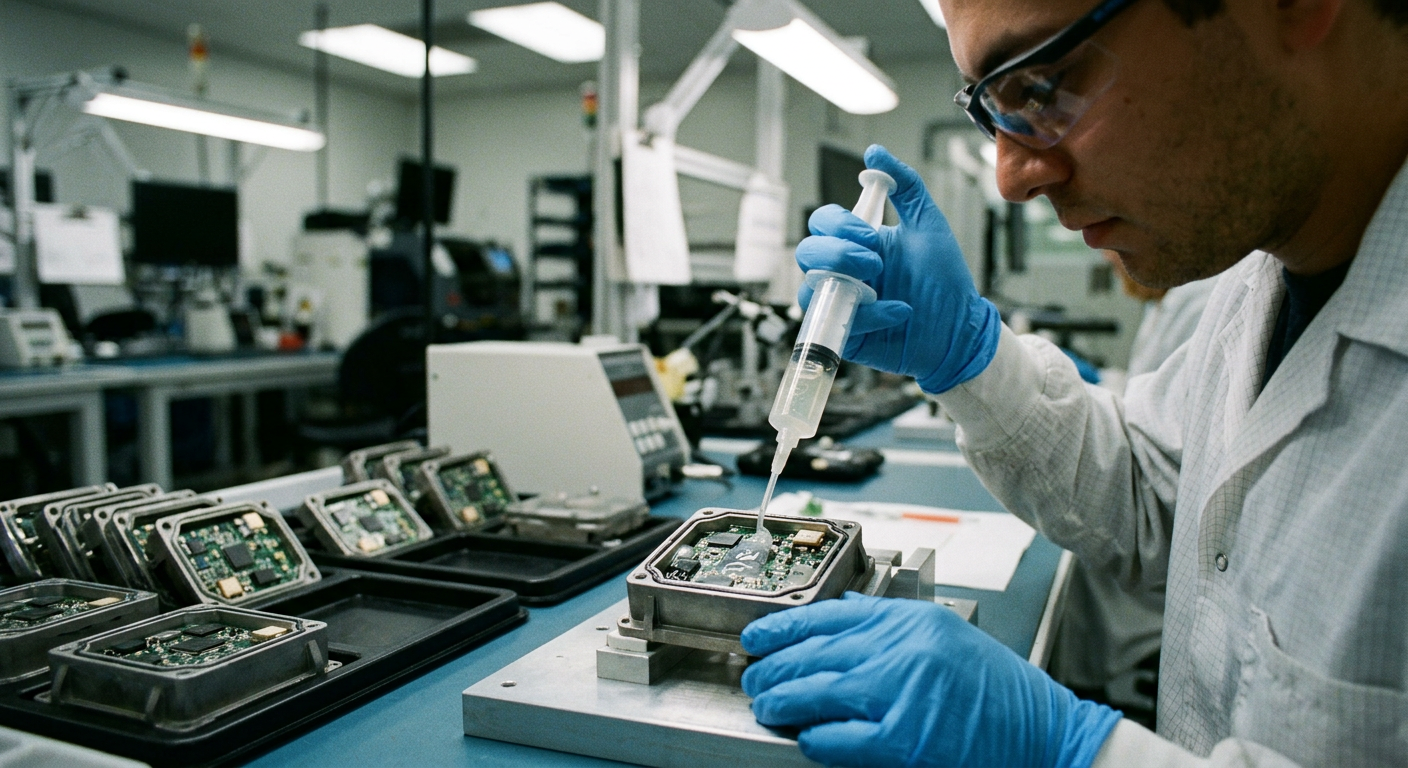
Silicone potting is used when a sensor module needs reliable isolation from the environment without introducing excessive mechanical stress. Pressure sensors, for example, may require selective potting that protects the PCB and terminals while leaving the pressure path unobstructed. Temperature sensors mounted near motors or battery systems use silicone to stabilize wiring and reduce moisture ingress. Outdoor environmental sensors often depend on silicone encapsulation to manage UV exposure, freeze-thaw cycles, and condensation.
In smart factories, proximity and vibration sensors are regularly installed close to moving machinery, washdown zones, and dusty enclosures. Silicone compounds help absorb shock, stabilize solder joints, and prevent corrosion caused by humidity or process contaminants. In EV systems, silicone is often preferred where both electrical insulation and heat stability are necessary, especially around current sensing, battery management electronics, and auxiliary control modules.
Another major use is in utility metering and infrastructure monitoring. Water, gas, and electricity meter sensors deployed across the United States must survive long service intervals and seasonal climate changes. A silicone potting material that remains flexible over time can protect internal electronics from crack formation caused by expansion mismatch between plastics, metals, and ceramic components.
Case-Based Buying Guidance
Real purchasing decisions usually depend on a specific sensor design and use environment. The case examples below show how material choice changes with application conditions rather than brand preference alone.
| Case | Operating Environment | Recommended Silicone Profile | Why It Fits | Buying Note |
|---|---|---|---|---|
| Automotive battery sensor | Heat, vibration, cycling, moisture | Two-part low-modulus, thermally stable silicone | Protects electronics while reducing stress cracking | Request long-cycle reliability data |
| Outdoor weather station sensor | UV, rain, freeze-thaw | Weather-resistant silicone potting compound | Maintains sealing and flexibility outdoors | Check UV and water ingress history |
| Factory proximity sensor | Oil mist, shock, dust | Self-leveling, chemically stable silicone | Encapsulates PCB and dampens vibration | Validate adhesion to housing plastics |
| Medical flow sensor electronics | Sensitive electronics, compact housing | Low-stress silicone gel or soft potting system | Reduces force on delicate components | Confirm process cleanliness and stability |
| Smart meter sensor module | Long field life, seasonal temperature shifts | Low-shrinkage insulating silicone | Supports long-term electrical reliability | Evaluate cost over service-life risk |
| Renewable energy monitoring node | Heat, outdoor duty, remote maintenance | Thermally stable or conductive silicone | Handles temperature load and weather exposure | Review cure speed for field production needs |
These examples are important because they translate material properties into actual buying decisions. U.S. teams often save time by building qualification around end-use stress instead of screening products purely by generic labels like “electronic silicone” or “sensor encapsulant.”
Supplier Selection in U.S. Cities and Trade Hubs
Local context matters in procurement. Buyers near Detroit may prioritize automotive-grade support and frequent technical visits. Companies in Silicon Valley often seek faster prototyping cycles and small-lot sample access. Manufacturers around Houston and the Gulf Coast may care more about harsh environment durability and chemical exposure resistance. In Chicago and the broader Midwest, industrial automation and maintenance-driven sourcing are particularly strong. On the coasts, major ports such as Los Angeles, Long Beach, Savannah, and New York-New Jersey shape lead times for imported materials and private-label programs.
For that reason, domestic and international sourcing strategies can complement each other. A U.S. producer may use a domestic silicone supplier for immediate engineering trials while developing a second-source agreement with an export-capable manufacturer that offers custom branding, lower landed cost at scale, and packaging tailored to local distribution. This dual-track approach is increasingly common among wholesalers, electronics distributors, and sensor module assemblers serving North American customers.
About Our Company
Qingdao QinanX New Material Technology Co., Ltd supports U.S. buyers with electronic silicone and related industrial adhesive systems built under ISO-managed manufacturing and multi-stage quality control with digital traceability, while compliance with RoHS and REACH helps document suitability for international electronics programs; its product strength comes from a broad formulation base across silicone, epoxy, polyurethane, acrylic, and other adhesive technologies, allowing sensor-module customers to match material quality, cure behavior, and application performance to specific designs instead of forcing a one-grade-fits-all approach. For cooperation, the company works with end users, distributors, dealers, brand owners, and independent buyers through flexible OEM/ODM, wholesale, retail, private-label, and regional distribution models, which is especially useful for U.S. importers needing custom packaging, branded lines, or tailored technical specifications. From a service standpoint, the company already has export experience in more than 40 countries, offers 24/7 technical assistance, free sample programs, and custom formulation support, and presents itself to American buyers not simply as a remote exporter but as a long-term supply partner able to back online pre-sale selection, post-sale troubleshooting, and scalable order fulfillment for the United States market through responsive commercial coordination and market-oriented support; buyers can learn more through its company background, review the broader product range, or request technical follow-up via the U.S. inquiry contact page.
Trend Shift Toward 2026
By 2026, the U.S. market is likely to move toward smarter and more sustainable material selection. Three trends stand out. First, sensor modules are becoming smaller and denser, which increases demand for low-viscosity, bubble-resistant, and low-stress silicone systems. Second, electrification and higher power density in EVs, charging infrastructure, and industrial controls are increasing interest in thermally managed potting compounds. Third, sustainability and regulatory pressure are encouraging cleaner production, stronger documentation, and more transparent compliance across supply chains.
Policy and market dynamics also matter. Federal investments in domestic manufacturing, energy infrastructure, and electronics resilience may strengthen demand for materials qualified for North American production programs. At the same time, OEMs are asking suppliers to prove not only compliance, but process consistency, traceability, and environmental reporting. Sensor manufacturers that align material sourcing with these expectations will likely reduce risk and shorten approval cycles.
The area chart shows the direction of formulation preferences: a gradual move away from purely price-led selection and toward performance-balanced materials with stronger process control, compliance visibility, and durability in connected electronics. This is especially relevant in the United States, where field failure costs, recalls, and service interruptions can exceed the initial material savings from under-specified compounds.
Practical Buying Checklist
Before finalizing a silicone potting compound sensor supplier in the United States, buyers should complete a structured review. Confirm whether the compound is designed for electronic encapsulation rather than general sealing. Verify cure conditions against existing production lines. Ask for sample material in the same package type planned for production. Run thermal cycling, humidity aging, adhesion checks, and electrical stability tests on actual sensor assemblies. Review packaging size, lead times, and minimum order quantities. For imported supply, discuss freight planning through major U.S. entry points and confirm response time for technical questions or replacement support.
It is also wise to define what “success” means before testing begins. For some projects, success is zero drift in sensor output after thermal shock. For others, it is resistance to cracking after repeated vibration or stable insulation after long humidity exposure. When success metrics are clear, comparing domestic and international suppliers becomes much more objective.
FAQ
What is the best silicone potting compound for a sensor module?
The best option depends on the sensor type and environment, but for many U.S. applications a two-part low-modulus silicone potting compound is preferred because it combines electrical insulation, moisture resistance, and reduced stress on sensitive electronics.
Is silicone better than epoxy for sensor protection?
Silicone is often better when flexibility, thermal cycling resistance, and low stress are important. Epoxy may be preferred when high hardness and structural rigidity matter more, but it can impose more stress on delicate sensor assemblies.
Can silicone potting affect sensor accuracy?
Yes. If the material is too rigid, shrinks too much, traps bubbles, or blocks a sensing path, it can affect calibration or signal stability. Qualification on the actual sensor design is essential.
Do U.S. buyers need RoHS and REACH documentation?
Many do, especially if products are sold globally or integrated into international supply chains. Even for domestic use, these documents often support compliance review and customer approval.
Are imported suppliers viable for the United States market?
Yes, if they can provide reliable quality control, traceability, compliance documentation, sample support, and responsive technical service. They are particularly attractive when OEM/ODM packaging or cost-performance is important.
What industries use silicone potting compounds for sensors most heavily?
Automotive, industrial automation, energy, building controls, medical devices, and smart electronics are the main users in the U.S. market.
Conclusion
For buyers in the United States, choosing the right silicone potting compound sensor solution means balancing reliability, process compatibility, compliance, and supply strategy. Domestic leaders such as Dow, Momentive, Wacker, Henkel, and MG Chemicals remain strong choices for many qualified programs, especially where direct engineering support is critical. At the same time, internationally experienced manufacturers with documented compliance, OEM/ODM flexibility, and responsive technical support can offer strong value for private-label, wholesale, and scalable production needs. The smartest approach is to qualify materials against the actual sensor design, compare suppliers on both technical fit and service depth, and build a sourcing plan aligned with long-term market growth through 2026 and beyond.

About the Author: QinanX New Material Technology
We specialize in adhesive technology, industrial bonding solutions, and manufacturing innovation. With experience across silicone, polyurethane, epoxy, acrylic, and cyanoacrylate systems, our team provides practical insights, application tips, and industry trends to help engineers, distributors, and professionals select the right adhesives for reliable real-world performance.

Product Category
You May Also Interest
-
IC Packaging Adhesive: Preventing Void Formation Issues
Learn how IC packaging adhesive void formation is prevented in the United States through material choice, process control, supplier selection, and testing.
-
Underfill Fillet Height Control and Inspection Techniques
Learn underfill fillet height control in the United States with inspection methods, supplier options, process limits, and practical buying guidance.
-
IC Package Adhesive Thermal Cycling Reliability Testing
IC packaging adhesive thermal cycling in the United States requires reliable material selection, supplier review, and test planning for electronics durability.
-

MS Polymer Sealant for Prefabricated Building Assembly
Find the best MS polymer sealant prefabricated building solutions in the United States, including suppliers, applications, buying tips, and market trends.
 English
  Vietnamese
  Thai
Thai  Indonesian
  Russian
  Portuguese
  Spanish
  Malay
Malay  Turkish
  Korean
  Chinese