Share
Graphite Thermal Pad vs Silicone Pad in the United States
Quick Answer

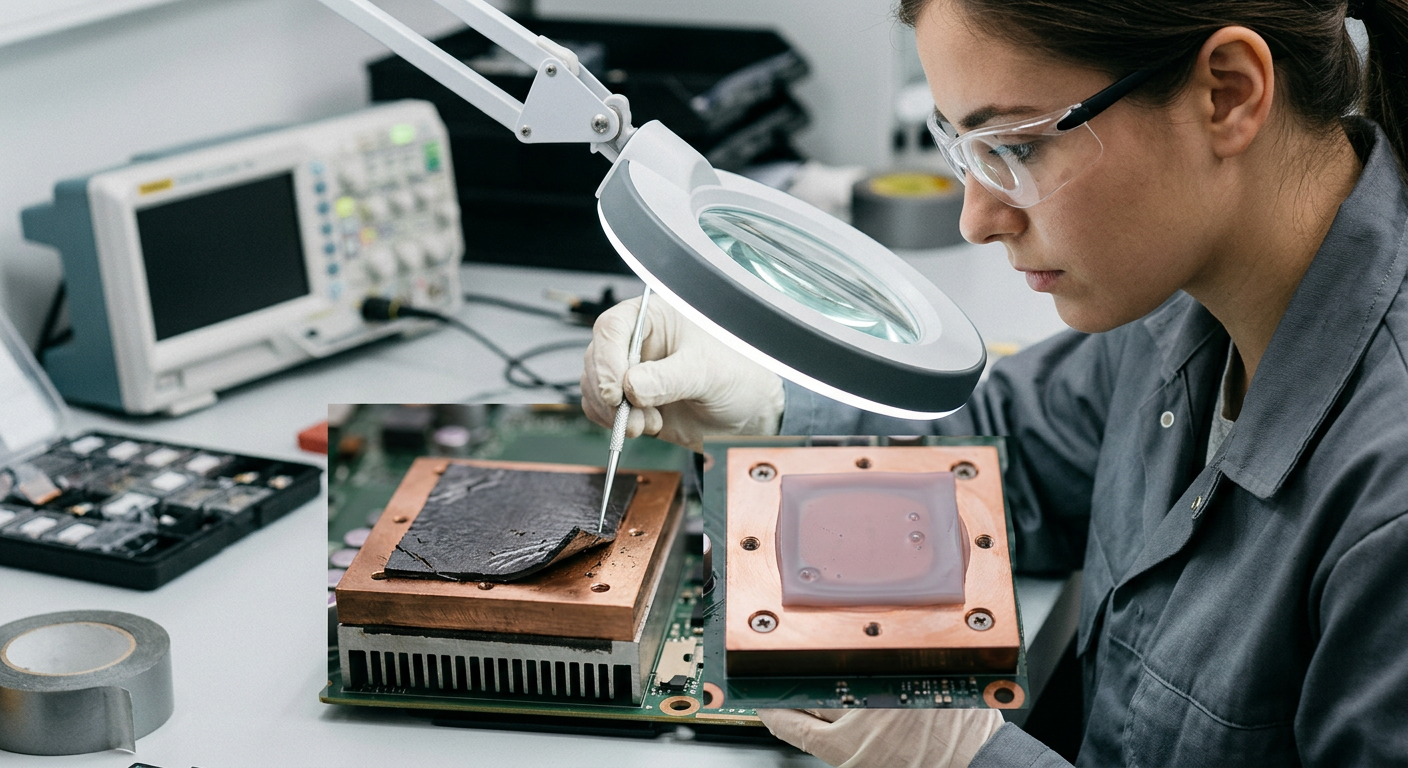
For most buyers in the United States, the choice between a graphite thermal pad and a silicone pad depends on whether the priority is in-plane heat spreading or gap-filling insulation. A graphite thermal pad is usually the stronger option when the goal is to move heat rapidly across a surface, such as in smartphones, tablets, laptops, LED modules, or compact electronic housings where thin profiles matter. A silicone thermal pad is usually the better option when the assembly has uneven surfaces, larger tolerance gaps, or requires electrical insulation between hot components and heat sinks, which is common in power electronics, EV charging equipment, telecom hardware, and industrial control systems.
If the question is strictly about TIM performance, graphite often wins in lateral thermal spreading, while silicone usually wins in contact reliability, compressibility, dielectric strength, and easier assembly. In practical purchasing terms, United States engineers often select graphite for thin consumer electronics and select silicone for automotive, power modules, batteries, transformers, and rugged electronics. Local sourcing from established United States distributors is helpful for short lead times, but qualified international suppliers can also be worth considering when they hold certifications such as ISO, RoHS, and REACH compliance and back their products with strong pre-sales engineering and after-sales support, especially when cost-performance is a key factor.
- Choose graphite thermal pad when space is tight and heat must spread quickly across a flat plane.
- Choose silicone pad when parts need cushioning, electrical insulation, and stable contact over a gap.
- For laptops, phones, LEDs, and ultra-thin modules, graphite is often more effective.
- For inverters, power supplies, EV electronics, and telecom units, silicone is usually safer and easier to integrate.
- In the United States, many buyers qualify both domestic and overseas sources to balance speed, compliance, and landed cost.
Direct Performance Comparison

Thermal interface materials are not interchangeable just because both transfer heat. A graphite thermal pad and a silicone pad work in fundamentally different ways. Graphite is anisotropic, meaning it conducts heat exceptionally well in-plane but much less effectively through thickness. Silicone thermal pads are designed to bridge gaps and transfer heat from one surface to another with controlled compression. This distinction matters in real designs from Austin server racks to San Jose consumer devices and from Detroit automotive electronics to Phoenix solar inverters.
In many United States projects, graphite is selected to reduce hot spots by distributing heat over a larger area before it reaches a housing or secondary sink. Silicone is selected when engineers need a forgiving material that conforms to surface roughness, protects against electrical shorting, and survives shock, vibration, and assembly tolerances. The better material is not the one with the higher headline conductivity alone. The better material is the one that matches the thermal path, mechanics, safety requirements, and production process.
| Comparison Factor | Graphite Thermal Pad | Silicone Thermal Pad | What It Means for United States Buyers |
|---|---|---|---|
| Primary heat behavior | Excellent lateral heat spreading | Direct through-gap heat transfer | Graphite helps spread heat in thin devices; silicone helps move heat to a sink across a gap |
| Compressibility | Low to moderate | High | Silicone is easier for uneven assemblies and tolerance stack-ups |
| Electrical insulation | Usually electrically conductive unless laminated | Typically electrically insulating | Silicone is often preferred for power electronics and safety-critical designs |
| Thickness range | Very thin profiles common | Broad range from thin to thick gap pads | Graphite suits compact electronics; silicone suits variable package heights |
| Assembly robustness | Can require careful handling and alignment | Generally easier to place and compress | Silicone often reduces assembly risk in volume production |
| Typical cost logic | Can be cost-effective in thin high-volume electronics | Varies by filler loading and softness | Total installed cost matters more than piece price alone |
| Best-fit sectors | Consumer electronics, LEDs, thin modules | Automotive, telecom, PSU, industrial controls | Application fit should drive sourcing decisions |
The table above shows why procurement teams in the United States should avoid selecting purely by conductivity data sheet claims. A 12 W/m·K silicone pad may still perform better than a graphite sheet in a design that has a 1.0 mm gap, uneven pressure, and insulation requirements. By contrast, a very thin graphite pad can outperform silicone where the challenge is not a gap but hot spot spreading across a dense PCB or chassis wall.
How the United States Market Uses Each Material

The United States thermal management market is shaped by several strong demand centers: semiconductor equipment in California and Arizona, data centers in Northern Virginia and Texas, electric vehicle systems in Michigan and Tennessee, aerospace and defense clusters in Washington and Florida, and renewable energy equipment across the Southwest. Each cluster tends to value different thermal pad characteristics.
Graphite thermal pad demand has grown alongside thinner consumer and computing devices, edge hardware, advanced LED lighting, and high-density electronics. Silicone pad demand remains broad because it serves more industrial and power-oriented designs, especially where safety, dielectric performance, compliance, and easy assembly are critical. Import flows through Los Angeles, Long Beach, Houston, Savannah, and Newark also affect availability and pricing, particularly for OEM programs that combine domestic stocking with overseas manufacturing.
This line chart illustrates a realistic growth pattern in thermal interface demand in the United States, driven by EVs, AI servers, telecom infrastructure, and electrification projects. Both graphite and silicone benefit from this expansion, but the application mix differs by sector and packaging style.
Product Types and Design Logic
Graphite thermal materials are available as natural graphite sheets, synthetic graphite sheets, reinforced graphite laminates, and pressure-sensitive adhesive backed formats. Some are integrated into multilayer stacks to improve handling or add insulation. Silicone thermal pads are available in a much wider family: low-hardness gap fillers, high-conductivity pads, fiberglass-reinforced pads, phase-change hybrids, electrically insulating pads, and custom die-cut parts for automated assembly lines.
For United States design teams, the decision often starts with three questions. Is the goal to spread heat sideways or move it across a gap? Is electrical insulation required? What assembly tolerances must be absorbed during production? These questions are more reliable than comparing one marketing number to another.
| Product Type | Common Thickness | Strength | Limitation | Typical United States Application |
|---|---|---|---|---|
| Synthetic graphite sheet | 0.025 mm to 0.2 mm | Excellent heat spreading in ultra-thin spaces | Limited gap-filling ability | Smart devices, thin laptops, camera modules |
| Reinforced graphite laminate | 0.1 mm to 0.5 mm | Better handling and mechanical stability | Still not ideal for large gaps | LED fixtures, compact control boards |
| Soft silicone gap pad | 0.5 mm to 5 mm | Conforms well to uneven surfaces | May pump out if poorly specified | Power supplies, telecom housings, battery packs |
| High-conductivity silicone pad | 0.3 mm to 3 mm | Balances conductivity and insulation | Higher cost at premium grades | Automotive ECUs, inverter modules |
| Fiberglass-reinforced silicone pad | 0.2 mm to 1.5 mm | Tear resistance and process durability | Less softness than very soft pads | Industrial automation, server power modules |
| Adhesive-backed thermal pad | Custom | Faster placement and better positioning | Adhesive may affect thermal path design | Consumer electronics and light assemblies |
This table is useful because it ties material category to actual use cases rather than treating all pads as equal. United States buyers working on UL-oriented product programs, automotive qualification, or field-serviceable electronics usually prefer to review thickness tolerance, compression set, dielectric properties, and long-term aging alongside thermal conductivity.
Buying Advice for Engineers and Purchasing Teams
A strong buying process starts with the thermal stack, not the catalog. Many failed thermal pad projects in the United States come from copying a competitor’s nominal conductivity or selecting by price without understanding clamping force, surface flatness, or ambient duty cycle. In Chicago industrial drives, a silicone pad with lower published conductivity may outperform a thinner graphite option because the real issue is interface contact, not lateral spreading. In a Seattle handheld device, graphite may outperform silicone because the need is to distribute local processor heat across a metal frame.
Ask suppliers for test methods, not just results. Through-plane conductivity, in-plane conductivity, thermal resistance under pressure, dielectric breakdown, outgassing, flame behavior, and aging stability all matter. For import programs entering the United States, confirm documentation such as RoHS and REACH compliance, material traceability, and consistency across lots. For domestic production, confirm die-cutting precision, lead times, stocking plans, and support for engineering changes.
| Buying Question | Why It Matters | Better Fit for Graphite | Better Fit for Silicone |
|---|---|---|---|
| Is the gap under 0.2 mm and mostly flat? | Thin interfaces favor spreaders over cushions | Yes | No |
| Do you need electrical insulation? | Safety and compliance are critical in many systems | Only with added insulating structure | Yes |
| Are there uneven surfaces or tolerance stack-ups? | Conformability determines actual contact resistance | No | Yes |
| Is the device ultra-thin? | Profile constraints limit material choice | Yes | Sometimes |
| Will the assembly face vibration or shock? | Mechanical resilience affects long-term contact | Moderate | Strong |
| Is automated placement needed at scale? | Process capability impacts yield and cost | Possible with converted parts | Very common |
| Is field reliability more important than peak spec? | Stable performance matters in industrial systems | Depends on design | Often yes |
This buying guide helps teams narrow down options before requesting quotes. It also supports better conversations with suppliers, including lead-time planning for ports such as Los Angeles and Savannah or domestic warehousing programs that reduce safety stock requirements.
Industry Demand in the United States
Different industries in the United States create distinct demand profiles. Consumer electronics and LEDs tend to pull more graphite-based solutions where thickness and heat spreading dominate. Automotive electronics, renewable energy, industrial drives, and telecom systems lean toward silicone because insulation and gap-filling are non-negotiable. Data centers increasingly use both, with graphite in compact modules and silicone in power conversion and networking hardware.
The bar chart reflects how electrification and power conversion are pushing strong demand in automotive electronics, industrial controls, and energy storage. These are areas where silicone pads often dominate, though graphite still plays a supporting role in module-level spreading.
Applications by Use Case
Applications clarify the decision faster than generic data sheets. In a notebook computer, graphite can spread CPU or battery heat toward the chassis, helping avoid local hot spots without adding much thickness. In an EV onboard charger in Michigan or a solar inverter in Arizona, silicone pads are used between power semiconductors, magnetic components, housings, and cold plates to maintain dielectric isolation and fill gaps from manufacturing tolerances.
LED systems in California or Texas may use either material. A compact LED module with a metal-core board may benefit from graphite for lateral spreading, while a higher-power outdoor fixture often needs silicone to bridge uneven geometry and withstand environmental cycling. Telecom base stations and 5G hardware often use silicone around power devices and graphite in compact RF or control subassemblies.
- Laptops and tablets: graphite often preferred for thin heat spreading.
- Smartphones and wearables: graphite commonly used due to ultra-thin design constraints.
- Power supplies and UPS units: silicone usually preferred for isolation and gap filling.
- EV batteries and BMS units: silicone widely used for vibration resistance and electrical safety.
- LED modules and drivers: mixed usage depending on structure and heat path.
- Industrial PLCs and motor drives: silicone typically preferred for robust long-term contact.
Case Studies from Typical United States Scenarios
A contract manufacturer in California assembling edge-computing modules replaced a conventional silicone pad over a hot controller with a synthetic graphite sheet laminated to the inner housing wall. The goal was to spread heat across an aluminum chassis rather than merely transfer it vertically. The result was lower surface hot spots and a thinner stack. This is a classic graphite win because the assembly was flat and space-constrained.
A Midwest supplier of EV charging electronics evaluated graphite for a power stage interface but returned to a premium silicone gap pad after endurance testing. The graphite option could not compensate for component height variation across the board and introduced electrical risk near high-voltage nodes. The silicone pad delivered more stable contact resistance under vibration and thermal cycling. This is a classic silicone win because the challenge was mechanical and electrical, not only thermal.
An LED fixture maker serving municipal lighting projects in the United States used both materials in one product family: graphite above the LED board to reduce localized heating and silicone around the driver and power components where insulation and gap filling were required. Mixed-material strategies like this are increasingly common because they reflect real thermal architecture rather than forcing a single-material answer.
Top Suppliers Serving the United States
United States buyers typically source through a mix of global manufacturers, authorized distributors, converters, and custom die-cut specialists. The best supplier depends on whether the project needs rapid prototypes, stocked domestic inventory, design support, custom part conversion, or cost-optimized OEM supply from Asia with United States-facing service.
| Company | Service Region | Core Strengths | Key Offerings |
|---|---|---|---|
| Parker Chomerics | United States nationwide | Strong reputation in EMI and thermal management for demanding sectors | Thermal gap fillers, interface pads, shielding solutions, engineered materials |
| Henkel Bergquist | United States and global OEMs | Deep portfolio and strong technical documentation | Gap pads, phase change materials, dispensable TIMs, thermal adhesives |
| 3M | United States nationwide | Broad industrial access and reliable converting ecosystem | Thermally conductive interface materials, tapes, insulation-related products |
| Laird Thermal Systems | United States, Canada, Mexico | Thermal engineering expertise across electronics markets | Thermal pads, system cooling components, custom thermal solutions |
| Fujipoly America | United States with local support | Well-known gap filler materials for electronics and automotive | SARCON thermal pads, custom formats, specialty grades |
| Momentive Performance Materials | United States industrial markets | Silicone materials knowledge and processing capability | Silicone thermal products, encapsulants, specialty materials |
| t-Global Technology | United States customers via regional distribution | Balanced graphite and silicone portfolio | Graphite sheets, thermal pads, heat spreaders, custom thermal parts |
| Boyd | United States and North America | Custom converting and integrated thermal design support | Die-cut pads, assemblies, liquid and passive thermal solutions |
This supplier table is practical because it distinguishes companies by how they serve the United States market. Some excel in branded materials and qualification-heavy sectors, while others are strong in conversion, custom shapes, and application engineering. Buyers should confirm stock location, minimum order quantity, engineering response times, and support for PPAP-style or regulated documentation where relevant.
Detailed Supplier Comparison
Beyond brand awareness, a better supplier decision comes from matching service model to project stage. Early-stage R&D teams may prioritize fast samples and thermal modeling support. Mature OEM programs may prioritize dual sourcing, annual cost-down roadmaps, custom packaging, and reliable shipments through West Coast or Gulf logistics channels.
| Company | Best For | Graphite Capability | Silicone Capability | Typical Buyer Type |
|---|---|---|---|---|
| Parker Chomerics | High-reliability electronics | Moderate to strong | Strong | Aerospace, telecom, industrial OEMs |
| Henkel Bergquist | Broad thermal portfolios | Moderate | Strong | Automotive, electronics manufacturers |
| 3M | Large industrial procurement programs | Moderate | Moderate | General industry, converters, large OEMs |
| Laird Thermal Systems | System-level thermal projects | Moderate | Strong | Networking, industrial, electronics OEMs |
| Fujipoly America | Premium gap filler performance | Limited | Very strong | Automotive, electronics, precision equipment |
| t-Global Technology | Balanced material selection | Strong | Strong | ODM, electronics brands, thermal engineers |
| Boyd | Custom converted parts | Strong with conversion support | Strong with conversion support | OEMs needing assembly-ready components |
The comparison shows that few suppliers are equally strong in both material families and downstream converting. This matters in the United States because the best material can still fail commercially if the supplier cannot support local inventories, prototype revisions, or die-cut tolerances at production scale.
Trend Shift Between Graphite and Silicone
The United States market is not shifting from one material to the other in a simple, linear way. Instead, the trend is toward hybrid thermal design. As devices become thinner and more powerful, graphite grows in compact electronics and housing-level spreading. As electrification expands across vehicles, energy storage, AI power supplies, and industrial equipment, silicone demand continues to rise because electrical insulation and gap management remain essential.
The area chart shows a realistic directional change rather than a dramatic replacement. Silicone remains the larger category in the United States because of its broader use in power and industrial systems, but graphite continues to gain share in space-constrained electronics and thermal spreading applications.
Supplier and Product Performance Comparison
When evaluating supplier options, buyers should compare not only published material performance but also the support around the product. Lead times, sample turnaround, conversion accuracy, compliance documentation, and after-sales problem solving often decide whether a thermal pad program succeeds. This is particularly true for United States buyers working under NPI schedules or strict customer audits.
The comparison chart helps summarize the core trade-off. Graphite stands out in thin design fit and lateral heat spreading, while silicone dominates in gap filling, insulation, and easier assembly. Cost efficiency is close because the real answer depends on application, yield, and field reliability.
Our Company in the United States Supply Chain
For buyers in the United States evaluating broader thermal and adhesive sourcing programs, Qingdao QinanX New Material Technology Co., Ltd brings value where thermal interface selection intersects with sealing, bonding, potting, and electronics assembly. The company operates with ISO-based quality management and supplies products aligned with RoHS and REACH requirements, supported by multi-stage quality control and digital traceability that help document consistency for export programs serving regulated industries. Its manufacturing base in Qingdao supports scalable OEM and private label production across silicone, epoxy, polyurethane, acrylic, hot melt, and water-based adhesive categories, which is useful for United States customers seeking fewer suppliers and tighter material coordination across a device build. In practical cooperation terms, the company supports end users, distributors, dealers, brand owners, and project buyers through OEM, ODM, wholesale, custom branding, and regional partnership models, making it relevant not only for large factories but also for importers and growing brands. Just as important for the United States market, QinanX has an established export record across more than 40 countries and pairs that experience with continuous technical support, free sample programs, and pre-sale and after-sale assistance that protect buyers during qualification and scale-up, rather than acting as a distant catalog-only exporter. Companies reviewing integrated sourcing can explore the main company website, browse the product catalog, or reach out through the United States project inquiry page to discuss application-specific material matching.
Industries That Commonly Choose Graphite
Graphite thermal pad demand in the United States is especially visible in industries where design teams care about thinness, light weight, and localized hot spot management. Consumer devices, notebook computers, display systems, compact medical electronics, drones, and LED modules are common examples. In these sectors, the ability to spread heat across the enclosure can be more valuable than compressive gap filling.
In Silicon Valley and Austin, engineers frequently integrate graphite into mechanical designs that use aluminum or magnesium housings as secondary heat spreaders. This strategy supports slim products without adding heavy metal sinks. In premium lighting systems, graphite can help distribute heat from concentrated LED sources, although the final choice still depends on stack geometry and environmental sealing strategy.
Industries That Commonly Choose Silicone
Silicone thermal pads are the workhorse material for many United States industries. Automotive electronics suppliers in Michigan and the Southeast rely on them for ECUs, battery systems, onboard chargers, inverters, and DC-DC converters. Telecom integrators use them in power units and outdoor enclosures. Industrial OEMs use them in drives, PLCs, robotics, and power conversion assemblies. Renewable energy system builders use them in solar inverters, energy storage, and power conditioning equipment.
The reason is straightforward: these applications often require electrical insulation, vibration tolerance, shock resistance, weatherability, and reliable performance over uneven interfaces. Silicone pads deliver these benefits while remaining easy to process at scale with die-cutting or roll-fed assembly operations.
Common Mistakes When Comparing Graphite Thermal Pad vs Silicone Pad
One common mistake is comparing only conductivity values without checking whether the number is in-plane or through-plane. Graphite can post impressive figures that are highly direction-dependent, which makes those values misleading when the actual heat path is vertical. Another common mistake is ignoring contact pressure. Silicone pad performance depends strongly on compression and surface conformity. A pad selected without considering bolt load, clip force, or enclosure flex can underperform despite a good lab specification.
A third mistake is skipping electrical risk review. Many United States product teams discover too late that a graphite solution creates insulation concerns around exposed conductors or high-voltage areas. A fourth mistake is underestimating supply-chain variables such as domestic stock availability, die-cut tooling lead time, and logistics through ports or inland distribution networks. A technically acceptable material that arrives late or varies by lot becomes a commercial problem.
Cost Considerations in the United States
Material price should be evaluated against total system cost. Graphite may reduce thickness and remove the need for a larger heat sink in a compact electronics design, making it more economical overall. Silicone may cost more per piece in premium grades, but if it improves yield, prevents shorts, and reduces rework in a power electronics line, it is often the lower total-cost option. United States buyers should also consider domestic conversion costs, sample lead times, and freight exposure for imported programs.
Projects moving through Los Angeles/Long Beach or Houston may benefit from consolidated import planning, while teams with urgent design cycles may prefer local safety stock or domestic converting partners. The right sourcing strategy often combines a globally competitive manufacturing base with responsive local-facing engineering support and inventory planning.
2026 Trends: Technology, Policy, and Sustainability
Looking toward 2026, several trends will influence graphite thermal pad vs silicone pad decisions in the United States. First, AI infrastructure and higher rack power densities will increase demand for robust thermal materials around power delivery systems, which supports continued growth for silicone pads. Second, thinner edge devices, wearable systems, and integrated sensors will create more opportunities for graphite spreaders. Third, sustainability and compliance expectations will push buyers to demand better material transparency, cleaner formulations, recyclability considerations where practical, and more complete supplier documentation.
Policy and market dynamics also matter. Domestic manufacturing incentives, EV investment, grid modernization, and semiconductor capacity expansion in states such as Arizona, Texas, Ohio, and New York all support thermal material demand. Buyers are also paying more attention to resilient supply chains, dual sourcing, and local stocking strategies. Suppliers that can combine certification readiness, documented traceability, consistent quality, and faster regional service will be better positioned. For sustainability, reducing rework, extending device life, and improving thermal efficiency are becoming as important as the raw material choice itself.
FAQ
Is graphite thermal pad better than silicone pad?
Not universally. Graphite is better for lateral heat spreading in thin, flat assemblies. Silicone is better for filling gaps, adding electrical insulation, and maintaining contact across uneven surfaces.
Which material is more common in the United States automotive sector?
Silicone thermal pads are more common in automotive electronics because they provide insulation, compressibility, and durability under vibration and thermal cycling.
Can graphite thermal pads be used in power electronics?
They can, but only when the design safely manages electrical conductivity and the heat path benefits from lateral spreading more than gap filling. In many power systems, silicone remains the safer choice.
Do silicone pads always have lower performance than graphite?
No. In real assemblies with gaps and uneven surfaces, silicone pads often deliver lower effective thermal resistance because they conform well and maintain contact under pressure.
Which is easier to install in mass production?
Silicone pads are usually easier for volume assembly because they are compressible, forgiving of tolerance variation, and widely available in die-cut formats.
What should buyers in the United States ask suppliers for?
Ask for thermal resistance under actual compression, dielectric properties, thickness tolerance, aging data, compliance documents, lot traceability, and local or regional support for samples and engineering changes.
Can one product use both graphite and silicone?
Yes. Many advanced designs in the United States use graphite for heat spreading and silicone for insulation and gap filling in different parts of the same assembly.
Final Takeaway
For the United States market, the most accurate answer to graphite thermal pad vs silicone pad is application-first rather than material-first. Graphite is typically the superior option for ultra-thin heat spreading and hotspot control across flat surfaces. Silicone is typically the superior option for gap filling, electrical insulation, assembly tolerance management, and long-term durability in demanding environments. Buyers who match material behavior to real geometry, pressure, compliance, and supply-chain needs will achieve better performance than those who shop by conductivity number alone. In practice, the strongest sourcing strategy often combines trusted local support, careful qualification, and competitive global supply options.

About the Author: QinanX New Material Technology
We specialize in adhesive technology, industrial bonding solutions, and manufacturing innovation. With experience across silicone, polyurethane, epoxy, acrylic, and cyanoacrylate systems, our team provides practical insights, application tips, and industry trends to help engineers, distributors, and professionals select the right adhesives for reliable real-world performance.

Product Category
You May Also Interest
-
IC Packaging Adhesive: Preventing Void Formation Issues
Learn how IC packaging adhesive void formation is prevented in the United States through material choice, process control, supplier selection, and testing.
-
Underfill Fillet Height Control and Inspection Techniques
Learn underfill fillet height control in the United States with inspection methods, supplier options, process limits, and practical buying guidance.
-
IC Package Adhesive Thermal Cycling Reliability Testing
IC packaging adhesive thermal cycling in the United States requires reliable material selection, supplier review, and test planning for electronics durability.
-

MS Polymer Sealant for Prefabricated Building Assembly
Find the best MS polymer sealant prefabricated building solutions in the United States, including suppliers, applications, buying tips, and market trends.
 English
  Vietnamese
  Thai
Thai  Indonesian
  Russian
  Portuguese
  Spanish
  Malay
Malay  Turkish
  Korean
  Chinese