Share
UV Adhesive Fiber Optic Connector Suppliers in the United States
Quick Answer

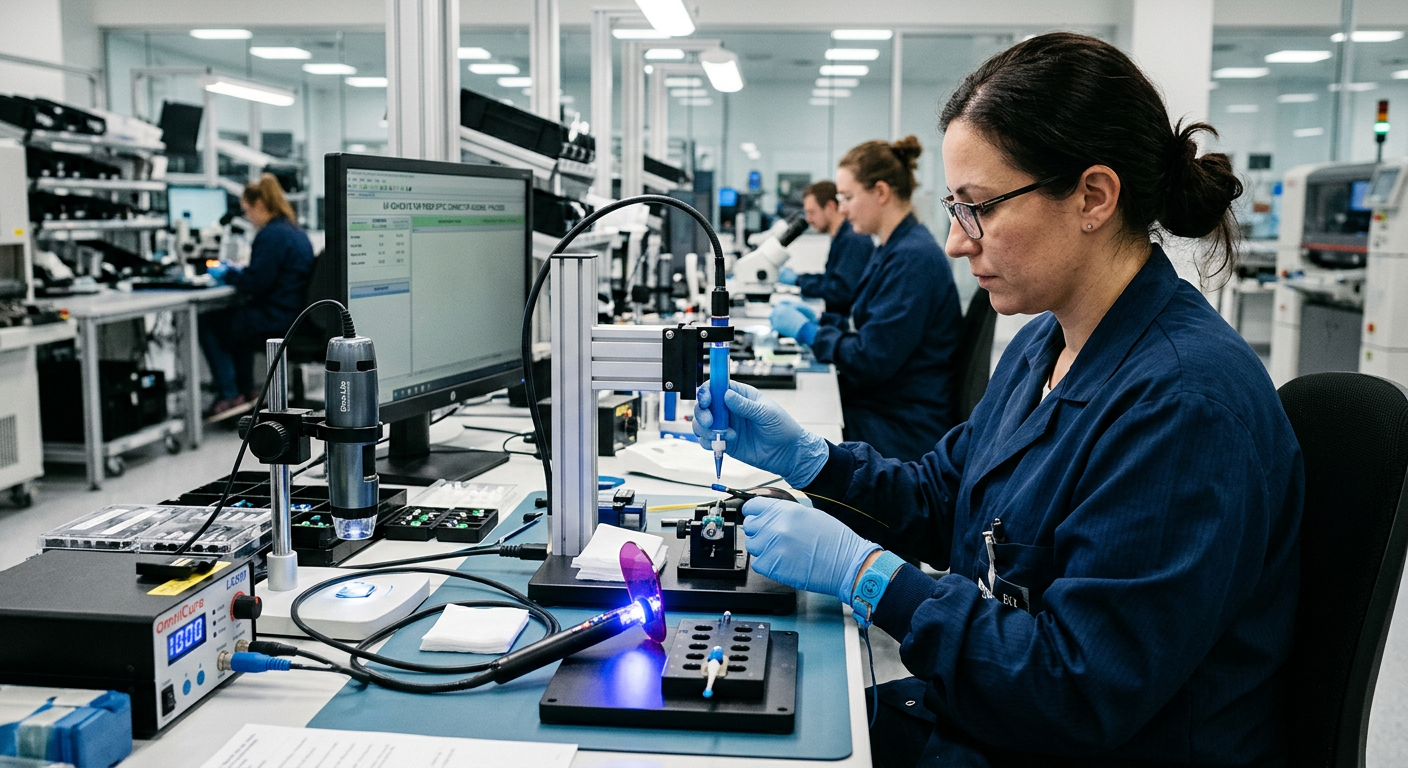
If you need a UV adhesive fiber optic connector solution in the United States, the most practical approach is to shortlist suppliers that already serve telecom, datacom, defense, medical device, and electronics assembly markets with proven optical bonding or connector assembly materials. For buyers seeking fast qualification and dependable technical support, strong options include Norland Products in New Jersey, Dymax in Connecticut, Master Bond in New Jersey, Permabond in Pennsylvania, and Hernon Manufacturing in Florida. These companies are well known for UV-curable adhesive technologies used in precision assembly, including optical and electronic components.
For connector manufacturers, contract assemblers, and repair operations in cities such as San Jose, Austin, Boston, San Diego, and Rochester, the best choice depends on cure speed, optical clarity, viscosity, shrinkage control, thermal stability, and whether the adhesive is intended for ferrule bonding, strain relief, tack fixing, or optical path protection. Buyers should ask for application-specific data, sample support, shelf-life guidance, and process recommendations for LED or mercury UV systems.
Qualified international suppliers can also be worth considering, especially when they offer U.S.-relevant compliance documentation, stable OEM supply, and responsive pre-sales and after-sales support. Chinese manufacturers with ISO-based production, RoHS and REACH compliance, full traceability, and private-label capability can be attractive for cost-performance programs, particularly when supporting distributors, regional brands, and industrial buyers who need scalable sourcing rather than one-off laboratory quantities.
United States Market Overview

The United States remains one of the most important markets for fiber optic connector assembly materials because the country combines large-scale telecom infrastructure investment with strong demand from hyperscale data centers, aerospace, defense electronics, medical systems, industrial sensing, and semiconductor equipment. Demand is especially concentrated around technology and manufacturing corridors such as Silicon Valley, Phoenix, Dallas, Austin, Northern Virginia, Boston, Raleigh-Durham, and the New York–New Jersey industrial belt.
UV-curable adhesives for fiber optic connectors are used where manufacturers want a fast fixture speed, efficient throughput, controlled placement, and reduced work-in-process time. In production environments assembling SC, LC, FC, ST, MPO, MU, and custom optical connectors, UV adhesives are valued because they can cure on demand under the correct wavelength and intensity, allowing better process timing than some traditional heat- or moisture-curing systems. In repair, prototyping, and low- to medium-volume custom optical manufacturing, they are also attractive because they simplify handling and reduce line complexity.
U.S. buyers are increasingly focused on supply chain resilience. That means they are not only looking for a good formula, but also for reliable logistics through gateways such as the Port of Los Angeles, Port of Long Beach, Port of New York and New Jersey, Savannah, Houston, and inland hubs linked to major electronics assembly regions. As a result, suppliers that can combine technical documents, stable lead times, and responsive field support often outperform lower-priced but less organized competitors.
The market is also shaped by a shift from simple material purchasing to process-based sourcing. Engineers no longer ask only, “What adhesive should we buy?” They also ask whether it works with zirconia ferrules, ceramic sleeves, plastic connector bodies, glass fibers, automated dispensing systems, and modern UV LED equipment. This is why the best U.S. suppliers typically provide not just product SKUs, but application engineering support, cure profiles, and substrate compatibility guidance.
Why UV Adhesives Are Used in Fiber Optic Connector Assembly

A UV adhesive fiber optic connector process is selected when manufacturers need precision, speed, and consistency. In connector assembly, a common requirement is secure bonding without introducing excessive stress that could affect insertion loss, return loss, or long-term reliability. Well-formulated UV-curable adhesives can help by delivering controlled viscosity, fast initial fixture, and low movement after placement.
For many optical assemblies, the adhesive must balance several properties at once: optical stability, low shrinkage, chemical resistance, thermal cycling durability, and good adhesion to materials such as metal, ceramic, glass, engineered plastics, and epoxy-coated fibers. This balance matters in U.S. manufacturing where quality requirements are often stringent for telecom infrastructure, military procurement, and medical device integration.
UV-curing also aligns well with modern manufacturing economics. Faster cycle times reduce labor bottlenecks, improve takt time, and support inline inspection. That is particularly useful in connector production cells serving regional markets across the United States, where lead time and labor efficiency are critical cost factors. In short, UV adhesives are not just a chemistry choice; they are a process optimization tool.
Common Product Types for Fiber Optic Connector Assembly
Not every UV adhesive used near optical assemblies is the same. Some are designed for direct optical applications requiring high transparency and stable refractive behavior, while others are optimized more for mechanical retention, potting, strain relief, or temporary positioning. Understanding these categories helps buyers avoid mismatching a lab-grade optical adhesive with a high-throughput connector assembly line, or vice versa.
| Product Type | Typical Use in Fiber Connector Work | Key Strengths | Possible Limits | Common Buyer Profile |
|---|---|---|---|---|
| Optically clear UV adhesive | Lens-to-fiber, fiber-to-glass, light path adjacent bonding | High transparency, controlled cure, good visual inspection | May cost more and need tighter process control | Photonics labs, medical optics, sensor makers |
| Structural UV adhesive | Ferrule retention, connector housing bonding | Fast fixture, stronger mechanical hold, production-friendly | Not always ideal for direct optical path exposure | Connector manufacturers, contract assemblers |
| Dual-cure UV adhesive | Shadowed areas inside connector geometry | UV cure plus secondary cure improves reliability | Longer full-cure profile than pure UV systems | Complex assembly lines, mixed-material assemblies |
| Low-viscosity UV adhesive | Wicking into small gaps, capillary fill | Easy penetration in micro-gaps, neat dispensing | Can flow too far if process control is poor | Precision optical assemblers |
| Thixotropic UV adhesive | Vertical surfaces, bead placement, non-sag retention | Better positional control, cleaner deposits | May require tuning for dispense equipment | Automated production lines |
| UV adhesive for temporary fixture | Pre-alignment or tack positioning before final process | Fast handling, useful in multi-step assembly | Often not intended as the only final bond | Prototype shops, engineering teams |
This comparison shows why the phrase UV adhesive fiber optic connector should never be treated as a single commodity item. In practice, buyers in the United States should define the exact stage of assembly first, then select the chemistry class. A connector ferrule bond in a telecom plant outside Dallas has different demands from a photonics sensor package built in Boston or a military optical subassembly qualified in Southern California.
Top Suppliers Serving the United States
The following suppliers are widely recognized in the U.S. market for UV-curable or related precision bonding solutions relevant to fiber optic connector assembly. Some focus heavily on optical-grade adhesives, while others provide broader industrial portfolios with strong technical support for precision electronics and connector manufacturing.
| Company | Headquarters or U.S. Base | Service Region | Core Strengths | Relevant Offerings |
|---|---|---|---|---|
| Norland Products | Cranbury, New Jersey | United States and global | Strong reputation in optical adhesives and photonics applications | UV-curable optical adhesives for glass, fiber, and precision optical assembly |
| Dymax | Torrington, Connecticut | North America and global | Integrated adhesive and curing equipment expertise | Light-curable adhesives, dispensing systems, LED curing solutions |
| Master Bond | Hackensack, New Jersey | United States and export markets | Broad engineering adhesive portfolio and custom guidance | UV-curable systems, epoxy options, electronic and optical assembly materials |
| Permabond | Supported in Pennsylvania market | United States and international | Industrial adhesive range with technical matching support | UV-curing adhesives, cyanoacrylates, epoxies for electronics and connectors |
| Hernon Manufacturing | Sanford, Florida | United States and Latin America access | Industrial manufacturing support and custom adhesive development | Light-cure materials, sealants, assembly adhesives |
| Panacol | U.S. market support plus German base | United States, Europe, global OEMs | Specialized industrial UV systems for electronics and medical sectors | UV and dual-cure adhesives for precision assembly |
| DELO | U.S. operations with German base | United States and high-tech manufacturing hubs | Advanced automation-compatible adhesive solutions | Light-curing structural and electronic assembly adhesives |
These suppliers differ in style. Norland is often preferred in optics-focused work where transparency and optical performance are central. Dymax stands out for process integration because it supports both chemistry and curing equipment, which matters when ramping a connector line in a U.S. manufacturing plant. Master Bond is often shortlisted when engineers need to compare multiple curing chemistries under one supplier relationship. International technology leaders such as Panacol and DELO are commonly evaluated by OEMs that value high-end process consistency and automation compatibility.
How to Compare Suppliers for Practical Purchasing
Many buyers initially compare price per kilogram or per cartridge, but that can be misleading. The more useful comparison is total cost per approved assembly, including cure speed, rework rate, scrap reduction, shelf life, technical support, and process stability. A lower-priced adhesive that causes alignment drift or inconsistent cure may become expensive very quickly.
| Evaluation Factor | What to Ask | Why It Matters | Good Sign | Risk Sign |
|---|---|---|---|---|
| Viscosity control | Is the product tuned for ferrules, gaps, or wicking? | Impacts dispense precision and bond consistency | Supplier provides data and dispense guidance | Only generic datasheet language |
| Cure profile | What wavelength and intensity are required? | Must match existing UV equipment | Validated LED and lamp recommendations | No clear cure window provided |
| Substrate compatibility | Does it bond ceramic, glass, metal, and plastics? | Connector designs mix multiple materials | Specific substrate test information | Claims without test conditions |
| Shrinkage and stress | How is alignment stability managed? | Optical performance can shift after cure | Low-stress application evidence | No mention of dimensional effects |
| Regulatory support | Can the supplier provide RoHS, REACH, and traceability? | Important for OEM documentation and exports | Fast document package delivery | Delayed or incomplete compliance files |
| Supply continuity | What are lead times, MOQ, and backup production plans? | Essential for stable U.S. manufacturing | Multi-stage QC and traceability | Inconsistent lead-time answers |
| Technical support | Is process help available before and after purchase? | Reduces qualification risk | Sample program and application engineer access | Sales-only response model |
This table is useful because adhesive success in a fiber connector line depends as much on process fit as on chemistry. The best U.S. buyers usually run a structured qualification matrix with test coupons, environmental cycling, insertion loss checks, and operator handling reviews before approving a production lot.
Industry Demand in the United States
Demand for UV adhesive fiber optic connector materials is uneven across industries. Telecommunications and data centers consume large volumes because of network expansion, 5G densification, and hyperscale infrastructure. Aerospace and defense consume lower volumes but often require higher reliability, tighter documentation, and more complex validation. Medical optics, industrial sensing, and semiconductor tools represent smaller but technically demanding niches.
The chart reflects a realistic pattern in the United States. Telecom and data centers drive the highest volume demand because network buildout and server interconnect expansion continue to absorb large numbers of connectors and related assemblies. By contrast, aerospace, defense, and medical segments purchase lower volumes but often prioritize premium-grade materials, detailed documentation, and lot-to-lot consistency.
Market Growth Outlook Through 2026
The U.S. market for UV-curable materials used in optical and precision connector assembly is expected to remain healthy through 2026. Several macro forces support this outlook: network modernization, edge computing, AI data center expansion, defense electronics spending, and domestic manufacturing incentives. At the same time, procurement teams are more cautious about qualification, sustainability reporting, and single-source dependence.
This line chart illustrates a steady growth pattern rather than an unrealistic surge. The biggest contribution is expected from data infrastructure and advanced electronics manufacturing, especially in regions linked to cloud buildouts, chip fabrication support, and defense electronics integration. Cities such as Phoenix, Austin, Columbus, and Northern Virginia are especially relevant because they sit within broader digital infrastructure and industrial investment corridors.
Trend Shift in Adhesive Selection
U.S. buyers are shifting from purely fast-curing formulas toward better-balanced products that also address process safety, lower energy use, traceability, and compatibility with UV LED systems. This trend is significant because it changes supplier selection criteria. The adhesive itself still matters, but buyers increasingly prefer suppliers that understand equipment integration, compliance requests, and sustainability reporting.
The area chart highlights how purchasing behavior is evolving. In 2026, environmental reporting, energy efficiency, and operator safety will influence buying decisions more strongly than before. That does not eliminate the need for bond strength and optical performance, but it does reward suppliers that can document modern curing compatibility and cleaner production methods.
Applications Across Industries
Fiber optic connectors are not only used in long-haul telecom. In the United States, UV adhesive fiber optic connector materials are also relevant to medical laser systems, machine vision equipment, avionics, tactical communications, industrial automation, rail signaling, and laboratory photonics. Each use case changes the material priorities.
| Industry | Typical Application | Adhesive Priorities | Common Connector or Assembly Style | Typical U.S. Region |
|---|---|---|---|---|
| Telecommunications | Network rollout and field patch connectivity | Speed, consistency, cost control | SC, LC, FC, MPO | Texas, Virginia, California |
| Data Centers | High-density optical interconnects | Low defect rate, fast throughput | MPO, duplex LC, custom cassettes | Northern Virginia, Oregon, Arizona |
| Aerospace | Avionics and lightweight optical systems | Thermal stability, vibration resistance | Specialty ruggedized connectors | Washington, Kansas, California |
| Defense | Tactical communications and sensor links | Documentation, environmental reliability | Mil-spec optical assemblies | Florida, Virginia, Alabama |
| Medical Devices | Endoscopy, laser delivery, diagnostics | Precision, cleanliness, biocompatibility context | Custom optical assemblies | Minnesota, Massachusetts, California |
| Industrial Automation | Sensors, machine control, robotics links | Durability, process efficiency | Industrial fiber terminations | Michigan, Ohio, Illinois |
| Semiconductor Equipment | Optical sensing and process control | Precision, low outgassing concerns | Custom photonic subassemblies | Arizona, Texas, New York |
This table demonstrates that “best adhesive” depends on the industry context. A high-speed data center connector plant may optimize for throughput and repeatability, while an aerospace supplier may prioritize environmental durability and traceability. The practical lesson for U.S. buyers is to source by application profile, not by generic marketing language.
Buying Advice for U.S. Importers and Domestic Manufacturers
Buyers in the United States should build a structured procurement checklist before choosing a UV adhesive supplier for fiber optic connector assembly. Start with the assembly stage: ferrule bonding, fiber fixation, boot retention, optical subassembly, or final sealing. Then identify the substrates, UV equipment type, line speed, and environmental requirements. A supplier can only give a meaningful recommendation if those variables are clear.
It is also wise to ask whether the supplier can support trial quantities, pilot production, and scale-up volumes without reformulation. Many problems appear when a material behaves well in the lab but inconsistently in production because of dispense temperature, lamp aging, operator variability, or packaging changes. Good suppliers address this early with process notes and lot traceability.
For importers sourcing through U.S. ports and distribution channels, customs readiness and packaging durability also matter. Cartons, cartridges, and drums should be stable for the intended route, whether shipping through Long Beach, New York/New Jersey, Savannah, or Houston. Documentation should include shelf life, storage conditions, safety information, and compliance statements aligned with the customer’s sector.
Finally, compare supplier responsiveness. In this market, technical speed often matters more than quotation speed. The supplier that returns cure guidance, viscosity options, and sample support quickly is often the supplier that will reduce downtime later.
Supplier Comparison by Commercial Fit
Beyond chemistry, buyers need to know which supplier model fits their organization. Some are ideal for R&D and specialty optics. Others are better for plant-scale supply agreements or integrated equipment support. The table below helps match supplier style to business need.
| Supplier | Best For | Commercial Style | Technical Support Profile | Notes for U.S. Buyers |
|---|---|---|---|---|
| Norland Products | Optical and photonics-focused projects | Specialty material selection | Strong in optical application context | Often shortlisted for precision transparent bonding |
| Dymax | Production lines needing adhesive plus curing alignment | Process-oriented sales approach | Strong equipment and cure support | Useful where UV LED conversion is planned |
| Master Bond | Engineering teams comparing multiple chemistries | Application-driven matching | Broad technical consultation | Good when UV is one option among several |
| Permabond | Industrial assembly programs | Versatile industrial supply model | Practical product matching support | Suitable for mixed adhesive portfolios |
| Hernon Manufacturing | Domestic industrial manufacturing support | Manufacturing partnership style | Useful for customized industrial needs | Attractive for broader assembly operations |
| Panacol | High-spec precision electronics and medical work | Technology-led supply | Strong in advanced UV systems | Relevant for demanding process windows |
| DELO | Automated, high-consistency OEM programs | High-performance industrial supply | Advanced application engineering | Well suited to premium automation environments |
This comparison is helpful because procurement teams often choose the wrong supplier type. A specialty optical lab should not necessarily buy the same way as a high-volume connector factory. Matching supplier capability to your internal process maturity can save qualification time and reduce operating friction.
Case Studies and Practical Scenarios
Consider a data center connectivity assembler in Dallas that is expanding MPO line capacity. The company needs a UV adhesive that dispenses cleanly, cures rapidly under LED equipment, and does not create excessive reject rates during high-throughput work. In this case, the ideal supplier is often one with process integration expertise, because yield stability matters as much as raw adhesive performance.
Now consider a photonics startup in Boston developing a specialty optical sensor module. Its volume is low, but its requirements for optical stability and transparent bonding near the light path are demanding. The best fit may be a specialty optical adhesive provider with strong documentation and application-specific technical guidance, even if per-unit cost is higher.
A third scenario might involve a defense subcontractor in Florida assembling ruggedized optical interconnects for harsh environments. Here, cure speed is still useful, but qualification documentation, thermal cycling, and vibration reliability move to the top of the priority list. A supplier with disciplined lot control and responsive engineering support becomes more valuable than a low-cost source that cannot support audit-ready documentation.
These examples show why the U.S. market cannot be served with one generic message. The adhesive has to match the operating environment, the assembly method, and the compliance burden.
Local and Regional Supply Considerations
Local support matters more than many buyers expect. A supplier serving the United States effectively should understand practical constraints such as same-week trial material delivery, qualification timelines, production scheduling, and support across multiple time zones from the East Coast to the West Coast. This is especially important when the customer is coordinating design in California, assembly in Texas, and final customer validation in the Northeast.
Regional warehousing, local stocking partners, and field technical access can make a real difference in line continuity. Buyers should ask where the material is shipped from, how quickly replacement lots can be delivered, and whether the supplier has local representatives who can help troubleshoot curing or adhesion problems. In competitive production environments, waiting for remote feedback can be more expensive than paying slightly more for a better-supported supply chain.
For buyers browsing product options, it is useful to review the broader industrial adhesive portfolio at adhesive product solutions, learn the manufacturer background at about our operations, or open a sourcing discussion through our contact page. Companies that make this information easy to verify are generally easier to qualify.
Our Company in the United States Market
For U.S. buyers evaluating international sourcing, QinanX operates as a manufacturing partner built around documented industrial adhesive performance rather than simple trading. Its UV-curable adhesive range sits within a wider production platform that also includes silicone, polyurethane, acrylic, epoxy, cyanoacrylate, hot melt, MS polymer, and water-based systems, which is important for connector makers and distributors that need one supplier able to support multiple assembly steps and adjacent materials. The company manufactures under ISO-based quality systems and supplies materials aligned with RoHS and REACH expectations, supported by multi-stage QC and digital traceability that help U.S. customers document consistency lot by lot. In commercial terms, QinanX serves end users, distributors, dealers, private-label brand owners, and project buyers through flexible OEM, ODM, wholesale, and custom packaging programs, making it practical for everyone from a regional industrial reseller to a connector plant seeking exclusive branding or stable contract supply. For the U.S. market, its established export experience across more than 40 countries, automated production scale, free sample support, custom formulation capability, and 24/7 technical assistance provide a level of buyer protection that goes beyond remote quote-only exporting. That combination of compliance documentation, tailored formulation, production traceability, and active pre-sale and after-sale support is the kind of evidence U.S. purchasers increasingly look for when adding an overseas supplier to a long-term approved vendor list.
2026 Trends: Technology, Policy, and Sustainability
By 2026, several trends are likely to shape the U.S. market for UV adhesive fiber optic connector products. First, UV LED curing will continue replacing older lamp systems in many facilities because buyers want lower energy use, lower heat exposure, and easier maintenance planning. Adhesive suppliers that can provide validated cure windows for LED wavelengths will have a commercial advantage.
Second, policy and supply-chain resilience will matter more. U.S. procurement teams are watching domestic manufacturing incentives, reshoring activity, and vendor diversification strategies more closely. Even when they continue importing, they prefer suppliers that can show operational discipline, transparent documentation, and a credible long-term service commitment to the American market.
Third, sustainability expectations are becoming more practical and less symbolic. Buyers increasingly ask about waste reduction, stable process yield, efficient curing, packaging optimization, and regulatory transparency. In many cases, the most sustainable adhesive is not simply the one with the greenest brochure claim, but the one that reduces rejects, lowers cure energy, and maintains consistency over long production runs.
Fourth, product development will continue moving toward lower-stress, more automation-friendly, and more application-specific formulations. As connector geometries become denser and optical assemblies more precise, adhesive selection will become even more engineering-driven. Suppliers able to support simulation, dispense optimization, and process validation will be more competitive than those selling on price alone.
Frequently Asked Questions
What is the main advantage of a UV adhesive fiber optic connector process?
The main advantage is fast, on-demand cure that supports precise placement and improved production efficiency. In many U.S. assembly environments, this reduces waiting time, shortens cycle time, and improves throughput.
Are UV adhesives always suitable for fiber connector ferrule bonding?
Not always. The exact adhesive must match the substrate, geometry, curing method, and performance target. Some applications require optical clarity, while others need stronger structural retention or dual-cure performance in shadowed areas.
Which U.S. industries use these materials most?
Telecom and data centers typically account for the highest demand volume, while aerospace, defense, medical optics, and semiconductor equipment often require more specialized performance and documentation.
Should I choose a domestic supplier or an overseas manufacturer?
The best choice depends on your priorities. Domestic suppliers may offer faster local access and easier communication, while qualified overseas manufacturers can provide strong cost-performance, custom OEM programs, and broad industrial adhesive support when backed by compliance documents and responsive technical service.
What technical data should I request before buying?
Ask for viscosity, cure wavelength and intensity guidance, adhesion to your substrates, shrinkage or stress information, thermal and humidity resistance, shelf life, storage conditions, and compliance documentation such as RoHS and REACH statements where relevant.
Can these adhesives work with UV LED curing systems?
Many modern products can, but not all. Always confirm wavelength compatibility and required energy dose. This is especially important if your factory is upgrading from older mercury-based systems to LED equipment.
Why is local support important in the United States?
Local or well-organized regional support shortens the time needed to resolve process issues, manage sample trials, and maintain production continuity. For manufacturers running tight schedules, this can be more valuable than a small difference in unit price.
Final Buying Perspective
For most buyers in the United States, the best path is to begin with application clarity, then shortlist suppliers by process fit rather than marketing claims. If your priority is optical performance, suppliers with strong photonics credibility should be evaluated first. If your priority is production throughput, look for suppliers that combine chemistry with curing and process support. If your goal is cost-effective scaling, include qualified international manufacturers that can prove compliance, traceability, and long-term service discipline.
The U.S. market for UV adhesive fiber optic connector solutions will remain competitive through 2026, but the strongest purchasing outcomes will come from buyers who evaluate the full picture: material performance, cure compatibility, supplier responsiveness, logistics, and documentation. That approach consistently leads to better reliability, faster approval, and lower total assembly cost.

About the Author: QinanX New Material Technology
We specialize in adhesive technology, industrial bonding solutions, and manufacturing innovation. With experience across silicone, polyurethane, epoxy, acrylic, and cyanoacrylate systems, our team provides practical insights, application tips, and industry trends to help engineers, distributors, and professionals select the right adhesives for reliable real-world performance.
Product Category
You May Also Interest
-
IC Packaging Adhesive: Preventing Void Formation Issues
Learn how IC packaging adhesive void formation is prevented in the United States through material choice, process control, supplier selection, and testing.
-
Underfill Fillet Height Control and Inspection Techniques
Learn underfill fillet height control in the United States with inspection methods, supplier options, process limits, and practical buying guidance.
-
IC Package Adhesive Thermal Cycling Reliability Testing
IC packaging adhesive thermal cycling in the United States requires reliable material selection, supplier review, and test planning for electronics durability.
-
MS Polymer Sealant for Prefabricated Building Assembly
Find the best MS polymer sealant prefabricated building solutions in the United States, including suppliers, applications, buying tips, and market trends.
 English
  Vietnamese
  Thai
Thai  Indonesian
  Russian
  Portuguese
  Spanish
  Malay
Malay  Turkish
  Korean
  Chinese