Share
Flame Retardant Potting Compound Suppliers in the United States
Quick Answer

If you need a flame retardant potting compound in the United States, the most practical choice depends on your application, certification target, and production scale. For electronics, EV modules, power supplies, sensors, and control units, the most commonly considered suppliers in the U.S. market include Henkel, 3M, Master Bond, MG Chemicals, Epic Resins, and Dymax. These companies are widely recognized for technical documentation, application support, and materials used in electrical and electronic protection where flame resistance, insulation, thermal stability, and environmental durability matter.
For buyers who want faster technical coordination inside the U.S., manufacturers with established domestic sales channels and engineering support are usually the safest option, especially when UL-related documentation, process validation, and production consistency are essential. For buyers managing aggressive cost targets, qualified international suppliers can also be worth evaluating. Companies with strong export experience, ISO-based quality systems, RoHS and REACH compliance practices, and responsive pre-sales and after-sales support can offer a strong cost-performance balance for private label, OEM, and volume procurement.
- Henkel: strong for industrial electronics, automotive, and large-scale manufacturing support across the United States.
- 3M: trusted for electrical insulation and specialty materials with broad U.S. distribution coverage.
- Master Bond: suitable for demanding custom formulations, aerospace, electronics, and high-spec projects.
- MG Chemicals: practical for electronics assembly, maintenance, prototyping, and mid-volume use.
- Epic Resins: focused on epoxy and urethane systems for electrical and industrial encapsulation.
For immediate action, define your required flame class, operating temperature, cure profile, viscosity, thermal conductivity, and substrate compatibility first. Then request samples, test data, and processing recommendations before approving full-scale production.
United States Market Overview

The United States remains one of the most active markets for flame retardant potting materials because it combines advanced electronics manufacturing, aerospace engineering, EV expansion, industrial automation, grid modernization, telecom infrastructure, and medical device production. Demand is especially concentrated in manufacturing and distribution corridors such as California, Texas, Illinois, Ohio, Michigan, North Carolina, and the Northeast. Ports and logistics hubs including Los Angeles, Long Beach, Houston, Savannah, New York/New Jersey, and Chicago help move imported raw materials and finished adhesive products efficiently into regional supply chains.
In the U.S. market, buyers rarely choose a flame resistant potting material on price alone. They usually assess whether the product can support compliance goals, survive thermal cycling, resist moisture ingress, protect circuits from vibration, and maintain dielectric strength across field conditions. For sectors such as consumer electronics, industrial controls, battery systems, renewable energy inverters, and LED drivers, buyers frequently compare epoxy, polyurethane, and silicone formulations. Each chemistry presents tradeoffs in hardness, flexibility, flame retardancy, thermal management, cure speed, and repairability.
Another defining feature of the U.S. market is documentation. Engineers, sourcing managers, and quality teams often expect technical data sheets, safety data sheets, processing windows, lot traceability, and evidence of compliance with regulations or customer-specific approval systems. This means suppliers that can pair product performance with documentation discipline often gain a competitive edge.
Market Growth and Procurement Direction

The following chart illustrates a realistic growth trend for the U.S. flame retardant potting compound market, driven by electrification, safety standards, and miniaturized electronics requiring better thermal and fire protection.
Common Product Types
Flame retardant potting compounds in the United States are generally selected from epoxy, polyurethane, silicone, and hybrid systems. The correct material depends on whether the protected assembly must resist fire, dissipate heat, absorb shock, maintain dielectric integrity, or survive outdoor exposure.
| Material Type | Typical Flame Performance | Main Strengths | Key Limitations | Typical U.S. Applications | Best Fit Buyers |
|---|---|---|---|---|---|
| Epoxy | Often selected for strict flame resistance and structural stability | Strong adhesion, high hardness, good chemical resistance | Can be brittle under heavy thermal shock | Power modules, transformers, PCB encapsulation, ignition systems | Industrial OEMs, power electronics makers |
| Polyurethane | Good flame retardant grades available | Flexible, impact resistant, useful in thermal cycling | Some grades are less chemically resistant than epoxy | Sensors, automotive electronics, control modules | Automotive and automation buyers |
| Silicone | Strong high-temperature and flame resistant options | Excellent flexibility, weatherability, wide service temperature range | Usually higher cost and lower structural strength | LED drivers, outdoor electronics, telecom units | Outdoor and high-temperature applications |
| Thermally Conductive Epoxy | Available with flame retardant packages | Heat dissipation plus electrical protection | Higher filler loading can affect flow | Battery packs, inverters, chargers, converters | EV, energy storage, renewable energy firms |
| Low-Viscosity Encapsulation Resin | Application dependent | Flows into complex geometry and tight gaps | May require careful void control | Small sensors, connectors, fine electronics | Precision electronics manufacturers |
| Fast-Cure Potting Systems | Available across several chemistries | Improves throughput and line speed | Short working time can complicate processing | Consumer electronics, contract manufacturing | High-volume production lines |
This table shows why there is no single best flame retardant potting material for every U.S. buyer. Epoxy remains dominant for rigid protection and insulation, polyurethane is attractive where shock resistance matters, and silicone is preferred for outdoor or high-temperature conditions. Thermally conductive systems are growing rapidly as EVs, chargers, and power electronics become more compact and heat-sensitive.
Industry Demand in the United States
Demand varies by sector. U.S. procurement teams in automotive electronics, industrial automation, renewable energy, and telecommunications often prioritize different combinations of flame resistance, dielectric strength, thermal conductivity, and long-term weather stability.
How U.S. Buyers Evaluate Flame Resistant Potting Materials
In the United States, a practical buying decision usually starts with six questions. What flame rating is required by the end customer or product category? What operating temperature range will the assembly face? Does the design need rigidity or flexibility? Is heat dissipation important? What cure profile fits the production line? Can the supplier support documentation, repeatability, and troubleshooting?
For example, a power supply maker in Texas may prioritize thermal conductivity, dielectric strength, and fast cure to increase output. A telecom equipment manufacturer in California may focus more on UV stability, moisture resistance, and long service life for outdoor enclosures. A battery module integrator in Michigan may need a balance of fire safety, thermal control, and mechanical protection under vibration.
Because of these differences, the most successful U.S. sourcing teams typically request sample kits and evaluate materials in a controlled process window before final approval. Viscosity, degassing behavior, exotherm, cure shrinkage, and adhesion to plastics, metals, and coated boards all influence field performance.
Top Suppliers Serving the United States
| Company | Service Region | Core Strengths | Key Offerings | Typical End Markets | Practical Notes |
|---|---|---|---|---|---|
| Henkel | Nationwide United States | Large industrial support network, broad engineering resources | LOCTITE encapsulants, thermal management materials, electronic adhesives | Automotive, industrial, electronics, energy | Strong option for enterprise-scale programs and qualification-heavy projects |
| 3M | Nationwide United States | Trusted electrical materials portfolio, established distribution | Electrical insulation compounds and specialty protection materials | Electrical, electronics, utility, industrial | Appeals to buyers seeking broad documentation and distributor access |
| Master Bond | United States and export markets | Custom formulations, high-spec technical focus | Epoxy, silicone, and polyurethane potting and encapsulation systems | Aerospace, medical, electronics, defense | Good fit for demanding engineering applications and specialty needs |
| MG Chemicals | Broad U.S. distribution | Accessible product range, electronics-focused support | Potting compounds, conformal coatings, rework and maintenance materials | Electronics manufacturing, repair, prototyping | Practical for contract manufacturers and technical maintenance teams |
| Epic Resins | United States, especially industrial sectors | Focused expertise in resins and encapsulation systems | Epoxy and urethane potting compounds | Transformers, sensors, electrical assemblies | Useful when electrical encapsulation is the main priority |
| Dymax | United States with international support | Process efficiency and specialty curing expertise | Electronic materials and specialty assembly solutions | Medical, electronics, industrial assembly | Often considered where throughput and precision processing matter |
| Qingdao QinanX New Material Technology Co., Ltd | United States via export supply, OEM, and channel cooperation | Broad adhesive manufacturing base, flexible customization, cost-performance sourcing | Electronic potting compound, epoxy systems, silicone electronics materials, polyurethane adhesives | Electronics, electrical, construction, transportation, renewable energy | Relevant for importers, private label buyers, and regional distributors seeking custom supply models |
This supplier comparison is practical for U.S. buyers because it distinguishes between companies optimized for enterprise qualification, technical customization, broad distribution, or cost-focused sourcing. Domestic support often reduces qualification friction, while experienced international manufacturers can add value for private label projects, distributor expansion, and cost-sensitive production programs.
Applications Across Key Industries
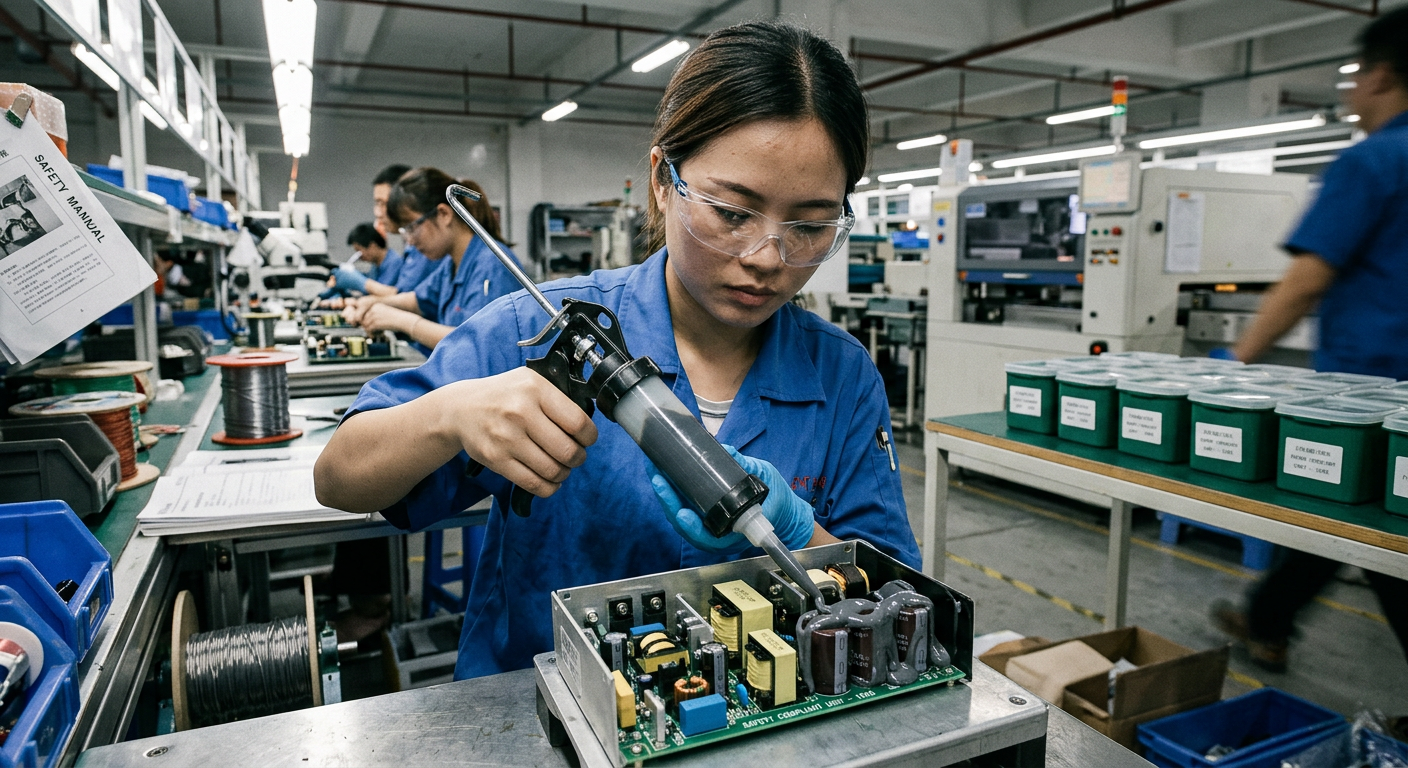
Flame retardant encapsulation materials are used wherever electronics need both environmental protection and improved fire performance. In automotive applications, they appear in sensors, battery components, charging controls, and lighting electronics. In industrial equipment, they protect relays, power supplies, transformers, and control boards. In renewable energy systems, they are found in inverters, junction components, and energy storage electronics.
Telecom and networking infrastructure in the United States also use flame resistant potting compound solutions where weather resistance, dielectric performance, and stable service life are required. Medical device makers may specify lower outgassing, stable cure profiles, and clean processing. Construction-related electronics such as lighting drivers, access control devices, and smart building modules add another layer of demand, especially in projects that must align with safety and electrical code expectations.
| Industry | Typical Components | Main Performance Priority | Preferred Material Trend | Common U.S. Procurement Concern | Example Regions |
|---|---|---|---|---|---|
| Automotive | Sensors, ECUs, charging units | Vibration resistance and thermal reliability | Polyurethane and thermally conductive epoxy | Long-term durability under cycling | Michigan, Ohio, Tennessee, Texas |
| Industrial Automation | Controllers, relays, power modules | Electrical insulation and mechanical protection | Epoxy | Process repeatability and cure control | Illinois, Ohio, Pennsylvania |
| Renewable Energy | Inverters, battery electronics, converters | Thermal management and fire safety | Thermally conductive epoxy and silicone | Outdoor reliability and heat dissipation | California, Texas, Arizona |
| Telecom | Outdoor enclosures, connectors, modules | Moisture resistance and weatherability | Silicone | UV resistance and field maintenance life | California, Georgia, New Jersey |
| Consumer Electronics | Adapters, LED drivers, compact boards | Fast cure and compact filling | Low-viscosity epoxy or PU | Cycle time and cost control | California, Texas, Florida |
| Medical Devices | Monitors, modules, sensors | Stable processing and reliability | Specialty epoxy or silicone | Documentation and validation support | Minnesota, Massachusetts, California |
The explanation behind these patterns is straightforward. Each U.S. sector uses flame retardant potting compounds for a different risk profile. Automotive buyers fear vibration and temperature swings. Renewable energy buyers focus on heat and outdoor exposure. Medical and telecom buyers care about consistency, documentation, and long field life. That is why category-specific selection is more effective than choosing a generic “best” product.
Trend Shift in Material Selection
The U.S. market is gradually shifting away from one-size-fits-all rigid materials toward application-specific systems that combine flame resistance with thermal management, flexibility, and faster processing.
Buying Advice for U.S. Procurement Teams
When buying a flame retardant potting compound in the United States, start with the end-use environment rather than the chemistry name. A material may look attractive on paper but still fail because its viscosity is too high for narrow cavities, its exotherm is too strong for sensitive components, or its rigidity causes cracking under thermal cycling. Real qualification work matters.
Buyers should ask suppliers for a technical data sheet, safety data sheet, recommended mixing and dispensing conditions, cure schedule, shelf-life information, and substrate compatibility guidance. It is also wise to review whether the material supports the target fire performance and electrical insulation expectations required by the customer or product category. If heat buildup is a concern, thermal conductivity should be evaluated with the same seriousness as flame behavior.
For private label or cost-sensitive procurement, it is smart to compare not only unit price but also usable yield, rework rate, cure time, packaging efficiency, freight profile, and lot consistency. A lower-priced material can become more expensive if it causes bubbles, scrap, or slower production.
| Selection Factor | Why It Matters | What to Ask the Supplier | Common U.S. Buyer Mistake | Best Evaluation Method | Impact on Total Cost |
|---|---|---|---|---|---|
| Flame Performance | Supports product safety goals | What fire-related data and approvals are available? | Assuming all potting resins have equal safety behavior | Review reports and test assemblies | High |
| Viscosity | Affects filling of components and void control | What is the mixed viscosity and working time? | Ignoring flow in tight geometries | Trial dispensing on actual parts | High |
| Cure Profile | Controls production speed and reliability | How long does cure take at room or elevated temperature? | Choosing a material that disrupts line throughput | Line simulation test | High |
| Thermal Conductivity | Improves heat dissipation in compact electronics | What conductivity range is available? | Using basic insulation-only resin in hot assemblies | Thermal cycling and heat map review | Medium to High |
| Flexibility vs Hardness | Influences crack resistance and shock durability | Is the cured system rigid, semi-rigid, or flexible? | Selecting rigid epoxy for vibration-heavy use | Mechanical and environmental testing | Medium |
| Documentation and Traceability | Helps qualification and ongoing QA | Can you provide lot traceability and QC records? | Overlooking paperwork until audit stage | Supplier quality review | Medium |
This checklist is important because U.S. sourcing decisions are increasingly judged on total manufacturing risk, not just initial material price. A suitable supplier reduces delays during qualification, shortens troubleshooting time, and lowers the chance of warranty failures.
Local and International Supply Considerations
Domestic suppliers in the United States often provide faster communication, shorter lead times for stocked products, easier sample logistics, and more familiar technical support. They are usually preferred when projects involve urgent prototypes, frequent engineering revisions, or high audit pressure from regulated customers.
At the same time, experienced international manufacturers have become more relevant in the U.S. market, especially for OEM, ODM, private label, and distributor-oriented projects. Buyers importing through major gateways such as Los Angeles, Long Beach, Houston, Savannah, and New York/New Jersey can often secure favorable landed costs on bulk packaging or custom formulations, provided the supplier demonstrates stable quality systems, compliance discipline, and responsive support.
Supplier and Product Comparison View
The comparison chart below reflects a realistic buyer scoring model across support strength, customization, product breadth, and cost-performance positioning.
Case Studies and Typical Purchasing Scenarios
A contract electronics manufacturer in California producing power adapters may choose a low-viscosity, flame resistant epoxy to improve cavity fill and reduce scrap. In this case, the deciding factors are dispense consistency, cure speed, and manageable rework loss. A renewable energy integrator in Texas may instead select a thermally conductive flame retardant potting system for inverter control modules because heat dissipation and outdoor stability outweigh low initial cost.
An automotive supplier in Michigan may prefer a more flexible polyurethane-based flame resistant encapsulant for sensor modules exposed to vibration and road temperature cycles. Here, impact resistance and reduced cracking are more valuable than maximum hardness. A telecom enclosure assembler near Atlanta may select silicone-based flame retardant potting chemistry for outdoor electronics that face humidity, UV exposure, and broad temperature swings.
These scenarios show that the best U.S. sourcing outcome comes from matching the resin system to the field environment, process demands, and service life expectation instead of selecting by brand alone.
Local Suppliers and Distribution Realities
In the United States, many buyers work through regional distributors even when the original manufacturer is a large global brand. This can improve delivery speed and simplify stocking. Companies with established warehousing or channel support in states such as California, Texas, Illinois, Georgia, and New Jersey usually perform well because they can serve both coastal import hubs and inland manufacturing clusters efficiently.
For custom projects, direct manufacturer support is often preferable. This is especially true when a buyer needs modified viscosity, thermal conductivity, packaging size, label branding, or region-specific sales arrangements. Distributors are efficient for standard grades, but customized flame retardant encapsulation programs usually require direct formulation and engineering coordination.
Our Company
For U.S. buyers evaluating alternative supply options, Qingdao QinanX New Material Technology Co., Ltd is relevant because it operates as a specialized adhesive manufacturer with a broad product base that includes electronic silicone, polyurethane systems, acrylic adhesives, and epoxy-based electronic potting compound solutions for industrial and electrical applications. Its manufacturing system is supported by ISO certification, compliance practices aligned with RoHS and REACH, multi-stage quality control, and full digital traceability, which gives procurement and quality teams concrete evidence of process discipline rather than unsupported quality claims. For component buyers, distributors, dealers, brand owners, and private label programs in the United States, the company supports flexible cooperation through OEM, ODM, wholesale, custom packaging, and regional channel development, making it suitable for both established industrial customers and newer market entrants. Its export experience across more than 40 countries, automated production lines for consistent scale, free sample support, 24/7 technical assistance, and tailored formulation capability show that it is equipped to support U.S. projects with practical pre-sale and after-sale coordination. Buyers looking for long-term supplier development can review the company background through its company profile and use the U.S. inquiry contact channel for product matching, sample requests, and branded supply discussions.
Future Trends Through 2026
Looking toward 2026, the U.S. market for flame retardant potting compounds is expected to move in three clear directions: higher thermal functionality, tighter compliance expectations, and stronger sustainability pressure. The rapid growth of EV electronics, battery systems, charging infrastructure, and renewable energy control units is pushing suppliers to develop materials that combine flame resistance with better thermal conductivity and lighter weight processing.
Policy and customer requirements are also shaping formulation choices. Buyers increasingly ask about halogen considerations, emissions, material transparency, and safer chemistry profiles, especially when products enter regulated or brand-sensitive markets. Sustainability does not mean performance can be compromised; instead, it means suppliers must prove that safer and more responsible formulations can still meet long-life electrical and mechanical demands.
Digital quality systems are another trend. U.S. manufacturers increasingly value traceability, lot-level process records, and technical response speed. Suppliers that can connect formulation consistency with digital QC evidence will likely gain market share. By 2026, successful flame resistant potting compound suppliers in the United States will not compete on price alone. They will compete on reliability, engineering partnership, documentation, lead-time control, and adaptability to electrified products.
FAQ
What is a flame retardant potting compound used for?
It is used to encapsulate and protect electrical and electronic assemblies from fire risk, moisture, dust, vibration, chemicals, and temperature stress while also improving insulation and long-term reliability.
Which chemistry is best: epoxy, polyurethane, or silicone?
Epoxy is often best for rigid protection and electrical insulation, polyurethane is often better for flexibility and vibration resistance, and silicone is often preferred for outdoor use and high-temperature environments.
Do U.S. buyers need local technical support?
For complex or regulated applications, local or highly responsive technical support is strongly recommended because it reduces qualification delays and helps resolve process issues faster.
Is imported material a realistic option in the United States?
Yes. Imported material can be a strong option when the supplier offers stable quality systems, clear compliance documentation, export experience, dependable logistics, and fast technical communication.
What should be tested before approving a potting compound?
At minimum, buyers should test flow behavior, cure profile, adhesion, flame-related performance, dielectric properties, thermal cycling response, moisture resistance, and compatibility with actual component geometry.
How do I choose a supplier for private label or OEM sales?
Look for a manufacturer that can provide custom formulation, branded packaging, lot traceability, stable output capacity, export experience, and consistent pre-sales and after-sales support.
Final Recommendation
For most buyers in the United States, the right flame retardant potting compound is the one that matches the exact operating environment, compliance target, and production process rather than the one with the broadest marketing visibility. Domestic suppliers such as Henkel, 3M, Master Bond, MG Chemicals, Epic Resins, and Dymax remain strong choices when engineering documentation, fast support, and qualification confidence are top priorities. At the same time, qualified international manufacturers with strong certification practices, export discipline, and flexible OEM or private label models can be highly competitive for cost-sensitive or customized supply programs. The best next step is to shortlist two or three suppliers, request samples, compare processing behavior on actual assemblies, and make the final decision based on total performance, compliance readiness, and lifecycle cost.

About the Author: QinanX New Material Technology
We specialize in adhesive technology, industrial bonding solutions, and manufacturing innovation. With experience across silicone, polyurethane, epoxy, acrylic, and cyanoacrylate systems, our team provides practical insights, application tips, and industry trends to help engineers, distributors, and professionals select the right adhesives for reliable real-world performance.

Product Category
You May Also Interest
-
IC Packaging Adhesive: Preventing Void Formation Issues
Learn how IC packaging adhesive void formation is prevented in the United States through material choice, process control, supplier selection, and testing.
-

Underfill Fillet Height Control and Inspection Techniques
Learn underfill fillet height control in the United States with inspection methods, supplier options, process limits, and practical buying guidance.
-
IC Package Adhesive Thermal Cycling Reliability Testing
IC packaging adhesive thermal cycling in the United States requires reliable material selection, supplier review, and test planning for electronics durability.
-

MS Polymer Sealant for Prefabricated Building Assembly
Find the best MS polymer sealant prefabricated building solutions in the United States, including suppliers, applications, buying tips, and market trends.
 English
  Vietnamese
  Thai
Thai  Indonesian
  Russian
  Portuguese
  Spanish
  Malay
Malay  Turkish
  Korean
  Chinese