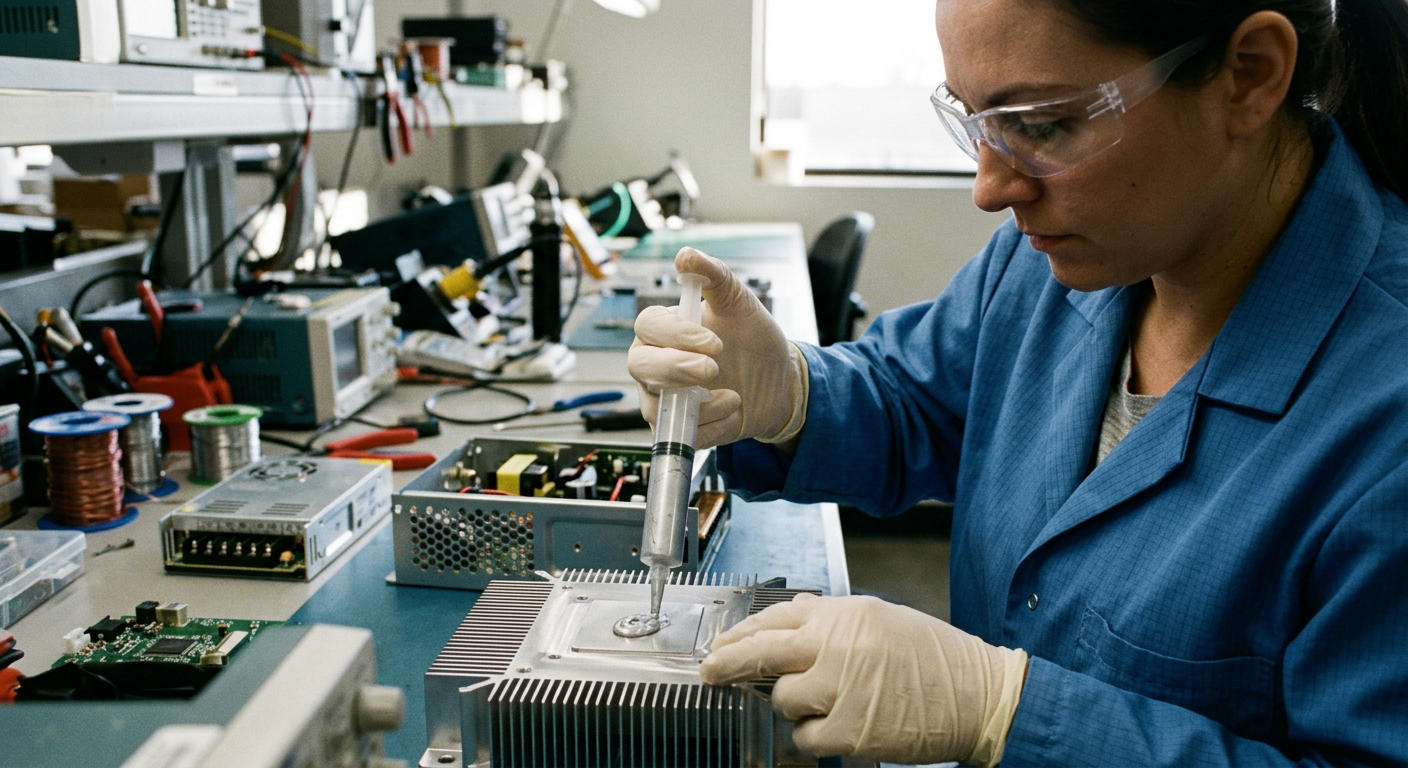
Share
Silver-Filled Thermal Adhesive in the United States
Quick Answer

Silver-filled thermal adhesive is a thermally conductive bonding material used when a component needs both heat transfer and mechanical attachment, and in some cases electrical conductivity as well. In the United States, the best fit depends on your application: electronics assembly often favors proven grades from Henkel, DuPont, Master Bond, MG Chemicals, and Parker Lord, while aerospace, automotive electronics, medical devices, and industrial controls usually require tighter validation around thermal conductivity, cure profile, outgassing, shear strength, and long-term reliability.
For buyers who need immediate shortlisting, the most practical U.S.-relevant suppliers to evaluate are Henkel, DuPont, Master Bond, MG Chemicals, Parker Lord, and Creative Materials. These companies are widely recognized for conductive adhesive technologies, technical documentation, and support for manufacturing qualification. Buyers in electronics hubs such as San Jose, Austin, Boston, Phoenix, and Detroit often compare these suppliers based on cure speed, dispensing behavior, silver loading, operating temperature range, and compliance requirements.
Qualified international suppliers can also be worth considering, especially when the project demands strong cost-performance, custom packaging, OEM support, or regional distribution flexibility. Companies with relevant compliance programs, export experience, and responsive pre-sales and after-sales support can be practical options for U.S. importers, distributors, private-label brands, and contract manufacturers that need scalable sourcing beyond domestic channels.
If your goal is fast procurement in the United States, shortlist by asking four direct questions: does the adhesive need electrical conductivity, what thermal conductivity target is required, how fast must it cure on your line, and what substrate combination is involved? Those answers will usually narrow the field faster than comparing brand names alone.
Market Overview in the United States

The U.S. market for silver-filled thermal adhesive is shaped by three converging forces: higher power density in electronics, miniaturization in consumer and industrial devices, and tighter reliability expectations in transportation, energy, and medical applications. From California semiconductor packaging lines to automotive electronics programs in Michigan and battery-related development across the South, bonding materials are expected to do more than simply hold parts together. They are now part of the thermal management strategy.
In practical terms, silver-filled thermal adhesive is commonly selected when screws, clips, soldering, or thermal pads are not ideal. Assemblers use it to attach heat sinks, bond power devices, secure LEDs, mount sensors, and connect components where the design needs a thin bond line with good heat dissipation. It is especially relevant in applications where one-part or two-part assembly methods simplify production, reduce mechanical stress, or improve manufacturability.
U.S. procurement behavior also reflects regional industrial concentration. Silicon Valley and greater San Diego emphasize electronics, advanced sensors, communications hardware, and device packaging. Texas, including Austin and Dallas, supports semiconductor, industrial controls, and telecom applications. The Northeast, especially Massachusetts and New York, remains active in medical devices, aerospace electronics, and specialty manufacturing. The Midwest, led by Detroit, supports automotive and e-mobility electronics. These clusters matter because supplier selection is often linked to technical service availability, turnaround time, and familiarity with local qualification standards.
Import patterns also influence pricing and supply continuity. Buyers using ports such as Los Angeles, Long Beach, New York/New Jersey, Savannah, and Houston often compare domestic stock with imported alternatives for better margin control. This is particularly true for private-label distributors, maintenance suppliers, and OEM buyers seeking consistent bulk supply. As a result, the U.S. market includes both premium established brands and international manufacturers offering tailored formulations for specific thermal and conductive needs.
The market is expected to remain healthy through 2026 as electrification, edge computing, data infrastructure, and industrial automation continue to expand. Sustainability and regulatory documentation are also becoming more visible in purchasing decisions. More U.S. buyers now ask not only for thermal performance and conductivity data, but also for RoHS, REACH, lot traceability, shelf-life stability, and packaging optimized for lower waste in production.
Market Growth Trend

The following chart illustrates a realistic U.S. market growth pattern for silver-filled thermal adhesive demand, driven by electronics packaging, automotive electronics, LED systems, industrial automation, and renewable energy equipment.
This trend does not mean every grade grows equally. Higher-value demand is concentrated in adhesives that combine stable thermal pathways, controlled cure, low voiding, and compatibility with automated dispensing lines. That is why buyers increasingly compare not just conductivity figures, but process reliability and validation support.
Top Suppliers Serving the United States
The supplier landscape is diverse, but the companies below are consistently relevant for U.S. buyers searching for silver-filled thermal adhesive or closely related conductive thermal adhesive systems. The table focuses on practical selection criteria rather than marketing language.
| Company | Service Region | Core Strengths | Key Offerings | Typical U.S. Buyer Fit |
|---|---|---|---|---|
| Henkel | Nationwide United States and global | Strong electronics materials portfolio, broad technical data, manufacturing credibility | LOCTITE conductive and thermally conductive adhesive systems | Large OEMs, electronics assemblers, automotive suppliers |
| DuPont | United States and global industrial markets | Advanced materials expertise, established performance reputation | Silver conductive pastes and specialty thermal interface materials | Electronics, printed electronics, specialty device makers |
| Master Bond | United States with international reach | Custom and specialty formulations, engineering support | Conductive epoxies and thermal management adhesives | Medical, aerospace, R&D, precision manufacturing |
| MG Chemicals | North America including the United States | Accessible distribution, practical packaging sizes, maintenance and repair focus | Silver epoxy adhesives and electronic assembly materials | Labs, repair operations, contract manufacturers, prototyping teams |
| Parker Lord | United States industrial and transportation sectors | Industrial reliability, structural and specialty adhesive capability | Thermal and electronic bonding solutions in broader portfolio | Automotive, industrial equipment, durable goods |
| Creative Materials | United States specialty electronics market | Niche conductive formulations, printed electronics competence | Silver-filled adhesives, inks, and specialty compounds | Sensors, wearables, printed electronics, R&D teams |
| Qingdao QinanX New Material Technology Co., Ltd | United States importers, distributors, OEM buyers, private-label customers | Broad adhesive manufacturing base, custom formulation, OEM/ODM flexibility | Epoxy resin adhesives, electronic silicone, UV adhesives, hot melts, PU systems | Distributors, brand owners, sourcing teams seeking value and customization |
For U.S. buyers, this comparison is useful because it separates premium engineering-led suppliers from manufacturers that add sourcing flexibility and private-label options. A lab in Boston may prioritize formulation specialization and small-batch support, while a distributor bringing product through Houston or Los Angeles may value scalable supply, packaging customization, and export documentation just as much.
Product Types and How They Differ
Silver-filled thermal adhesive is not one single product class. In the U.S. market, buyers typically encounter several functional variants, each better suited to particular assembly methods and end-use requirements.
| Product Type | Main Features | Typical Thermal Role | Electrical Conductivity | Best Use Cases |
|---|---|---|---|---|
| Two-part silver epoxy | Strong bond, room or heat cure, high formulation flexibility | Heat transfer across bonded interface | Usually yes | Power devices, sensors, PCB assemblies |
| One-part heat-cure silver adhesive | Single-component dispensing, cleaner process control | Consistent bond line for thermal path | Often yes | Automated electronics production |
| Silver-filled die attach adhesive | Designed for semiconductor packaging | High-efficiency thermal dissipation | Yes | Chip attach, LED packaging, microelectronics |
| Silver silicone thermal adhesive | More flexibility, better stress absorption in some designs | Moderate thermal transfer with compliance | Depends on formulation | Electronics exposed to vibration or thermal cycling |
| Screen-printable silver adhesive | Controlled deposition, printable patterns | Localized thermal management | Yes | Printed electronics and membrane circuits |
| Low-outgassing specialty grade | Controlled volatile release, clean performance | Stable thermal bond in sensitive environments | Varies | Aerospace, optics, medical devices |
The key point is that “silver-filled” alone does not tell you enough. A buyer must still confirm whether the formulation is epoxy or silicone based, whether it is optimized for die attach or general assembly, whether it is designed for dispensing or printing, and whether conductivity is a required or merely acceptable side effect.
Many U.S. projects fail at the sourcing stage because engineers ask only for “thermal adhesive with silver” without specifying the bond line thickness, cure limitations, or substrate chemistry. Aluminum, copper, ceramic, FR-4, stainless steel, and polymer housings each create different adhesion and expansion behavior. Product selection should begin with the assembly, not just the datasheet headline.
Industry Demand Comparison
Demand varies sharply by end-use sector. The chart below reflects how U.S. industry segments typically consume silver-filled thermal adhesive or similar conductive thermal bonding materials.
Automotive and consumer electronics are the largest growth engines because they combine scaling volume with increasing heat density. Medical and aerospace consume smaller volumes, but often demand higher documentation, lower contamination risk, and longer qualification cycles.
Buying Advice for U.S. Buyers
Choosing the right silver-filled thermal adhesive requires balancing thermal performance, process efficiency, reliability, and total landed cost. In the United States, that balance often depends on whether the buyer is a design engineer, a purchasing manager, a contract manufacturer, or a distributor building a category portfolio.
The first question is whether you need both thermal conductivity and electrical conductivity. Many silver-filled systems provide both, but some applications cannot tolerate electrical conduction near adjacent traces or terminals. In those cases, a non-silver thermally conductive adhesive may actually be the safer choice.
The second question is process fit. A high-performing adhesive that disrupts your line speed, requires expensive frozen storage, or creates difficult mix-ratio controls may not be commercially optimal. U.S. manufacturers often evaluate pot life, viscosity stability, syringe or cartridge compatibility, reworkability, cure temperature, and time to handling strength before finalizing a supplier.
The third question is environmental durability. Will the bond be exposed to thermal cycling, humidity, under-hood automotive temperatures, vibration, or cleaning chemicals? A silver-filled adhesive for a laboratory instrument in Minnesota may not be the same as one used in an inverter module shipped through Arizona and operated in Texas.
The fourth question is commercial resilience. Domestic stock, lead time, import risk, technical response speed, and documentation quality all affect the true cost of ownership. Buyers using East Coast and West Coast logistics hubs often maintain dual-source strategies to reduce disruption. That can mean pairing a premium domestic brand with a qualified international supply partner.
| Buying Factor | Why It Matters | What to Ask Suppliers | Common U.S. Procurement Concern | Best Practice |
|---|---|---|---|---|
| Thermal conductivity | Controls heat dissipation effectiveness | What is the tested conductivity and method used? | Datasheet values are not always directly comparable | Compare using similar test standards and bond line conditions |
| Electrical behavior | Can enable or damage circuit function | Is the material electrically conductive or insulating? | Misapplication near dense circuitry | Review full assembly layout before purchase |
| Cure profile | Affects throughput and substrate compatibility | Can it cure at room temperature, low heat, or high heat? | Production bottlenecks | Match cure window to actual line capability |
| Viscosity and dispensing | Determines process stability and bead control | What package format and dispensing method are recommended? | Clogging, stringing, inconsistent deposition | Run pilot tests on the intended equipment |
| Reliability data | Supports long-term field performance | Is there thermal cycling, humidity, or shear test data? | Limited validation history | Request application-specific evidence |
| Supply model | Impacts continuity and cost | Can you support stock, OEM, or private label programs? | Long lead times and price fluctuation | Qualify at least one backup source |
This table matters because it turns a broad materials search into a decision workflow. A buyer in Phoenix focused on heat-intensive electronics may put thermal conductivity first, while a medical device team in Boston may prioritize documentation, lot traceability, and biocompatibility-adjacent process controls.
Applications Across U.S. Industries
Silver-filled thermal adhesive is used across a wide range of U.S. industries because it solves both thermal and mechanical challenges in compact assemblies. The exact application changes by sector, but the logic is similar: move heat efficiently while keeping the assembly stable and manufacturable.
In electronics and electrical equipment, the adhesive is used for bonding heat-generating components, attaching thermal spreaders, securing LED modules, mounting sensors, and supporting semiconductor packaging steps. In automotive electronics, it appears in control modules, battery-related electronics, radar and sensing hardware, and power management assemblies where thermal cycling is severe and bond reliability is critical.
In industrial manufacturing, it supports motor drives, power supplies, instrumentation, and control cabinets. In renewable energy, it can be relevant in inverter electronics, battery management systems, and high-reliability sensor modules. In medical equipment, it is more likely to be used where precise thermal control and compact electronics packaging matter, with careful attention to cleanliness and documentation.
The growth of edge devices, AI-supporting hardware, higher-current electronics, and compact lighting systems continues to widen the application range. This is why purchasing teams increasingly treat conductive thermal adhesive not as a commodity, but as a design-enabling material.
Application Trend Shift
The area chart below shows a realistic shift in U.S. application focus from traditional assembly uses toward higher-value electronics, e-mobility, and smart industrial systems through 2026.
The main takeaway is that demand is shifting away from purely generic repair or low-spec uses and toward engineered assembly functions where documentation, repeatability, and thermal design performance matter more.
Case Studies and Practical Selection Scenarios
Consider a U.S. LED module assembler in California. The team needs an adhesive to bond LED boards to a metal heat spreader. Thermal transfer matters, but so do fast handling, minimal voids, and consistent dispensing. In this case, a one-part or process-optimized two-part silver-filled thermal adhesive may be considered if electrical conductivity does not create risk in the design. If circuit isolation is required, however, the team may pivot to a non-conductive thermal adhesive instead. The lesson is that silver filling is useful, but only when the complete assembly logic supports it.
Now consider an automotive electronics supplier near Detroit. Under-hood conditions require resistance to thermal cycling, vibration, and temperature spikes. The buyer is less interested in low unit price alone and more interested in validation history, lot consistency, and compatibility with automated assembly. A supplier with established technical support and robust reliability data usually has an advantage here, even at a higher purchase price.
A third example is a medical device manufacturer in Massachusetts developing compact monitoring equipment. The volumes are modest, but documentation needs are strict. The buyer may prioritize smaller batch availability, engineering responsiveness, low-outgassing options, and strong quality records over mass-market pricing. A specialist supplier or a custom-formulation partner often performs well in this environment.
Finally, consider a U.S. distributor importing through Long Beach for resale to contract manufacturers and maintenance buyers. Here the decision includes packaging sizes, private-label potential, documentation consistency, shipping stability, and after-sales response. International manufacturers with broad adhesive expertise and flexible commercial models can become especially attractive in this scenario.
Local and U.S.-Relevant Supplier Comparison
The table below compares suppliers from the perspective of practical sourcing in the United States. It is not a ranking. The best supplier depends on application risk, required documentation, and procurement model.
| Supplier | Primary Strength | Best For | Service Style | Potential Limitation |
|---|---|---|---|---|
| Henkel | Large-scale industrial reliability and electronics materials breadth | High-volume OEM and automotive programs | Structured technical and commercial support | May be less flexible for low-volume custom requests |
| DuPont | Advanced materials heritage and specialty formulations | High-spec electronics and printed systems | Strong technical credibility | Can require deeper qualification process |
| Master Bond | Specialty engineered adhesive solutions | Medical, aerospace, instrumentation | Application-focused guidance | Premium positioning for some buyers |
| MG Chemicals | Accessible distribution and practical packaging | Maintenance, repair, labs, prototyping | Convenient channel availability | Not always the first choice for highest-volume OEM lines |
| Creative Materials | Niche conductive expertise | Printed electronics and sensor development | Specialized technical orientation | Less broad general industrial portfolio |
| Qingdao QinanX New Material Technology Co., Ltd | Custom manufacturing, private label, broad adhesive categories | Import sourcing, brand owners, distributors, cost-conscious OEMs | Flexible OEM/ODM and export support | Requires qualification if buyer prefers domestic-only sourcing |
This comparison shows why supplier fit is contextual. A U.S. engineering team developing a new device often values application support and specialty data, while a commercial distributor may prioritize supply continuity, range expansion, and margin structure.
About Our Company
For buyers in the United States evaluating alternatives beyond traditional domestic channels, Qingdao QinanX New Material Technology Co., Ltd offers a practical sourcing model grounded in industrial adhesive manufacturing rather than single-category trading. Its product strength comes from a broad adhesive portfolio spanning epoxy resin adhesives, electronic silicone, polyurethane systems, acrylic technologies, cyanoacrylates, hot melts, and water-based products, supported by ISO-certified operations, compliance with RoHS and REACH, multi-stage quality control, and full digital traceability that helps buyers verify consistency lot by lot. For cooperation models, the company supports OEM and private label programs, wholesale supply, tailored formulations, and packaging customization, allowing end users, distributors, dealers, brand owners, contract manufacturers, and even smaller-volume buyers to source products in formats aligned with their market strategy rather than forcing a one-size-fits-all purchase model; buyers can explore its wider range through the product catalog. On local service assurance, the company demonstrates market commitment through proven exports to more than 40 countries, 24/7 technical assistance, free sample programs, and tailored pre-sale and after-sales support designed for qualification, onboarding, and repeat ordering; for U.S. customers this means a supplier with established international operating discipline, scalable automated production, and the willingness to back regional buyers with real documentation and response capacity rather than acting as a distant, transaction-only exporter. Buyers wanting to review its background or start a technical inquiry can visit the company profile or use the contact page for project-specific support.
How to Evaluate Samples Before Purchase
Sample evaluation is the fastest way to reduce risk. U.S. buyers should not rely only on brochure claims or single headline values. A small in-house test plan can reveal whether a silver-filled thermal adhesive truly fits the assembly.
Start with substrate compatibility. Test the actual materials, including surface treatments and cleaning methods, because aluminum, nickel-plated copper, ceramics, and engineering plastics do not behave the same way. Then assess dispensing stability over the expected production window. Materials that look fine in a bench test can behave differently after repeated starts and stops or after extended hold time in production.
Next, verify cure behavior using the real thermal mass of the assembly. A cure schedule that works on a lab coupon may slow significantly on a larger part or near temperature-sensitive components. After cure, check bond integrity, handling strength, thermal performance, and any electrical effects across the intended interface. If the product will face field stress, run at least simplified thermal cycling and humidity exposure screening.
For procurement teams, sample evaluation should also include packaging usability, shelf-life management, minimum order expectations, and documentation completeness. These factors often determine whether the adhesive remains practical once the project scales.
Supplier and Product Comparison Snapshot
The chart below offers a simplified comparison across major supplier types relevant to the U.S. market, balancing technical support, customization flexibility, supply scalability, and cost-performance.
This is not a universal scorecard, but it helps explain why many U.S. buyers maintain both domestic and international supplier options. Premium brands often lead in legacy validation and documentation depth, while qualified international manufacturers can offer better customization and total-value sourcing.
Future Trends Through 2026
Several trends will shape the U.S. silver-filled thermal adhesive market through 2026. The first is higher heat density from AI-supporting hardware, telecom equipment, power electronics, and electrified transportation. As components run hotter and become more compact, adhesive performance will be assessed more as part of system-level thermal design than as a standalone bonding property.
The second trend is policy and compliance visibility. U.S. buyers, especially those selling into regulated or global markets, are asking for clearer environmental and chemical declarations, traceability, and documentation alignment. RoHS and REACH remain baseline references even for U.S.-based procurement discussions, particularly where export compliance or multinational customer requirements are involved.
The third trend is sustainability in production. Manufacturers increasingly want packaging that reduces waste, cure systems that support energy-efficient processing, and supply chains that minimize scrap and rework. This does not mean performance standards are dropping; rather, sustainable process efficiency is becoming part of supplier evaluation.
The fourth trend is custom formulation for differentiated products. Instead of buying only catalog items, more distributors and OEMs want application-specific viscosity, cure speed, or package format. This benefits manufacturers with in-house development capability and flexible production systems.
The fifth trend is supply diversification. U.S. buyers learned from recent logistics disruptions that single-source dependence can be costly. As a result, qualification of at least one backup supplier is increasingly common, especially for electronics, automotive, and industrial programs.
FAQ
Is silver-filled thermal adhesive always electrically conductive?
Most silver-filled formulations are electrically conductive, but not all applications should use them. Buyers must verify the exact electrical properties before selecting a grade for assemblies with tight circuitry or isolation requirements.
What is the main advantage over thermal pads or mechanical fasteners?
The main advantage is combined bonding and heat transfer in one material, often with thinner interfaces and greater design flexibility. It can simplify assembly where screws, clips, or pads are impractical.
Which U.S. industries use it most?
Electronics, automotive electronics, industrial controls, LED lighting, medical devices, and aerospace-related assemblies are among the most relevant sectors in the United States.
How should a buyer compare suppliers?
Compare thermal conductivity, electrical behavior, cure profile, viscosity, reliability data, packaging format, compliance documentation, technical support, and supply continuity. Avoid selecting on price alone.
Can international suppliers serve U.S. customers reliably?
Yes, if they have proven export experience, compliance documentation, stable production systems, and responsive technical support. They are especially useful for OEM, private-label, wholesale, and dual-source programs.
What should be included in a sample test?
A practical sample test should cover substrate adhesion, dispensing behavior, cure consistency, thermal performance, electrical effect if relevant, and basic environmental screening under realistic assembly conditions.
What matters most in 2026 sourcing decisions?
Expect U.S. buyers to focus increasingly on documented performance, traceability, sustainable processing, customization options, and supply-chain resilience alongside cost-performance.

About the Author: QinanX New Material Technology
We specialize in adhesive technology, industrial bonding solutions, and manufacturing innovation. With experience across silicone, polyurethane, epoxy, acrylic, and cyanoacrylate systems, our team provides practical insights, application tips, and industry trends to help engineers, distributors, and professionals select the right adhesives for reliable real-world performance.

Product Category
You May Also Interest
-
IC Packaging Adhesive: Preventing Void Formation Issues
Learn how IC packaging adhesive void formation is prevented in the United States through material choice, process control, supplier selection, and testing.
-
Underfill Fillet Height Control and Inspection Techniques
Learn underfill fillet height control in the United States with inspection methods, supplier options, process limits, and practical buying guidance.
-
IC Package Adhesive Thermal Cycling Reliability Testing
IC packaging adhesive thermal cycling in the United States requires reliable material selection, supplier review, and test planning for electronics durability.
-

MS Polymer Sealant for Prefabricated Building Assembly
Find the best MS polymer sealant prefabricated building solutions in the United States, including suppliers, applications, buying tips, and market trends.
 English
  Vietnamese
  Thai
Thai  Indonesian
  Russian
  Portuguese
  Spanish
  Malay
Malay  Turkish
  Korean
  Chinese