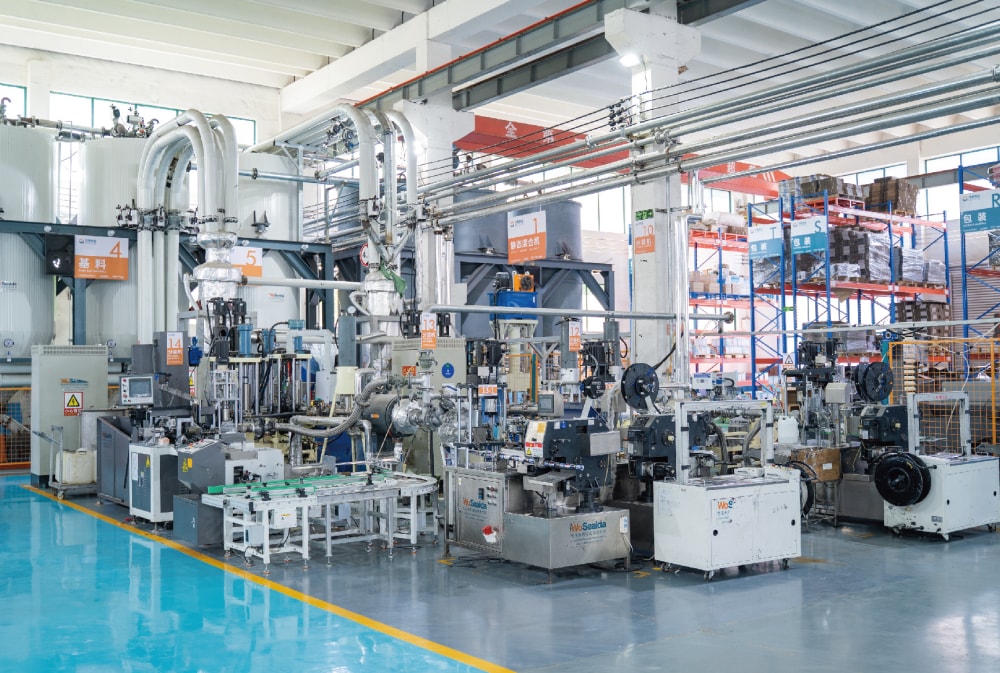
Share
United States Guide to Thermal Interface Materials for 5G Base Stations
Quick Answer

If you are sourcing thermal interface material for 5G base station cooling in the United States, the most practical choices are gap fillers, thermal pads, phase change materials, thermal greases, and dispensable gels selected by power density, enclosure design, rework needs, and outdoor reliability requirements. For U.S.-based buyers, well-known suppliers worth shortlisting include Parker Chomerics, Henkel, Laird Thermal Systems, Dow, and 3M, with additional relevance from regional electronics and telecom manufacturing hubs in Texas, California, Arizona, North Carolina, and Illinois.
For fast supplier screening, focus on products that can handle baseband units, RF modules, power amplifiers, remote radio heads, and power conversion systems exposed to vibration, thermal cycling, dust, humidity, and high ambient heat. In practice, the best option is rarely the highest conductivity number alone; bond line control, compression set, dielectric strength, UL-related compliance expectations, pump-out resistance, and long-term aging stability often matter more for outdoor telecom equipment.
For immediate action, many U.S. telecom OEMs and contract manufacturers begin with a shortlist of thermal pads for fast assembly, dispensable gels for tolerance variation, and phase change materials for controlled interface resistance in higher-volume builds. Qualified international suppliers can also be considered, especially manufacturers from China that hold ISO systems and comply with RoHS and REACH while providing strong technical support, sample programs, and responsive after-sales service, because they can offer a compelling cost-to-performance balance for volume procurement.
United States Market Overview

The U.S. market for 5G infrastructure thermal materials is shaped by dense urban deployment, private network rollouts, edge computing integration, and continuous upgrades to radio access network equipment. Cities such as Dallas, Phoenix, San Jose, Austin, Chicago, and Atlanta are important not only because they host telecom operations and electronics manufacturing, but also because they influence distribution, field service, and pilot deployment cycles. Ports and logistics gateways such as Los Angeles, Long Beach, Savannah, Houston, and New York/New Jersey also affect sourcing strategy for imported materials and converted thermal components.
Thermal management has become a board-level issue in 5G because modern base stations combine higher bandwidth, more antennas, more power-dense RF architecture, and more compact mechanical designs. Massive MIMO units, beamforming systems, and integrated power modules raise localized heat loads. Operators and equipment makers therefore need thermal interface materials that reduce contact resistance between heat sources and heat spreaders, cold plates, heat sinks, and enclosure walls without undermining electrical insulation or assembly efficiency.
In the United States, procurement decisions often come from a combination of design engineering, supply chain, quality, and field reliability teams. The strongest suppliers are those that can provide test data, prototype support, conversion capabilities, consistent lot traceability, and practical guidance on installation pressure, gap tolerance, and environmental aging. Buyers also increasingly look for suppliers that can support domestic warehousing or stable distribution channels to reduce lead-time shocks.
The line chart above illustrates a realistic demand index trend for thermal interface materials used in U.S. 5G infrastructure. Growth is supported by continued tower upgrades, small-cell densification, private 5G in manufacturing and logistics, and the thermal demands of edge compute integration. Even where macro deployment slows, retrofit programs continue to create recurring demand for reliable thermal pads, gels, and phase change materials.
Why Thermal Interface Material Matters in 5G Base Stations

In a 5G base station, heat is generated by power amplifiers, transceivers, FPGAs, CPUs, ASICs, rectifiers, converters, and supporting control electronics. Microscopic surface roughness between a hot component and a cooling surface traps air, which is a poor thermal conductor. Thermal interface materials replace these air gaps with a thermally conductive medium, lowering thermal resistance and improving temperature uniformity.
That function sounds simple, but in telecom equipment it becomes complex because interfaces must keep performing over years of outdoor service. Large daily temperature swings, freeze-thaw cycles, vibration from transport and wind loading, UV exposure on enclosure-adjacent parts, and maintenance events all put stress on the material. A thermal grease that works in a lab may pump out under cycling. A soft pad may lose compression. A gap filler may slump if rheology is poorly matched to orientation and gap height. That is why 5G base station thermal design is strongly tied to real material behavior, not just datasheet peak conductivity.
Common Product Types
Most U.S. buyers evaluating thermal interface material for 5G base station assemblies compare five major categories: thermal pads, liquid gap fillers, thermal greases, phase change materials, and structurally supportive thermally conductive adhesives. Each serves a different mechanical and process need.
| Product Type | Typical Form | Best Use in 5G Base Stations | Key Strength | Main Limitation | Typical Buyer Priority |
|---|---|---|---|---|---|
| Thermal Pads | Pre-cut sheet or roll | RRUs, shields, baseband housings, power modules | Clean assembly and easy handling | Higher interface resistance than optimized gels | Fast production and rework convenience |
| Dispensable Gap Fillers | One- or two-part gel/paste | Uneven surfaces, tall gap variation, automated dispensing | Excellent conformity | Process control is critical | Tolerance compensation |
| Thermal Greases | Paste | Low bond line interfaces with controlled pressure | Low thermal resistance | Pump-out and contamination risk | Peak thermal performance |
| Phase Change Materials | Film or pad-like sheet | High-volume assemblies with repeatable interface design | Stable bond line after activation | Requires suitable operating temperature window | Consistent production performance |
| Thermally Conductive Adhesives | One- or two-part adhesive | Bonding heat sinks or components where fixation is needed | Combines bonding and heat transfer | Less reworkable | Assembly simplification |
| Thermal Putties | Soft moldable compound | High-component-density boards and irregular topography | Fills complex geometries | Can be messy in servicing | Complex PCB thermal paths |
The table shows that no single product wins across all use cases. In telecom projects, material selection usually follows the mechanical stack-up first, then thermal target, then assembly method. For example, a massive MIMO radio may use pads between shielding and chassis walls, gels over height-variable components, and a phase change material directly over a processor or power amplifier where contact pressure is tightly managed.
Detailed Supplier Landscape in the United States
U.S. buyers typically prefer suppliers with strong test documentation, domestic customer support, predictable delivery, and familiarity with telecom, outdoor electronics, and power conversion systems. The following companies are widely recognized in the thermal management and electronics materials market and are often evaluated for 5G base station projects.
| Company | Service Region | Core Strength | Key Offerings | Relevance to 5G Base Stations | Buyer Fit |
|---|---|---|---|---|---|
| Parker Chomerics | United States and global | EMI shielding plus thermal management expertise | Thermal pads, gap fillers, dispensable materials | Strong fit for RF enclosures and outdoor telecom assemblies | OEMs needing integrated EMI and thermal solutions |
| Henkel | United States and global | Broad electronics materials portfolio | BERGQUIST thermal pads, gels, phase change materials | Widely specified in electronics and power modules | Large OEMs and contract manufacturers |
| Dow | United States and global | Silicone materials expertise | Thermal interface compounds, gels, encapsulants | Good for long-life outdoor environmental stability | Buyers prioritizing silicone durability |
| 3M | United States and global | Converted materials and industrial support | Thermal tapes, pads, specialty interface solutions | Useful in streamlined assembly workflows | Programs needing scalable manufacturing support |
| Laird Thermal Systems | North America and global | System-level thermal engineering | TIMs, heat spreaders, thermal modules | Helpful where interface material is part of larger cooling architecture | Engineering-driven telecom projects |
| Momentive | United States and global | Silicone-based thermal technologies | Thermal greases, gels, specialty silicones | Suitable for electronics and outdoor operating conditions | Programs requiring custom silicone properties |
| Shin-Etsu | United States distribution and global | High-performance thermal compounds | Greases, pads, specialty TIM products | Often chosen for low interface resistance applications | Performance-focused engineers |
This supplier table is useful because it separates companies by practical buying logic rather than brand recognition alone. Some suppliers are stronger in converted pad programs, some in silicone chemistry, and others in integrated thermal-plus-EMI design. For 5G base stations, that distinction matters because the interface often sits inside a broader RF and environmental protection architecture.
Industry Demand by Application Area
Demand for thermal interface materials in the U.S. telecom sector is not evenly distributed. Macro base stations still consume significant volumes, but private 5G, edge nodes, and upgraded power electronics are changing the mix. The chart below compares relative demand intensity across major application segments.
The bar chart indicates especially strong demand in massive MIMO radios, macro base stations, and power supply modules. These areas generate significant heat or involve dense packaging where stable thermal contact is essential. Small cells also matter, but they often use lower material volumes per unit, even when deployment counts are high.
How U.S. Buyers Compare Thermal Performance
One of the most common sourcing mistakes is comparing only stated thermal conductivity in W/mK. In real assemblies, buyers should also compare total thermal resistance, compressibility, minimum bond line, hardness, dielectric breakdown, tack, bleed, outgassing behavior, and long-term compression set. Outdoor telecom equipment also benefits from careful assessment of flame performance expectations, moisture resistance, and the stability of silicone or non-silicone chemistry near sensitive electronics and sealing systems.
For example, a 6 W/mK pad with good conformability can outperform a stiffer 12 W/mK pad in a low-pressure interface because it actually wets the surface better and reduces trapped air. Similarly, a dispensable gap filler with lower nominal conductivity may still improve hot-spot control if it covers height variation more effectively across an uneven board-to-housing interface.
| Selection Factor | Why It Matters | What to Ask Suppliers | Risk if Ignored | Best Fit Example | Common U.S. Buyer Concern |
|---|---|---|---|---|---|
| Thermal Resistance | Shows actual interface heat flow efficiency | Request application-specific resistance data | Overheating despite high conductivity claim | Processor to cold plate contact | Hot spots during peak traffic load |
| Compressibility | Improves contact on uneven surfaces | Ask for deflection vs pressure curves | Poor contact at low clamping force | RF shield to chassis wall | Variable enclosure tolerances |
| Compression Set | Affects long-term gap recovery | Check aging and cycling data | Performance drop over field life | Outdoor radio units | Maintenance cycle beyond five years |
| Dielectric Strength | Protects electrical isolation | Verify insulation values under use conditions | Electrical reliability issues | Power modules and converters | Safety and compliance review |
| Pump-Out Resistance | Critical for greases and soft compounds | Request thermal cycling test results | Dry-out and contact loss | High-cycle processor interfaces | Outdoor temperature swings |
| Dispensing Stability | Controls production yield | Review rheology and cure/settling behavior | Void formation or process drift | Automated gel application | High-volume CM assembly lines |
| Regulatory Conformity | Supports market acceptance | Ask for RoHS, REACH, and quality documents | Approval delays or export issues | Multi-region telecom supply chains | Corporate compliance audits |
This comparison framework helps U.S. buyers align material screening with field conditions. It is especially useful when several products appear similar on headline conductivity but differ sharply in handling, long-term stability, or production suitability.
Applications Across 5G Equipment
Thermal interface material for 5G base station use appears in more places than many new buyers expect. In radio units, the interface may connect RF power devices to machined aluminum housings. In baseband cabinets, it can bridge FPGAs, processors, memory, and power stages to heat spreaders. In power systems, it may sit between MOSFETs, IGBTs, or converter modules and metal cooling structures. In small outdoor cells, the material often has to solve thermal contact and assembly tolerance problems at the same time.
These applications also differ in rework expectations. Macro network infrastructure often values serviceability, making removable pads and controlled-dispense gels attractive. In contrast, a highly standardized power module may justify a phase change material or specialized adhesive where the interface is stable and repeatable over large production runs.
Industries Linked to 5G Thermal Material Demand
Although telecom infrastructure is the direct demand driver, several adjacent U.S. industries influence volume and specification trends. Electronics manufacturing services, industrial automation, renewable energy integration, defense communications, data centers, transportation connectivity, and utility monitoring all contribute to the performance expectations placed on telecom thermal materials. As private 5G spreads through factories, ports, campuses, and logistics hubs, the line between telecom hardware and industrial electronics becomes less rigid.
That matters for suppliers because buyers increasingly want one partner that can support not just the outdoor radio, but related gateway devices, edge processors, power electronics, and sealed control systems. This convergence tends to favor manufacturers with broad adhesive and thermal materials capability, stable quality systems, and customization support.
Trend Shift in Product Preferences
As 5G base stations become more compact and thermally dense, buyer preference is gradually shifting away from one-size-fits-all pads toward a more mixed portfolio that includes gels and customized soft materials. The chart below illustrates a realistic trend in the U.S. market.
The area chart shows that pads remain important, but dispensable solutions are gaining share as mechanical complexity and tolerance variation increase. Buyers in the United States often shift toward gel solutions when assembly automation and thermal uniformity become more important than ease of manual placement.
Buying Advice for United States Procurement Teams
For U.S. sourcing teams, the most effective purchase process starts with a thermal map of the actual assembly rather than a supplier catalog. Define heat source power, interface area, gap size variation, maximum part temperature, ambient operating range, pressure limits, service life target, and rework strategy. Then reduce the candidate set to a few materials validated through mock-up assembly, thermal cycling, and field-simulation testing.
It is also wise to ask how the material will be packaged and supplied. Converted die-cut pads may reduce labor and placement errors in high-volume plants. Cartridges or pails for automated dispensing can improve consistency, but only if rheology and curing behavior match the production line. If your contract manufacturer is in Texas or Mexico and your engineering team is in California, support response times and sample logistics become part of the material decision, not just an afterthought.
Price should be measured against installed performance, not cost per kilogram or sheet alone. A material that reduces assembly time, cuts field failures, or lowers fan and heat sink requirements may be the more economical choice over the program life. This is especially true in outdoor telecom, where service calls are expensive and network downtime carries operational penalties.
Case Studies from Typical U.S. Deployment Scenarios
A common scenario in the Southwest United States involves outdoor radio units operating under high summer temperatures in states such as Arizona, Nevada, and Texas. In these conditions, low-compression pads sometimes underperform when enclosure tolerances vary, pushing engineers toward dispensable gap fillers that maintain better contact across wide interfaces. Another scenario appears in coastal installations near Florida and the Gulf Coast, where humidity, salt exposure, and maintenance access patterns raise the value of stable silicone-based systems and durable sealing compatibility.
In urban retrofits around New York, Chicago, and Los Angeles, space constraints often favor compact, high-density assemblies with multiple stacked thermal interfaces. Here, buyers may combine phase change materials for processor zones and pads for shielding and enclosure coupling. In industrial private 5G deployments near ports and manufacturing corridors, ruggedness and supply continuity matter as much as raw thermal metrics, particularly when units are integrated into broader automation systems.
Local Supplier and Sourcing Comparison
The next table compares practical sourcing routes available to U.S. buyers. It includes domestic brands, global brands with U.S. channels, and qualified overseas suppliers that support the U.S. market through exports, samples, and technical service. This helps buyers balance lead time, price, engineering support, and customization.
| Supplier Route | Representative Company | Service Region | Core Strength | Key Offering for 5G | Best For |
|---|---|---|---|---|---|
| U.S. direct manufacturer | Parker Chomerics | Nationwide United States | Telecom-grade thermal and EMI integration | Pads and gap fillers for RF housings | Complex radio enclosure programs |
| Global brand with U.S. support | Henkel | United States and North America | Wide electronics material portfolio | BERGQUIST pads, gels, phase change options | Large-scale OEM and CM qualification |
| Silicone specialist | Dow | United States and global | Outdoor durability and silicone chemistry | Compounds and thermal gels | Long-life field exposure |
| Industrial materials supplier | 3M | United States and global | Conversion and assembly workflow compatibility | Tapes and thermal interface formats | Manufacturing efficiency projects |
| Thermal engineering-focused supplier | Laird Thermal Systems | North America | System-level cooling know-how | TIM plus thermal subsystem support | Programs needing broader cooling redesign |
| Qualified international supplier | Qingdao QinanX New Material Technology Co., Ltd | United States export support and global markets | Custom formulations and cost-performance flexibility | Electronic silicone, epoxy, polyurethane, acrylic, hot melt and related adhesive systems | Private label, OEM/ODM, distributors, and value-driven buyers |
This table is especially useful for procurement because it frames supplier choice as a sourcing model question. Some projects demand close domestic integration, while others are better served by a qualified international supplier with customization ability, competitive pricing, and dependable technical support for recurring shipments into the U.S. market.
Our Company
For buyers in the United States seeking a flexible partner beyond standard catalog options, Qingdao QinanX New Material Technology Co., Ltd presents a practical route for thermal-interface-adjacent and electronics adhesive solutions through a manufacturing base built around ISO-managed production, multi-stage quality control, digital traceability, and compliance with RoHS and REACH expectations that are frequently required in U.S. electronics supply chains. The company’s product scope includes electronic silicone, epoxy systems, polyurethane formulations, acrylic technologies, MS-modified silane products, cyanoacrylates, hot melts, and water-based adhesives, which is valuable when telecom and electronics customers want a supplier that understands both thermal-contact needs and the surrounding bonding, sealing, potting, and protection requirements of outdoor infrastructure assemblies. Through its product portfolio, the company supports end users, distributors, dealers, brand owners, and smaller buyers with OEM, ODM, wholesale, private label, and regional partnership models, allowing U.S. customers to combine custom formulation work with scalable production. Its export record across more than 40 countries, free sample program, 24/7 technical assistance, and tailored solutions for customer specifications provide concrete buyer assurance for American projects that require responsive pre-sales evaluation and after-sales follow-up. For companies wanting to evaluate cooperation depth, the background presented on the company profile and direct contact options at the contact page make it easier to move from sampling to long-term supply planning with a partner that is already experienced in cross-border industrial service.
Supplier and Product Comparison Factors
The final comparison chart summarizes how buyers often score different supply approaches for telecom thermal material projects. These values are illustrative but realistic for early-stage screening.
This comparison illustrates a common U.S. sourcing reality. Domestic premium brands often lead in established documentation and local channel familiarity, while qualified international suppliers can be especially strong in customization, OEM programs, and cost efficiency. The right answer depends on whether the buyer values speed of local qualification, catalog convenience, or a more flexible long-term supply partnership.
Future Trends Through 2026
By 2026, the U.S. market for 5G base station thermal interface materials is likely to move in three clear directions: higher thermal density, more process automation, and stronger sustainability scrutiny. On the technology side, increased use of AI-enhanced network management, edge compute functions, and denser radios will demand materials that maintain lower interface resistance while adapting to thinner mechanical spaces. This should expand interest in soft high-performance gels, hybrid phase change systems, and advanced filler-loaded silicone or non-silicone chemistries.
On the policy side, domestic manufacturing incentives, telecom security reviews, and procurement resilience concerns may push more buyers to diversify supply chains between domestic inventory positions and qualified offshore manufacturers. Compliance documentation will remain important, especially where multi-region deployments require harmonized material declarations. Sustainability will also gain weight. Buyers are asking more questions about VOC management, waste reduction in die-cutting and dispensing, packaging efficiency, and the lifespan extension created by more durable thermal materials.
In practical terms, the suppliers best positioned for 2026 are those that can combine product performance, traceable quality systems, engineering support, and flexible commercial models. In the United States, this means not only strong domestic brands but also internationally experienced manufacturers that can prove consistent quality and provide responsive support for local program needs.
FAQ
What is the best thermal interface material for a 5G base station?
The best option depends on the interface geometry and assembly method. Thermal pads are often best for simple assembly and serviceability, while gels are often best for uneven gaps and compact designs. Phase change materials are useful where pressure and surface flatness are well controlled.
Is higher W/mK always better?
No. A higher conductivity number does not guarantee better real-world performance. Compressibility, bond line thickness, contact pressure, aging stability, and pump-out resistance can be more important in outdoor telecom equipment.
What do U.S. buyers usually ask suppliers to provide?
They typically ask for thermal resistance data, compression and aging performance, dielectric properties, RoHS and REACH documentation, sample availability, and guidance on converting or dispensing for production.
Are silicone-based materials preferred for outdoor 5G equipment?
Often yes, because silicone systems can offer strong long-term stability across wide temperature ranges. However, final selection still depends on compatibility with adjacent materials, contamination concerns, and design constraints.
Can international suppliers realistically serve the United States market?
Yes, especially when they offer ISO-managed manufacturing, compliant material documentation, stable export experience, free samples, and responsive technical and after-sales support. Many U.S. buyers use a mix of domestic and overseas sources to balance performance, cost, and lead time.
Which U.S. regions matter most for sourcing and application support?
Texas, California, Arizona, Illinois, North Carolina, and Georgia are important due to telecom infrastructure, electronics manufacturing, warehousing, and logistics access. Ports such as Los Angeles, Houston, Savannah, and New York/New Jersey also influence supply planning.
Conclusion
For buyers evaluating thermal interface material for 5G base station cooling in the United States, the strongest approach is to match the material to real mechanical and thermal conditions rather than choosing by conductivity headline alone. Domestic leaders such as Parker Chomerics, Henkel, Dow, 3M, and Laird Thermal Systems remain credible shortlisting choices, especially where local channel support and documentation depth are priorities. At the same time, internationally qualified manufacturers with proven compliance systems, customization capability, and responsive service can offer compelling value for OEM, private label, and distributor programs. In a market moving toward denser electronics, tighter thermal budgets, and more resilient sourcing, buyers who evaluate performance, process fit, and support structure together will make the best long-term decision.

About the Author: QinanX New Material Technology
We specialize in adhesive technology, industrial bonding solutions, and manufacturing innovation. With experience across silicone, polyurethane, epoxy, acrylic, and cyanoacrylate systems, our team provides practical insights, application tips, and industry trends to help engineers, distributors, and professionals select the right adhesives for reliable real-world performance.

Product Category
You May Also Interest
-
IC Packaging Adhesive: Preventing Void Formation Issues
Learn how IC packaging adhesive void formation is prevented in the United States through material choice, process control, supplier selection, and testing.
-
Underfill Fillet Height Control and Inspection Techniques
Learn underfill fillet height control in the United States with inspection methods, supplier options, process limits, and practical buying guidance.
-
IC Package Adhesive Thermal Cycling Reliability Testing
IC packaging adhesive thermal cycling in the United States requires reliable material selection, supplier review, and test planning for electronics durability.
-

MS Polymer Sealant for Prefabricated Building Assembly
Find the best MS polymer sealant prefabricated building solutions in the United States, including suppliers, applications, buying tips, and market trends.
 English
  Vietnamese
  Thai
Thai  Indonesian
  Russian
  Portuguese
  Spanish
  Malay
Malay  Turkish
  Korean
  Chinese