Share
Thermal Adhesive vs Thermal Paste in the United States
Quick Answer

For most buyers in the United States, thermal paste is the better choice when you need efficient heat transfer and future disassembly, while thermal adhesive is the better choice when you need both heat transfer and permanent bonding in one material. If you are mounting heat sinks on chipsets, LEDs, compact power modules, or parts that cannot use screws or clips, thermal adhesive is often the practical option. If you are assembling CPUs, GPUs, serviceable power electronics, or any device that may require maintenance, thermal paste is usually the safer and more cost-effective choice.
In practical procurement terms, U.S. manufacturers in electronics hubs such as San Jose, Austin, Phoenix, Detroit, and Boston usually choose thermal paste for serviceable assemblies and thermal adhesive for space-limited, vibration-prone, or high-volume bonded assemblies. Top suppliers commonly considered in the U.S. market include Henkel, 3M, Parker Lord, MG Chemicals, Master Bond, and Aavid/Boyd-linked thermal interface distributors. Qualified international suppliers can also be worth evaluating, especially Chinese manufacturers with RoHS and REACH compliance, ISO-based quality systems, and strong pre-sales and after-sales support, because they often provide attractive cost-performance advantages for OEM and private-label programs.
Understanding the U.S. Market for Thermal Interface Materials

The U.S. market for thermal management materials continues to expand as electronics become smaller, hotter, and more power-dense. Demand is being pushed by electric vehicles, battery packs, power conversion systems, telecom equipment, industrial automation, data centers, and high-brightness LED lighting. Buyers in the United States are no longer selecting thermal interface materials only on thermal conductivity. They are also evaluating assembly speed, automation compatibility, outgassing behavior, electrical insulation, rework needs, UL-related compliance expectations, and long-term reliability under cycling conditions.
Regional buying behavior also matters. In Silicon Valley and Orange County, design teams often prioritize low bleed, controlled viscosity, and compatibility with automated dispensing. In Texas, especially Austin and Dallas, thermal materials are frequently evaluated for power electronics, telecom hardware, and contract manufacturing efficiency. In the Detroit automotive corridor, engineers emphasize vibration resistance, temperature cycling, and qualification discipline. Around Phoenix and Chandler, semiconductor and advanced electronics production creates demand for stable thermal compounds with clean processing behavior. Coastal trade hubs such as Los Angeles, Long Beach, Savannah, New York, and Houston also influence sourcing strategy, because lead times, container costs, and bonded inventory programs can affect total landed cost as much as raw product price.
In this environment, the debate over thermal adhesive versus thermal paste is not academic. It directly affects assembly design, warranty risk, field serviceability, and production throughput. A product manager choosing the wrong thermal interface may create avoidable failures, excessive labor costs, or difficult rework conditions.
The chart above illustrates a realistic demand growth pattern for thermal interface materials in the United States. The trajectory reflects the combined effect of EV production, AI server growth, renewable energy installations, and electronics miniaturization. Buyers comparing thermal adhesive and thermal paste should view the decision through this broader market lens: materials that support automation, reliability, and cost control are gaining share fastest.
What Thermal Adhesive and Thermal Paste Actually Do

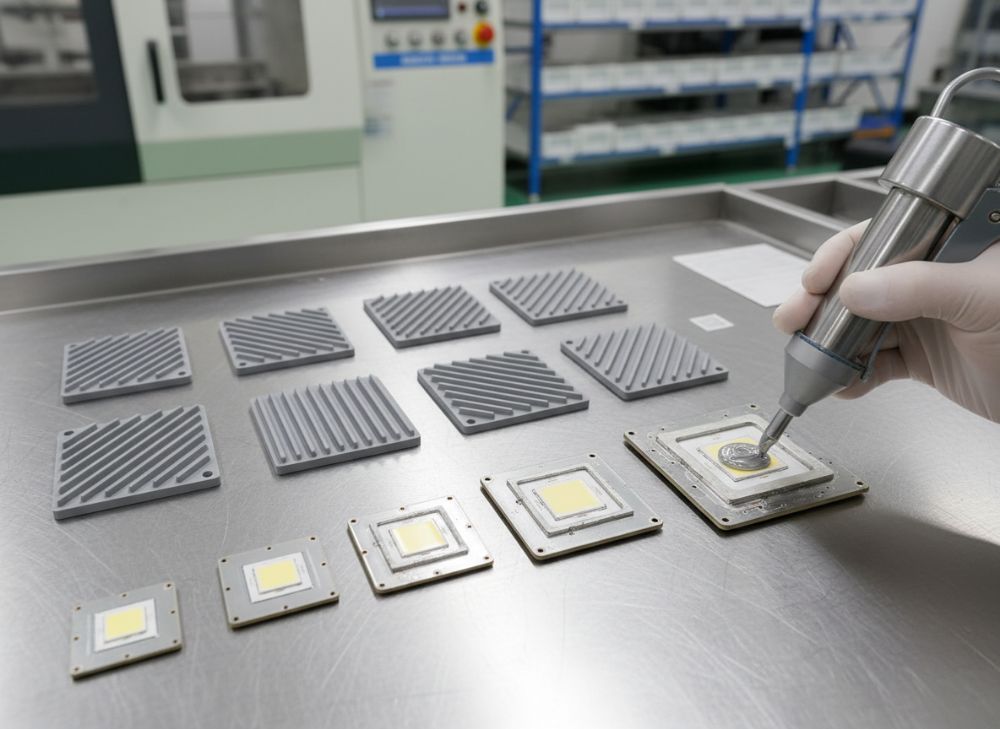
Thermal paste is a non-structural thermal interface material designed to fill microscopic air gaps between two mating surfaces, such as a processor and a heat sink. Its main job is to improve heat transfer by replacing insulating air with a thermally conductive compound. It does not normally hold parts together mechanically, so it is usually paired with clips, screws, springs, or brackets.
Thermal adhesive also transfers heat, but unlike paste, it adds bonding strength. It is typically used where the thermal interface must also secure the component. Depending on the chemistry, it may be a one-part or two-part system based on silicone, epoxy, acrylic, or polyurethane-modified formulations. Some thermal adhesives are electrically insulating; others are electrically conductive. Cure profile, hardness, bond strength, and thermal conductivity vary widely.
This difference sounds simple, but it changes the entire design logic. Paste is selected when maintenance and optimal contact pressure are available. Adhesive is selected when hardware reduction, faster assembly, vibration resistance, or design miniaturization are more important than easy disassembly.
Key Differences at a Glance
| Comparison Point | Thermal Adhesive | Thermal Paste | Why It Matters for U.S. Buyers |
|---|---|---|---|
| Primary function | Transfers heat and bonds parts | Transfers heat only | Determines whether extra fasteners are needed |
| Serviceability | Usually difficult or permanent | Easy to remove and replace | Important for maintenance-heavy industries |
| Assembly method | Often supports simplified, hardware-free assembly | Requires clips, screws, or retention frames | Affects labor time and bill of materials |
| Thermal performance ceiling | Good, but often below top pastes | Often excellent at thin bond lines | Critical for CPUs, GPUs, and dense power devices |
| Mechanical stability | Better for shock and vibration retention | Provides little or no structural hold | Useful in automotive and industrial equipment |
| Rework impact | Higher risk of scrap if removal is needed | Low rework cost | Influences warranty and field repair economics |
| Typical applications | LED modules, compact heat sinks, sensors | CPUs, GPUs, serviceable electronics | Guides fast product category selection |
This table shows why the material choice should be tied to assembly architecture rather than thermal conductivity alone. Many U.S. procurement teams initially compare only data sheet conductivity numbers, yet bond line thickness, clamping force, and required disassembly usually have a larger effect on real-world performance.
When Thermal Adhesive Is the Better Choice
Thermal adhesive is generally superior when a component must be bonded to a heat sink or metal substrate without screws, clips, brackets, or weld points. It is especially useful in LED lighting modules, small telecom modules, automotive sensors, battery management assemblies, and compact industrial controls. In these environments, engineers often need a material that holds the part in place despite thermal cycling and mechanical vibration.
Another reason U.S. manufacturers choose thermal adhesive is assembly simplification. Removing screws and brackets can shorten production time, reduce SKUs, and lower mechanical complexity. In high-volume factories, even a few seconds saved per unit can translate into substantial annual cost reductions. For consumer electronics and custom modules with limited enclosure space, adhesive attachment may be the only feasible design path.
However, the trade-off is permanence. Many epoxy-based thermal adhesives are hard to remove without damaging the substrate or component. This is acceptable in disposable or non-serviceable designs, but it is a serious drawback in repairable systems.
When Thermal Paste Is the Better Choice
Thermal paste remains the preferred choice for processors, graphics modules, power semiconductors, server hardware, and any product that benefits from maintenance access. Its advantage is not only thermal efficiency but also flexibility. Engineers can disassemble the assembly, clean the interface, and reapply the material during service or testing. This is why thermal paste dominates desktop computing, many embedded systems, and serviceable industrial electronics in the United States.
Paste also performs well where strong and even mechanical pressure can be maintained. In applications with proper clamping force, the paste forms a very thin interface layer, minimizing thermal resistance. That often gives it an edge over adhesives, which may cure to a thicker bond line. For buyers in sectors such as data center hardware, aerospace electronics prototyping, or test equipment, paste is usually the more adaptable material.
Common Product Types in the U.S. Market
| Product Type | Typical Chemistry | Best Use | Main Advantage | Main Limitation | Common U.S. End Users |
|---|---|---|---|---|---|
| Non-curing thermal paste | Silicone or synthetic oil with fillers | CPUs, GPUs, serviceable modules | Easy rework | No bonding strength | IT hardware assemblers, repair shops |
| One-part thermal adhesive | Silicone or moisture/heat cure system | Fast dispensing lines | Simplified process | Longer cure constraints in some cases | LED and electronics OEMs |
| Two-part thermal adhesive | Epoxy or acrylic system | Permanent bonded heat sinks | Strong bond | Mixing and pot life management | Industrial and automotive suppliers |
| Thermal gap filler gel | Silicone filled compound | Uneven surfaces, enclosures | Fills large tolerances | May need containment | Battery and power electronics makers |
| Thermal pad with adhesive face | Silicone pad with tacky surface | Simple assembly and insulation | Clean handling | Lower peak performance than paste | Contract manufacturers |
| Phase change thermal material | Wax/polymer filled TIM | Repeatable automated assembly | Controlled interface under heat | Specific operating window | Server and telecom hardware firms |
The U.S. market does not operate on a simple adhesive-versus-paste binary. Buyers also compare gels, pads, and phase change materials. Still, when the choice is narrowed to thermal adhesive versus thermal paste, most projects hinge on permanence, interface thickness, production method, and maintenance philosophy.
Buying Advice for U.S. Engineers and Procurement Teams
Start by asking whether the assembly must ever be opened. If the answer is yes, thermal paste should be your default candidate. If the answer is no, then evaluate whether adhesive can reduce hardware, labor, and vibration risk. Next, determine the real bond line thickness. A thermal paste under strong clamp pressure may outperform a high-conductivity adhesive if the adhesive cures at a thicker line.
You should also review the operating environment. Automotive under-hood assemblies in Michigan or Ohio need different thermal and mechanical stability than indoor networking hardware in Northern Virginia. Exposure to humidity, salt spray, oil vapor, frequent thermal cycling, or sustained high temperatures can change the preferred chemistry. Application method matters as well. A material that works in a laboratory may be unsuitable for automated dispense lines in a high-throughput factory near Chicago or Monterrey-linked North American supply chains.
Procurement teams should go beyond unit price and review total cost: packaging size, waste rate, dispensing compatibility, cure time, rework burden, shipping conditions, shelf life, and supplier responsiveness. In many cases, a lower-priced material becomes expensive if it introduces rejects or slows the line.
The bar chart highlights the industries where the thermal adhesive versus thermal paste decision matters most in the United States. EV electronics and data centers are especially influential because they combine high heat loads with stringent reliability requirements. In these sectors, engineers often use different thermal interface materials within the same product platform rather than forcing one material to do every job.
Industries and Typical Application Choices
| Industry | Typical U.S. Locations | Preferred Material | Typical Application | Selection Reason | Watch-Out Issue |
|---|---|---|---|---|---|
| Data centers | Northern Virginia, Texas, Oregon | Thermal paste | CPU and GPU cooling | High performance and serviceability | Pump-out over long cycles |
| Automotive electronics | Detroit, Ohio, Tennessee | Thermal adhesive | Sensors and control modules | Vibration resistance and compact assembly | Difficult field rework |
| LED lighting | California, North Carolina, Illinois | Thermal adhesive | LED board to heat sink bonding | Fast bonded installation | Cure consistency |
| Telecom equipment | Texas, Georgia, New Jersey | Mixed use | Power modules and RF assemblies | Different zones need different TIMs | Material compatibility |
| Industrial automation | Midwest, Pennsylvania, Carolinas | Mixed use | Drives, controllers, sensors | Balance of serviceability and robustness | Environmental exposure |
| Consumer electronics | California, Texas, import assembly networks | Thermal adhesive | Small heat sinks and modules | Reduced hardware and thin form factor | Warranty replacement cost |
This industry table shows that the right answer is often application-specific rather than product-specific. A telecom enclosure, for example, may use thermal adhesive for small bonded heat spreaders and thermal paste for serviceable processor modules in the same chassis.
Real-World Application Examples
Consider an LED streetlight project in Los Angeles. The design team may prefer thermal adhesive to bond aluminum-backed LED boards onto heat sinks because it reduces assembly hardware and helps survive vibration during installation and outdoor operation. By contrast, a cloud server assembly in Ashburn, Virginia almost certainly relies on thermal paste between processors and heat sinks because the parts must be removable for servicing, replacement, and validation testing.
In a Detroit-area EV electronics project, thermal adhesive may be selected for compact control modules where sensors or small heat spreaders must stay attached under vibration and thermal cycling. In a Phoenix semiconductor test fixture, thermal paste could be favored because fixtures are reworked frequently and thermal contact must remain repeatable. These examples show why asking “which is better” only makes sense after defining the application, service model, and assembly process.
Case Studies
A U.S. LED fixture assembler in the Midwest moved from screw-mounted heat sinks plus paste to a thermally conductive adhesive system for a compact retrofit module. The result was a lower part count, faster assembly, and fewer alignment issues. However, the company had to improve cure control and incoming inspection because mis-mixed two-part adhesive batches caused occasional thermal variation. The lesson was that adhesive can streamline assembly, but process discipline becomes more important.
A server hardware integrator in Texas evaluated thermal adhesive for a custom accelerator card but returned to thermal paste after pilot trials. While the adhesive reduced hardware complexity, it made thermal validation slower and rework more expensive. Because the cards required tuning and occasional field replacement, paste remained the better lifecycle fit. The lesson was that design simplification does not always outweigh service economics.
An industrial controls manufacturer in Pennsylvania adopted a mixed strategy: thermal adhesive for small internal heat spreaders that never require service, and thermal paste for power components mounted under removable clamps. This reduced total assembly cost without sacrificing maintainability. For many U.S. manufacturers, this mixed approach is the most realistic answer.
Top Suppliers Relevant to the United States
| Company | Service Region | Core Strengths | Key Offerings | Best Fit Buyer | Notes |
|---|---|---|---|---|---|
| Henkel | Nationwide U.S. support | Large technical network, broad thermal portfolio | BERGQUIST thermal materials, adhesives, gap fillers | Automotive, electronics, industrial OEMs | Strong qualification support |
| 3M | Nationwide U.S. distribution | Reliable branded materials, global supply capability | Thermal tapes, interface materials, specialty adhesives | Industrial and electronics manufacturers | Good for standardized sourcing |
| Parker Lord | U.S. industrial and automotive markets | Engineered adhesives and material expertise | Thermal management and structural bonding solutions | Transportation and industrial buyers | Strong in demanding environments |
| Master Bond | United States and export projects | Specialized formulations, engineering support | Thermal epoxies, electrically insulating adhesives | Aerospace, medical, specialty electronics | Useful for custom requirements |
| MG Chemicals | North American electronics channels | Accessible packaging, repair and OEM options | Thermal paste, adhesives, compounds | Maintenance teams, labs, smaller OEMs | Easy channel availability |
| Boyd / Aavid-linked channels | U.S. thermal management market | System-level cooling expertise | Heat sinks, interface materials, integrated solutions | OEMs seeking full thermal assemblies | Good for co-designed solutions |
| Dow | Nationwide and global electronics support | Silicone thermal materials, reliability | Thermal interface compounds and encapsulants | Electronics and mobility applications | Strong silicone chemistry base |
This supplier table is useful for shortlisting because it connects real company names with realistic buyer profiles. Large OEMs often prefer suppliers with broad technical support and qualification infrastructure, while smaller U.S. buyers may prioritize packaging flexibility, local distributor stock, and ease of purchasing.
Supplier Comparison by Selection Priorities
This comparison chart does not replace qualification testing, but it helps explain how U.S. buyers often segment the market. Large multinational suppliers score strongly on technical depth and product range, while channel-friendly brands may be more accessible for low-volume buyers, repair organizations, and prototype teams.
Detailed Analysis of Local and International Sourcing Options
U.S. buyers usually have three sourcing paths. The first is direct purchase from a major branded supplier with domestic technical support. This is the most common route for regulated, automotive, or qualification-heavy programs. The second is procurement through specialized distributors that can bundle heat sinks, interface materials, and application advice. This route can be efficient for design-build teams and contract manufacturers. The third is qualification of international manufacturers for private label, OEM, or cost-focused production. This route is increasingly important for buyers managing aggressive cost targets or seeking packaging customization.
International sourcing has become more viable because many overseas producers now operate with stronger process control, digital traceability, and internationally recognized compliance frameworks. For U.S. importers moving through Long Beach, Los Angeles, New York, Savannah, or Houston, landed cost can remain attractive when volumes are high and forecasting is stable. The key is to verify consistency, documentation quality, and responsiveness during qualification rather than relying on price alone.
Our Company
Qingdao QinanX New Material Technology Co., Ltd serves U.S. buyers as a professional adhesive manufacturer with a broad industrial portfolio that includes electronic silicone, epoxy systems, polyurethane adhesives, acrylic technologies, hot melt products, cyanoacrylates, water-based adhesives, and MS modified silane solutions, allowing thermal and adjacent assembly needs to be consolidated through one supplier. For buyers comparing thermally functional bonding materials with more traditional interface compounds, the company’s manufacturing discipline is supported by ISO-based operations, multi-stage quality control, digital traceability, and compliance with international requirements such as RoHS and REACH, which are practical proof points for electronics and industrial qualification. Its cooperation model is also flexible for the U.S. market: end users, distributors, dealers, brand owners, and even smaller specialty buyers can work through OEM, ODM, private label, wholesale, and custom packaging programs rather than a single rigid supply format. Backed by automated production lines, tailored formulation capability, exports to more than 40 countries, and round-the-clock technical assistance plus sample support, QinanX is positioned for long-term U.S. business relationships, helping customers move from trial to scale with pre-sale guidance, specification matching, and after-sales follow-up rather than acting like a distant transactional exporter. Buyers can explore the broader product lineup on the product page, review the company background on the about us page, or discuss a thermal bonding requirement directly through the contact page.
How to Evaluate a Supplier Before You Buy
| Evaluation Factor | What to Ask | Why It Matters | Good Sign | Risk Sign | Best For |
|---|---|---|---|---|---|
| Thermal data quality | Is conductivity tested under clear conditions? | Prevents misleading comparisons | Detailed test method disclosure | Only headline numbers | All buyers |
| Cure or application control | What are mixing, pot life, and cure windows? | Affects factory repeatability | Process guide provided | Vague processing advice | Adhesive buyers |
| Rework impact | Can the bonded part be removed safely? | Protects warranty economics | Application-specific recommendation | No discussion of removal | Serviceable products |
| Compliance package | Are RoHS, REACH, and SDS documents ready? | Supports procurement approval | Fast documentation response | Incomplete files | Regulated industries |
| Packaging flexibility | Are syringes, cartridges, pails, or private label options available? | Reduces waste and improves fit | Multiple pack formats | Single bulk-only option | OEMs and distributors |
| Technical support | Will the supplier help with trials and failures? | Speeds qualification | Responsive pre- and post-sale team | Slow generic replies | New programs |
| Supply stability | Can lead time and lot consistency be maintained? | Prevents production disruption | Traceability and QC evidence | Inconsistent batches | Volume buyers |
This evaluation framework is especially useful for U.S. distributors, contract manufacturers, and brand owners. Thermal materials can appear similar on paper, but supplier behavior during qualification often determines whether the project runs smoothly after launch.
Trend Shift Toward 2026
By 2026, three trends are likely to shape the thermal adhesive versus thermal paste market in the United States. The first is power density. AI computing, battery systems, and wide-bandgap power electronics are raising heat loads, forcing buyers to use more application-specific materials. The second is manufacturing efficiency. As labor costs stay high, adhesive systems that eliminate hardware or support automation will gain ground. The third is sustainability and policy pressure. OEMs will pay closer attention to VOC profiles, packaging waste, traceability, and compliance alignment across supply chains.
There is also a trend toward mixed-material design. Instead of asking a single material to handle every thermal challenge, engineers are combining paste, adhesive, pads, and gels across different zones of the same assembly. This is especially visible in EVs, renewable energy inverters, and telecom power systems.
The area chart shows a realistic increase in mixed thermal strategy adoption. This reflects the growing complexity of U.S. electronics assemblies and the declining usefulness of one-size-fits-all material decisions. For many 2026 programs, the real question will not be “thermal adhesive or thermal paste,” but “where should each material be used for the best lifecycle outcome?”
Future Outlook for Technology, Policy, and Sustainability
From a technology standpoint, the United States will see stronger demand for thermally conductive materials compatible with automated dispensing, low-bleed performance, controlled cure behavior, and reliability under harsh cycling. Electrification and AI infrastructure will reward suppliers that can provide repeatable processing data and application engineering, not just commodity pricing.
From a policy and compliance perspective, buyers will continue demanding clearer material disclosures, especially in electronics, automotive, and renewable energy supply chains. RoHS and REACH familiarity will remain important even for products assembled in the U.S., because many OEMs sell globally. Documentation readiness will become a competitive advantage.
On sustainability, pressure will increase around lower waste packaging, safer formulations, and longer product life. Thermal paste may benefit where repairability aligns with circular economy goals, while thermal adhesive may gain where it reduces hardware usage and assembly energy. The winning suppliers will be those that can quantify trade-offs and support customers with application-specific evidence.
FAQ
Is thermal adhesive stronger than thermal paste?
Yes. Thermal adhesive provides mechanical bonding, while thermal paste normally does not. Paste needs separate clamps or fasteners to hold parts together.
Does thermal paste cool better than thermal adhesive?
In many serviceable, tightly clamped applications, yes. Thermal paste often achieves lower thermal resistance because it forms a thinner interface layer. But real performance depends on surface flatness, pressure, and bond line thickness.
Can I replace thermal paste with thermal adhesive?
Only if permanent bonding is acceptable and the design does not require future disassembly. For CPUs, GPUs, or repairable power devices, replacing paste with adhesive is usually not recommended.
What is best for LED heat sinks in the United States?
Thermal adhesive is often the better choice for LED boards and compact heat sinks, especially when reducing hardware and simplifying assembly are priorities. Many U.S. lighting projects use adhesive-based bonding for exactly this reason.
What is best for computers and servers?
Thermal paste is generally best for computers, servers, and accelerator modules because those systems require maintenance, upgrades, and controlled rework.
Are imported thermal adhesives a good option for U.S. buyers?
They can be, especially when the supplier offers strong compliance documentation, consistent batch control, OEM or private-label flexibility, and responsive technical support. Cost-performance can be very attractive if qualification is handled properly.
Should buyers in the United States use one supplier for all thermal needs?
Not always. Some companies prefer one strategic supplier for qualification efficiency, while others use multiple vendors to match different product categories and reduce supply risk.
Final Takeaway
If you need removable, service-friendly thermal management, choose thermal paste. If you need thermal transfer plus permanent attachment, choose thermal adhesive. For many U.S. manufacturers, the smartest answer is a mixed strategy that uses each material where it creates the best balance of thermal performance, assembly efficiency, reliability, and lifecycle cost. In a market shaped by data centers, EVs, advanced electronics, and 2026 sustainability expectations, the best purchase decision is the one tied to actual operating conditions, production methods, and service obligations rather than a single headline conductivity number.

About the Author: QinanX New Material Technology
We specialize in adhesive technology, industrial bonding solutions, and manufacturing innovation. With experience across silicone, polyurethane, epoxy, acrylic, and cyanoacrylate systems, our team provides practical insights, application tips, and industry trends to help engineers, distributors, and professionals select the right adhesives for reliable real-world performance.

Product Category
You May Also Interest
-
IC Packaging Adhesive: Preventing Void Formation Issues
Learn how IC packaging adhesive void formation is prevented in the United States through material choice, process control, supplier selection, and testing.
-
Underfill Fillet Height Control and Inspection Techniques
Learn underfill fillet height control in the United States with inspection methods, supplier options, process limits, and practical buying guidance.
-
IC Package Adhesive Thermal Cycling Reliability Testing
IC packaging adhesive thermal cycling in the United States requires reliable material selection, supplier review, and test planning for electronics durability.
-

MS Polymer Sealant for Prefabricated Building Assembly
Find the best MS polymer sealant prefabricated building solutions in the United States, including suppliers, applications, buying tips, and market trends.
 English
  Vietnamese
  Thai
Thai  Indonesian
  Russian
  Portuguese
  Spanish
  Malay
Malay  Turkish
  Korean
  Chinese