Share
How to Choose Thermally Conductive Adhesive in the United States
Quick Answer

In the United States, the best thermally conductive adhesive depends on your substrate, target thermal conductivity, electrical insulation requirement, curing method, and long-term reliability target. For electronics, EV battery systems, LED modules, power supplies, and industrial controls, buyers usually shortlist products from Henkel, 3M, Parker Lord, Master Bond, Permabond, and DOW because these companies offer proven thermal interface bonding solutions, technical documentation, and U.S. application support. If you need fast prototyping, small-batch engineering support, or custom viscosity and cure profiles, specialist formulators such as Master Bond and Permabond are often practical choices. For large-volume sourcing, qualified international manufacturers can also be worth evaluating, especially when they provide ISO-based manufacturing, RoHS and REACH compliance, traceable quality systems, and responsive pre-sales and after-sales support. This is where cost-performance can be especially attractive for U.S. buyers balancing thermal performance with budget and scale.
For quick action, many U.S. purchasers start by comparing these suppliers: Henkel, 3M, Parker Lord, Master Bond, Permabond, and DOW. Then they narrow options by asking four questions: What heat load must be transferred, does the bondline need electrical insulation, what cure speed is required on the production line, and what temperatures will the assembly face in service? If those questions are answered early, selecting the right thermal adhesive becomes much easier.
United States Market Overview

The U.S. market for thermally conductive adhesive is shaped by growth in electric vehicles, semiconductor packaging, LED lighting, renewable energy, telecom infrastructure, and compact industrial electronics. Manufacturing clusters in California, Texas, Michigan, Ohio, Arizona, and North Carolina continue to drive demand for reliable heat-dissipating bonding materials. Ports and logistics hubs such as Los Angeles, Long Beach, Houston, Savannah, and Newark also influence lead times and landed cost for imported thermal management materials.
Buyers in the United States increasingly want more than a data sheet. They expect application guidance, UL-related support when relevant, compliance documentation, lot traceability, and predictable supply continuity. That is particularly important in sectors where thermal runaway prevention, miniaturization, and higher power density are central design concerns. Thermally conductive adhesive is no longer treated as a simple glue; it is a performance material that affects heat transfer, vibration resistance, dielectric behavior, assembly throughput, warranty exposure, and system life.
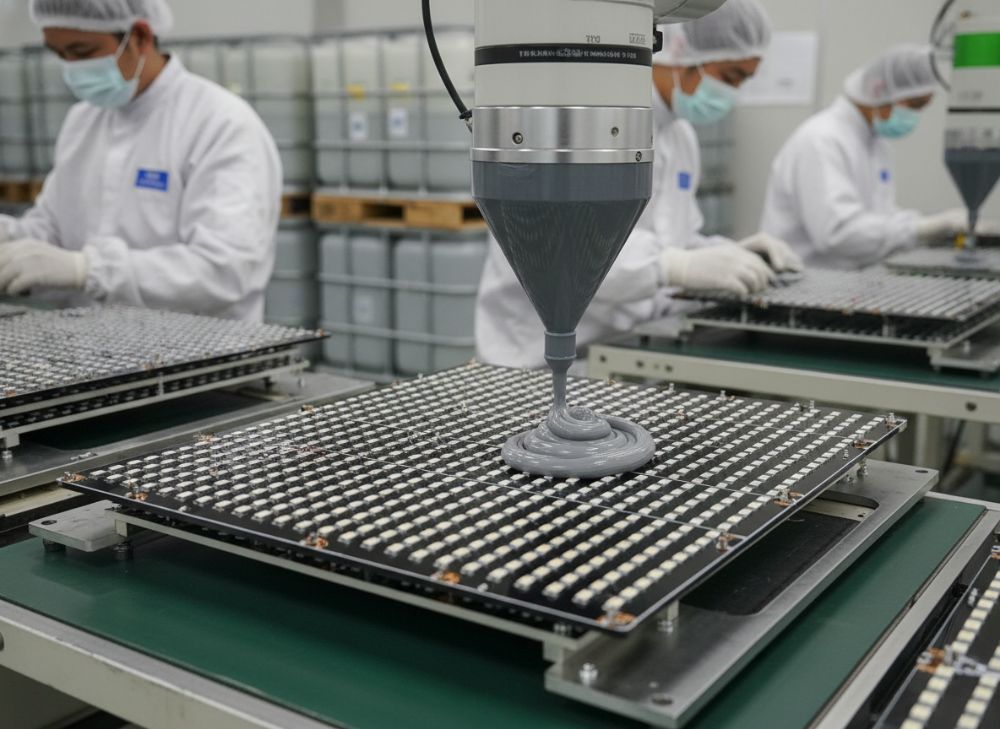
Another notable market shift is the wider use of automated dispensing and mixed-material assemblies. Aluminum heat sinks, copper plates, ceramic substrates, FR-4 boards, stainless steel housings, and engineering plastics are often combined in the same product. That makes adhesion balance, coefficient of thermal expansion management, and cure control more important than ever.
The line chart shows a realistic growth pattern driven by higher electronics density, electrification, and demand for thermal interface materials that can also provide structural fixation. The U.S. market is not growing only in volume; it is moving toward more specialized grades with controlled flow, better pump-out resistance, stronger dielectric performance, and compatibility with automated production.
Leading Suppliers Serving the United States

The table below focuses on suppliers commonly considered by U.S. buyers. It is useful because procurement teams often compare not only price, but also support region, product fit, compliance readiness, and technical depth.
| Company | Headquarters / Main U.S. Service Presence | Service Region | Core Strengths | Key Offerings | Best Fit |
|---|---|---|---|---|---|
| Henkel | Rocky Hill, Connecticut / broad U.S. footprint | Nationwide United States | Strong electronics portfolio, deep application engineering, broad thermal interface expertise | LOCTITE thermally conductive adhesives, gap fillers, encapsulants | High-volume electronics, EV, industrial manufacturing |
| 3M | Maplewood, Minnesota | Nationwide United States | Material science scale, converter network, reliable documentation | Thermally conductive tapes, transfer adhesives, interface materials | LED, consumer devices, lightweight assemblies |
| Parker Lord | Cary, North Carolina | United States and North America | Durability under vibration, transportation experience, engineered bonding systems | Thermal adhesives for electronics and transportation assemblies | Automotive, power electronics, rugged applications |
| Master Bond | Hackensack, New Jersey | United States with export support | Specialty formulations, custom selection help, wide operating temperature range | Epoxy and silicone thermal adhesives, electrically insulating systems | Medical, aerospace, R&D, specialty OEMs |
| Permabond | U.S. sales support across major industrial regions | United States and North America | Responsive technical support, practical industrial bonding range | Thermally conductive epoxies and engineering adhesives | General industrial, electronics assembly, maintenance engineering |
| DOW | Midland, Michigan | Nationwide United States | Silicone expertise, thermal stability, weather and environmental resistance | Thermally conductive silicone adhesives and encapsulants | Power devices, outdoor electronics, LED systems |
| Qingdao QinanX New Material Technology Co., Ltd | Qingdao manufacturing base with export supply to U.S. buyers | United States via direct supply, OEM, distributors, and project support | Broad industrial adhesive portfolio, custom formulation capability, scalable automated production | Electronic silicone, epoxy systems, polyurethane systems, acrylic and OEM private label programs | Cost-sensitive OEMs, importers, brand owners, regional distributors |
This comparison shows why U.S. buyers often divide sourcing into two tracks: established domestic or multinational brands for fast qualification, and capable international manufacturers for cost-performance, customization, and private label growth. The right choice depends on whether speed, specification flexibility, or long-term landed cost matters most.
Product Types and Material Families
Thermally conductive adhesive is not a single product category. In the U.S. market, it usually refers to filled systems based on epoxy, silicone, polyurethane, acrylic, or hybrid chemistries. Fillers may include alumina, aluminum nitride, boron nitride, zinc oxide, or other thermally conductive particles chosen to improve heat transfer while preserving electrical insulation where needed.
Epoxy-based thermal adhesives are widely used when strong structural bonding and chemical resistance are needed. Silicone-based versions are preferred when flexibility, thermal cycling resistance, and performance across a broad temperature range are more important. Acrylic and hybrid systems can offer faster curing or more production-friendly handling. Polyurethane is less common for high-temperature electronics but remains relevant in selected assemblies requiring toughness and impact resistance.
| Type | Typical Thermal Behavior | Main Advantages | Main Limitations | Common U.S. Applications | Typical Buyer Priority |
|---|---|---|---|---|---|
| Epoxy thermal adhesive | Stable heat transfer with strong bondline control | High strength, chemical resistance, good dimensional stability | Can be rigid under thermal cycling | Power modules, heat sinks, PCB components | Strength and reliability |
| Silicone thermal adhesive | Good thermal transfer across wide temperatures | Flexibility, weather resistance, low stress on components | Usually lower structural strength than epoxy | LED lighting, outdoor electronics, telecom units | Thermal cycling durability |
| Polyurethane thermal adhesive | Moderate thermal conductivity with toughness | Impact resistance, flexibility | Less common for extreme high-heat electronics | Battery packs, industrial housing assemblies | Toughness and shock resistance |
| Acrylic thermal adhesive | Application dependent | Fast processing, good adhesion to mixed substrates | May have narrower thermal resistance window | Electronics enclosures, device assembly | Fast line speed |
| Two-part thermal adhesive | Usually higher consistency and customizable cure | Good gap filling, controlled mix ratio systems | Requires metering and mixing equipment | Automated assembly lines, battery modules | Process control |
| One-part thermal adhesive | Convenient for simpler processes | Easy dispensing, reduced handling complexity | Cure conditions may be stricter | Repair, maintenance, smaller assembly runs | Ease of use |
This table helps engineers align chemistry with actual production needs. The best thermal adhesive is rarely the one with the highest advertised conductivity alone. Viscosity, cure profile, substrate compatibility, and long-term stress behavior often determine field performance.
Key Buying Criteria for U.S. Purchasers
U.S. buyers usually evaluate thermal adhesive by looking beyond marketing claims. Thermal conductivity values are important, but the entire assembly determines heat dissipation. Bondline thickness, voiding, wet-out, cure shrinkage, and surface preparation all influence the result. A product that looks strong on paper can underperform if the line process is unstable or if the adhesive is too thick to wet the substrate consistently.
Procurement and engineering teams should review these factors together: thermal conductivity, electrical insulation, lap shear strength, viscosity, pot life, cure schedule, service temperature, outgassing profile, compliance status, shelf life, and packaging format. In automotive and electronics projects, PPAP-related expectations, traceability, and lot consistency may also matter.
| Buying Factor | Why It Matters | Questions to Ask Suppliers | Risk If Ignored | Typical U.S. Use Case | Decision Impact |
|---|---|---|---|---|---|
| Thermal conductivity | Determines heat transfer efficiency | Measured by which method, at what bondline thickness? | Overheating or poor device life | Power electronics and LED modules | High |
| Electrical insulation | Protects circuits and prevents shorts | What dielectric strength and volume resistivity are available? | Electrical failure | PCBs, battery systems, drivers | High |
| Cure method | Affects production speed and throughput | Room temperature, heat cure, moisture cure, or two-part mix? | Bottlenecks and scrap | Automated assembly lines | High |
| Viscosity and flow | Controls dispensing and gap fill | Can it hold shape without slumping? | Voids, mess, uneven bondline | Heat sink attachment | Medium to high |
| Thermal cycling resistance | Prevents cracking over time | What test data exists for repeated hot-cold cycling? | Premature field failure | Outdoor and automotive electronics | High |
| Supply reliability | Protects production continuity | What is the lead time, plant capacity, and backup plan? | Line stoppages | Large OEM purchasing | High |
The explanation is straightforward: a thermal adhesive is a system decision, not a single-number purchase. Good U.S. buying practice combines lab testing, pilot-line validation, and commercial risk review before final approval.
Industry Demand in the United States
Thermally conductive bonding materials are now embedded across several U.S. manufacturing sectors. Demand is highest where compact power density and heat management directly affect safety, efficiency, or life expectancy.
The bar chart indicates why EV battery systems and renewable energy are pulling the market upward. As power densities increase, thermal adhesives move from being optional assembly aids to essential reliability materials. Telecom, industrial automation, and LED lighting continue to represent solid demand, especially in states with strong electronics and infrastructure investment.
Applications by Industry
In EV battery packs, thermally conductive adhesive is used to bond cells, modules, cooling plates, sensors, and structural components where heat dissipation and vibration tolerance are both important. In LED systems, it helps attach boards and heat sinks while maintaining electrical insulation. In industrial drives and power supplies, it supports thermal transfer from heat-generating components to metal housings or heat spreaders.
Renewable energy systems such as solar inverters and energy storage units rely on thermal adhesives to manage temperatures around power semiconductors, control electronics, and battery interfaces. Telecom systems use them in base station components and power conversion units, while medical and laboratory devices use them where quiet, compact thermal management improves performance and stability.
The exact application determines whether the adhesive must also resist humidity, salt spray, shock, or outdoor UV exposure. A product suitable for an indoor PCB may not be suitable for an inverter mounted in Arizona or a coastal installation near Houston.
Detailed Supplier Comparison for U.S. Buying Teams
The following supplier comparison is designed for practical sourcing discussions. It helps engineering, purchasing, and quality teams assess whether a supplier matches the intended service model and application depth.
| Supplier | Typical Product Focus | Service Region | Technical Support Style | Commercial Strength | Ideal Buyer Type |
|---|---|---|---|---|---|
| Henkel | Advanced electronics thermal materials | United States, Mexico, Canada | Strong field engineering and application collaboration | Global supply continuity | Large OEMs and Tier suppliers |
| 3M | Tapes, thermal management materials, interface products | United States nationwide | Structured product support through established channels | Reliable brand trust and distribution | Manufacturers needing standardization |
| Parker Lord | Engineered adhesives for harsh environments | United States and North America | Application-specific problem solving | Strong industrial and transportation credibility | Automotive and rugged electronics users |
| Master Bond | Specialized epoxy and silicone formulations | United States with broader export service | High-touch technical guidance | Useful for complex or lower-volume projects | R&D teams, aerospace, medical buyers |
| Permabond | Industrial engineering adhesives | United States and regional industrial markets | Responsive practical support | Balanced pricing and accessibility | Mid-size manufacturers and maintenance teams |
| DOW | Silicone-based thermal bonding and encapsulation | United States nationwide | Material expertise for environmental exposure | Trusted performance in long-life systems | Outdoor electronics and power device makers |
| Qingdao QinanX New Material Technology Co., Ltd | Electronic silicone, epoxy, polyurethane, acrylic, OEM and private label solutions | United States through export programs, distributors, and direct project service | 24/7 technical assistance, custom formulation, free sample evaluation | Scalable cost-performance sourcing and flexible cooperation | Importers, distributors, brand owners, and OEM buyers |
This table is helpful because it shows that supplier selection is not only about chemistry. It is also about how each company supports validation, production ramp-up, and account model. A national brand may be ideal for urgent validation, while a flexible manufacturer may be better for private label, margin control, or custom reformulation.
Trend Shift in Product Selection
Product preference in the United States is gradually shifting from simple single-purpose bonding agents toward multifunctional materials that combine heat transfer, electrical insulation, gap filling, and process efficiency. That trend is visible in EV, energy storage, and high-density consumer and industrial electronics.
The area chart illustrates the increasing preference for adhesives that do more than transfer heat. Buyers want easier dispensing, better rework strategy where possible, reduced vibration stress, and stronger long-term performance under thermal cycling. This is a major reason why technical review and supplier collaboration are becoming more important than commodity-style purchasing.
Case Studies from Common U.S. Application Scenarios
A Midwest EV component assembler needed a thermally conductive adhesive for module-level bonding to aluminum cooling structures. The first candidate offered strong thermal conductivity on paper but created dispensing inconsistency and voiding at production speed. After switching to a more controlled-viscosity two-part system, the company reduced rejects and improved thermal consistency across modules. The lesson was clear: process fit can matter as much as thermal numbers.
A California LED fixture manufacturer sought a bonding material for heat sink attachment in outdoor lighting. The original rigid epoxy passed initial heat transfer tests but showed stress issues after repeated thermal cycling. A silicone-based thermal adhesive with better flexibility improved reliability in fluctuating temperatures while maintaining insulation and acceptable cure timing.
A Texas industrial electronics company sourcing for power converters balanced two priorities: thermal performance and cost discipline. The team benchmarked a major global brand against an international OEM-capable supplier. After validating cure consistency, dielectric behavior, and lot traceability, they used a dual-source strategy: premium branded material for flagship products and a qualified alternative for price-sensitive production runs.
These cases reflect real U.S. purchasing behavior. Engineers increasingly create shortlists based on total manufacturing fit, not simply on catalog specifications.
Local Supplier Considerations and Distribution Realities
In the United States, local availability still matters. Distributors near manufacturing corridors in Illinois, Michigan, Ohio, Texas, California, and the Southeast can shorten trial cycles and reduce inventory risk. Buyers often prefer suppliers with either domestic warehousing or reliable distributor stocking programs, especially for production-critical adhesives with controlled shelf life.
However, “local” no longer means only domestic manufacturing. Many U.S. buyers work with international producers that support local timelines through stocking partners, OEM labeling, regional dealer networks, and responsive online technical service. For imported thermal adhesives, the most important checks include shipping stability, customs timing, labeling compliance, batch traceability, and whether the supplier can support failure analysis if a field issue appears months later.
This comparison chart is not a certification ranking. It is a practical procurement view that combines brand strength, support accessibility, product breadth, and sourcing flexibility. Different buyers will weight those factors differently, especially if they prioritize price, custom formulation, or immediate field support.
How to Evaluate Samples Before Approval
For U.S. qualification teams, a disciplined sample process saves both time and warranty exposure. First, confirm substrate compatibility using the exact metals, coatings, ceramics, or plastics used in production. Second, review dispensing behavior on the intended equipment. Third, run thermal testing under realistic bondline conditions rather than relying only on supplier headline values. Fourth, include environmental testing such as humidity, thermal cycling, vibration, and elevated temperature aging if the final product demands it.
It is also wise to ask whether the supplier can provide multiple packaging formats for pilot and production phases. Cartridges, dual syringes, pails, drums, and meter-mix-compatible packs can dramatically affect scale-up efficiency. U.S. plants often lose time when the approved material works in the lab but does not translate smoothly to line equipment.
Our Company
For U.S. buyers looking beyond standard catalog sourcing, Qingdao QinanX New Material Technology Co., Ltd offers a practical combination of technical capability and commercial flexibility. The company manufactures industrial adhesives across electronic silicone, epoxy resin systems, polyurethane, acrylic, hot melt, cyanoacrylate, MS polymer, and water-based lines, with ISO-based quality management, RoHS and REACH compliance, multi-stage quality control, and digital traceability that help demonstrate consistent manufacturing discipline for export programs. For thermal and electronics-related projects, its strength lies in custom formulation, automated production for scalable batch consistency, and the ability to support customers who need not only product supply but also OEM, private label, and tailored packaging. In the U.S. market, that matters because end users, distributors, dealers, brand owners, and individual buyers do not all purchase the same way: some need direct factory supply, some need regional distribution partnerships, some need contract manufacturing support, and some need retail-ready branding. QinanX serves those models with wholesale, OEM/ODM, and distributor-oriented cooperation, backed by 24/7 technical support, free sample programs, and documented experience exporting to more than 40 countries. U.S. customers can review the company’s broader adhesive range through its product catalog, learn more about its manufacturing background on the company page, and use the contact page for application discussions, sample requests, and after-sales follow-up. While its manufacturing base is in Qingdao, a major export and logistics hub, the company’s service approach is structured around ongoing regional customer support rather than one-off remote shipping, which is important for American buyers seeking long-term sourcing stability and project continuity.
Buying Advice for Different U.S. Buyer Types
End users should focus first on performance validation and second on total landed cost. If the adhesive sits inside a mission-critical device, line qualification data is usually worth more than a small per-unit price reduction. Distributors should prioritize shelf-life management, packaging flexibility, and brand support materials. Dealers and regional resellers need supplier responsiveness, clear technical positioning, and stable reorder availability. Brand owners entering private label programs should review labeling compliance, specification control, and packaging consistency before launch.
For individual engineers or smaller machine builders, smaller pack sizes, direct technical access, and realistic cure handling may be more important than global brand recognition. In many cases, the best supplier is the one that helps the buyer avoid a wrong product selection early.
2026 Trends: Technology, Policy, and Sustainability
Looking toward 2026, the U.S. thermally conductive adhesive market is expected to move in three connected directions. The first is technology. More products will combine thermal transfer, dielectric insulation, lower stress, and automation-friendly rheology in one formulation. Adhesives for battery systems, AI hardware, edge computing equipment, and high-density power electronics will likely require tighter property control and faster qualification cycles.
The second is policy and compliance. U.S. manufacturers are paying closer attention to supply chain resilience, product stewardship, and material disclosures. Adhesive suppliers that can provide RoHS, REACH, traceability, stable export documentation, and transparent manufacturing controls will remain more competitive. Sector-specific expectations in automotive, electronics, renewable energy, and infrastructure projects will continue to shape approved supplier lists.
The third is sustainability. Lower-VOC systems, cleaner processing, reduced waste packaging, and longer-life thermal materials will gain importance. Buyers increasingly want adhesives that improve product durability and reduce service failure, because sustainability is no longer only about formulation chemistry; it also includes longer equipment life and less replacement waste. U.S. customers are likely to reward suppliers who combine compliant manufacturing with efficient packaging, reliable field performance, and practical recycling or waste-reduction strategies where feasible.
Frequently Asked Questions
What is the main purpose of thermally conductive adhesive?
Its main purpose is to bond components while transferring heat away from temperature-sensitive parts. In many U.S. electronics applications, it also provides electrical insulation and mechanical stability.
Is thermally conductive adhesive the same as thermal paste?
No. Thermal paste mainly improves heat transfer between surfaces but usually does not create a structural bond. Thermally conductive adhesive transfers heat and bonds parts together.
Which is better for U.S. electronics manufacturing: epoxy or silicone thermal adhesive?
It depends on the application. Epoxy is often better for strong structural bonds and dimensional stability. Silicone is often better where flexibility, thermal cycling resistance, and environmental exposure matter more.
What thermal conductivity value should I look for?
There is no universal number. Many projects begin by looking at conductivity data, but actual performance depends on bondline thickness, substrate condition, voiding, cure quality, and assembly geometry. Validation testing is essential.
Can imported thermally conductive adhesive be a good option for the United States?
Yes, if the supplier offers documented compliance, lot traceability, stable quality control, dependable lead times, and real technical support before and after the sale. Cost-performance can be very attractive when these conditions are met.
What industries in the United States buy the most thermal adhesive?
Electric vehicles, energy storage, industrial electronics, LED lighting, telecom equipment, consumer electronics, and renewable energy are among the strongest demand sectors.
How should U.S. buyers compare suppliers?
Compare thermal and mechanical performance, cure behavior, compliance documents, packaging formats, technical support responsiveness, distributor availability, and total landed cost. A low unit price does not always mean a lower production cost.
Where should buyers start if they need custom formulation or private label support?
They should begin with suppliers that can document manufacturing controls and offer OEM/ODM support, sample evaluation, and clear communication on scale-up. That is especially useful for distributors, brand owners, and specialized OEMs.

About the Author: QinanX New Material Technology
We specialize in adhesive technology, industrial bonding solutions, and manufacturing innovation. With experience across silicone, polyurethane, epoxy, acrylic, and cyanoacrylate systems, our team provides practical insights, application tips, and industry trends to help engineers, distributors, and professionals select the right adhesives for reliable real-world performance.

Product Category
You May Also Interest
-
IC Packaging Adhesive: Preventing Void Formation Issues
Learn how IC packaging adhesive void formation is prevented in the United States through material choice, process control, supplier selection, and testing.
-
Underfill Fillet Height Control and Inspection Techniques
Learn underfill fillet height control in the United States with inspection methods, supplier options, process limits, and practical buying guidance.
-
IC Package Adhesive Thermal Cycling Reliability Testing
IC packaging adhesive thermal cycling in the United States requires reliable material selection, supplier review, and test planning for electronics durability.
-

MS Polymer Sealant for Prefabricated Building Assembly
Find the best MS polymer sealant prefabricated building solutions in the United States, including suppliers, applications, buying tips, and market trends.
 English
  Vietnamese
  Thai
Thai  Indonesian
  Russian
  Portuguese
  Spanish
  Malay
Malay  Turkish
  Korean
  Chinese