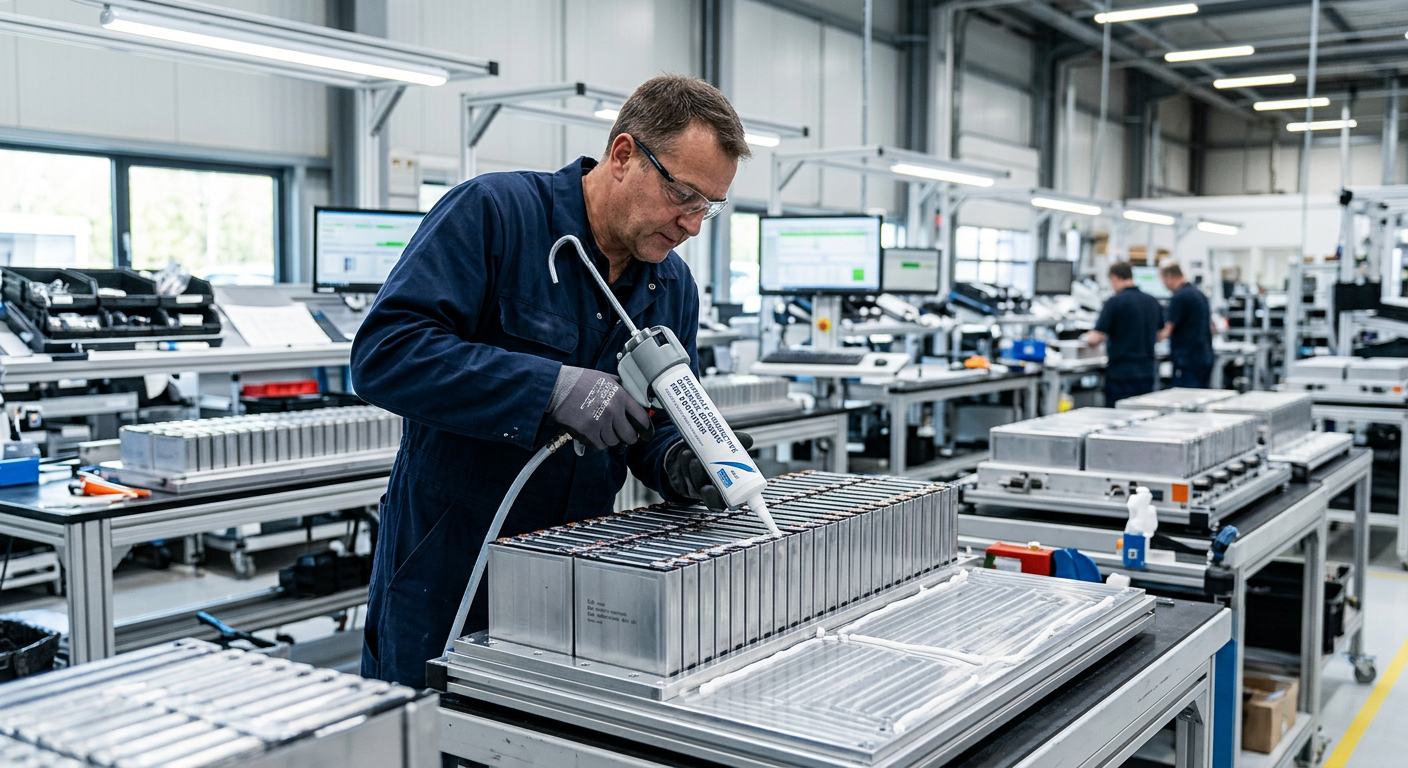
Share
Best Thermal Conductive Silicone Adhesive EV Suppliers in the United States
Quick Answer

If you need thermal conductive silicone adhesive EV solutions in the United States, the most practical shortlist includes Henkel, DuPont, Dow, Parker Lord, and MG Chemicals because these companies have established technical support, recognized materials portfolios, and proven use across EV battery pack, module, and power electronics assembly. For buyers focused on pack-level thermal management, gap filling, bonding stability, vibration resistance, and scalable production support, these suppliers are among the strongest starting points for RFQs, validation trials, and compliance review.
For U.S. buyers, Henkel is often favored for broad EV manufacturing integration, Dow for silicone chemistry depth and electronics reliability, DuPont for advanced materials engineering, Parker Lord for structural and transportation-grade bonding expertise, and MG Chemicals for accessible industrial and electronics-focused procurement. Qualified international suppliers can also be worth evaluating, especially when they offer RoHS and REACH compliance, ISO-based production systems, export experience, and strong pre-sales and after-sales support. In that context, a cost-performance-driven Chinese manufacturer with custom formulation capability can be a practical option for battery manufacturers, distributors, private-label brands, and regional importers serving the U.S. market.
United States EV Adhesive Market Overview

The United States has become one of the most active markets for EV battery materials, driven by battery gigafactory investments, domestic assembly expansion, and rapid development across states such as Michigan, Tennessee, Georgia, Texas, Ohio, Nevada, and California. As EV production scales, thermal interface and thermal bonding materials are no longer niche consumables; they are now critical process inputs for battery safety, charging performance, energy density, and warranty control. Thermal conductive silicone adhesive EV products are increasingly specified not only by cell and module manufacturers but also by Tier 1 integrators, battery enclosure fabricators, charging system manufacturers, and energy storage companies that share similar thermal management requirements.
In practical purchasing terms, U.S. demand is influenced by several factors: thermal conductivity targets, dielectric behavior, pump-out resistance, cure profile, automation compatibility, UL-related safety expectations, outgassing control, and supply continuity. Buyers around Detroit, Austin, Fremont, Atlanta, and Phoenix often evaluate suppliers based on local technical response time and whether the adhesive can support both prototyping and serial production. Because U.S. production lines place high importance on repeatability, traceability, and EHS documentation, suppliers that can provide TDS, SDS, batch traceability, and application engineering support are better positioned to win contracts.
Another market dynamic is logistics. Ports such as Los Angeles, Long Beach, Savannah, Houston, and New York-New Jersey matter for imported raw materials and finished industrial adhesives. Domestic warehousing and regional fulfillment can reduce safety stock pressure for OEMs and contract manufacturers. This is especially relevant for EV programs, where a delayed adhesive approval or stockout can disrupt battery module assembly and validation timing. As a result, procurement teams increasingly prefer suppliers that combine chemistry expertise with dependable inventory planning and technical collaboration.
Market Growth Trend

The chart below illustrates a realistic growth pattern for the U.S. market segment related to thermally conductive silicone adhesive EV applications, tracking estimated market demand growth alongside increasing EV battery manufacturing activity.
Top Suppliers in the United States
The supplier landscape in the United States includes multinational chemical companies, transportation-focused adhesive specialists, and electronics material providers. The table below helps narrow the field based on service region, core strengths, and key offerings relevant to EV battery thermal management.
| Company | Headquarters / U.S. Presence | Service Region | Core Strengths | Key EV-Related Offerings | Best Fit Buyers |
|---|---|---|---|---|---|
| Henkel | Strong U.S. industrial footprint | Nationwide United States | Automotive integration, broad LOCTITE portfolio, process engineering support | Thermal interface materials, silicone-based gap fillers, bonding and sealing systems | OEMs, battery pack manufacturers, Tier 1 suppliers |
| Dow | Major U.S. materials operations | United States and North America | Deep silicone chemistry expertise, electronics reliability, scalable supply | Thermally conductive silicones, encapsulants, potting and sealing materials | Battery module producers, electronics integrators |
| DuPont | Extensive U.S. manufacturing and technical base | United States and global automotive programs | Advanced materials R&D, multi-material engineering, compliance support | Thermal management materials, dielectric solutions, specialty adhesives | EV platforms, engineering-led sourcing teams |
| Parker Lord | Established U.S. transportation sector presence | United States with automotive reach | Transportation bonding, vibration management, structural durability | Adhesives for structural joining, thermal management, shock-resistant assembly | Vehicle assemblers, enclosure makers, mobility suppliers |
| MG Chemicals | North American distribution network | United States and Canada | Electronics materials accessibility, distributor availability, practical batch sizing | Thermally conductive compounds, silicones, potting and encapsulation products | Prototype teams, smaller manufacturers, MRO buyers |
| Master Bond | U.S.-based specialty adhesive producer | United States and export markets | Application-specific formulation, engineered specialty chemistries | Thermal adhesives, electrically insulating compounds, custom systems | Niche engineering projects, custom performance requirements |
This supplier table is useful because it separates broad industrial leaders from more specialized providers. Henkel, Dow, and DuPont are often shortlisted for high-volume programs where documentation, validation support, and line integration matter as much as adhesive performance. Parker Lord is especially relevant where vibration and structural duty combine with thermal needs. MG Chemicals and Master Bond can be very practical where lead time, prototype support, or custom formulation flexibility matter more than a massive global procurement framework.
Types of Thermal Conductive Silicone Adhesive for EV Use
Not every product labeled as a thermal silicone adhesive fits the same EV application. In battery manufacturing, buyers should distinguish between true bonding adhesives, gap fillers, potting compounds, structural-thermal hybrids, and dispensable sealants. Selecting the wrong type can create assembly defects, weak thermal pathways, difficult rework conditions, or poor long-term durability under vibration and thermal cycling.
| Product Type | Main Function | Typical Thermal Conductivity | Common EV Applications | Advantages | Selection Note |
|---|---|---|---|---|---|
| One-part silicone adhesive | Bonding and sealing | 0.8 to 2.5 W/m·K | Sensor fixation, cover bonding, light thermal transfer zones | Easy processing, simplified dispensing, reduced mixing error | Check cure speed and depth for enclosed assemblies |
| Two-part silicone adhesive | Controlled bonding with better cure consistency | 1.5 to 4.0 W/m·K | Battery modules, housing assemblies, power electronics | More consistent curing, tunable performance, automation friendly | Verify mix ratio control and pot life |
| Thermal gap filler silicone | Heat transfer across uneven surfaces | 2.0 to 6.0 W/m·K | Cell-to-cooling plate interfaces, module interfaces | Fills tolerances well, low stress on components | Not always designed for structural bonding |
| Silicone potting compound | Encapsulation and thermal protection | 1.0 to 3.5 W/m·K | BMS electronics, junction boxes, connectors | Environmental protection, dielectric insulation, shock resistance | Review reworkability and viscosity carefully |
| Structural thermal adhesive | Mechanical joining plus heat transfer | 1.0 to 3.0 W/m·K | Pack frame parts, thermal-mechanical assemblies | Reduces fasteners, supports lightweighting | Confirm shear strength and crash-related performance |
| Dispensable silicone sealant | Sealing with moderate heat dissipation | 0.7 to 2.0 W/m·K | Battery covers, ingress protection seams, charging units | Good weatherability, flexible sealing, vibration tolerance | Best when sealing is primary and heat transfer is secondary |
This comparison matters because procurement teams often receive data sheets that highlight thermal conductivity alone, while the real decision should involve adhesion to aluminum, coated steel, copper, engineering plastics, and composite housings. In EV assemblies, process details such as vertical sag resistance, cure shrinkage, and dielectric strength can be just as important as bulk heat transfer numbers.
Industry Demand by Application Segment
Demand is not evenly distributed across the EV value chain. Battery packs remain the largest driver, followed by power electronics, onboard charging systems, and adjacent energy storage systems. The chart below shows a realistic comparison of demand intensity in the U.S. market.
Buying Advice for U.S. EV Adhesive Buyers
When sourcing thermal conductive silicone adhesive EV materials in the United States, the smartest approach is to start from the application, not the catalog. A battery cell fixing application may need a soft material with thermal transfer and dielectric insulation, while a module frame assembly may need stronger adhesion and better mechanical retention. Always begin with substrate list, bond line thickness, expected thermal path, operating temperature range, exposure to coolant or moisture, and required dispensing method.
U.S. buyers should also demand documentation that supports validation. Typical checkpoints include TDS and SDS review, lot traceability, storage and shelf life data, cure profile, flame and dielectric considerations, compression behavior, and test data for thermal cycling. For pilot-to-production transitions, it is wise to ask whether the supplier can keep viscosity and cure behavior stable across larger volume batches. A product that works in a lab can still fail on an automated bead dispensing line if rheology shifts too much.
Commercial terms matter too. Some U.S. manufacturers prefer local stocking in Midwest or Southeast distribution corridors to support automotive plants, while others accept imported supply if the supplier can guarantee consistent lead times through ports such as Savannah or Long Beach. Buyers should also compare the level of application engineering. An adhesive supplier that helps optimize dispensing speed, bead geometry, cure timing, and rework strategy often creates more real value than a supplier with a marginally better thermal number on paper.
| Buying Factor | Why It Matters | Questions to Ask | Risk If Ignored | Best Practice | Typical U.S. Buyer Priority |
|---|---|---|---|---|---|
| Thermal conductivity | Determines heat transfer efficiency | At what bond line and test method? | Hot spots, lower battery life | Compare test methods, not headline numbers only | Very high |
| Adhesion to substrates | Affects long-term assembly stability | Tested on aluminum, steel, coated metals, plastics? | Delamination and vibration failure | Request substrate-specific test data | Very high |
| Dielectric properties | Important around battery and electronics systems | What insulation and dielectric strength values apply? | Electrical safety issues | Match to pack electrical architecture | High |
| Cure profile | Impacts throughput and assembly sequence | What is tack-free time, full cure time, heat assist option? | Line bottlenecks, inconsistent bonding | Trial on actual line conditions | High |
| Dispensing behavior | Controls automation efficiency | What viscosity window and pump compatibility apply? | Stringing, voids, poor repeatability | Run production-mimic trials | High |
| Supply support | Protects production continuity | Is local stock or forecast planning available? | Plant stoppage, expensive emergency sourcing | Align forecast and safety stock with supplier | Very high |
This buying table works as a sourcing checklist. It helps procurement, quality, and process engineering teams align on decision criteria before samples are approved. In the U.S. market, cross-functional alignment is especially important because battery material choices affect safety, warranty exposure, and throughput at the same time.
Industries and Applications
Although EV battery packs are the headline use case, thermally conductive silicone adhesive materials support a much wider group of industries in the United States. These include electric buses, commercial fleet electrification, two-wheel mobility, rail electronics, charging infrastructure, industrial automation, renewable energy storage, and high-power consumer electronics. The core reason is similar across all of them: compact systems generate heat, and that heat must be managed without sacrificing electrical insulation, vibration resistance, or manufacturability.
In automotive and transportation, these adhesives are commonly used for bonding thermal pads, sealing housings, fixing sensors, securing cooling system interfaces, and protecting battery-related electronics. In charging infrastructure, they help manage heat in power modules and control assemblies exposed to outdoor environments. In stationary energy storage, similar materials support pack-level safety and long-cycle durability, especially where large-format lithium systems face repeated thermal load changes.
Applications differ by geometry. Some projects require a thin bond line with precise bead control around enclosures. Others need a thicker, compliant interface between uneven surfaces such as a module base and a cooling plate. In electronics areas, low-modulus silicone systems are often preferred to reduce stress on delicate components while still conducting heat away from hotspots. That is why product selection should always be tied to the actual mechanical and thermal design, not just the market label.
Trend Shift in Material Selection
The market is gradually shifting from simple seal-and-bond materials toward multifunctional solutions that combine thermal management, dielectric insulation, lightweighting support, and process automation. The area chart below shows this realistic trend shift in the United States.
Case Studies and Practical Scenarios
A practical U.S. case is a battery module integrator in Michigan that needed a silicone-based thermal adhesive with reliable adhesion to anodized aluminum and coated steel while maintaining electrical insulation. The initial candidate offered strong thermal conductivity on paper, but dispensing inconsistency caused air entrapment and local heat buildup during testing. After switching to a lower-sag, more automation-friendly formulation with better rheology control, the line achieved more uniform bond lines and reduced rework. This is a common lesson in EV adhesive procurement: process stability can be as important as material properties.
Another realistic scenario comes from Texas, where a charging equipment manufacturer needed weather-resistant thermal silicone materials for power electronics enclosures. The key challenge was balancing outdoor durability with heat dissipation in hot climate conditions. A silicone system with stable performance under thermal cycling and moisture exposure proved more suitable than a harder alternative that created stress at interfaces. For buyers in southern U.S. climates, temperature fluctuation and environmental sealing often need to be reviewed together rather than separately.
A third example is from California, where a prototype EV startup needed faster sourcing cycles and lower MOQ options while preparing pilot builds. In that case, a supplier with practical technical support and flexible packaging sizes offered more value than a large-volume-only producer. This kind of situation explains why the supplier base in the United States includes both major multinational materials companies and smaller specialty providers. The right partner depends on whether the buyer is scaling a gigafactory line, qualifying a niche powertrain component, or preparing a private-label industrial materials program.
Local and International Supplier Comparison
U.S. buyers often compare domestic sourcing convenience with imported cost-performance. The right decision depends on project stage, validation burden, stock strategy, and whether custom formulation is required.
| Supplier Option | Typical Advantage | Possible Limitation | Best Use Case | Service Region | Commercial Fit |
|---|---|---|---|---|---|
| Large U.S. multinational | Strong validation support, local engineering, established supply chain | Higher pricing, less flexible MOQs on custom projects | Automotive OEM and Tier 1 programs | Nationwide U.S. | Long-term contracts |
| U.S. specialty adhesive maker | Custom engineering access, niche problem solving | Smaller scale, narrower portfolio | Unique thermal-mechanical requirements | Regional or nationwide | Project-based and specialty sourcing |
| Electronics materials distributor brand | Easy ordering, small batch availability | May not fit large EV production scale | Prototype builds and maintenance | U.S. distribution networks | Spot buy and pilot orders |
| Qualified Chinese OEM supplier | Cost-performance, custom formulas, private label support | Need careful review of lead times and local support | Distributors, brand owners, cost-sensitive industrial programs | U.S. import channels via major ports | OEM, ODM, wholesale |
| Regional importer with local stock | Faster delivery than direct import, easier commercial handling | Less direct formulation control | Mid-volume industrial customers | Metro and industrial hubs | Repeat purchasing |
| Hybrid sourcing model | Balances validation security and cost control | More supplier management complexity | Multi-site U.S. manufacturing organizations | National programs | Strategic dual-source planning |
This table helps explain why many U.S. buyers dual-source. They may keep a large domestic supplier for core programs while qualifying an international source for private-label, distributor, aftermarket, or cost-sensitive lines. That model can reduce risk while preserving margin flexibility.
Supplier and Product Capability Comparison
Below is a practical visual comparison of supplier capability priorities in the current U.S. market. The values are indicative rather than absolute, but they reflect how buyers often compare major options.
Our Company
For U.S. buyers seeking a cost-effective but technically credible alternative, QinanX offers a practical route for thermal conductive silicone adhesive EV projects through a manufacturing model built on ISO-managed production, compliance with RoHS and REACH expectations, multi-stage quality control, and full digital traceability that supports batch consistency and audit readiness. The company’s strength is not limited to one silicone category; it operates across organic silicon adhesives, polyurethane, epoxy, acrylic, hot melt, and water-based systems, which is useful when EV and electronics customers want one supplier that understands adjacent bonding, sealing, and potting needs. For cooperation, QinanX serves end users, importers, distributors, dealers, private-label brand owners, and project-based buyers through OEM, ODM, wholesale, custom branding, and flexible packaging models, supported by automated production lines and formulation development for application-specific performance targets. For the U.S. market, this matters because buyers often need a supplier that can move from sample validation to scalable private-label or regional distribution programs without changing manufacturing backbone. Through established export experience across more than 40 countries, round-the-clock technical assistance, sample support, and a customer-facing service approach designed around both online responsiveness and practical pre-sales and after-sales coordination, QinanX works as a long-term market participant rather than a one-time remote exporter. Buyers who want to explore product scope can review the broader industrial adhesive range, learn more on the company background page, or request formulation and commercial support through the United States inquiry channel.
What Makes a Good EV Thermal Silicone Adhesive
A good thermal conductive silicone adhesive for EV use is not just one with a high filler loading. It needs balanced performance across thermal conductivity, dielectric insulation, flexibility, bond durability, and processing stability. Silicone chemistry is often preferred in EV environments because it tolerates thermal cycling well, remains flexible under vibration, and can provide reliable environmental sealing. However, the exact formulation still determines whether the product is best suited to battery modules, electronics, housings, or charging systems.
In the U.S. market, buyers increasingly ask for materials that support lightweighting, lower VOC concerns, and reduced assembly complexity. A properly selected silicone adhesive can replace multiple fasteners, improve heat transfer continuity, and simplify automated dispensing. At the same time, excessive stiffness, poor wetting, or incompatible cure conditions can create serious downstream issues. That is why engineering qualification should include substrate compatibility tests, thermal aging, and application simulation before final release.
Future Trends Through 2026
By 2026, the U.S. market for thermal conductive silicone adhesive EV materials is expected to move in three clear directions. First, thermal management materials will become more multifunctional, combining heat transfer, sealing, dielectric protection, flame-related performance considerations, and even structural contribution in selected designs. Second, policy and localization trends will keep encouraging North American EV supply chain expansion, which means buyers will demand stronger documentation, regional inventory planning, and more transparent quality systems. Third, sustainability will become more visible in sourcing reviews, including lower-waste packaging, improved dispensing efficiency, and material systems that support durable long-life battery platforms rather than frequent replacement cycles.
Technology development will also focus on improved thermal conductivity without sacrificing softness or processability. That is important because next-generation battery architectures generate more demanding thermal loads but still require stress relief across delicate interfaces. In parallel, manufacturers will look for materials that work well with automation, machine vision-assisted dispensing, and digital batch traceability. Suppliers that can combine chemistry performance with process data and dependable service will likely outperform those that compete only on price.
FAQ
What is thermal conductive silicone adhesive EV used for?
It is used in EV battery packs, modules, power electronics, onboard chargers, sensors, and enclosure systems to bond components while transferring heat and often providing electrical insulation and environmental sealing.
Is a thermal silicone adhesive the same as a gap filler?
No. Some products are true adhesives designed for bonding strength, while others are gap fillers designed mainly to bridge uneven surfaces and improve thermal transfer. Some formulations partially overlap, but they should not be treated as interchangeable without validation.
Why do U.S. buyers often prefer silicone for EV thermal applications?
Silicone materials generally perform well under thermal cycling, maintain flexibility, resist weathering, and support electrical insulation, making them suitable for demanding EV and electronics environments.
How should I choose between a U.S. supplier and an overseas supplier?
Choose based on validation demands, lead time tolerance, documentation requirements, MOQ, price target, and the need for custom formulation. Many buyers use a dual-source strategy: domestic supply for core programs and qualified international supply for cost-performance or private-label projects.
What certifications or compliance signals should I check?
Common checkpoints include ISO-managed manufacturing, RoHS and REACH compliance where relevant, lot traceability, SDS and TDS completeness, and any application-specific electrical, thermal, or environmental test data required by your program.
Can these adhesives be customized?
Yes. Many manufacturers can adjust viscosity, cure speed, thermal conductivity, packaging format, and branding. Customization is especially valuable when a buyer needs a product matched to a specific substrate combination or dispensing process.
Which U.S. regions have the strongest demand?
Michigan, Texas, California, Georgia, Tennessee, Ohio, and Nevada are key demand zones because of automotive production, EV assembly, battery plant investment, and electronics manufacturing activity.
What is the most common mistake in sourcing?
The most common mistake is buying based only on thermal conductivity numbers without checking adhesion, processability, dielectric properties, cure behavior, and long-term reliability under actual operating conditions.
Conclusion
For buyers in the United States, the best thermal conductive silicone adhesive EV supplier depends on whether the priority is automotive-scale validation, custom engineering, rapid prototype support, or cost-performance sourcing. Henkel, Dow, DuPont, Parker Lord, MG Chemicals, and specialty U.S. suppliers remain strong benchmarks for local procurement. At the same time, experienced international manufacturers with compliant production systems, export maturity, and flexible OEM or private-label support deserve serious consideration, especially for distributors, regional brands, and buyers seeking margin efficiency without giving up technical credibility. The most successful sourcing strategy is the one that matches material performance, process fit, supply assurance, and long-term support to the real needs of the application.

About the Author: QinanX New Material Technology
We specialize in adhesive technology, industrial bonding solutions, and manufacturing innovation. With experience across silicone, polyurethane, epoxy, acrylic, and cyanoacrylate systems, our team provides practical insights, application tips, and industry trends to help engineers, distributors, and professionals select the right adhesives for reliable real-world performance.

Product Category
You May Also Interest
-
IC Packaging Adhesive: Preventing Void Formation Issues
Learn how IC packaging adhesive void formation is prevented in the United States through material choice, process control, supplier selection, and testing.
-
Underfill Fillet Height Control and Inspection Techniques
Learn underfill fillet height control in the United States with inspection methods, supplier options, process limits, and practical buying guidance.
-
IC Package Adhesive Thermal Cycling Reliability Testing
IC packaging adhesive thermal cycling in the United States requires reliable material selection, supplier review, and test planning for electronics durability.
-

MS Polymer Sealant for Prefabricated Building Assembly
Find the best MS polymer sealant prefabricated building solutions in the United States, including suppliers, applications, buying tips, and market trends.
 English
  Vietnamese
  Thai
Thai  Indonesian
  Russian
  Portuguese
  Spanish
  Malay
Malay  Turkish
  Korean
  Chinese