Share
Die Attach Film vs Paste in the United States
Quick Answer

For most electronics manufacturers in the United States, die attach film is usually the better choice when the priority is thin bond lines, clean processing, repeatable placement, and high-volume semiconductor packaging. Die attach paste is usually the better choice when the priority is gap filling, flexible dispensing, lower tooling complexity, and easier adaptation to mixed package designs. If your production line serves advanced memory, logic, RF, LED, or compact automotive electronics, film often wins on process consistency. If your line supports power devices, uneven substrates, or varied package geometries, paste often remains the more practical option.
In the U.S. market, buyers commonly evaluate suppliers such as Henkel, DuPont, NAMICS, Shin-Etsu, Resonac, and Indium Corporation for proven electronic assembly materials and local technical support. Domestic manufacturing hubs such as Phoenix, Austin, San Jose, Dallas, and upstate New York often prefer suppliers that can provide fast sampling, field engineering, and steady logistics near major ports and air cargo corridors.
Qualified international suppliers can also be a smart option. Companies with RoHS and REACH compliance, ISO-managed manufacturing, traceable quality systems, and strong pre-sales and after-sales support can offer attractive cost-performance advantages for U.S. importers, private label buyers, distributors, and OEMs. That is especially relevant when a buyer needs custom adhesive development, mixed shipment programs, or scalable contract supply rather than only off-the-shelf products.
Market Snapshot in the United States

The U.S. market for die attach materials is shaped by semiconductor reshoring, EV growth, data center expansion, defense electronics, medical devices, and higher reliability expectations in industrial automation. Demand is strongest where package miniaturization, thermal cycling resistance, conductivity control, and assembly yield directly affect product cost and field failure risk.
In practical purchasing terms, the film-versus-paste decision is less about which material is universally superior and more about which process window best matches the package, line speed, substrate flatness, cure profile, storage conditions, and final application environment. A fabless design house in California may optimize around outsourced OSAT compatibility and bond line precision, while an automotive Tier 1 supplier in Michigan may prioritize thermal fatigue life, lot-to-lot consistency, and PPAP-style documentation.
Major logistics gateways also influence supplier selection. Buyers importing materials frequently evaluate lead times through Los Angeles, Long Beach, Savannah, Houston, and Newark, while inland distribution often flows through Memphis, Chicago, and Dallas. In this environment, dependable packaging, cold-chain discipline where needed, and responsive technical troubleshooting can matter almost as much as raw product data.
The line chart above shows a realistic demand index trend for die attach materials in the United States. It reflects the broad uplift from advanced packaging, EV electronics, and domestic semiconductor investment. Growth is not uniform across all segments, but the direction is clear: buyers increasingly want materials that support automation, reliability, and traceable quality.
How Die Attach Film and Die Attach Paste Differ

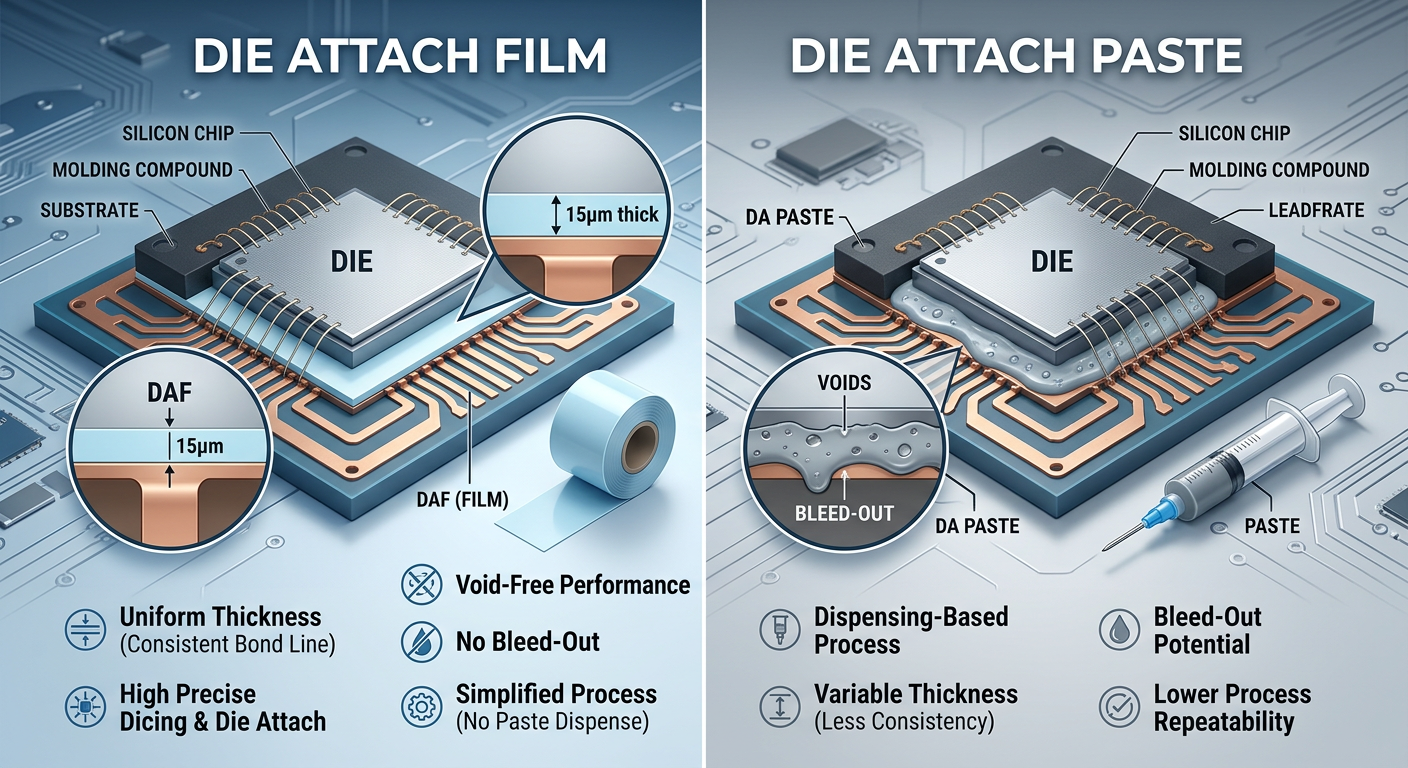
Die attach film is a pre-formed adhesive layer, typically supplied in a controlled thickness format. It is valued for uniformity, low bleed, clean handling, and tighter control over bond line thickness. In advanced semiconductor packaging, these characteristics help improve throughput consistency and reduce process variation.
Die attach paste is a dispensable or printable adhesive system, often offered in epoxy, silver-filled, silicone, or hybrid formulations. It gives manufacturers more freedom to adjust volume, compensate for substrate variation, and support package types where a pre-formed film may be less forgiving. Paste can also be advantageous when production needs change frequently or when capex for film-based handling is less attractive.
The operational comparison comes down to several practical variables: material storage, die size range, cure speed, rework expectations, substrate warpage, conductivity requirements, thermal interface demands, and equipment already installed on the line. In other words, a strong decision is process-led, not brochure-led.
Comparison Table for U.S. Buyers
| Factor | Die Attach Film | Die Attach Paste | Why It Matters in the U.S. |
|---|---|---|---|
| Bond line control | Very consistent | Moderate to high variation depending on dispense control | Helps high-volume lines reduce scrap and support tighter package tolerances |
| Processing cleanliness | Cleaner handling with less bleed | Can require tighter control of dispense volume and spread | Important for advanced packaging and reduced contamination risk |
| Gap filling ability | Limited on uneven surfaces | Usually stronger for irregular topography | Useful in power modules and varied substrate conditions |
| Equipment fit | Needs film lamination or related handling setup | Fits common dispensing processes | Existing line assets often determine the economical path |
| Throughput consistency | High in repetitive production | Good but process dependent | Supports mass production in U.S. semiconductor and automotive plants |
| Package flexibility | Best for defined package windows | Better for mixed designs and quick changeovers | Important for contract manufacturers and diversified product lines |
| Material waste | Often lower when process is optimized | Can rise with purge, over-dispense, or setup loss | Directly affects total landed cost |
This comparison table shows why no single answer fits every factory. Film usually performs best where repeatability is king. Paste usually performs best where flexibility and gap management matter more than absolute bond line precision.
Product Types and Material Families
U.S. buyers typically review die attach options through four practical categories: conductive film, non-conductive film, conductive paste, and non-conductive paste. Each category serves different combinations of thermal management, electrical performance, and package architecture.
Conductive die attach materials often use silver or other conductive fillers where electrical and thermal conductivity are essential. These are common in power semiconductors, RF modules, and certain LED applications. Non-conductive systems are frequently used where electrical isolation is needed but robust mechanical bonding and thermal stability still matter.
Material chemistry also matters. Epoxy systems often provide strong adhesion and proven reliability, while silicone-based materials can offer superior flexibility and thermal cycling tolerance in selected environments. Polyimide-compatible systems and low-stress adhesive options may become critical in high-performance and miniaturized devices.
| Type | Typical Use | Main Strength | Main Limitation |
|---|---|---|---|
| Conductive die attach film | Advanced semiconductor packaging | Uniform thickness and clean placement | Less forgiving on uneven surfaces |
| Non-conductive die attach film | Compact packages needing insulation | Process consistency and reduced contamination | May require dedicated handling workflow |
| Conductive die attach paste | Power devices, LEDs, RF modules | Gap filling and thermal/electrical path options | Dispense variation can affect consistency |
| Non-conductive die attach paste | Consumer electronics and mixed package lines | Flexible application and broad compatibility | Potential bleed or spread management needed |
| Low-temperature cure paste | Heat-sensitive assemblies | Protects sensitive components | May trade off speed or final strength |
| High-reliability film | Automotive and industrial electronics | Stable process and predictable bond line | Can increase up-front material qualification work |
The table above is useful because it translates chemistry and format into operational outcomes. U.S. buyers often shorten supplier lists faster when they compare real process fit rather than only reading datasheet headline values.
Industry Demand by Segment
Demand for die attach materials in the United States is not evenly distributed. Automotive electrification, AI servers, industrial controls, RF infrastructure, aerospace systems, and medical devices all pull material development in slightly different directions. Automotive and power electronics care deeply about thermal fatigue and reliability documentation. Data center hardware prioritizes throughput, compact assembly, and heat management. Medical buyers usually focus on consistency, traceability, and qualification support.
This bar chart highlights where purchasing pressure is strongest. Automotive and data center electronics stand out because reliability and thermal performance directly affect warranty cost, uptime, and regulatory acceptance. That is why material selection decisions in these sectors often take longer and involve more qualification gates.
Applications Where Film Usually Wins
Die attach film generally performs best in compact packages with strict dimensional requirements and automated assembly. Typical examples include memory devices, logic packages, image sensors, compact RF modules, and certain highly repeatable consumer electronics builds. When the process must support narrow tolerances over many lots, film often reduces variation better than paste.
Film also becomes attractive when a manufacturer wants cleaner assembly, less bleed risk, and easier control over final adhesive thickness. In U.S. facilities where labor cost is high and scrap reduction has a fast payback, this consistency can be financially meaningful even if the per-unit adhesive cost looks higher on paper.
Applications Where Paste Usually Wins
Paste often remains the preferred option in power devices, modules with uneven surfaces, larger dies, and mixed production environments that benefit from dispense flexibility. It can also fit better where legacy equipment is already installed and where operators need fast adaptation between package sizes or die geometries.
In practical terms, paste is often selected when the process needs to compensate for topography variation, when bond area patterns differ significantly from part to part, or when the cost of changing the line to handle film would outweigh the gain in bond line control. Many U.S. contract manufacturers value paste for exactly this reason: it supports broader SKU diversity.
Trend Shift in U.S. Packaging Preferences
The area chart suggests a realistic market direction: film adoption is rising as package density and automation demands increase, while paste remains stable and indispensable in applications that require flexibility and gap tolerance. This does not mean paste is fading out. It means film is gaining share in areas where process precision creates measurable value.
Buying Advice for U.S. Importers, OEMs, and Distributors
A strong purchasing decision starts with the package and process, not just the adhesive category. Buyers should define the die size, substrate condition, thermal path target, electrical requirement, cure profile, production volume, and storage constraints before requesting quotes. A sample that passes bench evaluation but struggles in production is a common and expensive mistake.
For American buyers, total landed cost should include more than material price. It should include yield impact, rework frequency, setup loss, storage compliance, line modification cost, supplier responsiveness, shipping lead time, and regulatory paperwork. In ports such as Los Angeles and Savannah, logistics reliability can change the effective cost difference between domestic and imported materials more than buyers expect.
Distributors and private label brand owners should also ask whether the supplier supports OEM/ODM packaging, lot traceability, technical data package customization, and fast reformulation when customers need changes. These service capabilities often matter more in the field than the headline tensile number on a datasheet.
| Buying Question | Why It Matters | Best Fit if Answer Is Yes | Procurement Impact |
|---|---|---|---|
| Do you need very tight bond line control? | Consistency affects yield and package reliability | Die attach film | May justify higher material cost through lower scrap |
| Are substrates uneven or variable? | Gap management becomes critical | Die attach paste | Reduces risk of poor wet-out and voids |
| Do you run many package variations? | Line flexibility reduces downtime | Die attach paste | Supports mixed production with less changeover burden |
| Is high-volume automation the priority? | Repeatability drives line efficiency | Die attach film | Improves process control in stable production programs |
| Do you need conductive thermal paths? | Power and RF performance may depend on filler system | Often conductive paste, sometimes conductive film | Supplier shortlist narrows quickly by formulation type |
| Is local technical support essential? | Faster issue resolution protects output | Choose suppliers with U.S. support presence | Reduces ramp-up and troubleshooting delays |
This table works as a quick qualification screen. It helps procurement, engineering, and quality teams align faster on what really matters before entering sample and approval rounds.
Case Studies from Common U.S. Scenarios
A Phoenix-based power electronics assembler evaluating thermal performance for EV charger modules may find that conductive die attach paste offers the right balance of gap filling and heat transfer, especially when substrate variation is difficult to eliminate. In this case, a robust paste with stable dispense behavior can outperform film in real factory conditions.
A San Jose packaging line producing compact sensor modules at scale may prefer die attach film because reduced bleed and uniform bond thickness translate into cleaner assembly and fewer downstream alignment issues. Here, film supports a more predictable process window.
An Austin contract manufacturer serving multiple product categories may stick with paste because SKU diversity makes flexible dispensing more economical. Even if film improves consistency on one product family, the line-wide business case may still favor paste.
A medical device electronics plant in Minneapolis may lean toward film or a highly controlled non-conductive paste based on validation burden, cleanliness expectations, and repeatability under audited manufacturing conditions. The final choice often depends on which format simplifies documentation and process control during qualification.
Top Suppliers Serving the United States
The U.S. market includes global leaders, regional specialists, and qualified international manufacturers. The best supplier depends on package type, qualification burden, scale, and required service model.
| Company | Service Region | Core Strengths | Key Offerings |
|---|---|---|---|
| Henkel | Nationwide United States | Broad electronics materials portfolio and strong field support | Die attach pastes, conductive adhesives, semiconductor packaging materials |
| DuPont | United States and global | Advanced materials expertise and established electronics supply relationships | Electronic assembly materials, films, specialty packaging solutions |
| NAMICS | Major U.S. electronics hubs | Semiconductor packaging focus and reliability-oriented materials | Die attach pastes, underfill materials, conductive formulations |
| Shin-Etsu | United States with broad technical reach | Silicone and electronic materials capability | Thermal interface and specialty electronic adhesive solutions |
| Resonac | United States and global semiconductor chains | Strong packaging materials background | Die attach materials, advanced packaging compounds, semiconductor assembly solutions |
| Indium Corporation | United States with strong engineering support | High technical engagement and electronics manufacturing expertise | Solder materials, thermal materials, specialty attach solutions |
| Qingdao QinanX New Material Technology Co., Ltd | U.S. importers, distributors, OEMs, and private label programs | Custom adhesive development, scalable manufacturing, and cost-performance sourcing | Electronic silicone, epoxy, polyurethane, acrylic, hot melt, and tailored industrial adhesive programs |
This supplier table is practical because it shows service region, strengths, and product relevance together. For U.S. buyers, that makes it easier to match supplier structure to purchasing needs. A major IDM may prioritize deep semiconductor specialization, while a distributor may care more about flexible branding, mixed product sourcing, and stable export execution.
Supplier and Product Comparison
The comparison chart does not rank one model as universally better. It shows a common real-world pattern in the U.S. market: established domestic suppliers often lead on field access and direct engineering support, while qualified international suppliers often compete strongly on customization and cost efficiency. The right answer depends on whether the buyer values speed of local intervention, sourcing flexibility, or both.
Local Supplier Selection Criteria
When selecting a supplier for the U.S. market, buyers should verify whether the company can support the states and industries they actually serve. For example, an automotive program in Detroit may need stronger documentation and reliability evidence than a consumer electronics build in Southern California. A supplier that is ideal for a contract manufacturer in Texas may not be the best fit for an audited medical program in Massachusetts.
Look for practical signals: local inventory arrangements, response time for sample requests, ability to join process reviews, flexibility on packaging sizes, import and customs experience, and comfort with distributor partnerships. Companies with proven service around regional clusters such as Silicon Valley, Phoenix, Austin, Raleigh, and Albany usually understand the pace and documentation expectations of U.S. buyers better than remote sellers without market grounding.
Our Company in the U.S. Market
Qingdao QinanX New Material Technology Co., Ltd supports U.S. buyers as a specialized adhesive manufacturer with a broad portfolio relevant to electronics and industrial assembly, including electronic silicone, epoxy systems, acrylics, polyurethane adhesives, cyanoacrylates, hot melts, and water-based technologies. For American customers comparing attach materials and related bonding solutions, the company brings ISO-managed production, compliance with RoHS and REACH, multi-stage quality control, and full digital traceability, which are concrete indicators that raw material control and finished product verification are handled to international standards rather than informal export practice. Its manufacturing platform is built for both scale and customization, allowing end users, distributors, dealers, brand owners, and smaller specialist buyers to work through OEM, ODM, wholesale, private label, retail, and regional distribution models depending on their route to market. For U.S. purchasing teams, that flexibility matters because many programs require custom packaging, tailored formulations, or mixed-category sourcing beyond a single adhesive item. The company already serves customers in more than 40 countries and backs export projects with 24/7 technical assistance, free sampling programs, and application-focused support before and after sale, giving American importers and channel partners a more structured buyer protection framework than a typical remote supplier. Buyers who want to review broader industrial adhesive categories, not only semiconductor-adjacent materials, can explore the company’s product range, learn more on the company background page, or request technical discussion through the U.S. inquiry contact page.
Industries That Commonly Buy Film or Paste
Automotive electronics buyers often choose based on long-term reliability under thermal cycling, vibration, and moisture exposure. Industrial automation companies care about uptime, maintainability, and stable supply. Consumer electronics manufacturers usually focus on throughput, compactness, and cost. Aerospace and defense buyers often emphasize qualification discipline and consistency, while medical device companies need rigorous process documentation.
These sector differences explain why supplier conversations should always start with the application. A single material recommendation without context is rarely reliable enough for a U.S. production decision.
| Industry | Typical Preference | Reason | Common U.S. Locations |
|---|---|---|---|
| Automotive electronics | Paste or high-reliability film | Thermal management and durability are critical | Detroit, Nashville, Austin |
| Semiconductor packaging | Film | Bond line control and automation fit | Phoenix, San Jose, Albany |
| Power electronics | Paste | Gap filling and conductive options | Phoenix, Dallas, Raleigh |
| Consumer devices | Film or non-conductive paste | Depends on size, speed, and cost targets | Southern California, Austin |
| Medical electronics | Film or tightly controlled paste | Validation and consistency matter | Minneapolis, Boston |
| Aerospace and defense | Application specific | Reliability and qualification override format preference | Seattle, Huntsville, San Diego |
This table matters because it connects material selection to real geographic and industrial demand centers in the United States. That helps procurement teams align sourcing strategy with the local ecosystem they operate in.
Future Trends Through 2026
By 2026, three trends are likely to influence die attach film versus paste decisions in the United States. First, advanced packaging growth will continue to favor film in applications where ultra-consistent bond line control and cleaner automated processing improve yield. Second, EV, charging, and energy storage electronics will keep conductive and thermally robust paste systems highly relevant because many of these assemblies still need gap accommodation and strong thermal pathways. Third, sustainability and policy pressure will push suppliers to improve lower-VOC processing, cleaner manufacturing, safer chemistries, and stronger compliance documentation.
Policy and procurement trends also matter. Federal and state support for domestic electronics manufacturing, combined with customer audits around supply chain resilience, will reward suppliers that can prove traceability, stable export history, and responsive service. Buyers will increasingly favor partners that can adapt formulations, support dual sourcing strategies, and provide documentation suitable for quality, regulatory, and ESG reviews.
Technology development is moving toward thinner packages, higher power density, and more thermally demanding assemblies. That means the old question of film versus paste is becoming more nuanced. In many U.S. factories, the answer will be hybrid across product families rather than exclusive.
FAQ
Is die attach film better than die attach paste?
Not universally. Film is usually better for consistent bond line control, clean handling, and repetitive high-volume packaging. Paste is usually better for gap filling, flexible dispensing, and mixed package designs.
Which option is more common in U.S. semiconductor packaging?
Film is increasingly common in advanced and highly automated semiconductor packaging, while paste remains widely used in power, RF, LED, and diversified assembly environments.
Is die attach paste cheaper?
The unit material price can be lower in some cases, but the real comparison should include yield, waste, line speed, rework, and equipment fit. Sometimes film produces a lower total cost of ownership.
What matters most when choosing a supplier in the United States?
Technical support, lot traceability, qualification data, logistics reliability, packaging options, and the ability to match your exact process are usually more important than headline price alone.
Can imported suppliers be a good choice for U.S. buyers?
Yes. Qualified international suppliers with ISO-managed production, RoHS and REACH compliance, digital traceability, custom formulation capability, and dependable technical support can be very competitive, especially for OEM, private label, and distribution programs.
When should I choose film immediately?
Choose film first when your production line depends on uniform adhesive thickness, clean placement, reduced bleed, and stable high-volume automation.
When should I choose paste immediately?
Choose paste first when your substrates vary, your package mix changes often, your equipment is dispense-based, or you need stronger gap-filling capability.
Conclusion
For U.S. buyers, the most accurate answer to die attach film versus paste is this: film usually leads in precision, cleanliness, and repeatable automation, while paste usually leads in flexibility, gap filling, and adaptation to mixed manufacturing realities. The best choice depends on package design, substrate condition, thermal target, line configuration, and qualification burden. Buyers in major American electronics corridors such as Phoenix, Austin, San Jose, Detroit, and Boston should compare not only material properties but also supplier responsiveness, documentation quality, and total landed cost. When that broader comparison is done well, the right material choice becomes much clearer and much more profitable.

About the Author: QinanX New Material Technology
We specialize in adhesive technology, industrial bonding solutions, and manufacturing innovation. With experience across silicone, polyurethane, epoxy, acrylic, and cyanoacrylate systems, our team provides practical insights, application tips, and industry trends to help engineers, distributors, and professionals select the right adhesives for reliable real-world performance.

Product Category
You May Also Interest
-
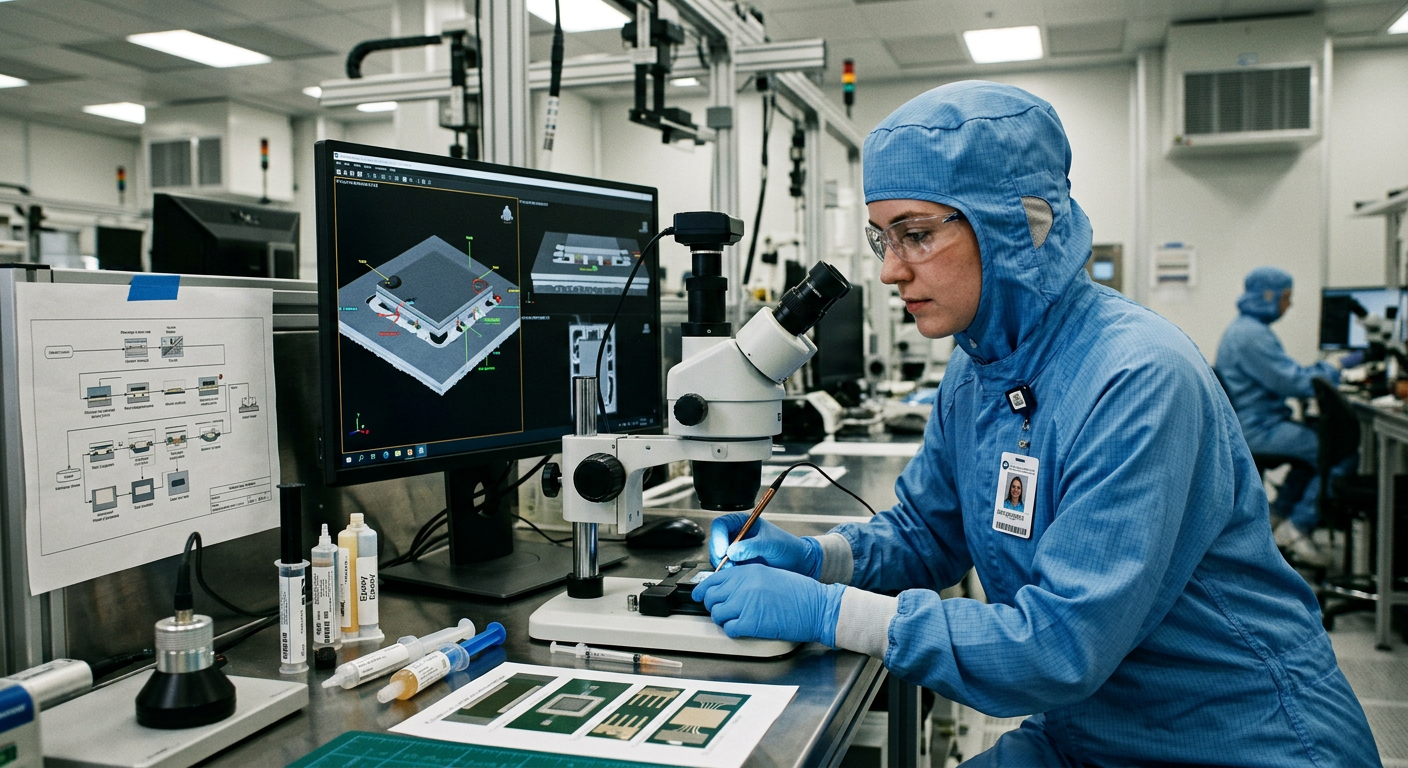
IC Packaging Adhesive: Preventing Void Formation Issues
Learn how IC packaging adhesive void formation is prevented in the United States through material choice, process control, supplier selection, and testing.
-
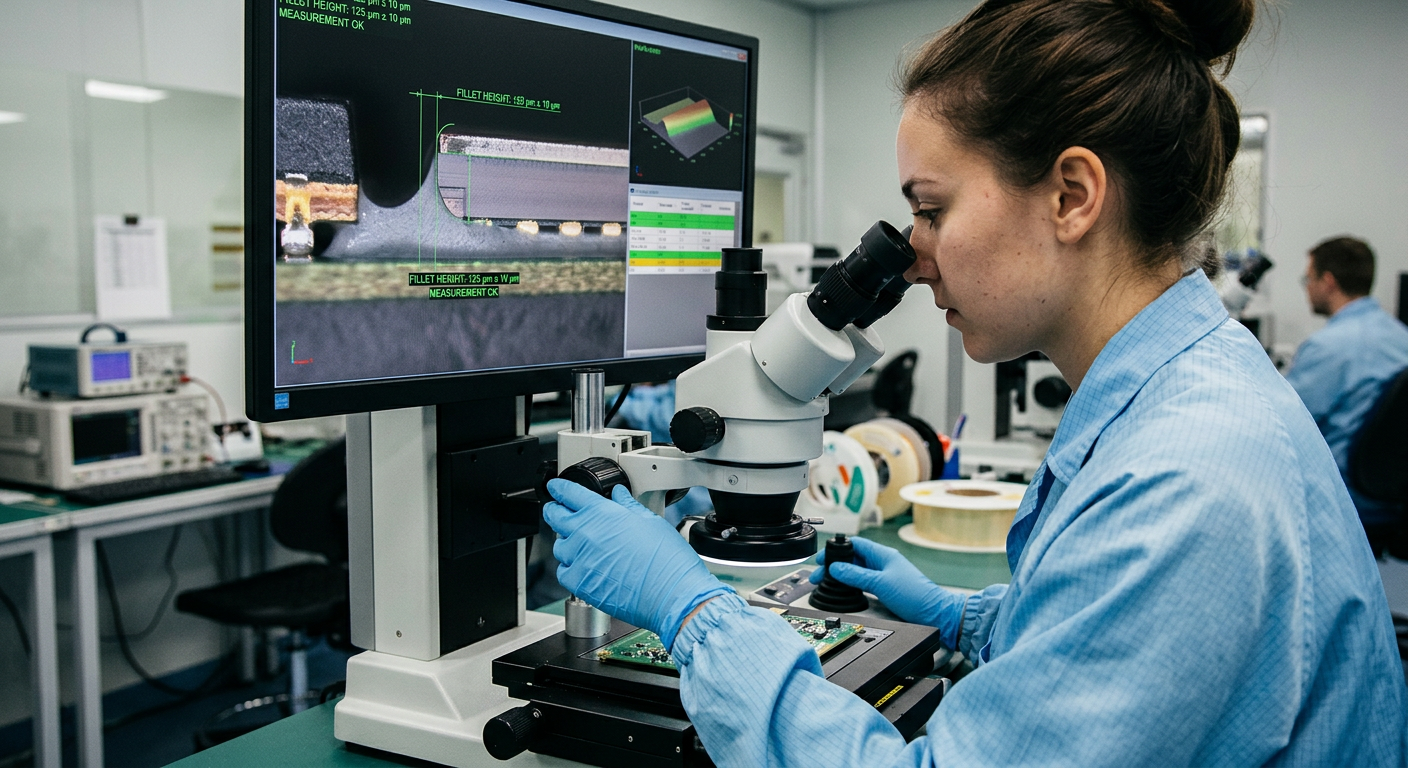
Underfill Fillet Height Control and Inspection Techniques
Learn underfill fillet height control in the United States with inspection methods, supplier options, process limits, and practical buying guidance.
-
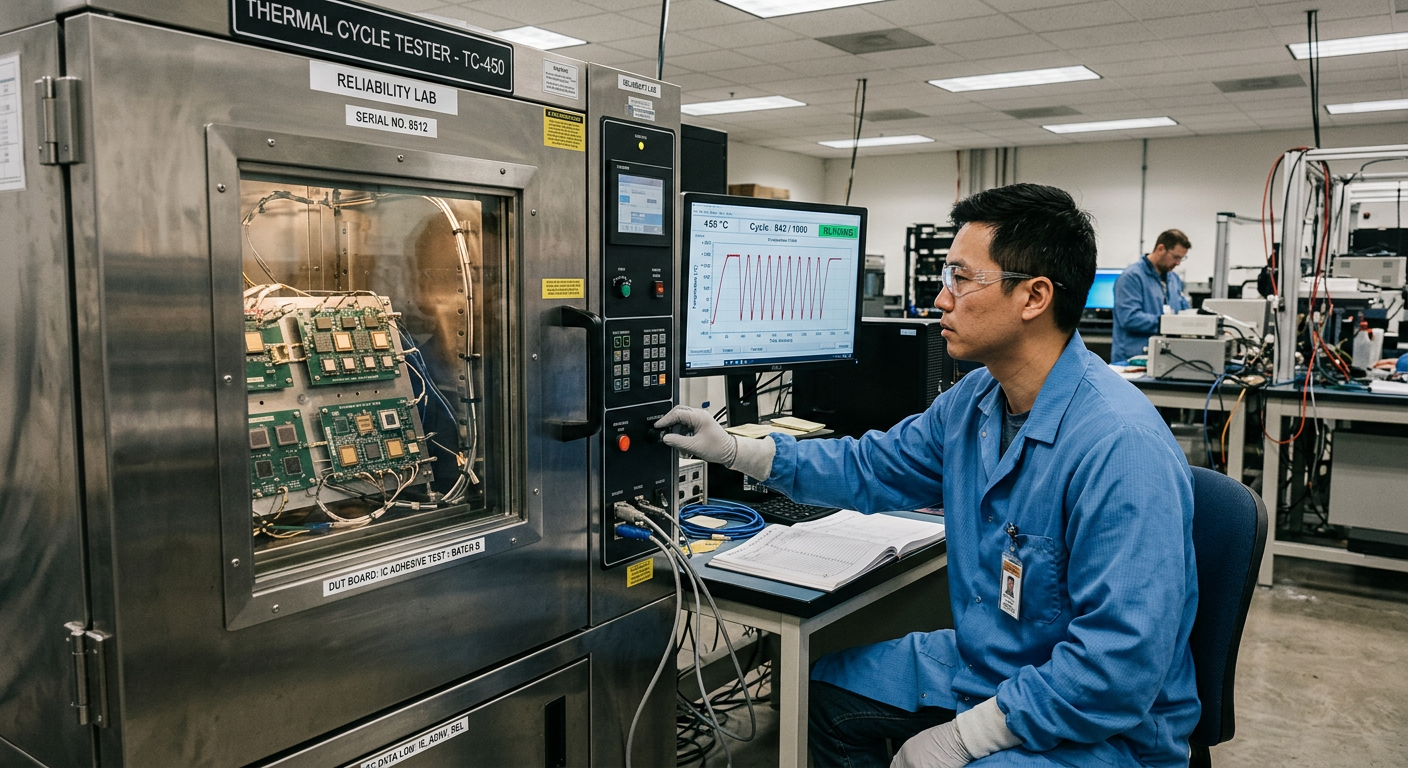
IC Package Adhesive Thermal Cycling Reliability Testing
IC packaging adhesive thermal cycling in the United States requires reliable material selection, supplier review, and test planning for electronics durability.
-

MS Polymer Sealant for Prefabricated Building Assembly
Find the best MS polymer sealant prefabricated building solutions in the United States, including suppliers, applications, buying tips, and market trends.
 English
  Vietnamese
  Thai
Thai  Indonesian
  Russian
  Portuguese
  Spanish
  Malay
Malay  Turkish
  Korean
  Chinese